Tree profile
Pignut hickory (Carya glabra): how to identify it
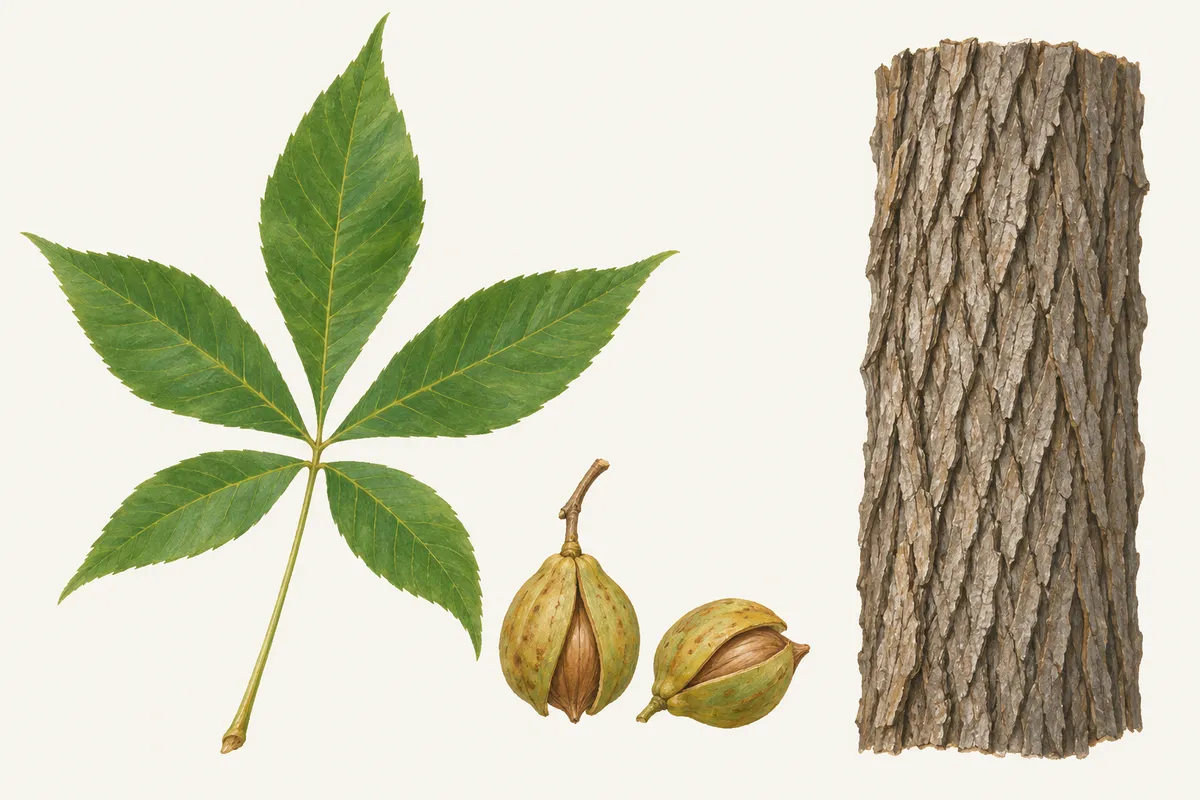
Five narrow leaflets on a smooth, slender stalk, a small pear-shaped fruit whose thin husk barely opens, and bark in tight interlacing ridges: pignut is the plain, common hickory of dry eastern ridges.
In short
Pignut hickory identification starts with the fruit: pear-shaped, 1 to 2 inches long, in a thin husk that splits only partway and clings to an unribbed nut. The leaves are alternate and compound, 8 to 12 inches long, with 5, sometimes 7, lance-shaped leaflets on a slender, smooth stalk. Mature bark forms close, interlacing ridges, and the terminal bud is small, about 1/4 inch, and light brown.
- A pear shape and a husk that stays mostly closed are the quickest pignut marks.
- Five leaflets on a hairless stalk separate it from mockernut, which has 7 to 9 on a very hairy stalk.
- Red hickory, with mostly 7 leaflets, is treated by the Forest Service as a variety of pignut and is hard to separate.
Field marks at a glance
- Scientific name
- Carya glabra
- Family
- Juglandaceae (walnut family)
- Type
- Broadleaf, deciduous
- Leaves
- Alternate, pinnately compound, 8 to 12 inches long, with 5, sometimes 7, lance-shaped, finely toothed leaflets; stalk slender and smooth; end leaflet larger than the lower ones.
- Fruit
- Pear-shaped (obovoid), 1 to 2 inches long (about 1 1/4 in per Missouri Department of Conservation); thin husk that splits only partway and clings to the nut; ripe September to October.
- Nut
- Round but flattened, not ribbed, thick-shelled; Virginia Tech calls the kernel slightly bitter.
- Bark
- Smooth and light gray when young; later close, interlacing ridges with shaggy tops; NC State describes flat, sharp-edged ridges forming diamonds and X's.
- Buds and twigs
- Twigs moderately slender, smooth, reddish brown; terminal bud small, ovate, about 1/4 inch, light brown; leaf scars three-lobed.
- Fall color
- Yellow to golden (NC State, Missouri Department of Conservation).
- Size
- Often 80 to 90 ft tall and 36 to 48 in across, occasionally 120 ft (USDA Forest Service); NC State gives 60 to 80 ft in cultivation.
- Range
- Nearly all of the eastern US, from Massachusetts and southern Ontario to central Lower Michigan and Illinois, south through Missouri and Arkansas to Louisiana and East Texas, east along the Gulf to central Florida.
Pignut hickory (Carya glabra) is the hickory of dry eastern ridges and the one hardest to pin down, because nothing about it is dramatic. It ranks 51st among live trees on US forest land in the USDA Forest Service inventory, ahead of shagbark, and it grows in oak-hickory woods from Massachusetts to Florida. Never eat a nut on the strength of a web page or an app; check with a local expert. This page is about naming the tree from its fruit, leaf, bud and bark.
How to identify pignut hickory
Start with whatever lies on the ground, then work up to the twigs.
1. The fruit. Virginia Tech's pignut fact sheet describes an obovoid to pear-shaped fruit, 1 to 2 inches long, with a thin husk that only partially splits at maturity. The Missouri Department of Conservation gives about 1 1/4 inches, a short beak, and a thin dark brown husk that splits late or not at all. The USDA Forest Service's Silvics of North America adds that the husk splits only to the middle or slightly beyond and generally clings to the nut. The nut is unribbed with a thick shell. A small, pear-shaped husk still half closed is the best single pignut clue.
2. The leaf. Leaves alternate and are pinnately compound, 8 to 12 inches long, with 5, sometimes 7, lance-shaped, finely toothed leaflets. The leaf stalk is slender and smooth (Virginia Tech). NC State Extension gives leaflets 3 to 6 inches long and 1 to 2 inches wide, the end leaflet larger than the lower ones, with paler undersides. In fall they turn yellow.
3. The bud. The terminal bud is small, ovate and light brown; Virginia Tech gives about a quarter inch. That is small for a hickory, and it is the main winter difference from shagbark and mockernut, whose buds are much larger. Leaf scars are three-lobed, the monkey face shared by all hickories.
4. The bark. Smooth and light gray on young trees, later scaly, then close interlacing ridges with shaggy tops on old trunks (Virginia Tech). NC State describes flat, sharp-edged ridges forming diamonds and X's. It can look rough, but the plates never curl off in long strips the way shagbark's do.
When the crown is out of reach, a photo of a husk or a fallen leaf is enough for Tree Identifier to suggest a name. It gives no confidence score and no list of alternatives, so check the husk and the bud size against the next section before deciding between pignut and its neighbors.
Pignut vs mockernut, shagbark and bitternut
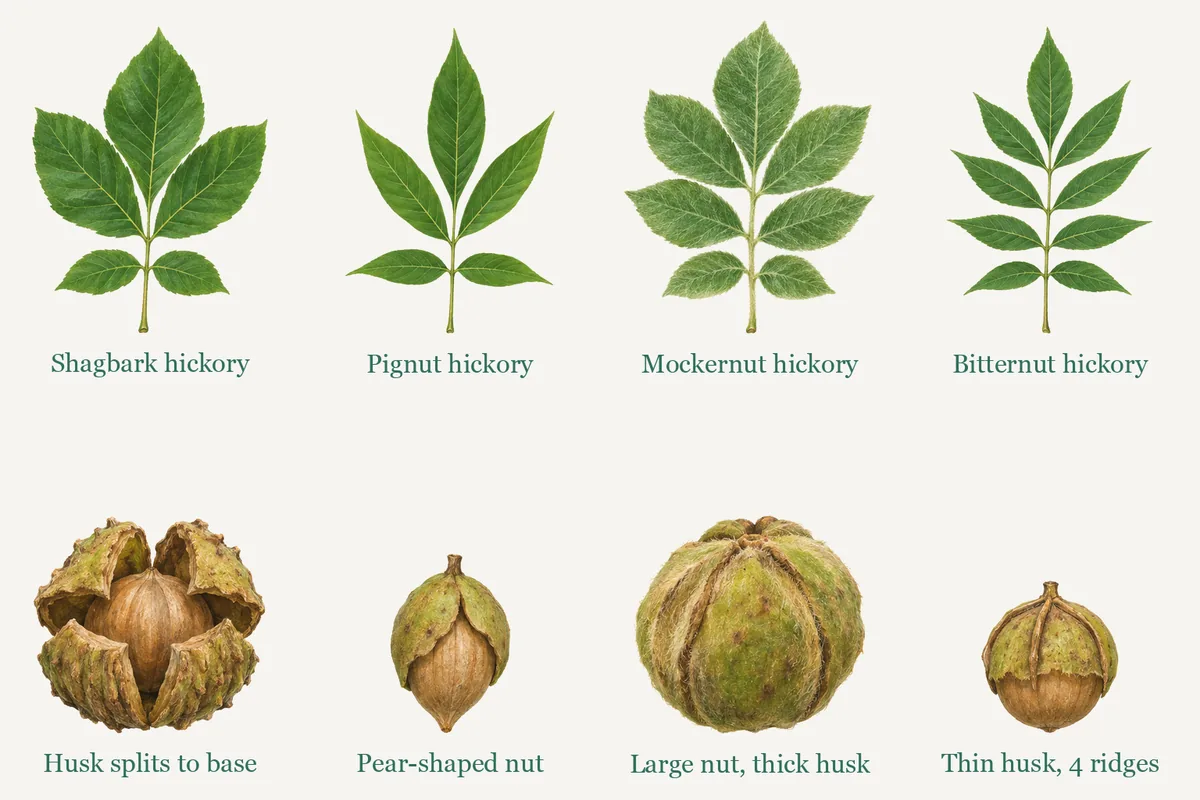
These four hickories often share a slope. One feature from each row is usually enough.
| Feature | Pignut | Mockernut | Shagbark | Bitternut |
|---|---|---|---|---|
| Leaflets | 5, sometimes 7 | 7–9 | 5, sometimes 7 | 7–11 |
| Leaf stalk | Slender, smooth | Stout, very hairy | Stout, mostly smooth | Slender, hairy |
| Fruit | Pear-shaped, 1–2 in | Round to oval, 1 1/2–2 in | Nearly round, 1 1/2–2 in | Nearly round, about 1 in |
| Husk | Thin, opens partway | Thick, splits cleanly | Very thick, splits in four | Thin, four-winged above the middle |
| Terminal bud | Small, light brown | Very large, whitish under dark scales | Large, brown, hairy | Narrow, sulfur-yellow |
Sources: Virginia Tech's fact sheets for mockernut, shagbark and bitternut. Each has its own page: mockernut hickory, shagbark hickory and bitternut hickory. The hickory genus page adds shellbark and pecan.
Red hickory: the pignut complex
Some field guides list red hickory (Carya ovalis) as its own species. The Forest Service treats it as Carya glabra var. odorata and calls its position controversial: it was reduced to a synonym in 1953 and raised to a variety in 1979. The main difference is how far the husk opens, and red hickory mostly has 7 leaflets against 5 on pignut. Many trees are intermediate, and the Forest Service says the two can be told apart with certainty only in November, so it maps them together as one complex.
In practice, a hickory with small light brown buds, pear-shaped thin-husked fruit and 5 to 7 leaflets is in the pignut group. Deciding between the two names is beyond a photo, and beyond most field guides.
In the Ozarks there is a second look-alike. The Missouri Department of Conservation separates black hickory (Carya texana) from pignut by leaflets, 7 against 5, and by twigs that taper abruptly toward the terminal bud on black hickory but not on pignut.
Where pignut hickory grows
The Forest Service describes a range covering nearly all of the eastern United States: from Massachusetts and the southwest corner of New Hampshire west through southern Vermont and extreme southern Ontario to central Lower Michigan and Illinois, south through extreme southeastern Iowa, Missouri and Arkansas to Louisiana and parts of East Texas, then east along the Gulf Coast to Mississippi and Alabama and into central Florida.
It frequently grows on dry ridgetops and side slopes, but is also common on moist sites in the mountains and Piedmont; in the Great Smoky Mountains it reaches 4,850 feet (1,480 m). It is a common but not abundant member of the oak-hickory forest, with northern red oak, white oak and chestnut oak as frequent companions. In Missouri it is mostly in the eastern Ozarks, in dry upland woods on acid soils (Missouri Department of Conservation).
Size, age and nut years
The Forest Service gives 80 to 90 feet in height, occasionally 120 feet, with trunks 36 to 48 inches across and a bole that often forks. NC State lists 60 to 80 feet and a spread of 25 to 40 feet for planted trees, and Missouri's field guide describes a narrow crown two to four times longer than broad.
Seed production in quantity begins at about 30 years and peaks between 75 and 200, with seed possible up to about 300 years; good crops come every year or two (Forest Service). That makes pignut more reliable than shagbark or bitternut for the husk test. The guide to identifying trees by seeds and nuts covers the other husked nuts you may find beside it.
With location turned on, Tree Identifier's Tree Map pins each tree you identify, which helps when you want to return in November, the month the Forest Service names for separating pignut from red hickory.
Look-alikes and how to tell them apart
Shagbark hickory (Carya ovata)
Shagbark also has 5 leaflets, but its mature bark peels in long plates that curl away from the trunk, its terminal bud is large, brown and hairy with 3 to 4 scales, and its round fruit has a very thick husk that splits fully into four.
Mockernut hickory (Carya tomentosa)
Mockernut has 7 to 9 leaflets on a stout, very hairy leaf stalk, a very large bud that drops its dark outer scales to show a silky whitish bud, and a round, thick husk that splits cleanly. Pignut's stalk is slender and smooth and its bud is small.
Red hickory (Carya glabra var. odorata, also C. ovalis)
The USDA Forest Service says red hickory has mostly 7 leaflets against 5 on pignut, differs mainly in how far the husk opens, and can be told apart with certainty only in November. Many trees are intermediate; treat them as the pignut complex.
Bitternut hickory (Carya cordiformis)
Bitternut has 7 to 11 leaflets, narrow sulfur-yellow buds, and a nearly round fruit whose thin husk is four-winged above the middle. Pignut has 5 leaflets, light brown buds and a pear-shaped fruit without wings.
Black hickory (Carya texana)
In Missouri, the Department of Conservation separates them by leaflets and twigs: black hickory has 7 leaflets and twigs that taper abruptly toward the terminal bud; pignut has 5 leaflets and twigs that do not.
What a photo can't settle
- Pignut and red hickory intergrade, and the Forest Service says they can be told apart with certainty only in November; a photo app gives the species, not the variety.
- Pignut bark varies from tight to shaggy-topped ridges, so bark alone overlaps with mockernut and young shagbark; use the fruit and the buds.
- Leaflet counts vary on one tree: a single leaf with 7 leaflets does not rule out pignut.
Questions people ask
How do you identify a pignut hickory?
Find the fruit: a pear-shaped nut 1 to 2 inches long in a thin husk that only splits partway. Then count leaflets, usually 5 on a smooth, slender stalk, and look for small light brown buds about 1/4 inch long. Mature bark is tight and ridged, not peeling in long plates.
Why is it called pignut hickory?
The name is old and the sources here do not explain it. NC State lists ten common names, including pignut, broom hickory, red hickory, smoothbark hickory and switch hickory, and the USDA Forest Service uses sweet pignut hickory as its main name.
What is the difference between pignut and red hickory?
The USDA Forest Service treats red hickory as a variety of pignut, Carya glabra var. odorata, and calls its position controversial. Red hickory mostly has 7 leaflets and a husk that opens more fully; pignut mostly has 5. Many trees are intermediate.
How often does pignut hickory produce nuts?
The USDA Forest Service says seed production in quantity begins at about 30 years, peaks between 75 and 200 years, and that good crops come every year or two, with light crops between. The Missouri Department of Conservation gives 25 to 30 years for the first nuts.
Where does pignut hickory grow?
Across nearly all of the eastern United States, often on dry ridgetops and side slopes, but also on moist sites in the mountains and Piedmont. In the Great Smoky Mountains the Forest Service reports it up to 4,850 feet. It is a common but not abundant member of oak-hickory forests.
Sources
- Sweet Pignut Hickory (Carya glabra), Silvics of North America — USDA Forest Service
- Pignut hickory fact sheet — Virginia Tech Dendrology
- Carya glabra (pignut hickory) — North Carolina Extension Gardener Plant Toolbox, NC State University
- Pignut Hickory — Missouri Department of Conservation
- Mockernut hickory fact sheet — Virginia Tech Dendrology
- Bitternut hickory fact sheet — Virginia Tech Dendrology
Keep reading
- Tree profileHickory trees (Carya): how to identify them
- Tree profileShagbark hickory (Carya ovata): how to identify it
- Tree profileMockernut hickory (Carya tomentosa): how to identify it
- Field guideTree seed identification: from acorn, pod or samara to the tree
- Winter field guideWinter tree identification, from buds to bark