Tree profile
Shagbark hickory (Carya ovata): how to identify it
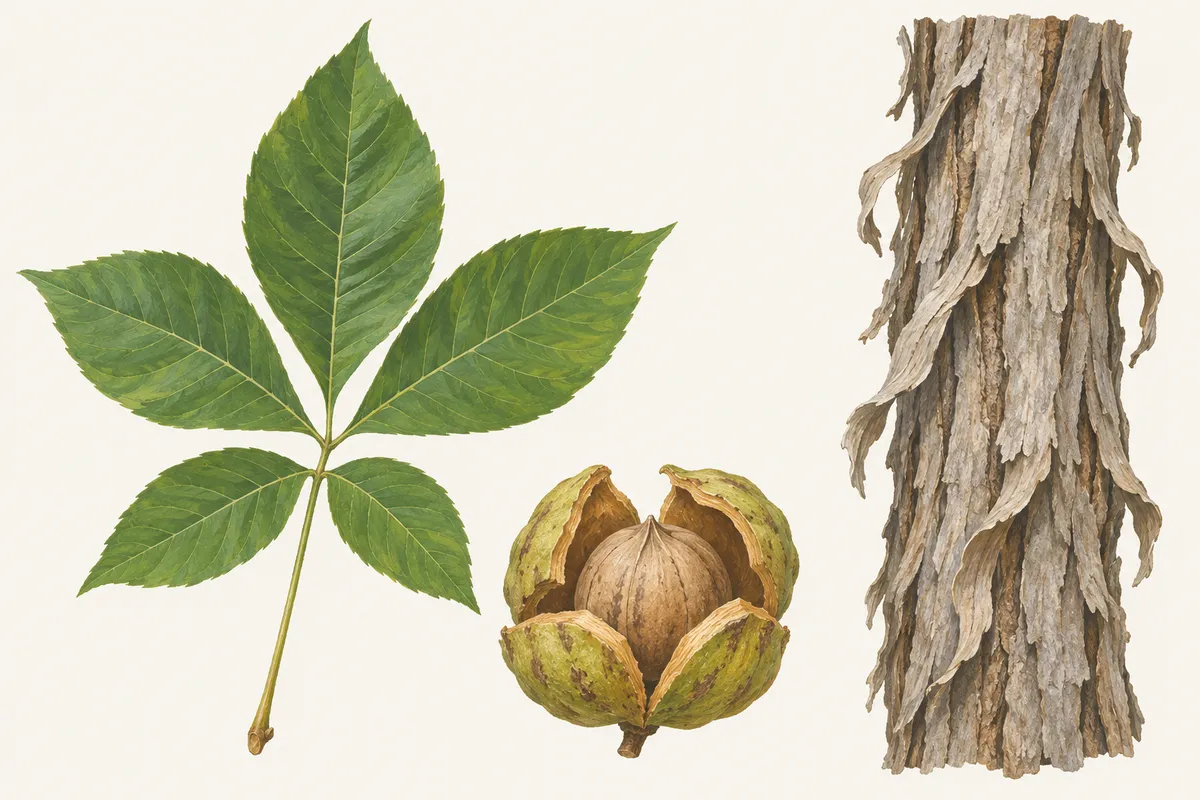
Long gray bark plates that curl away from the trunk at both ends, a compound leaf with five leaflets, and a nut in a thick husk that splits into four: shagbark is the easiest hickory to name, once it is old enough.
In short
Shagbark hickory identification rests on the bark: on mature trees it breaks into long, wide gray plates attached at the middle that curve away from the trunk at both ends. Check two more things: alternate compound leaves 8 to 14 inches long with 5, sometimes 7, leaflets, the end ones much larger, and a nearly round fruit 1 1/2 to 2 inches across in a very thick husk that splits into four.
- Shagbark bark is smooth and gray on young trees; the curling plates only come with age.
- Five leaflets, the top three much larger than the bottom pair, is the usual leaf.
- Shellbark hickory peels too, but has 7 leaflets on leaves 15 to 24 inches long and grows on bottomlands.
Field marks at a glance
- Scientific name
- Carya ovata
- Family
- Juglandaceae (walnut family)
- Type
- Broadleaf, deciduous
- Bark
- Smooth and gray when young; on mature trees, long, wide plates attached at the middle that curve away from the trunk at both ends, for a coarsely shaggy look.
- Leaves
- Alternate, pinnately compound, 8 to 14 inches long, with 5, sometimes 7, leaflets; the end leaflets much larger than the side ones; edges toothed and fringed with fine hairs.
- Fruit
- Nearly round, 1 1/2 to 2 inches, in a very thick husk that turns brown to brownish black and splits into four parts; borne 1 to 3 together, ripe in September and October.
- Nut
- Light brownish white, distinctly four-ribbed or four-angled at the tip.
- Buds and twigs
- Stout twigs; terminal bud large, brown and hairy, with 3 to 4 brown scales, about 1 inch long (Morton Arboretum); leaf scars three-lobed, the monkey face.
- Flowers
- Male catkins 4 to 6 in long in threes; small female flowers in short spikes at the twig tips, in spring as the leaves reach full size.
- Fall color
- Yellow to golden brown.
- Size
- Usually 70 to 80 ft tall and 12 to 24 in across; up to about 130 ft and 48 in (USDA Forest Service).
- Range
- Most of the eastern US, from southeastern Nebraska and southeastern Minnesota to southern Quebec and southern Maine, south to eastern Texas and Georgia; largely absent from the southeastern and Gulf coastal plains.
Shagbark hickory (Carya ovata) is the hickory most people learn first, because a mature trunk looks like nothing else in an eastern woodlot. It ranks 80th among live trees on US forest land in the USDA Forest Service inventory, and it grows with oaks and other hickories across most of the eastern states. Never eat a nut on the strength of a web page or an app; check with a local expert. This page is about naming the tree: bark, leaf, husk and bud, in the order that works best.
How to identify shagbark hickory
Check these four features. Bark plus one more is usually enough on a mature tree; on a young one, use the leaf and the bud.
1. The bark. Virginia Tech's shagbark fact sheet describes smooth gray young bark that later breaks into long, wide plates attached at the middle, curving away from the trunk and giving a coarsely shaggy look. The USDA Forest Service's Silvics of North America calls shagbark probably the most distinctive of the hickories for this loose-plated bark. The plates stay gray, so nothing colorful shows underneath, unlike a birch or a sycamore.
2. The leaf. Leaves alternate along the twig and are pinnately compound, 8 to 14 inches long, with 5 leaflets, sometimes 7. The end leaflets are much larger than the side ones, so the leaf looks top-heavy, and the toothed edges are fringed with fine hairs (Virginia Tech). In fall, the Morton Arboretum gives a golden brown color.
3. The fruit. The fruit is nearly round, 1 1/2 to 2 inches, inside a very thick husk. The Forest Service describes the husk turning from green to brown or brownish black and splitting into four valves at maturity, with the fruits borne one to three together and ripe in September and October. The nut inside is light brownish white and four-ribbed.
4. The bud. In winter, look at the end of a twig. Virginia Tech describes a large, brown, hairy terminal bud covered by 3 to 4 brown scales, more elongated than other hickories' buds; Morton gives about 1 inch. Leaf scars below the buds are three-lobed, the pattern often called a monkey face.
If you can reach none of this, a photo of the trunk or a fallen leaf is enough for Tree Identifier to suggest a name. It shows the common and scientific name without a confidence score or a list of look-alikes, so check the leaflet count and the husk before you settle on shagbark.
Shagbark vs shellbark, pignut and mockernut
Three other hickories grow in the same woods, and one of them peels as well.
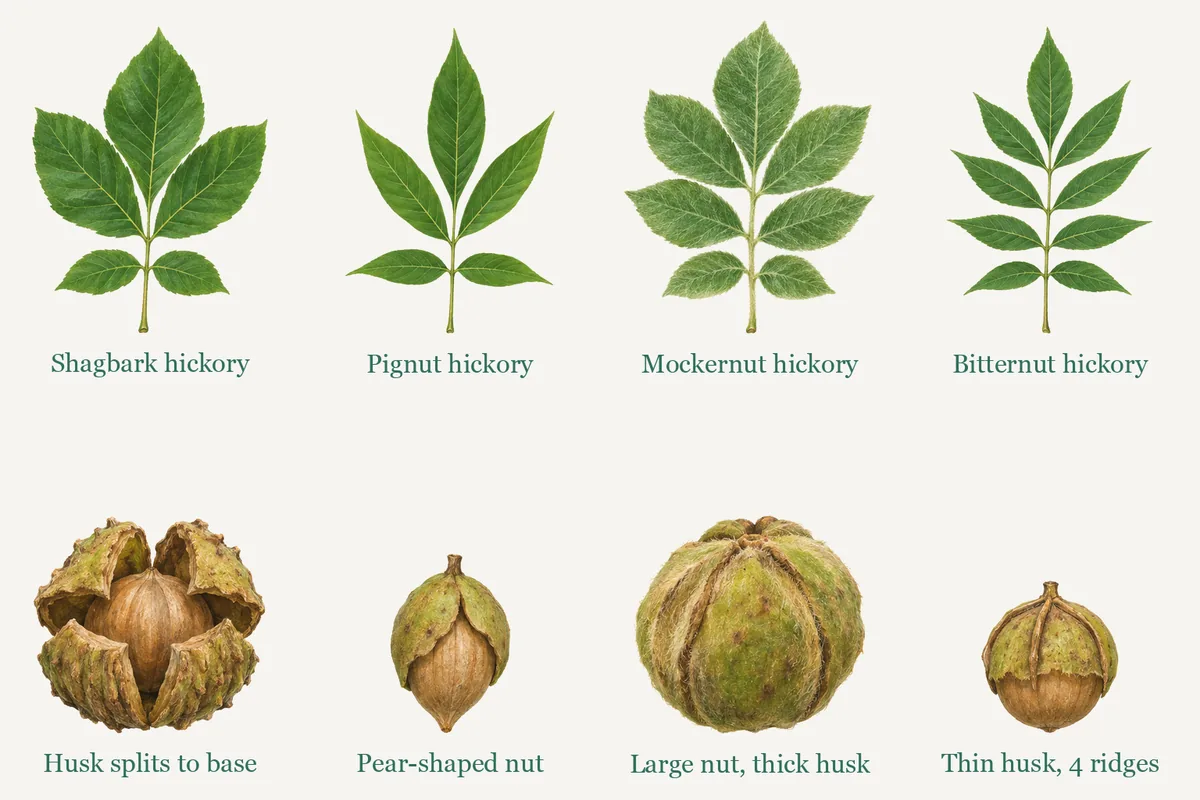
| Feature | Shagbark | Shellbark | Pignut | Mockernut |
|---|---|---|---|---|
| Leaflets | 5, sometimes 7 | Usually 7 (5–9) | 5, sometimes 7 | 7–9 |
| Leaf length | 8–14 in | 15–24 in | 8–12 in | 9–14 in |
| Bark | Long plates curling away | Long, loose shaggy plates | Close interlacing ridges, shaggy tops | Round-topped gray net, never peels |
| Husk | Very thick, splits in four | Up to 1/2 in thick | Thin, splits only partway | Thick, splits cleanly |
| Terminal bud | Large, brown, hairy, 3–4 scales | Elongated, larger than shagbark's | Small, about 1/4 in, light brown | Very large; outer scales drop to show a whitish bud |
Figures come from the Virginia Tech fact sheets for shellbark, pignut and mockernut. Shellbark is the hard one: its bark is just as shaggy. Its leaves are longer with more leaflets, its nuts are the largest of any hickory according to the Forest Service's shellbark chapter, and it is essentially a bottomland tree that needs moister sites than shagbark. The two hybridize, so expect some trees in between.
For the full side-by-side of the smooth-barked species, see pignut hickory and mockernut hickory. The genus page on hickories compares six species, pecan included.
Shagbark hickory vs walnut and other shaggy barks
Black walnut shares the alternate compound leaf and the husked nut. Walnut leaves carry far more leaflets, 10 to 24, its husk never splits open, and a twig sliced lengthwise shows chambered pith where shagbark's is solid. The hickory vs walnut page walks through the three checks.
Shaggy bark alone also points to a few unrelated trees. The guide to trees with peeling bark sorts them by what shows underneath; the bark guide lists silver maple, eastern redcedar and hophornbeam among the other shaggy barks, and none of them has shagbark's alternate compound leaf.
Where shagbark hickory grows
The Forest Service maps shagbark through most of the eastern United States, from southeastern Nebraska and southeastern Minnesota through southern Ontario and southern Quebec to southern Maine, and south to Georgia, Alabama, Mississippi, Louisiana and eastern Texas, with outlying populations in the mountains of northeastern Mexico. It is largely absent from the southeastern and Gulf coastal plains and the lower Mississippi Delta.
Site depends on latitude. In the north it is often on upland, south-facing slopes; in the south it is more common on alluvial soils and river bottoms. In the Blue Ridge of the Carolinas it reaches 3,000 feet (910 m). It grows with oaks, other hickories and mixed upland hardwoods; the Morton Arboretum lists it in upland woodlands and savannas of the Chicago region.
The Forest Service also describes a southern variety, Carolina shagbark (Carya ovata var. australis), whose fruits are usually longer than 1.4 inches (3.5 cm) and whose terminal bud scales are dark brown or black, against tan or light brown in the typical variety.
Size, age and nut years
Shagbark averages 70 to 80 feet tall with trunks 12 to 24 inches across, and can reach about 130 feet and 48 inches, according to the Forest Service; Virginia Tech gives over 120 feet. The trunk is straight and clear but tends to fork half to two-thirds of the way up.
Nut crops are irregular. The Forest Service gives commercial seed bearing from about age 40, the most seed between 60 and 200 years, some seed up to 300 years, and good crops every 1 to 3 years. Under a tree with no husks this year, look for old split husks in the leaf litter; they last a while and still show the four thick valves.
To estimate the age of a big trunk, the tree age calculator works from its circumference. With location turned on, Tree Identifier's Tree Map pins the shagbarks you find, so you can come back in a good nut year to check the husks, and the follow-up chat under a result is a place to ask how to tell it from shellbark where both grow.
Look-alikes and how to tell them apart
Shellbark hickory (Carya laciniosa)
Shellbark also peels in long loose plates, but its leaves are 15 to 24 inches long with usually 7 leaflets, its fruit reaches 2 to 2 1/2 inches with a husk up to 1/2 inch thick, and it grows on wet bottomlands. Shagbark leaves are 8 to 14 inches with 5 leaflets.
Pignut hickory (Carya glabra)
Pignut also has 5 leaflets, but its bark forms close, interlacing ridges with shaggy tops that do not curl off in long plates, its buds are small (about 1/4 inch), and its pear-shaped fruit has a thin husk that splits only partway.
Mockernut hickory (Carya tomentosa)
Mockernut bark is a net of round-topped gray ridges that never peels, its leaves carry 7 to 9 leaflets on a very hairy stalk, and its huge buds lose their dark outer scales in fall to show a silky whitish bud.
What a photo can't settle
- Shagbark bark only becomes shaggy with age, and shellbark and some other trees have shaggy bark too; one bark photo is not enough on its own.
- Shagbark and shellbark hybridize, and the Forest Service describes a southern variety (Carolina shagbark) with larger fruits and dark bud scales; a photo app names the species, not the variety or hybrid.
- Leaflet counts vary on one tree: count several sunlit leaves before ruling shagbark in or out.
Questions people ask
How do you identify a shagbark hickory?
Look at the bark of a mature trunk: long gray plates attached at the middle and curling away at both ends. Then confirm with the leaf, alternate and compound with 5 leaflets, the end ones largest, and with the fruit, a round nut in a thick husk that splits into four sections.
Does a young shagbark hickory have shaggy bark?
No. Virginia Tech describes the bark as smooth and gray at first; the long plates develop as the tree matures. On a young tree, rely on the five-leaflet leaf, the large brown hairy bud with 3 to 4 scales, and husks under nearby older trees.
What is the difference between shagbark and shellbark hickory?
Both have shaggy bark. Shellbark leaves are longer, 15 to 24 inches, with usually 7 leaflets, and its nuts are the largest of any hickory. The USDA Forest Service calls shellbark essentially a bottomland species that needs moister sites than shagbark. The two also hybridize.
How often does shagbark hickory produce nuts?
The USDA Forest Service gives good seed crops every 1 to 3 years, from about age 40, with the most seed between 60 and 200 years. In poor years you may find few or no husks under the tree.
How tall does shagbark hickory grow?
The USDA Forest Service gives an average of 70 to 80 feet with trunks 12 to 24 inches across, and a maximum of about 130 feet and 48 inches. The Morton Arboretum lists 60 to 80 feet for planted trees, with a spread of 30 to 50 feet.
Sources
- Shagbark Hickory (Carya ovata), Silvics of North America — USDA Forest Service
- Shagbark hickory fact sheet — Virginia Tech Dendrology
- Shagbark hickory (Carya ovata) — The Morton Arboretum
- Shellbark hickory fact sheet — Virginia Tech Dendrology
- Shellbark Hickory (Carya laciniosa), Silvics of North America — USDA Forest Service
- Pignut hickory fact sheet — Virginia Tech Dendrology
Keep reading
- Tree profileHickory trees (Carya): how to identify them
- Tree comparisonHickory vs walnut: how to tell the two nut trees apart
- Clue guideWhich tree has peeling bark? Sort it by the color underneath
- Tree profilePignut hickory (Carya glabra): how to identify it
- Field guideTree seed identification: from acorn, pod or samara to the tree