Tree profile
Bitternut hickory (Carya cordiformis): how to identify it
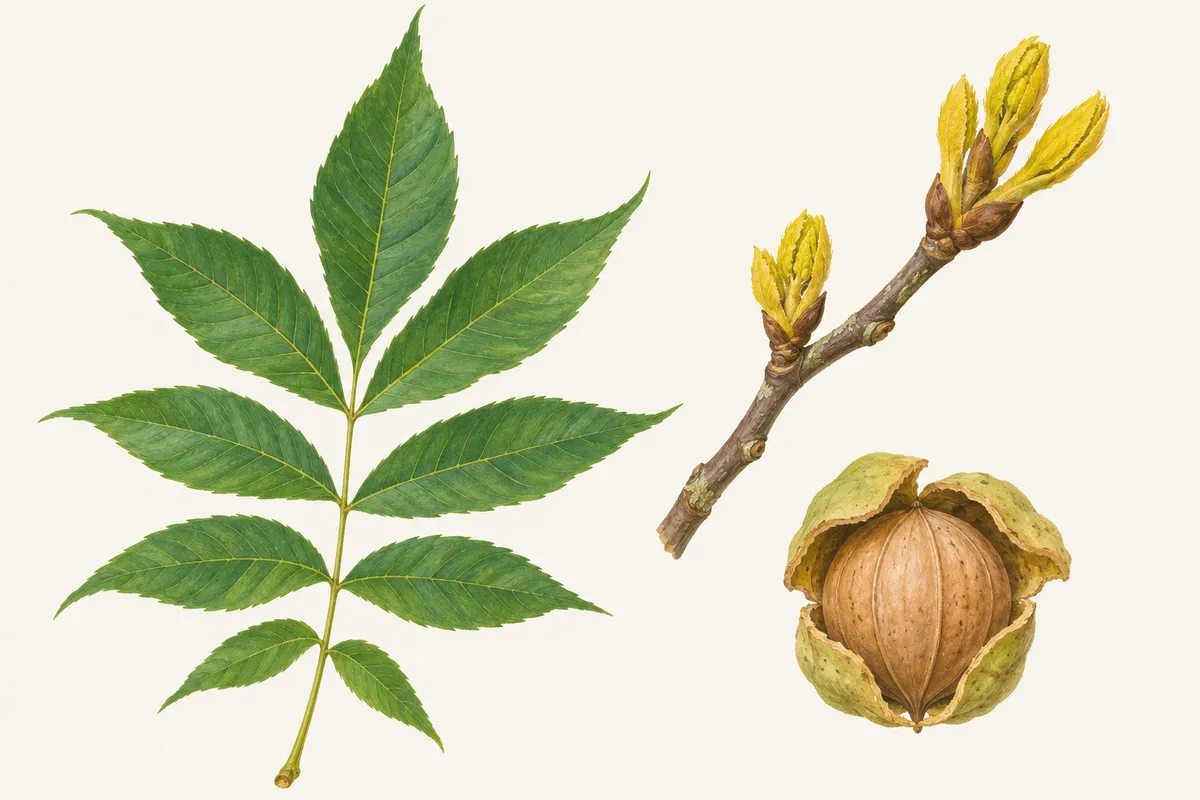
Bright sulfur-yellow buds in winter, slim leaflets in summer, and a small round husk with four ridges like wings: bitternut is the most widespread hickory, and the easiest to name from a twig.
In short
Bitternut hickory identification is quickest from the buds: narrow, four-angled and sulfur-yellow, unlike the brown or whitish buds of other hickories. The leaves are alternate and compound, 7 to 10 inches long, with 7 to 11 slender, toothed leaflets. The fruit is a nearly round nut about 1 inch long in a thin husk four-winged above the middle, and the bark stays thin, tight and smooth gray for years.
- Sulfur-yellow buds identify bitternut at a glance, in any season.
- The thin husk has four wing-like ridges above the middle and is often dusty yellow.
- Bitternut bark never peels in plates; it stays tight and smooth for years, then forms shallow interlacing ridges.
Field marks at a glance
- Scientific name
- Carya cordiformis
- Family
- Juglandaceae (walnut family)
- Type
- Broadleaf, deciduous
- Buds
- Terminal bud valvate, four-angled, sulfur-yellow to brown; the Morton Arboretum calls them bright yellow and showy in winter.
- Leaves
- Alternate, pinnately compound, 7 to 10 inches long, with 7 to 11 lance-shaped, toothed leaflets; stalk slender and hairy; dark green above, paler below.
- Fruit
- Nearly round, slightly flattened, about 1 inch (25 to 40 mm per the USDA Forest Service); thin husk, four-winged above the middle, often dusty yellow, splitting from the middle to the tip; ripe September to October.
- Nut
- Thin-shelled, light reddish brown to gray-brown, abruptly pointed; the kernel is bitter, high in tannin (USDA Forest Service).
- Bark
- Thin, tight and hard; smooth and silvery gray for years, later gray with shallow furrows and interlacing ridges; never shaggy plates.
- Flowers
- Male catkins 3 to 4 in long in threes; female flowers short, four-angled, on a terminal spike; April to May.
- Fall color
- Yellow-brown (Morton Arboretum).
- Size
- About 100 ft tall and 24 to 36 in across; lives about 200 years (USDA Forest Service); Morton gives 50 to 70 ft for planted trees.
- Range
- Eastern US and southern Canada, from Maine, Vermont, New Hampshire and southern Quebec west to northern Minnesota, south to eastern Texas and northwestern Florida.
Bitternut hickory (Carya cordiformis) is the hickory with yellow buds. It ranks 89th among live trees on US forest land in the USDA Forest Service inventory, and the Forest Service calls it probably the most abundant and uniformly distributed of all hickories. It is also the plainest in bark and the least useful for nuts, which is where the name comes from. Never eat a nut on the strength of a web page or an app; check with a local expert. This page covers how to name the tree.
How to identify bitternut hickory
1. The buds. Virginia Tech's bitternut fact sheet describes a terminal bud that is valvate, four-angled and sulfur-yellow to brown. The Morton Arboretum calls the terminal buds bright yellow and showy in winter. Valvate means the scales meet at the edges instead of overlapping like roof shingles, so the bud looks smooth and slim. No other common hickory has a yellow bud, and it is visible year round at the twig tips.
2. The leaf. Leaves alternate and are pinnately compound, 7 to 10 inches long, with 7 to 11 lance-shaped, toothed leaflets on a slender, hairy stalk, dark green above and paler below (Virginia Tech). The leaflets are narrower than shagbark's or mockernut's, so the leaf looks finer. Fall color is yellow-brown (Morton).
3. The fruit. Nearly round but slightly flattened, about 1 inch long, with a thin husk that is four-winged above the middle and often looks dusty yellow; it splits partway, from the middle to the sharp-pointed tip (Virginia Tech). The USDA Forest Service's Silvics of North America gives 1 to 1.5 inches, solitary or two or three together, ripe in September and October. The nut inside is thin-shelled, light reddish brown to gray-brown, and abruptly pointed.
4. The bark. Thin, tight and hard; smooth and silvery gray for years, much later gray with shallow furrows and interlacing ridges (Virginia Tech). Morton describes gray-green bark with tight, narrow ridges that turn scaly on older trunks. Bitternut never peels in long plates, so a hickory with smooth, tight bark on a big trunk is often bitternut.
Tree Identifier can suggest a name from one photo of the twig, a leaf or the husk. It shows no confidence score and no list of alternatives, so check the bud color yourself: it is the one feature that settles bitternut.
Bitternut vs pecan, pignut and mockernut
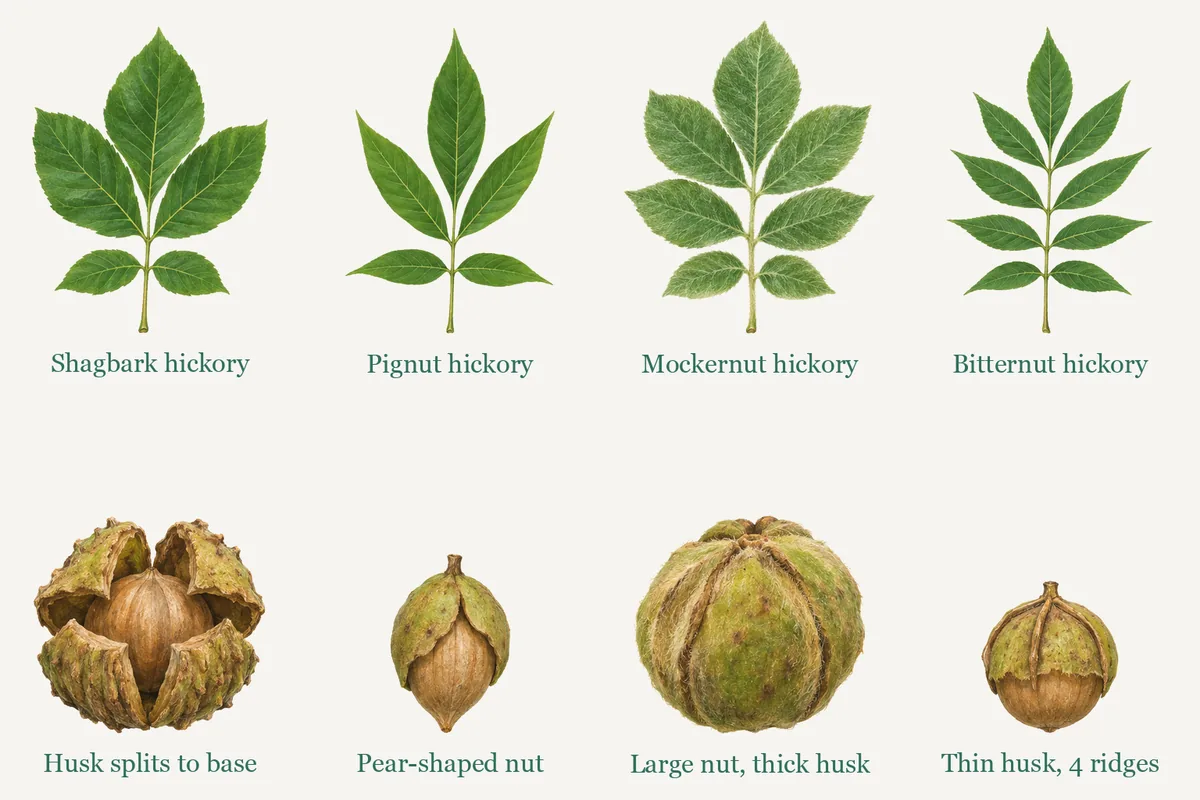
| Feature | Bitternut | Pecan | Pignut | Mockernut |
|---|---|---|---|---|
| Bud | Narrow, four-angled, sulfur-yellow | Yellowish brown, hairy | Small, about 1/4 in, light brown | Very large, silky whitish |
| Leaflets | 7–11, slender | 9–15, often curved | 5, sometimes 7 | 7–9 |
| Leaf length | 7–10 in | 12–18 in | 8–12 in | 9–14 in |
| Fruit | Round, about 1 in | Oblong, 1 1/2–2 in, in clusters | Pear-shaped, 1–2 in | Oval, 1 1/2–2 in |
| Husk | Thin, four-winged above the middle | Thin | Thin, opens partway | Thick, splits cleanly |
Figures come from Virginia Tech's fact sheets for pecan, pignut and mockernut. Pecan is bitternut's closest relative here; Virginia Tech lists it as a look-alike, and the Forest Service notes that the two hybridize. The pecan page has the full comparison. For the others, see pignut hickory, mockernut hickory and shagbark hickory, or the hickory genus page for six species side by side.
Virginia Tech also lists water hickory (Carya aquatica) as a look-alike. The Forest Service's water hickory chapter places it on the Atlantic and Gulf Coastal Plains from southeastern Virginia to southern Florida, west into eastern Texas and up the Mississippi Valley to southern Illinois, on clay flats, sloughs and backwaters that flood. Outside that zone, a yellow-budded hickory is bitternut.
Bitternut in winter and on the ground
Bitternut is one of the easiest trees to name in winter. Reach a low branch and look at the twig tip: a slim, bright yellow bud with no overlapping scales. The leaf scars below it are three-lobed, like those of every hickory. The winter tree identification guide puts bitternut beside the other buds you will meet in the same woods.
On the ground, look for small round husks with four ridges. Crops are irregular: the Forest Service gives good crops every 3 to 5 years, with light crops between, and seed falls almost entirely under the tree, from September through December. The guide to identifying trees by seeds and nuts compares these husks with walnut and the other hickories.
Where bitternut hickory grows
The Forest Service range runs from southwestern New Hampshire, Vermont, Maine and southern Quebec west to southern Ontario, central Michigan and northern Minnesota, south to eastern Texas and east to northwestern Florida and Georgia. It is most common from southern New England west to Iowa and from southern Michigan south to Kentucky, and absent from the mountain forests of northern New England and New York and from the higher Appalachians.
Despite the name swamp hickory, it grows on a wide range of sites: moist mountain valleys, streambanks, swamps and wet bottomlands, and dry uplands too. It reaches its largest size on rich bottomlands of the lower Ohio River Basin. Associates include hackberry, green ash, white ash, butternut, basswood, northern red oak, black maple, yellow-poplar, blackgum and the other hickories.
Size, age and nut years
Bitternut typically reaches about 100 feet with trunks 24 to 36 inches across, and lives about 200 years (Forest Service). Planted trees are smaller: Morton gives 50 to 70 feet tall and 40 to 50 feet wide. Its thin, hard bark insulates poorly, so older trees are susceptible to fire damage.
Nut production starts at about 30 years, is best between 50 and 125, and trees over 175 years seldom bear good crops. To estimate the age of a trunk, use the tree age calculator. With location turned on, Tree Identifier's Tree Map pins the find, so you can come back in a mast year to check the four-winged husks.
Look-alikes and how to tell them apart
Pecan (Carya illinoinensis)
Pecan has more leaflets, 9 to 15, often curved, on leaves 12 to 18 inches long, and oblong nuts 1 1/2 to 2 inches, brown splotched with black, often in clusters. Its buds are yellowish brown and hairy, not bright sulfur-yellow and four-angled.
Pignut hickory (Carya glabra)
Pignut usually has only 5 leaflets, small light brown buds about 1/4 inch long, and a pear-shaped fruit without wings whose husk opens only partway. Bitternut has 7 to 11 leaflets, yellow buds and a round, four-winged husk.
Mockernut hickory (Carya tomentosa)
Mockernut has a very large bud that turns silky whitish after its dark outer scales fall, a very hairy stout leaf stalk, and a bigger fruit, 1 1/2 to 2 inches, in a thick husk. Bitternut's bud is narrow and yellow and its husk thin.
Black walnut (Juglans nigra)
Black walnut leaves carry 10 to 24 leaflets, often without an end leaflet, its round husk stays closed, and a twig cut lengthwise shows chambered pith. Bitternut has 7 to 11 leaflets, solid pith and a husk that splits.
What a photo can't settle
- Bitternut hybridizes with pecan, pignut and shagbark (USDA Forest Service); hybrids will not match every feature here.
- Virginia Tech lists water hickory as a bitternut look-alike; on the southern Coastal Plain, where water hickory grows in swamps and sloughs, check a local key.
- Good nut crops come only every 3 to 5 years, so the husk test is not always available; the buds are the more reliable clue.
Questions people ask
How do you identify a bitternut hickory?
Look at the buds first: narrow, four-angled and sulfur-yellow. Then check the leaves, 7 to 11 slender leaflets on a leaf 7 to 10 inches long, and the fruit, a small round nut about 1 inch long in a thin husk with four wing-like ridges above the middle.
Are bitternut hickory nuts edible?
The USDA Forest Service describes the kernels as bitter and of little value for people because of high tannin, bitterness and astringency, and the Morton Arboretum calls them bitter and inedible. Never eat a nut on the strength of a web page or an app; check with a local expert.
What is the difference between bitternut hickory and pecan?
Pecan has more leaflets, 9 to 15 against 7 to 11, on longer leaves, and oblong nuts 1 1/2 to 2 inches long, often in clusters. Bitternut's fruit is about 1 inch and nearly round, with a four-winged husk, and its buds are bright sulfur-yellow. The two hybridize.
Where does bitternut hickory grow?
The USDA Forest Service calls it the most abundant and uniformly distributed hickory, from Maine and southern Quebec west to northern Minnesota and south to eastern Texas and northwestern Florida. It grows in moist valleys, streambanks and bottomlands, and also on dry uplands.
How long does bitternut hickory live?
About 200 years, according to the USDA Forest Service. Nut production starts at about 30 years, is best between 50 and 125, and trees over 175 years seldom bear good crops.
Sources
- Bitternut Hickory (Carya cordiformis), Silvics of North America — USDA Forest Service
- Bitternut hickory fact sheet — Virginia Tech Dendrology
- Bitternut hickory (Carya cordiformis) — The Morton Arboretum
- Pecan fact sheet — Virginia Tech Dendrology
- Water Hickory (Carya aquatica), Silvics of North America — USDA Forest Service
- Mockernut hickory fact sheet — Virginia Tech Dendrology
Keep reading
- Tree profileHickory trees (Carya): how to identify them
- Tree profilePecan (Carya illinoinensis): how to identify it
- Tree profileMockernut hickory (Carya tomentosa): how to identify it
- Winter field guideWinter tree identification, from buds to bark
- Field guideTree seed identification: from acorn, pod or samara to the tree