Tree profile
Northern pin oak (Quercus ellipsoidalis): how to identify Hill's oak
A red oak of sandy uplands and savannas around the western Great Lakes: leaves cut almost to the midrib like a pin oak's, but an acorn sunk deeper in its cap, on dry ground.
In short
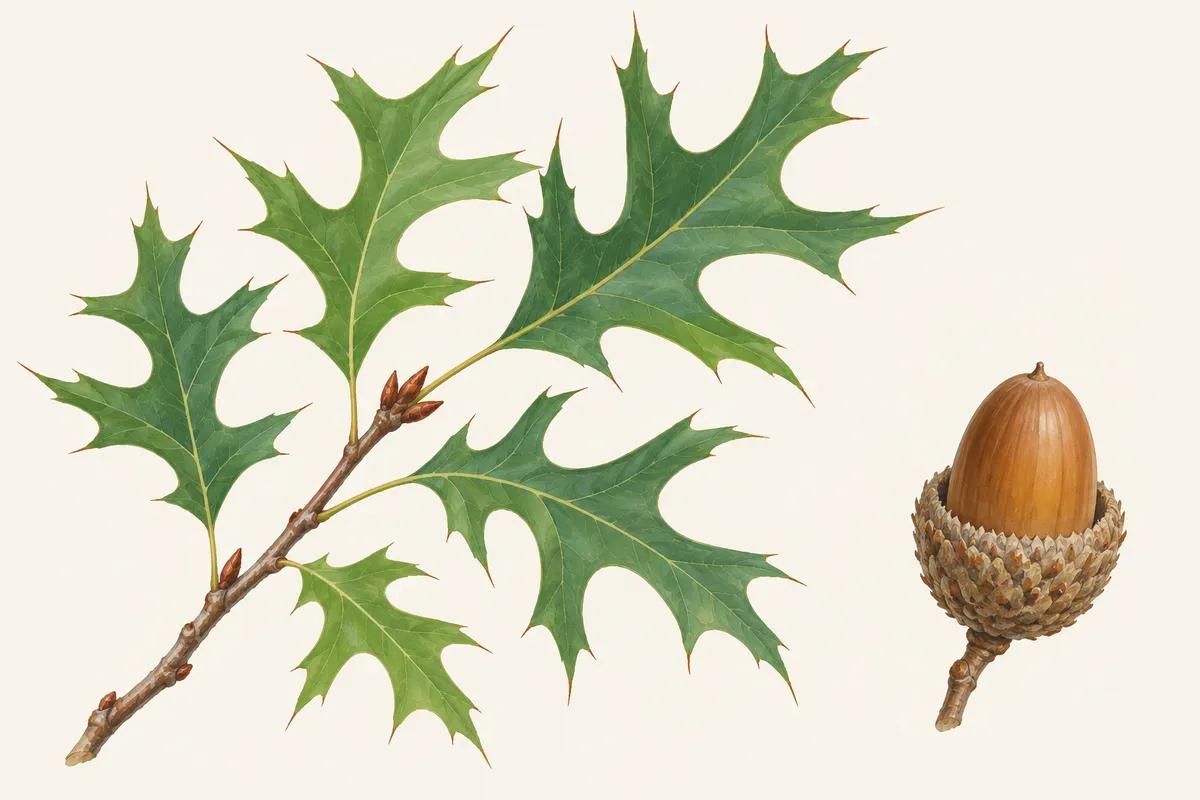
Northern pin oak identification rests on the acorn and the site. The leaves, 3 to 6 inches long, are cut by very deep, rounded sinuses into bristle-tipped lobes, like pin oak and scarlet oak. The acorn is elliptical, about 1/2 to 3/4 inch long, sunk a third to half into a deep cap with no rings at its tip, and the tree grows on dry, sandy uplands around the western Great Lakes.
- Pin oak acorn: round, in a thin saucer cap. Northern pin oak acorn: elliptical, in a deep cap covering a third to half.
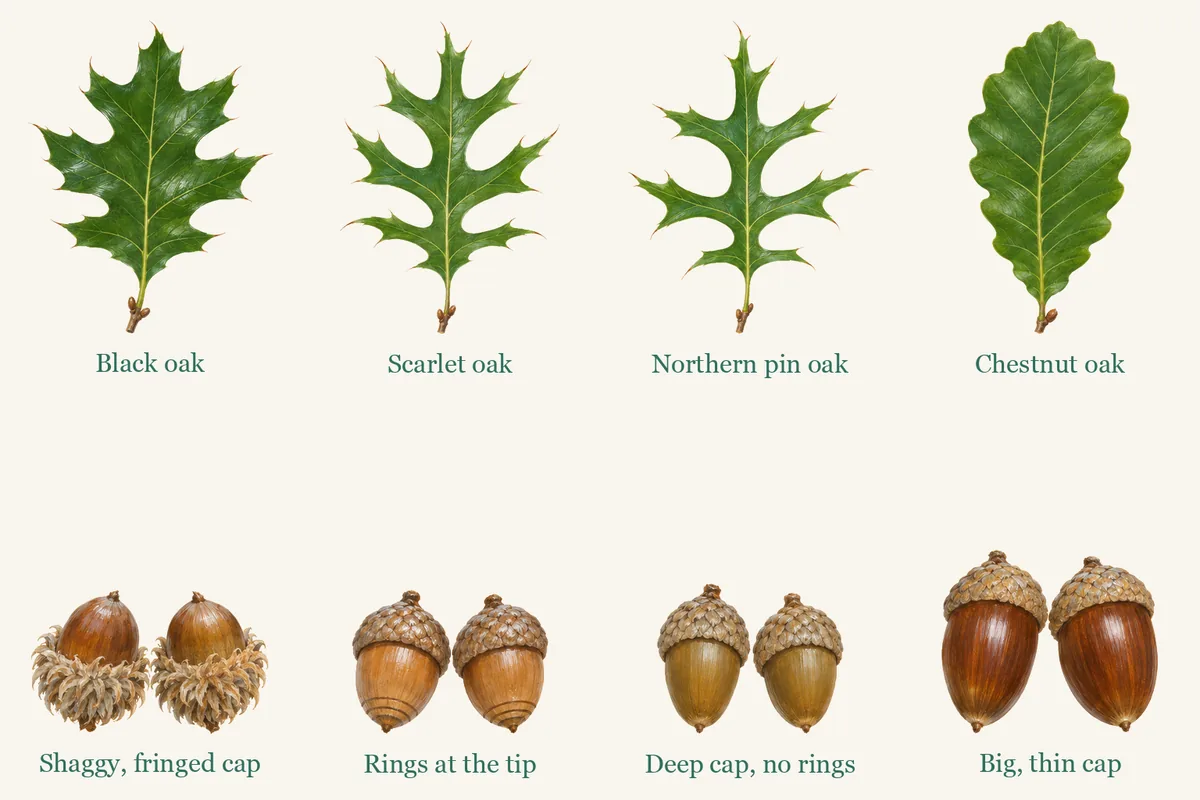
- Scarlet oak acorns often show concentric rings at the tip; northern pin oak acorns lack them, according to Virginia Tech.
- Dry sandy upland or savanna: think northern pin oak. Poorly drained floodplain: think pin oak.
Field marks at a glance
- Scientific name
- Quercus ellipsoidalis
- Family
- Fagaceae (beech family)
- Type
- Broadleaf, deciduous
- Leaves
- Alternate, simple, 3 to 6 inches long, oval with very deep sinuses and bristle-tipped lobes; somewhat shiny green above, paler and generally hairless below, with possible tufts in the vein angles (Virginia Tech).
- Lobes and sinuses
- 2 to 4 main lobes per side, each with 2 to 5 bristle-tipped points; sinuses broad and rounded, often reaching more than halfway to the midrib (Minnesota Wildflowers).
- Acorns
- Elliptical to almost round; 1/2 to 3/4 inch (Morton Arboretum), 12 to 18 mm (NRCan) or up to 1 inch (Virginia Tech). The deep cap covers a third to half of the nut; no concentric rings at the tip. Immature acorns often striped.
- Cap
- 10 to 15 mm wide, tapering to a stalk-like base (NRCan); scales hairy, those at the rim generally loose (Virginia Tech).
- Buds and twigs
- Terminal bud 4 to 6 mm, reddish brown, pointed, slightly angled, mostly hairless; twigs red-brown, hairy when young.
- Bark
- Gray-brown with smooth streaks on young trees; later darker with irregular ridges and narrow furrows, especially near the base. Inner bark orangish (Virginia Tech) or light yellow (NRCan).
- Winter leaves
- Dried leaves often stay on the tree into winter, even until spring (Morton Arboretum, Minnesota Wildflowers).
- Size and form
- Small to medium, up to about 70 ft (Virginia Tech), 40 to 75 ft (Morton); irregular crown, often with many dead branches.
- Range and habitat
- Missouri to Ohio and into Canada (Morton Arboretum); in Ontario west of Lake Superior and north of Lake Erie; common in central and southeastern Minnesota. Dry, sandy uplands, savannas and open disturbed ground.
Northern pin oak, also called Hill's oak, is a red oak of dry, sandy ground around the western Great Lakes: savannas, dry prairie margins and open, disturbed land, from Minnesota into Ontario. Its leaves are nearly identical to those of pin oak and scarlet oak, which is why it is so often misnamed. The acorn, the cap and the ground under your feet are what separate it.
How to identify a northern pin oak
Confirm the red oak group first: bristle tips on the lobes, and acorns that take two seasons to ripen. Then work through these.
1. Leaves cut very deep. Virginia Tech's northern pin oak fact sheet describes alternate leaves 3 to 6 inches long, oval with very deep sinuses and bristle-tipped lobes, somewhat shiny above, paler and generally hairless below, sometimes with tufts in the vein angles. Minnesota Wildflowers' northern pin oak page counts 2 to 4 main lobes per side, each ending in 2 to 5 bristle-tipped points, and broad rounded sinuses that often reach more than halfway to the midrib.
2. The acorn: elliptical, in a deep cap. Pick up acorns from under the tree. The Morton Arboretum's Hill's oak page gives 1/2 to 3/4 inch, slightly elongated, with the cap covering about a third. Natural Resources Canada's northern pin oak factsheet gives 12 to 18 mm, with a cap 10 to 15 mm wide enclosing a third to half of the nut and tapering to a stalk-like base. Virginia Tech gives 1/2 to 1 inch and a cap covering half.
3. The acorn tip. Turn the nut over. Virginia Tech says the tip of a northern pin oak acorn lacks concentric rings; scarlet oak acorns often show rings or fine cracks there.
4. Buds. Terminal buds are reddish brown, pointed and slightly angled, with mostly hairless scales (Virginia Tech); NRCan gives 4 to 6 mm.
5. Leaves in winter. Morton notes that dried leaves often stay on the tree into winter. Minnesota Wildflowers says they turn dull tan and often hang on until spring.
6. The ground. Morton places Hill's oak on dry, upland sites; NRCan on sandy soils in open, disturbed habitats, and more likely on uplands than pin oak.
Tree Identifier can name an oak from one photo of a leaf or an acorn. Inside this group, photograph an acorn in its cap from the side and the tip, and compare with the steps above; the app gives one name, with no confidence score and no list of look-alikes.
Northern pin oak vs pin oak, scarlet oak and black oak
| Mark | Northern pin oak | Pin oak | Scarlet oak | Black oak |
|---|---|---|---|---|
| Leaf | 3–6 in, very deep sinuses | 3–6 in, 5–9 lobes, U-shaped sinuses nearly to the midrib | 3–7 in, very deep sinuses | 4–10 in, 5–7 lobes, fuzzy below |
| Acorn | Elliptical, 1/2–3/4 in (up to 1 in) | About 1/2 in, round, flattened top | 1/2–1 in | Ovoid, 1/2–3/4 in |
| Cap | Deep, 1/3–1/2 of the nut, rim scales loose | Thin saucer | About half, shiny tight scales | Bowl, 1/3–1/2, fuzzy loose scales |
| Acorn tip | No rings | — | Often concentric rings | — |
| Buds | Reddish, mostly hairless | Small, chestnut brown | Reddish, hairy on upper half | 1/4–1/2 in, buff, fuzzy |
Figures come from the Virginia Tech fact sheets for pin oak, scarlet oak and black oak, with the northern pin oak acorn size from Morton. Pin oak is the most common confusion in towns: the pin oak page covers its neat pyramid and drooping lower limbs, and the USDA Forest Service's pin oak silvics places it mainly on level, poorly drained floodplain and river-bottom soils, the opposite of a northern pin oak site. The scarlet oak page shows its ringed acorn tip and swollen trunk base, and the black oak page its fuzzy buds and hairy leaf undersides.
Morton adds a practical difference: Hill's oak looks very similar to pin oak but tolerates higher soil pH, so it does not suffer the yellowing (chlorosis) that pin oak often shows on alkaline soil.
Where northern pin oak grows
Morton describes the natural range as Missouri to Ohio and into Canada, and lists Hill's oak as native to the Chicago region. NRCan calls it uncommon in Canada, where it grows in Ontario west of Lake Superior and north of Lake Erie. Minnesota Wildflowers calls it common throughout central and southeastern Minnesota, on dry sandy or rocky soils, savannas and dry prairie margins, and says it tolerates fire; it also grows in mesic wooded uplands, where northern red oak is the usual oak. In Minnesota, Minnesota Wildflowers adds, its range overlaps that of black oak only in the far southeastern counties.
The oak identification page sorts the red and white oak groups, and the acorn identification guide compares caps across the common oaks.
Size, bark and fall color
Virginia Tech describes a small to medium tree up to about 70 feet, with generally poor form, an irregular crown and many dead branches; Morton gives 40 to 75 feet for height and spread. Bark on young trees is gray-brown with smooth streaks, later darker with irregular broad ridges and narrow furrows, especially near the base (Virginia Tech). Virginia Tech calls the inner bark orangish, NRCan light yellow, and NRCan describes the outer bark as shallowly furrowed with narrow vertical plates.
Morton credits Hill's oak with excellent red fall color; Minnesota Wildflowers says it is usually deep maroon to rusty red, sometimes scarlet. The acorns take two years to mature and ripen in fall (Virginia Tech).
Northern pin oak (Quercus ellipsoidalis) is not in Tree Identifier's 138-species Collection. With location turned on, the app's Tree Map pins each find, which helps when you want to come back in fall for ripe acorns.
Look-alikes and how to tell them apart
Pin oak (Quercus palustris)
Pin oak's acorn is about 1/2 inch, round and flattened at the top, in a thin saucer cap; northern pin oak's is elliptical, in a deep cap covering a third to half. Pin oak is a neat pyramid with drooping lower branches, on poorly drained floodplains and flats (USDA Forest Service), and often yellows on alkaline soil; northern pin oak grows on dry uplands and tolerates higher pH.
Scarlet oak (Quercus coccinea)
Leaves are almost the same. Scarlet oak's acorn tip often shows concentric rings or fine cracks, its cap scales are shiny and tight, and older trunks often swell at the base. Northern pin oak's acorn lacks the rings and its rim scales are generally loose.
Black oak (Quercus velutina)
Black oak leaves are larger, 4 to 10 inches, and fuzzy beneath, and its buds are big, 1/4 to 1/2 inch, buff and fuzzy. Northern pin oak leaves are generally hairless below except for vein tufts, and its buds are 4 to 6 mm and mostly hairless.
Northern red oak (Quercus rubra)
Minnesota Wildflowers calls the two hard to tell apart where they meet, and gives northern pin oak a shiny upper leaf surface, deeper and broader rounded sinuses, and a small elliptical acorn in a deep cap. Northern red oak prefers mesic wooded uplands.
What a photo can't settle
- Sources disagree on acorn size and cap depth (a third in Morton, half in Virginia Tech, a third to half in NRCan); one acorn is not decisive, so check several.
- In leaf alone, northern pin oak can be indistinguishable from pin oak and scarlet oak; a photo app, Tree Identifier included, returns one name with no list of alternatives, so add an acorn photo.
- Range and habitat do much of the work for this tree; a planted oak in a park or nursery can break the habitat rule.
Questions people ask
Is northern pin oak the same as Hill's oak?
Yes. Northern pin oak and Hill's oak are two common names for Quercus ellipsoidalis; the Morton Arboretum uses Hill's oak, Virginia Tech and Natural Resources Canada use northern pin oak. It is a different species from pin oak, Quercus palustris.
How do you tell northern pin oak from pin oak?
Mainly by the acorn and the site. Pin oak's acorn is round and sits in a thin saucer cap; northern pin oak's is elliptical, in a deep cap covering a third to half. Pin oak grows on poorly drained floodplains and flats; northern pin oak on dry, sandy uplands. The leaves are nearly identical.
Does northern pin oak keep its leaves in winter?
Often. The Morton Arboretum says the dried leaves often stay on the tree into winter, and Minnesota Wildflowers says they turn dull tan and frequently persist until the buds break in spring.
Does northern pin oak get chlorosis?
Less than pin oak, according to the Morton Arboretum: Hill's oak tolerates higher soil pH, so chlorosis (yellowing leaves on alkaline soil) is not a problem for it, while pin oak often develops it. For a specific yellowing tree, ask a certified arborist.
Sources
- Northern pin oak fact sheet — Virginia Tech Dendrology
- Hill's oak (Quercus ellipsoidalis) — The Morton Arboretum
- Northern pin oak (Quercus ellipsoidalis), Trees, insects and diseases of Canada's forests — Natural Resources Canada
- Quercus ellipsoidalis (Northern Pin Oak) — Minnesota Wildflowers
- Pin oak fact sheet — Virginia Tech Dendrology
- Scarlet oak fact sheet — Virginia Tech Dendrology
- Pin Oak (Quercus palustris), Silvics of North America — USDA Forest Service
- Black oak fact sheet — Virginia Tech Dendrology