Also in Français
Tree profile
Olive tree (Olea europaea): how to identify it
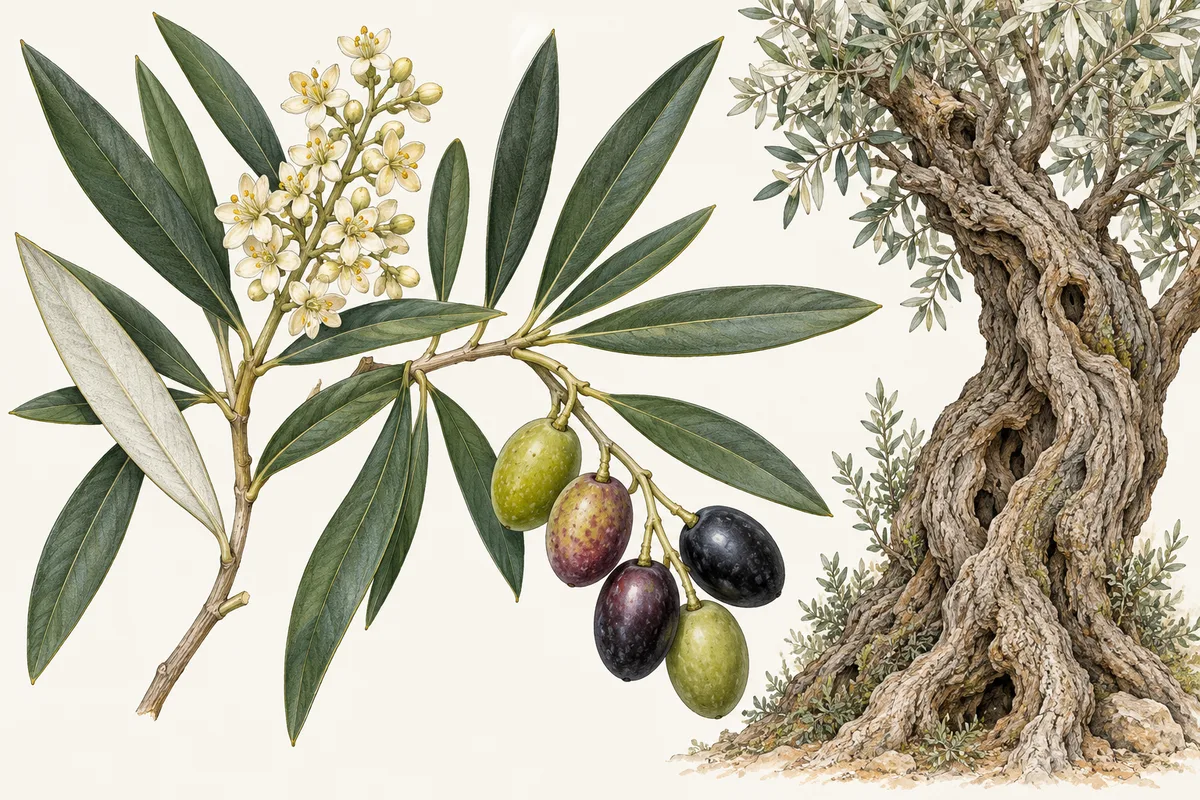
The evergreen of Mediterranean groves, patio pots and Australian paddocks: narrow leathery leaves, grey-green above and silver below, set in opposite pairs, on a trunk that twists with age.
In short
Olive tree identification starts with the leaves: evergreen, leathery, narrow, 1 to 3 inches long, grey-green above and silvery underneath, and set in opposite pairs. In summer, small creamy-white flowers come in short sprays, followed by oval fruit about 1.5 inches long that ripens from green to purplish black. Old trunks are gnarled, furrowed and twisted.
- Leaves in opposite pairs and green above, silver below: true olive. Leaves alternate and silvery on both sides: Russian olive.
- Russian, autumn, black and sweet olive are not olives at all; each has one quick field test below.
- In the UK the RHS rates many olives hardy to about -5 to -10°C, but they rarely fruit outdoors.
- In South Australia, feral olives are a declared pest plant; planted and maintained trees are not declared.
Field marks at a glance
- Scientific name
- Olea europaea
- Family
- Oleaceae (olive family)
- Type
- Broadleaf, evergreen
- Leaves
- Opposite, leathery, narrow (elliptic to lance-shaped), 1 to 3 inches (2.5 to 7.5 cm) long, grey-green above and silver underneath with fine hairs (NC State). Evergreen.
- Flowers
- Small, fragrant, creamy-white, in short sprays about 2 inches long from the leaf joints, in summer (NC State, RHS).
- Fruit
- An oval drupe about 1.5 inches long with one stone, green ripening to purplish black (NC State). Rarely sets in the UK (RHS).
- Bark and trunk
- Smooth and grey on young trees; gnarled, furrowed and twisted with age (NC State).
- Size and form
- 20 to 30 ft (6 to 9 m) tall and 15 to 25 ft wide in the ground (NC State); much smaller in a pot.
- Climate
- USDA zones 8 to 10 (NC State). In the UK, many olives are hardy to about -5 to -10°C (RHS).
- Origin
- The Mediterranean, Africa and south-central China (NC State); feral in parts of South Australia.
The olive is the tree of Mediterranean groves, but most people meet it in a pot on a patio in Britain, in a yard in California or Texas, or as a wild seedling in South Australian bushland. Several unrelated trees are also called olive. The checks below separate the true olive from all of them in a minute, starting with the leaf.
How to identify an olive tree in four checks
1. Opposite, narrow, leathery leaves. NC State Extension's olive profile describes evergreen, opposite, leathery leaves, elliptic to lance-shaped and 1 to 3 inches long. Look at a twig: the leaves come off in pairs, one facing the other. That single test rules out Russian and autumn olive.
2. Grey-green above, silver below. NC State describes the upper surface as greyish green and the underside as silver, with fine hairs. The RHS growing guide explains the silvery look as tiny white hairs on a leathery green leaf. Turn a leaf over: the two faces differ clearly.
3. Small cream flowers, then olives. In summer, olive carries fragrant, small white flowers in sprays about 2 inches long from the leaf joints (NC State); the RHS calls them creamy white. The fruit is an oval drupe about 1.5 inches long with one stone, green at first and ripening to purplish black. On a potted tree in Britain, flowers and fruit may never appear.
4. The trunk. NC State describes smooth grey bark on young trees that becomes gnarled, furrowed and twisted with age. A thick, contorted trunk under a small grey-green crown is the classic old olive.
Olive is one of the 138 species in Tree Identifier's Collection, so a photo of a leafy twig both names it and fills its place in the catalog. The app shows no confidence score and no look-alike list, so check the leaf pairs yourself when a Russian olive is a possibility.
Olive vs Russian, autumn, black and sweet olive
| Tree | Leaf arrangement | Leaf colour | Fruit | Habit |
|---|---|---|---|---|
| Olive (Olea europaea) | Opposite | Grey-green above, silver below | Oval, about 1.5 in, green to purplish black | Evergreen |
| Russian olive (Elaeagnus angustifolia) | Alternate | Silvery on both sides | About 1/2 in, silver-gray, reddening in fall | Deciduous, sometimes thorny |
| Autumn olive (Elaeagnus umbellata) | Alternate | Dull green above, scaly beneath | Small red berry speckled with silver | Deciduous, thorny |
| Black olive (Terminalia buceras) | Crowded at branch tips | Light green | Small black capsule, 1/4–1/2 in | Florida shade tree |
| Sweet olive (Osmanthus fragrans) | Opposite | Dark glossy green both sides | Not a feature | Evergreen shrub or small tree |
Russian olive. NC State's Russian olive profile describes alternate, lance-shaped leaves with silvery scales on both sides, occasional thorns, small fragrant flowers from April to June, and olive-like fruit about 1/2 inch that is silver-gray in late summer and reddens in fall. It is deciduous. The Russian olive page covers it in detail.
Autumn olive. NC State's autumn olive profile gives alternate leaves 2 to 4 inches long with wavy edges, silvery scales on young leaves and brown scales beneath, sharp thorns, and fruit that ripens from silvery yellow to red, speckled with scales. NC State lists both Elaeagnus species as invasive in North Carolina.
Black olive. In South Florida, black olive is a common street and shade tree. The UF/IFAS Master Gardener plant ID page describes a tree of 40 to 50 feet with obovate leaves up to 3 inches crowded at swollen branch tips and small reddish-brown to black fruit. UF/IFAS Extension Charlotte County notes that it should not be confused with the familiar olive and that its name comes from its black seed capsule.
Sweet olive. The NC State sweet olive profile describes an evergreen shrub of 10 to 20 feet with opposite, leathery, lustrous dark green leaves 2 to 5 inches long, finely toothed or smooth, and very fragrant white flowers that smell like apricots in early spring and some in fall. Its leaves are opposite like a true olive's, but glossy green on both faces instead of silver beneath.
Other trees with silvery foliage, such as silver maple and white poplar, are sorted in trees with silver leaves.
Olive trees in UK and US gardens and pots
UK. The RHS says many olives are hardy through most of the UK, tolerating about -5 to -10°C, though severe frosts can damage leaves and branches. It recommends containers in colder areas or on heavy, wet soils: a frost-proof pot at least 30 to 35 cm wide and deep, moved to a frost-free place over winter, and fleece around the canopy in very cold spells. Olives rarely fruit in the UK, the RHS notes, though they may after hot summers in some parts of the country.
US. NC State gives USDA hardiness zones 8 to 10 outdoors, with some cultivars in zone 7, and lists Mexico and Hawaii among the places where olive has been introduced. Elsewhere, an olive is usually a patio or indoor pot plant.
Feral olives in South Australia: weed status
Olives were planted widely in Australia, and some have gone wild. The Kangaroo Island Landscape Board states that feral olives are a declared pest plant under the Landscape South Australia Act 2019, that cultivated trees planted and maintained for use are not declared, and that landholders are required to control olive wildings so they do not spread beyond their boundaries. It adds that birds and animals carry olives from poorly maintained groves to neighbouring properties and roadsides. That is the board's statement of April 2025, read on 30 October 2026; check with your regional landscape board for the current position.
This page gives no advice on eating or preparing olives picked from a tree. For other fruiting trees in yards and gardens, see the fruit tree identification guide, and for a quick round of the trees around a house, identify trees in your yard.
Look-alikes and how to tell them apart
Russian olive (Elaeagnus angustifolia)
Russian olive leaves are alternate, not opposite, and covered in silvery scales on both sides. It is deciduous, often thorny, and its small fruit is about 1/2 inch and silver-gray, not a 1.5-inch green or black olive.
Autumn olive (Elaeagnus umbellata)
Autumn olive leaves are alternate, 2 to 4 inches, dull green above with silvery or brown scales beneath and wavy edges. Its fruit is a small red berry speckled with silver, and the shrub is deciduous and thorny.
Black olive (Terminalia buceras, syn. Bucida buceras)
A Florida shade tree, not a true olive. Its leaves are obovate, up to 3 inches, light green and crowded at swollen branch tips on zigzag stems, and its fruit is a small black capsule 1/4 to 1/2 inch.
Sweet olive (Osmanthus fragrans)
Sweet olive also has opposite, leathery leaves, but they are dark, glossy green on both sides, 2 to 5 inches long and often finely toothed. Its tiny white flowers smell strongly of apricots in fall and early spring.
What a photo can't settle
- A photo can confirm Olea europaea but not the cultivar; olive varieties are told apart by fruit and nursery records.
- A potted olive kept small and clipped may never flower or fruit, so the leaves are the only clue.
- This page gives no advice on eating or preparing olives from a tree; the RHS notes that fruit needs special preparation.
Questions people ask
How do I know if my tree is an olive tree?
Check that the leaves grow in opposite pairs, are narrow and leathery, 1 to 3 inches long, grey-green above and silver underneath, and stay on all winter (NC State). Small creamy-white flowers in summer and an old, twisted trunk confirm it.
How can I tell what type of olive tree I have?
First rule out the trees only named olive: Russian, autumn, black and sweet olive each fail the opposite-leaf, silver-underneath test in a different way. Naming the cultivar of a true olive needs the label from the nursery or a specialist; neither a photo nor this page can settle it.
Can olive trees grow in the UK?
Yes, with care. The RHS says many olives are hardy through most of the UK to about -5 to -10°C, suggests a large pot at least 30 to 35 cm wide in colder areas or heavy, wet soils, moved to a frost-free place in winter, and notes that olives rarely fruit in the UK.
Is a black olive tree a real olive?
No. The black olive of Florida streets is Terminalia buceras (formerly Bucida buceras). UF/IFAS Extension says it should not be confused with the familiar olive; the name comes from its small black seed capsules.
Are olive trees a weed in Australia?
In South Australia, feral olives are a declared pest plant under the Landscape South Australia Act 2019, according to the Kangaroo Island Landscape Board (April 2025). Planted and maintained trees are not declared, and landholders must control wildings so they do not spread.
Sources
- Olea europaea (Common Olive) — NC State Extension Gardener Plant Toolbox
- How to grow olives — Royal Horticultural Society (RHS)
- Call to control olive wildings on KI (14 April 2025) — Kangaroo Island Landscape Board, Landscape South Australia
- Elaeagnus angustifolia (Russian Olive) — NC State Extension Gardener Plant Toolbox
- Elaeagnus umbellata (Autumn Olive) — NC State Extension Gardener Plant Toolbox
- Black Olive — UF/IFAS Florida Master Gardener Volunteer Program
- Shade but no olives (Ralph Mitchell, 26 May 2022) — UF/IFAS Extension Charlotte County
- Osmanthus fragrans (Sweet Olive) — NC State Extension Gardener Plant Toolbox