Tree profile
Pawpaw (Asimina triloba): how to identify it
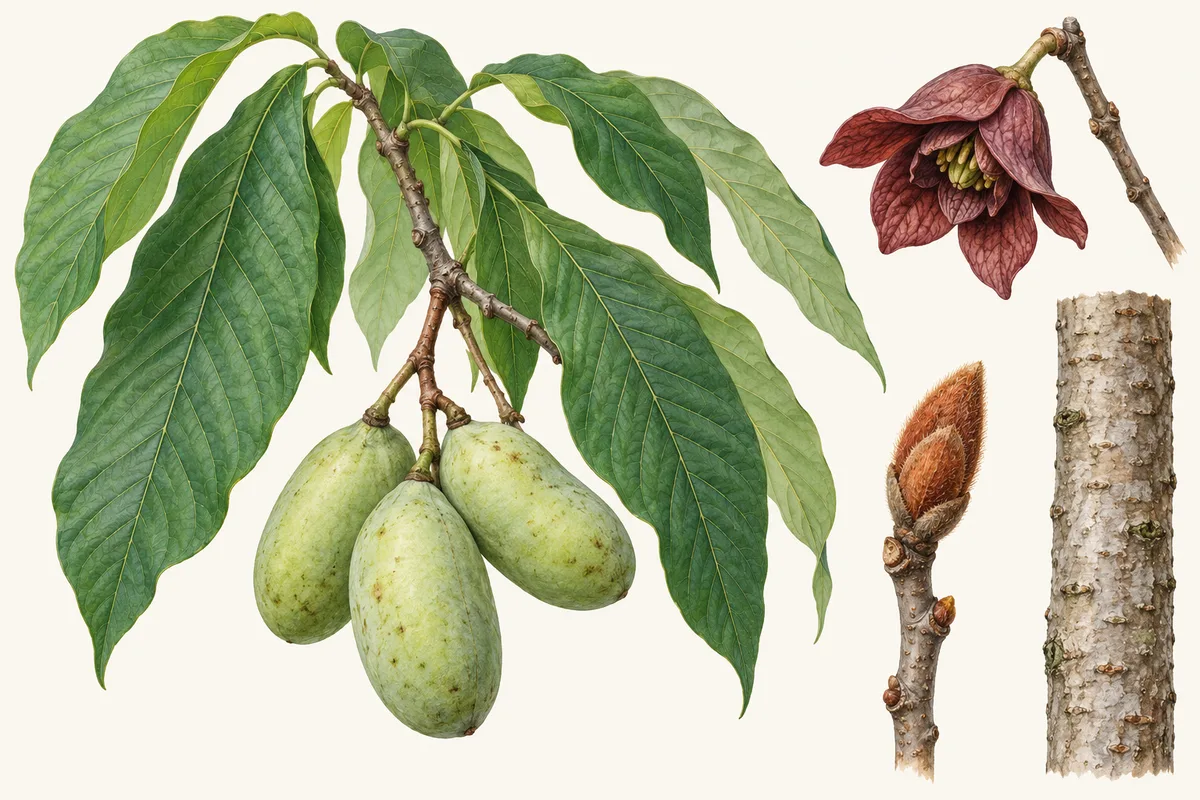
A small understory tree with tropical-looking leaves up to a foot long, hanging in two rows. Crush one: the green-pepper smell and the fuzzy, naked brown buds settle it.
In short
Pawpaw tree identification rests on three checks. The leaves are alternate, smooth-edged and widest beyond the middle, 6 to 12 inches long, drooping in two rows and smelling of green pepper when crushed. In spring, maroon six-petaled flowers 1 to 1.5 inches across appear before the leaves. In winter, look for naked, fuzzy, purplish-brown buds.
- Huge, drooping, smooth-edged leaves on a small tree growing in a clump in moist eastern woods: think pawpaw first.
- Crushed leaves smell of green pepper; the end bud is a naked, rusty-fuzzy brown bud with no scales.
- Cucumbertree has similar big leaves but a large, silky white end bud, a ring around the twig at each leaf and cone-like fruit.
Field marks at a glance
- Scientific name
- Asimina triloba
- Family
- Annonaceae (custard-apple family)
- Type
- Broadleaf, deciduous
- Leaves
- Alternate, simple, smooth-edged, obovate (widest beyond the middle), 5 to 12 inches long and 2 to 3 inches wide, hanging in two ranks. Crushed leaves smell of green pepper.
- Flowers
- Purplish-brown to maroon, bell-shaped, six petals, 1 to 1.5 inches across (Clemson: up to 2 inches), nodding, in early to mid-spring before or with the leaves.
- Fruit
- A short, fat, banana-like fruit 2.5 to 6 inches long, green, then yellowish, then brown as it ripens from late summer to early fall; single or in clusters.
- Buds
- End bud naked (no scales), flattened, fuzzy and purplish to rusty brown, 1/4 to 1/2 inch long.
- Twigs
- Moderately stout, red-brown.
- Bark
- Thin, smooth and brown with wart-like lenticels, often with light gray patches; becomes fissured and scaly with age.
- Form and size
- A small tree 15 to 30 ft tall, at most about 40 ft and 12 inches thick; often grows in clumps or thickets from root suckers in the understory.
- Fall color
- Yellow to yellow-green.
- Range
- Eastern North America, in about 25 states: from northern Florida north to southern Ontario and west to eastern Nebraska (Clemson). Moist, rich bottomland woods, ravines and stream banks.
Pawpaw (Asimina triloba) is a small eastern North American tree with leaves that look borrowed from the tropics, a member of the custard-apple family (Annonaceae). It grows in the shade of moist hardwood forests, often as a clump of stems from one root system, and it is easy to walk past until you notice the long, drooping leaves. Never eat a berry, nut, seed or pod on the strength of a web page or an app; check with a local expert. This page covers how to recognize the tree, not what to do with its fruit.
How to identify a pawpaw tree: leaves, smell and buds
1. The leaves. Pawpaw leaves are alternate, simple and smooth-edged, widest beyond the middle and tapering to the stalk. The Virginia Tech pawpaw fact sheet gives 5 to 11 inches long and 2 to 3 inches wide; NC State's pawpaw profile gives 6 to 12 inches. They hang in two ranks along the twig and droop, so a pawpaw patch looks layered. NC State adds that the underside is pale.
2. The smell. Crush a leaf and sniff. Both Virginia Tech and NC State describe a green-pepper odor. It takes two seconds and works on a single fallen leaf.
3. The end bud. Look at the tip of a twig. Pawpaw's end bud is naked, meaning it has no bud scales: just a flattened, fuzzy, purplish-brown bud, often slightly curved, 1/4 to 1/2 inch long. Cucumbertree, the main look-alike, has a large, silky white end bud and a ring around the twig at every leaf.
4. The habit. In the forest understory pawpaws usually grow in clumps or thickets. Clemson's pawpaw fact sheet attributes this to prolific root suckering, and the Morton Arboretum notes that it forms colonies by suckering.
A photo of a leafy branch is enough for Tree Identifier to suggest pawpaw. The app shows no list of look-alikes, so use the smell and the bud test to confirm it against cucumbertree below.
Pawpaw flowers and fruit
Flowers. In early to mid-spring, before or as the leaves open, pawpaw carries nodding, bell-shaped flowers with six purplish-brown to maroon petals, 1 to 1.5 inches across according to Virginia Tech and NC State (up to 2 inches in Clemson's description). Clemson describes a weak, unpleasant aroma; the Morton Arboretum compares the odor to fermented grapes. The flowers are pollinated by flies and beetles and are self-incompatible: they need pollen from a genetically different pawpaw to set fruit, which is why a single tree or a clump grown from one root system often carries little fruit.
Fruit. The fruit is short, fat and banana-shaped, 2.5 to 6 inches long. It turns from green to yellowish and then brown as it ripens from late summer to early fall, hanging singly or in clusters. Clemson records fruit from 7 ounces to 2 pounds.
Safety. NC State Extension lists pawpaw's poison severity as low, names acetogenins as the toxic principle, lists fruit, leaves, seeds and stems as poisonous parts, and says handling the fruit can cause skin irritation. Clemson says the seeds and green peel contain alkaloids that cause vomiting. A web page or a photo app cannot make a fruit safe; leave that to a local expert.
Bark, size and where pawpaw grows
- Bark: thin, smooth and brown with wart-like lenticels, often with light gray patches; NC State says it becomes fissured and scaly with age. Our bark identification guide groups pawpaw with other trees whose smooth bark is marked by lenticels.
- Size: Clemson and NC State give 15 to 30 feet; Virginia Tech gives a maximum of about 40 feet and 12 inches in diameter. In sun, Clemson says it takes a pyramidal shape with a single straight trunk.
- Range: Clemson counts 25 eastern US states, from northern Florida north to southern Ontario and west to eastern Nebraska, hardy in USDA zones 5 to 8.
- Habitat: moist, rich forests; the Morton Arboretum lists low bottom woods, wooded slopes, ravines and stream banks.
- Fall color: yellow to yellow-green.
- Wildlife: NC State notes that pawpaws are the larval host plants of the zebra swallowtail butterfly, and that songbirds, squirrels, raccoons and opossums eat the fruit.
Pawpaw vs magnolia and other look-alikes
Virginia Tech names three trees that look like pawpaw: dwarf pawpaw, cucumbertree and umbrella magnolia. The magnolias share the big, smooth-edged leaves, so check the twig. Cucumbertree, the most widespread of them, compares like this:
| Feature | Pawpaw | Cucumbertree |
|---|---|---|
| Leaf length | 5–12 in | 6–10 in |
| End bud | Small, naked, fuzzy brown | Large, silky, white |
| Ring around twig at each leaf | No | Yes (stipule scar) |
| Flowers | Maroon, 1–1.5 in, early spring | Greenish-yellow, 2.5–3 in, late spring |
| Fruit | Smooth, banana-shaped | Cone-like cluster, green to red to dark brown |
| Bark | Smooth, brown, warty lenticels | Gray-brown, flaky, soft enough to dent |
| Height | Up to about 40 ft | Up to 80 ft |
Cucumbertree figures come from Virginia Tech's cucumbertree fact sheet. Our magnolia page covers the genus, including the big-leaved umbrella and bigleaf magnolias. Persimmon is a weaker look-alike: smooth-edged leaves too, but much smaller ones and blocky bark; see the persimmon page.
If you find a pawpaw patch in flower and want to see it again when the fruit forms, Tree Identifier's Tree Map keeps every identification you save with its location. The follow-up chat under a result is a good place to ask how pawpaw differs from a magnolia you have in your yard.
Look-alikes and how to tell them apart
Cucumbertree (Magnolia acuminata)
Its leaves are similar in size, 6 to 10 inches, but the end bud is large, silky and white, a ring (stipule scar) circles the twig at each leaf, and the fruit is a 2 to 3 inch cone-like cluster that turns red, not a smooth banana-shaped fruit. It also grows much taller, to 80 feet.
Persimmon (Diospyros virginiana)
Persimmon also has smooth-edged leaves and orange-brown fruit, but its leaves are much smaller, 2.5 to 5 inches, its old bark breaks into square dark blocks, and its round fruit wears a leafy cap.
What a photo can't settle
- Young pawpaws and big-leaved magnolias look alike in a leaf photo; a close-up of the end bud, or the smell of a crushed leaf, settles what a photo cannot.
- A clump of pawpaw stems is often one plant spreading by root suckers, so a photo cannot tell you how many trees, or how many genetically different ones, you are looking at.
- A photo cannot tell you whether a fruit is safe to touch or eat; that question belongs to a local expert, not an app.
Questions people ask
What does a pawpaw tree look like?
A small tree, usually 15 to 30 feet, often in a clump of stems in shady, moist woods. The leaves are the giveaway: 6 to 12 inches long, smooth-edged, widest toward the tip and drooping, so the tree looks almost tropical. The bark is thin, smooth and brown with small warts.
Is a pawpaw tree poisonous?
NC State Extension lists low poison severity, names acetogenins as the toxic principle, lists fruit, leaves, seeds and stems as poisonous parts and says handling the fruit can irritate skin. Clemson says the seeds and the green peel contain alkaloids that cause vomiting. Never eat any part of an unidentified tree.
How can I tell a pawpaw from a magnolia?
Look at the twig. Cucumbertree, the commonest wild magnolia in pawpaw country, has a ring around the twig at every leaf and a large, silky white end bud; pawpaw has no rings and a small, naked, fuzzy brown end bud. Crush a leaf too: pawpaw smells of green pepper.
Why does my pawpaw tree flower but not fruit?
Pawpaw flowers are self-incompatible. NC State and Clemson both say a flower needs pollen from a genetically different pawpaw to set fruit, and the flowers are pollinated by flies and beetles, so a lone tree or a clump of root suckers from one tree often sets little or no fruit.
Sources
- Pawpaw fact sheet — Virginia Tech Dendrology
- Asimina triloba (Common Pawpaw) — NC State Extension Gardener Plant Toolbox
- Pawpaw (HGIC 1360) — Clemson Cooperative Extension Home & Garden Information Center
- Pawpaw (Asimina triloba) — The Morton Arboretum
- Cucumbertree fact sheet — Virginia Tech Dendrology
Keep reading
- Tree profileMagnolia tree identification: southern magnolia and its relatives
- Field guideTree bark identification: seven bark types and the trees that have them
- Field guideHow to identify trees by their leaves
- Tree profilePersimmon tree (Diospyros): how to identify it
- Field guideFruit tree identification by leaf, bark and blossom