Tree profile
Pinyon pine (Pinus edulis): how to identify it
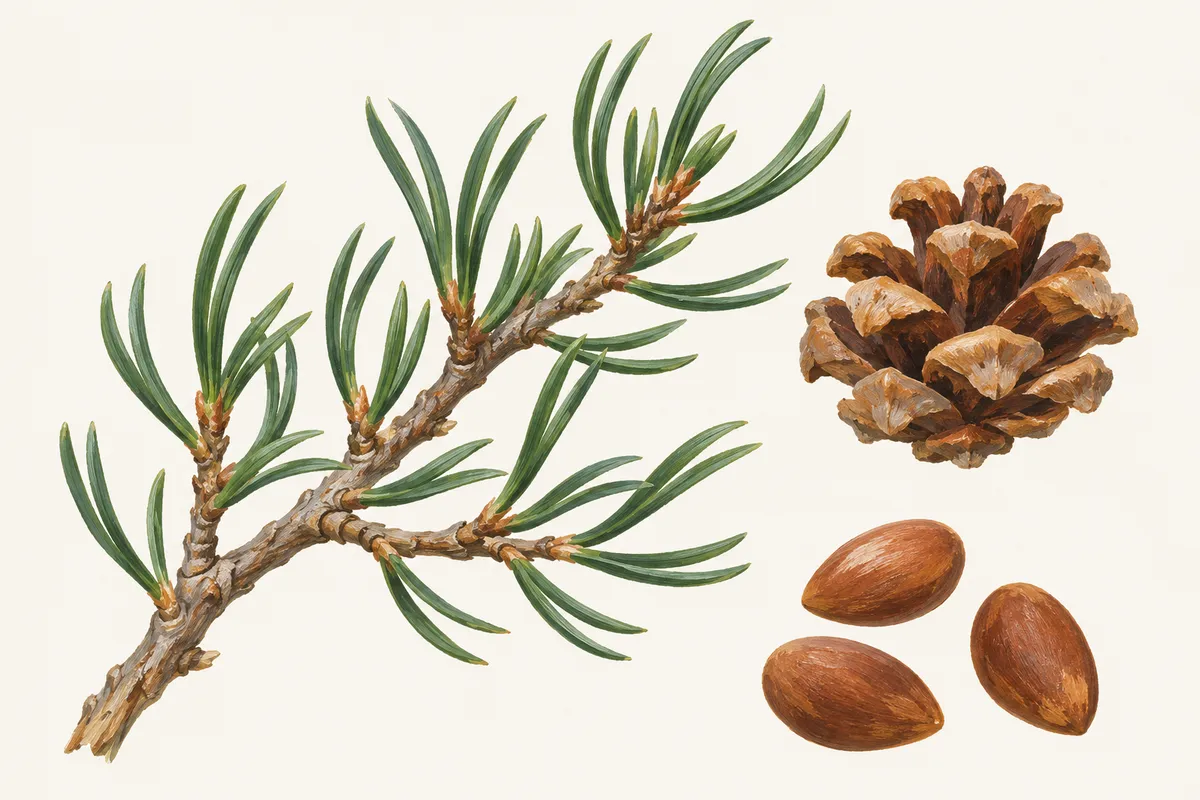
A small, bushy pine of the juniper foothills of the Southwest, with short, stiff needles in pairs and a round cone of a few thick scales that hold large wingless seeds.
In short
Pinyon pine identification rests on three features. The needles grow two per bundle, stiff, curved and only 1 to 2 inches long; the cones are small, rounded and 1 to 2 1/2 inches, with a few very thick scales and no prickles; and the tree is short and bushy, usually under 35 feet, in dry woodlands with juniper. One needle per bundle means singleleaf pinyon instead.
- Count the needles in several bundles: two means two-needle pinyon (Pinus edulis), one means singleleaf pinyon (Pinus monophylla), which replaces it westward in Nevada.
- Pinyon cone scales carry no prickle, and each scale holds large, wingless seeds, the pine nuts behind its other common name, nut pine.
- Pinyon grows between about 4,500 and 8,000 feet, usually mixed with Utah or oneseed juniper.
Field marks at a glance
- Scientific name
- Pinus edulis
- Family
- Pinaceae (pine family)
- Type
- Conifer, evergreen
- Needles
- Usually 2 per bundle, 1 to 2 inches long, coarse, stiff, thick and curved, blue-green or yellow-green (Virginia Tech); they stay on the tree 3 to 9 years (Utah State).
- Cones
- 1 to 2 1/2 inches, egg-shaped to round, reddish brown, on little or no stalk, with few, very thick scales and no prickles.
- Seeds
- Large, about 1/2 inch, thin-shelled and wingless, 10 to 20 per cone; they ripen in early September and the cones open from mid-September (USDA Forest Service).
- Twigs and buds
- Twigs stout, orange to brown, somewhat scraggly; buds small, oval and brown.
- Bark
- Thin, scaly or broken into small plates and ridges, red-brown to gray.
- Form
- Small, spreading, often bushy tree with an irregular rounded crown; mature trees 10 to 51 ft, most under 35 ft (USDA Forest Service); up to about 45 ft (Virginia Tech).
- Range
- The main woodland pine of Arizona, Colorado, New Mexico and Utah, with outlying stands in California, Oklahoma, Texas and Wyoming.
- Elevation
- Mostly 4,500 to 8,000 ft; single trees up to 10,500 ft on south- and west-facing slopes in Arizona (USDA Forest Service).
Pinyon pine (Pinus edulis) is the low, rounded pine that dots the mesas and foothills of the Southwest, almost always with juniper beside it. The USDA Forest Service counts pinyon-juniper woodland in Arizona, Colorado, New Mexico and Utah on about 36.9 million acres. Up close the tree is easy to name: short, stiff needles in pairs and a small, round cone with a few thick scales. The only real trap is its western neighbor, singleleaf pinyon, which you separate by counting needles.
How to identify a pinyon pine
Work through the needles, the cone, then the tree as a whole.
1. Count and feel the needles. Virginia Tech's pinyon pine fact sheet gives needles about 1 to 2 inches long, usually in pairs, coarse, stiff, thick and curved, blue-green or yellow-green. Utah State University Extension's pinyon page adds that they stay on the tree for 3 to 9 years. Count several bundles: pairs mean two-needle pinyon, single needles mean singleleaf pinyon.
2. Pick up a cone. Pinyon cones are small and stubby, 1 to 2 1/2 inches long, oval to round, reddish brown, on little or no stalk (Utah State). The scales are few and very thick, and none ends in a prickle, so the cone is smooth to hold, unlike most western hard pines. Each scale bears large, wingless seeds about 1/2 inch long.
3. Look at the twigs and bark. Twigs are stout and orange to brown, somewhat scraggly (Virginia Tech). The bark is thin, scaly or broken into small ridges and plates, red-brown to gray.
4. Step back. Pinyon is a small, spreading, often bushy tree with an irregular rounded crown. Virginia Tech gives a height up to about 45 feet; the Forest Service says most mature trees stay under 35 feet.
If you photograph a pinyon, include a needle bundle or a cone: Tree Identifier names a tree from one photo, without a confidence score or a list of alternatives, so a clear view of the needles in their bundle is what makes the answer checkable against the counts above.
Two-needle pinyon vs singleleaf pinyon
The two pinyons are close relatives that meet along the eastern Great Basin. The Forest Service's Silvics of North America says singleleaf pinyon replaces two-needle pinyon westward in Nevada and in parts of western Utah and northwestern Arizona, and that the two hybridize naturally in three zones: the eastern edge of the Great Basin, the mountains south of the Colorado Plateau, and along the Colorado River and its main tributaries.
| Trait | Two-needle pinyon (P. edulis) | Singleleaf pinyon (P. monophylla) |
|---|---|---|
| Needles per bundle | 2 (usually) | 1 (occasionally 2 or 3) |
| Needle | 1–2 in, stiff, curved, blue-green or yellow-green | 1–2 in, stout, slightly curved, sharp-tipped, green to gray-green |
| Cone | 1–2 1/2 in, round, few thick scales | 2–3 in, reddish brown, stays on the tree for years |
| Form | Bushy, up to about 45 ft | Up to about 40 ft, often several twisted trunks |
| Main range | Arizona, Colorado, New Mexico, Utah | Nevada, western Utah, northwestern Arizona, California |
Singleleaf figures come from Virginia Tech's singleleaf pinyon fact sheet, which also describes its young bark as smooth and light gray, later furrowed reddish brown with dark gray scaly ridges. A lone single needle among pairs does not make a singleleaf pinyon, and a pair here and there does not rule one out: hybrids exist, so count ten bundles from different branches.
One more name to know: a population in California once treated as a two-needled form of singleleaf pinyon is now recognized by the Forest Service as a separate species, California single-needle pinyon (Pinus californiarum).
Pinyon, juniper and the other pines nearby
Juniper. Utah juniper and oneseed juniper are pinyon's usual companions across most of its range, according to the Forest Service, with redberry, alligator and Rocky Mountain juniper in places. They share its low, bushy shape, so from a distance a slope of pinyon and juniper looks uniform. Up close, junipers have tiny scale leaves pressed along the twig and small, berry-like cones; the juniper page covers the species.
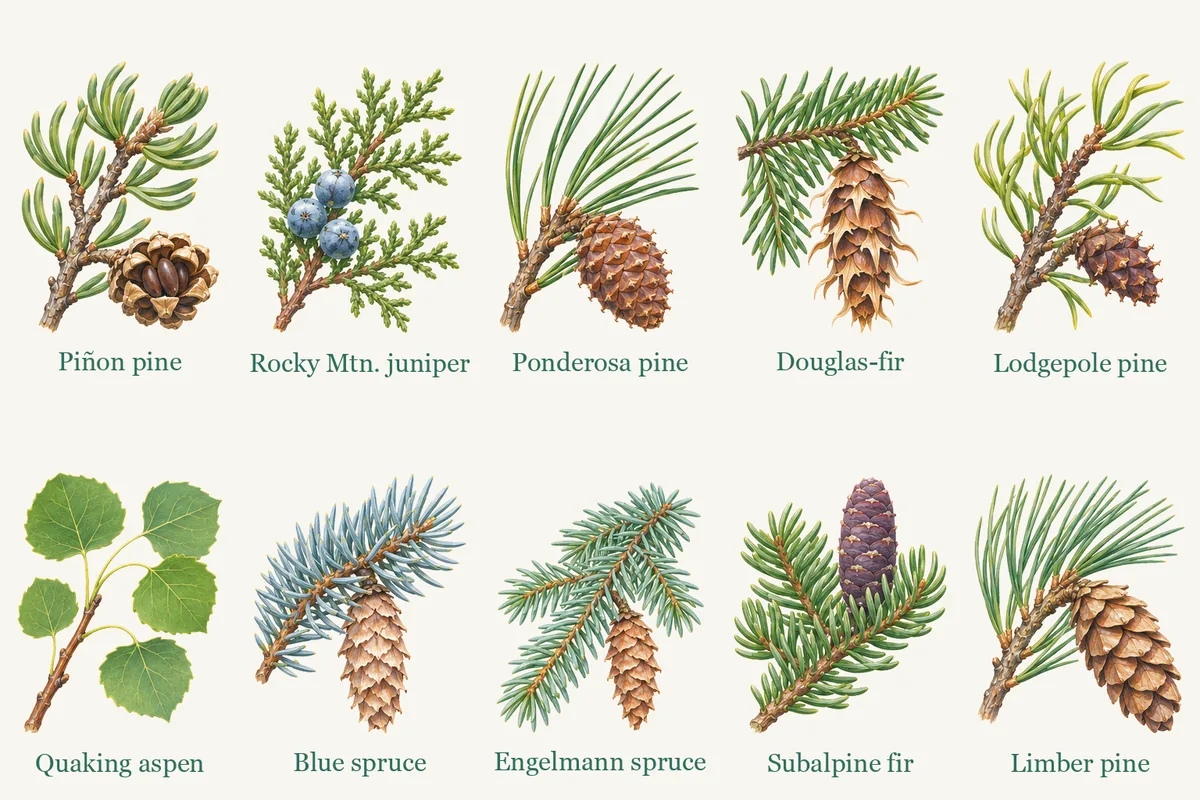
Lodgepole and ponderosa pine. Higher up, the woodland gives way to taller pines. Lodgepole also carries two short needles, but they are twisted, its cones are prickly and often closed, and the tree is tall and slender: see the lodgepole pine page. Ponderosa pine has needles 5 to 10 inches long, usually in threes. The pine identification page lays out all the common US pines by needle count and length, and the Rocky Mountain tree identification guide shows how the forest belts stack by elevation, with pinyon and juniper at the foot.
Where pinyon grows, and how slowly
The Forest Service places most pinyon woodland between 4,500 and 8,000 feet, in bands that shift by state: about 4,500 to 6,500 feet in Arizona, 6,000 to 8,000 in Colorado, and 5,000 to 7,000 in New Mexico and Utah. Single trees climb to 10,500 feet on warm south- and west-facing slopes in Arizona. Utah State notes the tree is shade intolerant and grows on dry sites.
Pinyon is slow and long-lived. Trees begin bearing cones at about 25 years, when they are only 5 to 10 feet tall, and substantial seed production waits until 75 to 100 years. Dominant trees are often about 400 years old, and some reach 800 to 1,000. Mature trees range from 10 to 51 feet; the largest recorded living pinyon, in New Mexico, measured 69 feet tall with a trunk 68 inches across (Forest Service).
The cones need most of three growing seasons to mature. Seeds ripen in early September and the cones open over about 50 days from mid-September, with 10 to 20 seeds in each. Good crops come on average every 4 to 7 years. With location turned on, Tree Identifier's Tree Map pins the tree, a simple way to find the same pinyon again in a good cone year.
Look-alikes and how to tell them apart
Singleleaf pinyon (Pinus monophylla)
Its needles grow one per bundle, occasionally two or three, stout, sharp-tipped and gray-green, 1 to 2 inches long; its cones are larger, 2 to 3 inches. It replaces two-needle pinyon westward in Nevada, western Utah and northwestern Arizona.
Lodgepole pine (Pinus contorta)
Lodgepole also has two short needles, but they are twisted rather than curved, and its cones carry a prickle on each scale and often stay closed. It is a tall, slender tree of higher, cooler mountains, not the bushy pine of the juniper foothills.
Utah juniper (Juniperus osteosperma)
Juniper grows beside pinyon and has the same low, bushy shape, but it has tiny, overlapping scale leaves instead of needles in bundles, and small berry-like cones instead of woody pine cones. Crush a twig: no needle bundle means juniper.
What a photo can't settle
- Two-needle and singleleaf pinyon hybridize in several zones, and a hybrid tree can carry both counts; count at least ten bundles before naming either.
- Pinyon's short, paired needles resemble those of other two-needle pines in a close-up photo; the round, prickle-free cone and the bushy shape are stronger evidence.
- Never eat a seed, nut or cone on the strength of a web page or an app; ask a local expert. This page covers identification, not foraging.
Questions people ask
How do you identify a pinyon pine?
Look for a small, bushy pine in dry foothills with juniper. Its needles grow two per bundle, stiff, curved and 1 to 2 inches long, and its cones are rounded, 1 to 2 1/2 inches, with a few thick scales and no prickles. Singleleaf pinyon looks similar but carries one needle per bundle.
What is the difference between two-needle and singleleaf pinyon?
The needle count. Two-needle pinyon (Pinus edulis) has needles in pairs; singleleaf pinyon (Pinus monophylla) has single needles, occasionally two or three, and somewhat larger cones, 2 to 3 inches. Singleleaf pinyon grows mainly in Nevada, western Utah and northwestern Arizona, and the two hybridize where they meet.
Where does pinyon pine grow?
The USDA Forest Service names it the major pine of woodlands in Arizona, Colorado, New Mexico and Utah, on about 36.9 million acres, with outlying populations in California, Oklahoma, Texas and Wyoming. Most pinyon-juniper woodland lies between 4,500 and 8,000 feet.
How old can a pinyon pine be?
Old for such a small tree. The USDA Forest Service reports that dominant trees are often about 400 years old and that some have been found at 800 to 1,000 years. Trees start bearing cones at about 25 years, and substantial seed crops wait until 75 to 100 years.
When do pinyon pine cones open?
In fall. The Forest Service says the seeds ripen in early September and the cones open over about 50 days from mid-September. Each cone holds about 10 to 20 seeds, and good crops come on average every 4 to 7 years, so many autumns bring few cones.
Sources
- Pinyon pine fact sheet — Virginia Tech Dendrology
- Singleleaf pinyon fact sheet — Virginia Tech Dendrology
- Pinyon (Pinus edulis), Silvics of North America — USDA Forest Service
- Pinyon Pine — Utah State University Extension, Forestry
Keep reading
- Tree profilePines (Pinus): how to identify a pine tree
- Tree profileJuniper trees: how to identify them
- Tree profileLodgepole pine (Pinus contorta): how to identify it
- Regional guideRocky Mountain tree identification, from foothills to treeline
- Field guidePine cone identification: what tree a cone came from