Tree profile
Pondcypress (Taxodium ascendens): how to identify it
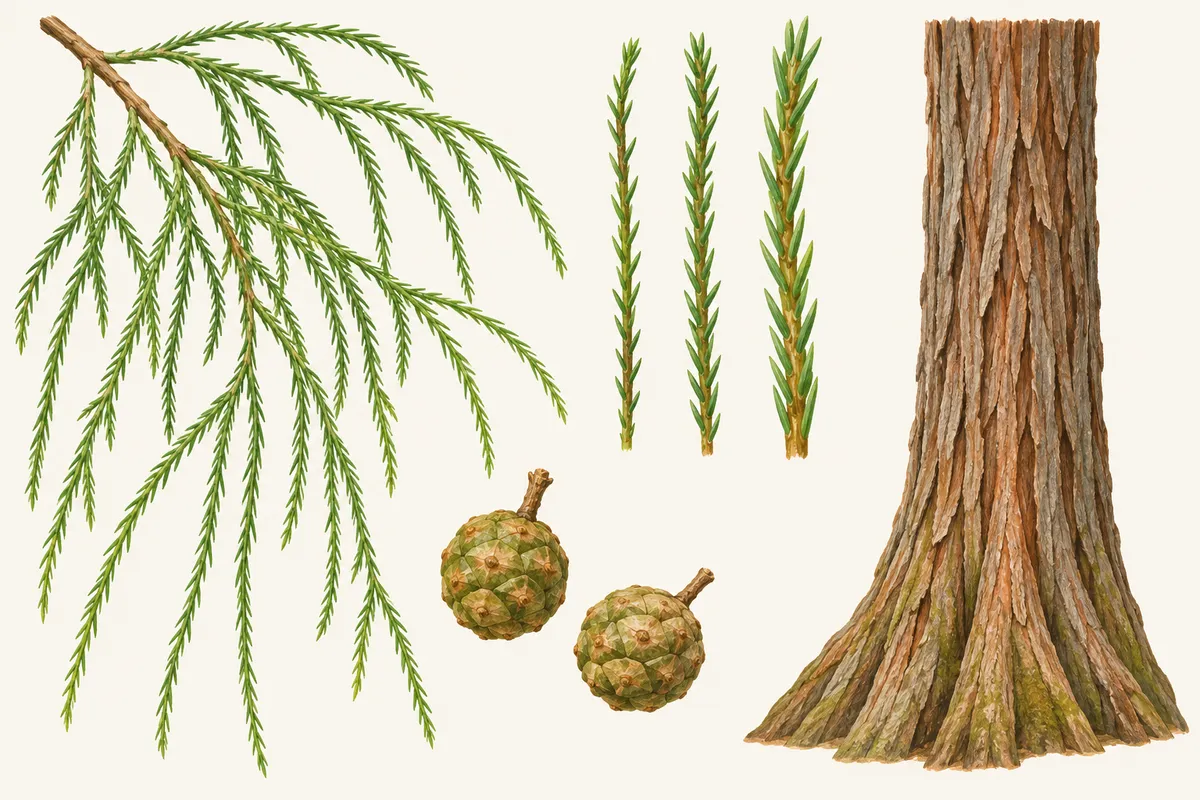
The cypress of still ponds and flatwoods in the Southeast: needles pressed tight to branchlets that point at the sky, a swollen base with rounded ridges, and fewer knees than its river-swamp cousin.
In short
Pondcypress identification starts with the needles: short, awl-like and about 3/8 inch long, pressed close along slender branchlets that grow upward from the branches, unlike the flat, two-row sprays of bald cypress. The cones are nearly round, about 3/4 to 1 inch across. The tree drops its foliage in fall, grows in still ponds and wet flatwoods of the Southeast, and has fewer, shorter, more rounded knees.
- Branchlets that point upward like bristles, with needles hugging them, are the pondcypress mark; bald cypress sprays lie flat like feathers.
- Look at the whole tree: seedlings and fast-growing shoots of pondcypress carry flat, two-ranked needles like bald cypress.
- Habitat helps: pondcypress grows in shallow ponds and wet areas, bald cypress mostly along rivers and streams.
Field marks at a glance
- Scientific name
- Taxodium ascendens (T. distichum var. imbricarium)
- Family
- Cupressaceae (cypress family)
- Type
- Conifer, deciduous
- Needles
- Linear or awl-like, about 3/8 inch long, held close to the twig in several ranks, green to yellow-green (Virginia Tech); NC State describes overlapping scale-like leaves up to 1/3 inch, round in section rather than flat, with a blue-gray bloom.
- Branchlets
- Slender, covered in tightly pressed foliage, and ascending: the small deciduous branchlets grow upward from the branches, more so than on bald cypress.
- Fall
- Foliage turns bright orange (NC State), then the small branchlets drop with their needles; the tree is bare in winter.
- Cones
- Nearly round, about 3/4 to 1 inch across, yellow-green when young and brown when ripe, when the scales separate (Virginia Tech).
- Pollen cones
- Male cones in hanging panicles 3 to 5 inches long; female cones small, near the branch tips.
- Bark
- Fibrous and shredded, red-brown, weathering gray (Virginia Tech); usually more coarsely ridged than bald cypress bark (USDA Forest Service).
- Base and knees
- Often a flared, fluted base with rounded ridges; knees are less common than on bald cypress, shorter and more rounded.
- Size
- Medium-sized and usually smaller than bald cypress: 30 to 70 feet, about 35 feet after 20 years (NC State); pyramidal crown with a clear trunk.
- Range and habitat
- Southeastern Coastal Plain, in shallow ponds and wet areas westward only to southeastern Louisiana; generally not in river or stream swamps (USDA Forest Service).
Pondcypress is the cypress of the still water of the Southeast: shallow ponds and wet areas of the Coastal Plain, rather than the river and stream swamps where bald cypress grows. It is a deciduous conifer that turns orange and drops its foliage every fall, and from a distance it looks like a slimmer bald cypress. Up close, the branchlets give it away, and the setting backs them up.
How to identify a pondcypress
Check these in order. The first two are the strongest; the rest confirm.
1. Needles pressed to the twig. Virginia Tech's pondcypress fact sheet describes leaves that are linear or awl-like, about 3/8 inch long, held close to the twig, green to yellow-green. NC State Extension's pond cypress profile adds that they overlap like scales, are round in section rather than flattened, and carry a blue-gray bloom. A bald cypress needle is flat and stands out from the twig.
2. Branchlets that point up. The small deciduous branchlets of pondcypress grow upward from the branches, so a branch looks like a row of green bristles held vertically. The USDA Forest Service's baldcypress silvics, which covers pondcypress too, calls them more ascending than those of bald cypress. Bald cypress sprays lie flat and horizontal, like feathers.
3. Round cones. The cones are nearly round, about 3/4 to 1 inch across, yellow-green when young and brown when ripe, when the scales come apart (Virginia Tech). They look the same as bald cypress cones, so they confirm the genus, not the species.
4. The base and the knees. Pondcypress often has a flared, fluted base. The Forest Service notes that its ridges tend to be rounded rather than sharp, that it is less likely than bald cypress to have knees, and that its knees are shorter and more rounded.
5. The bark. Fibrous and shredded, red-brown, weathering gray (Virginia Tech). The Forest Service says it is usually more coarsely ridged than bald cypress bark; NC State describes dark red-brown to silver-brown bark with many thin vertical ridges.
Tree Identifier can name the genus from one photo of a branch or the whole tree. For this pair, photograph a branch held against the sky so the angle of the branchlets shows, and compare the result with the steps above: the app gives one name, with no confidence score and no list of look-alikes.
Pondcypress vs bald cypress
The two trees share a genus, a family, round cones, knees and orange fall color. The table puts the field differences side by side; bald cypress figures come from the bald cypress page and the Forest Service.
| Mark | Pondcypress | Bald cypress |
|---|---|---|
| Needles | About 3/8 inch, awl-like, pressed to the twig in several ranks | 1/4 to 3/4 inch, flat, spread in two flat rows |
| Branchlets | Point upward | Horizontal, feather-like sprays |
| Knees | Fewer, shorter, rounded | More common, can be tall |
| Fluted base | Rounded ridges | Sharp ridges |
| Bark | Usually more coarsely ridged | Reddish-brown, peeling in long narrow strips |
| Habitat | Shallow ponds, wet flatwoods | Rivers, streams, floodplains |
| Range west | To southeastern Louisiana | To southeastern Texas and up the Mississippi Valley |
The Forest Service warns that trees are not always typical. Seedlings and fast-growing shoots of pondcypress often carry two-ranked leaves much like bald cypress foliage, and in mixed stands the two can be difficult, sometimes impossible, to separate. Judge a tree by its older, slower shoots, usually in the upper and outer crown, and by its setting.
Names: Taxodium ascendens, var. nutans or var. imbricarium
Three sources, three names for one tree. Virginia Tech and the FIA inventory list it as Taxodium ascendens, a species. The USDA Forest Service treats it as a variety of bald cypress, Taxodium distichum var. nutans, and notes that the name nutans (nodding) comes from a cultivated form with drooping branches. NC State Extension uses Taxodium distichum var. imbricarium and lists T. ascendens as a former name. The Forest Service gives its local names as pondcypress, cypress and black-cypress.
The name matters when you compare a result. A photo app or a field guide that returns "bald cypress" for a tree with upright, pressed-needle branchlets is not necessarily wrong: under the varietal treatment, pondcypress is a bald cypress. Write down both names in your notes.
Where pondcypress grows
The Forest Service places pondcypress in shallow ponds and wet areas of the southeastern Coastal Plain, westward only to southeastern Louisiana, and says it generally does not grow in river or stream swamps. Bald cypress, by contrast, follows rivers from southern Delaware to southern Florida, west along the Gulf to southeastern Texas and up the Mississippi Valley to southern Illinois and southwestern Indiana. A deciduous conifer standing in a shallow pond on the southeastern Coastal Plain is a good pondcypress candidate; one lining a river in Arkansas, west of pondcypress's range, is bald cypress. The Florida tree guide and the Southeast tree guide place both cypresses among their neighbors.
As a planted tree, pondcypress turns up far outside that range: NC State lists it for USDA hardiness zones 5a to 9b and names two cultivars, 'Nutans', a narrow, conical weeping form with drooping branchlets, and 'Prairie Sentinel'.
Size, growth and look-alikes in winter
Virginia Tech describes a medium-sized tree with a pyramidal crown, a clear trunk and often a buttressed base, generally smaller than bald cypress. NC State calls it slow-growing, about 35 feet after 20 years, and gives 30 to 70 feet at maturity. Bark is fibrous, and Virginia Tech notes it is thought to become thicker than bald cypress bark.
In winter, three bare conifers can stand in the same southern landscape. Pondcypress and bald cypress drop their branchlets whole, so pick one up from the ground: needles pressed along it mean pondcypress, a flat two-row comb means bald cypress. Dawn redwood, a planted tree, has opposite branchlets and buds. The dawn redwood page shows that test, and the cypress page explains why the true cypresses, which keep their foliage all year, belong to other genera.
Pondcypress (Taxodium ascendens) is not listed in Tree Identifier's 138-species Collection; bald cypress is. With location turned on, the app's Tree Map pins the find, so you can return in late fall to see the orange color and collect a fallen branchlet.
Look-alikes and how to tell them apart
Bald cypress (Taxodium distichum)
Bald cypress needles are flat, 1/4 to 3/4 inch long, and spread in two flat rows like a feather; pondcypress needles are shorter, pressed against branchlets that point upward. Bald cypress has more and taller knees and sharp ridges on its fluted base, and grows mostly along rivers and streams.
Dawn redwood (Metasequoia glyptostroboides)
Dawn redwood also drops its needles in fall, but its needles and side branchlets grow in opposite pairs and lie flat; pondcypress foliage is alternate and pressed to upright branchlets. Dawn redwood is a planted tree in the United States, not a pond tree of the coastal plain.
What a photo can't settle
- The USDA Forest Service says pondcypress and bald cypress are often difficult and sometimes impossible to tell apart, because seedlings and fast-growing pondcypress shoots carry flat, two-ranked needles like bald cypress.
- Sources do not agree on the name: a photo app may return bald cypress (Taxodium distichum) for a pondcypress, which is correct at the species level under the USDA treatment.
- In winter the tree is bare, and a photo of the trunk alone rarely separates the two cypresses; look for fallen branchlets or old cones under the tree.
Questions people ask
Is pondcypress a separate species from bald cypress?
Botanists disagree. Virginia Tech lists it as Taxodium ascendens, the USDA Forest Service treats it as a variety of bald cypress (var. nutans), and NC State Extension calls it Taxodium distichum var. imbricarium. All three describe the same tree of southeastern ponds with short needles pressed to upright branchlets.
Does pondcypress have knees?
Often, but fewer than bald cypress. The USDA Forest Service says pondcypress is less likely to have knees, and that its knees are shorter and more rounded. NC State describes knobby, conical knees rising from the ground or water around the roots.
Is pondcypress evergreen?
No. Like bald cypress it is a deciduous conifer: the needles turn bright orange in fall, according to NC State Extension, and the small branchlets drop with them, leaving the tree bare until spring.
Where does pondcypress grow?
On the southeastern Coastal Plain. The USDA Forest Service places it in shallow ponds and wet areas, reaching west only to southeastern Louisiana, and says it generally does not grow in river or stream swamps, where bald cypress dominates. It is also planted well outside that range.
Sources
- Baldcypress (Taxodium distichum), Silvics of North America — USDA Forest Service
- Pondcypress fact sheet — Virginia Tech Dendrology
- Taxodium distichum var. imbricarium (pond cypress) — North Carolina Extension Gardener Plant Toolbox, NC State University
Keep reading
- Tree profileBald cypress (Taxodium distichum): how to identify it
- Tree profileDawn redwood (Metasequoia glyptostroboides): how to identify it
- Regional guideFlorida tree identification, from the Panhandle to the Keys
- Regional guideSouthern tree identification for the Southeast US
- Tree profileCypress: how to identify a cypress tree