Tree profile
Red alder (Alnus rubra): how to identify the Pacific Northwest's commonest hardwood
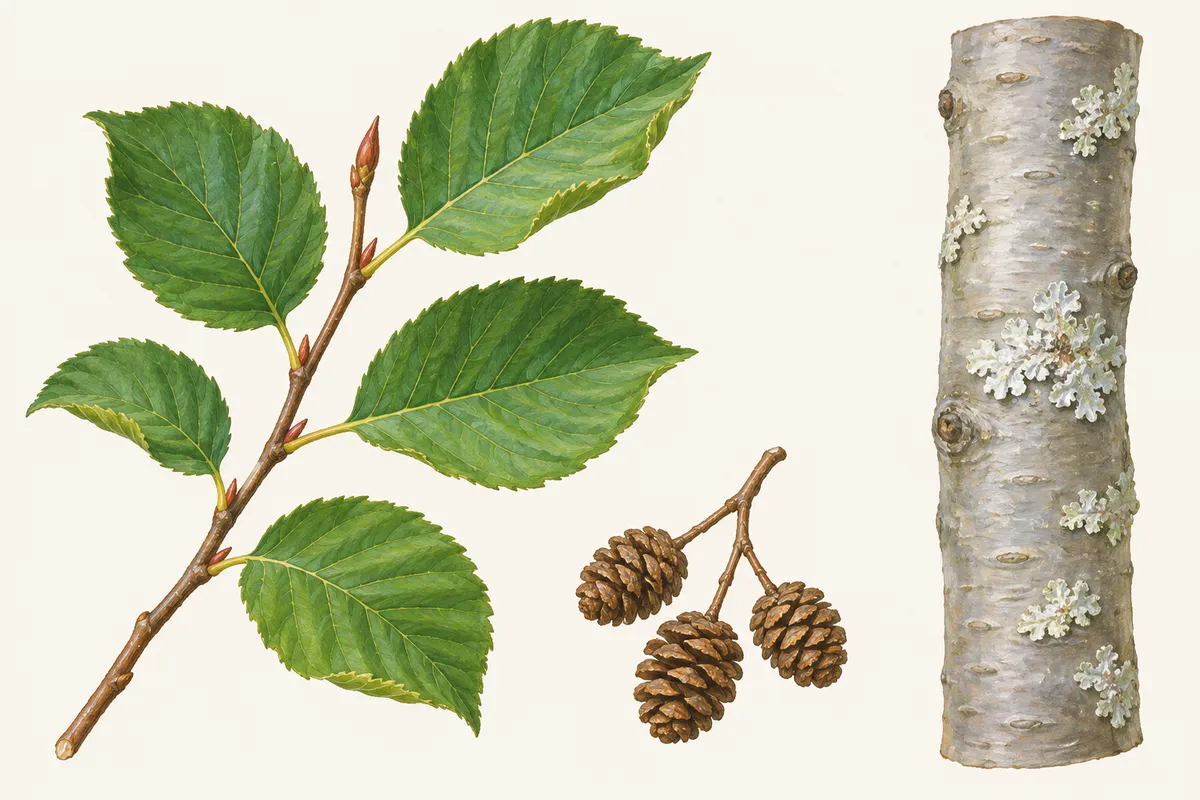
Pale, lichen-blotched trunks along a coastal creek, small woody cones on the twigs all winter, and a leaf edge that curls under when you run a finger along it: that is red alder.
In short
Red alder identification starts with the leaf edge: the leaves are oval, 7 to 13 cm long, coarsely double-toothed, grayish beneath, with the margin clearly rolled under. The bark is smooth, light gray and often nearly white with lichens, and turns red where it is cut. Small woody cones, 1.5 to 2.5 cm long, hang on the twigs through winter, and the tree grows within about 125 miles of the Pacific.
- Run a finger along the leaf edge: red alder's is rolled under, white alder's lies flat.
- The name comes from the inner bark, which is orange-red, so wounds and cut wood turn red.
- It is a coastal tree: usually within 125 miles (200 km) of the ocean and below 2,400 feet, from southeast Alaska to southern California.
Field marks at a glance
- Scientific name
- Alnus rubra
- Family
- Betulaceae (birch family)
- Type
- Broadleaf, deciduous
- Leaves
- Alternate, oval to rhombic, tapering at both ends, 7 to 13 cm (about 3 to 5 in) long, with 8 to 15 pairs of straight veins; dull dark green above, grayish beneath with hairy veins.
- Leaf edge
- Coarsely double-toothed, the largest teeth almost lobe-sized, and clearly rolled under (revolute).
- Bark
- Smooth, light gray, often nearly white with lichens; with age it breaks into irregular flat plates. The inner bark is orange-red, so wounds turn red.
- Buds
- Stalked, with 2 or 3 hairy scales meeting at their edges.
- Twigs
- Moderately stout, purplish brown, often triangular in cross-section, with prominent lenticels.
- Catkins
- Male catkins about 3 cm in winter, lengthening to 10 to 15 cm and reddish brown at pollination in late winter or early spring; female catkins 5 to 12 mm, in small clusters below them.
- Cones
- Woody, barrel-shaped, 12 to 25 mm long, short-stalked, abundant; seed shed from late fall into winter.
- Size
- Usually 40 to 50 ft (12 to 15 m); 100 to 130 ft (30 to 40 m) on favorable sites; to 25 m in Canada.
- Range
- Pacific Coast from southeast Alaska to southern California, mostly within 125 miles of the ocean and below 2,400 ft; isolated stands in northern Idaho.
Red alder is the pale-trunked broadleaf of the Pacific Northwest's creeks, road cuts and logged slopes. The USDA Forest Service calls it the most common hardwood in the region, and it is often the first tree back after a disturbance, growing fast in full sun on bare mineral soil. It is easy to recognize as an alder by its woody cones. Telling it from the other western alders takes one touch test on the leaf.
How to identify a red alder
1. Feel the leaf edge. Red alder leaves are oval to rhombic, tapering at both ends, 7 to 13 cm long with 8 to 15 pairs of veins. The edge is coarsely double-toothed, and Natural Resources Canada describes it as clearly rolled under. Oregon State University uses the botanical word, revolute. Run a finger along the margin: you feel a thin rim curled toward the underside. This is the single best field mark.
2. Turn the leaf over. The upper surface is dull dark green; the underside is grayish, with hairs along the veins. Natural Resources Canada notes the fine veinlets between the main veins run like the rungs of a ladder.
3. Look at the bark. Smooth and light gray, usually almost white with crusty lichens, sometimes shallowly furrowed, separating into irregular flat plates on old trees. Scrape or cut it and the orange-red inner bark shows; Oregon State says wounds turn red, which is where the name comes from.
4. Find the cones and buds. Woody, barrel-shaped cones 12 to 25 mm long hang on short stalks, and stay on the twigs into winter while they shed their seed. The buds stand on a short stalk with 2 or 3 hairy scales, and Oregon State notes the twigs are often distinctly triangular in cross-section.
5. Check where you are. The USDA Forest Service's Silvics of North America places red alder usually within 125 miles (200 km) of the ocean and below 2,400 feet (750 m), seldom east of the Cascade Range or the Sierra Nevada.
If the leaves are out of reach, a photo of the bark and a fallen cone is enough for Tree Identifier to suggest a name. The app gives one answer with no confidence score and no list of look-alikes, so confirm an alder result with the rolled-edge test, which a photo seldom shows.
Catkins, cones and seed
Red alder is monoecious: male and female catkins grow on the same tree, on the previous year's twigs. The Forest Service gives flowering in late winter or early spring. Male catkins, about 3 cm long through winter, lengthen to 10 to 15 cm at pollination and turn reddish brown, hanging in small clusters at the shoot tips; the female catkins are small, upright and reddish green, in clusters just below.
The female catkins ripen into the woody cones (strobili). Oregon State gives 12 to 25 mm for mature cones, Natural Resources Canada 15 to 25 mm, and the Forest Service 11 to 32 mm long. Each scale releases pairs of tiny winged nuts. Seed dispersal begins in late September in the middle of the range, and most seed falls in late fall and winter; the tree produces moderate crops almost every year and heavy crops every 3 to 5 years. Our guide to trees with catkins compares alder catkins with those of birch, hazel and willow.
Where red alder grows and how big it gets
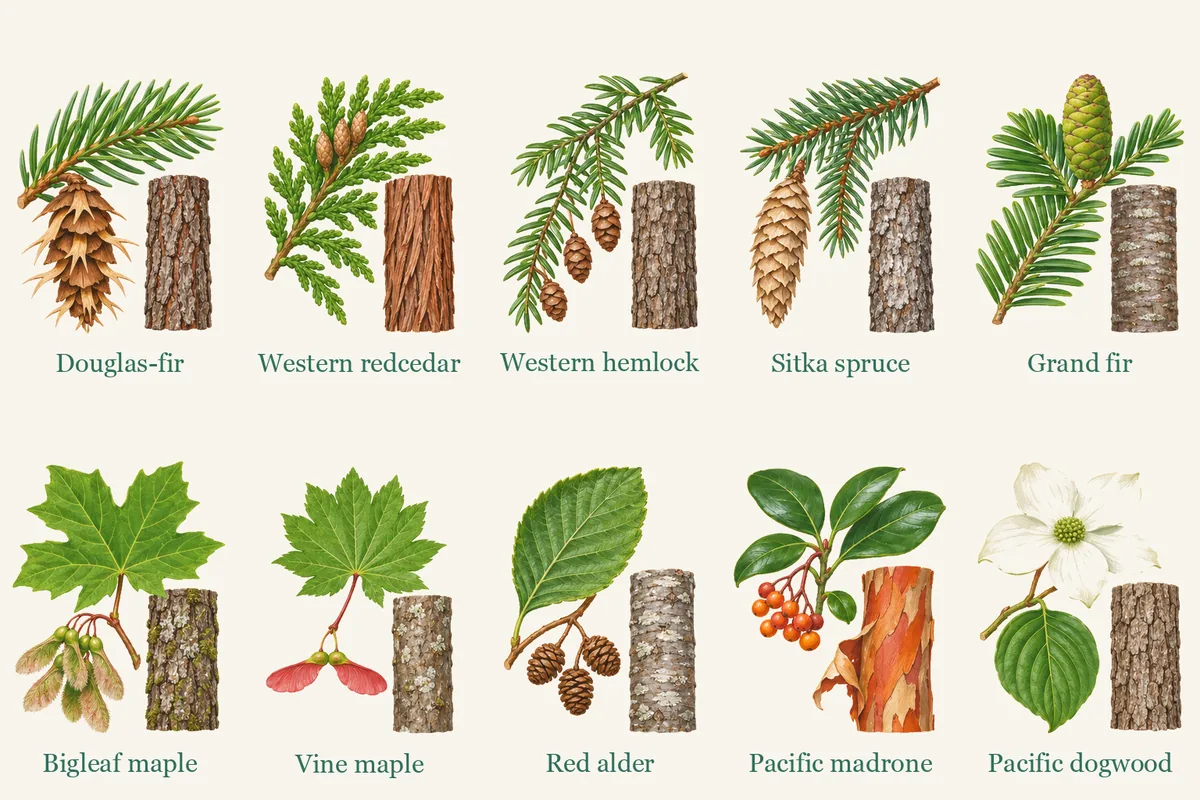
The Forest Service gives the range as southern California (34°N) to southeastern Alaska (60°N), with isolated populations in northern Idaho. Natural Resources Canada describes a narrow band within 150 km of the coast in British Columbia. It tolerates poor drainage and seasonal flooding and forms pure stands on stream bottoms and lower slopes, mixed with Douglas-fir, western hemlock, western redcedar, grand fir, Sitka spruce, black cottonwood and bigleaf maple, over vine maple, salmonberry and salal.
Oregon State gives a usual height of 40 to 50 feet, with record trees over 100 feet. On favorable sites the Forest Service reports 100 to 130 feet and trunks 22 to 30 inches across, with a record diameter of 78 inches. Growth is fast: about 30 feet at 5 years and 52 feet at 10 on good sites. The tree matures at 60 to 70 years and seldom passes 100. In a dense stand, red alders prune themselves well, leaving long, clean, slightly tapered trunks and narrow, dome-shaped crowns; open-grown trees have a broad conical crown reaching to the ground (Natural Resources Canada).
For the other trees of the region, see Pacific Northwest tree identification.
Red alder vs white alder and Sitka alder
| Alder | Leaf | Leaf edge | Buds | Habit and place |
|---|---|---|---|---|
| Red alder | Oval to rhombic, 7–13 cm, dull dark green, grayish beneath | Coarsely double-toothed, rolled under | Stalked, 2–3 hairy scales | Tree; coast, below 2,400 ft |
| White alder | Elliptic to rhombic, 6–10 cm, glossy above, yellow-green beneath | Singly or doubly toothed, wavy, flat | Slender, dark red, finely hairy, about 13 mm | Tree, often multi-trunked; streams inland and through California |
| Sitka alder | Broadly oval, 7–15 cm, shiny yellowish green, resinous when young | Sharp, gland-tipped double teeth, none near the stalk | Stalkless, 3–5 scales, purplish brown | Shrub or small tree to 15 m; cool, moist mountain sites |
Sources: Oregon State's white alder page and Natural Resources Canada's Sitka alder factsheet.
White alder shares red alder's range from southern British Columbia into Oregon and runs on through California. Oregon State says the summer leaf is the main way to separate them and that no known twig character works in winter. Mature white alder bark becomes plated and reddish brown, while red alder stays pale. Sitka alder is the one with buds sitting directly on the twig, a quick winter test in the mountains.
The alder page adds speckled alder of the North and East and the European black alder planted in parts of the United States, and sets alders beside birch and hazel.
Nitrogen, disturbance and where to look
Red alder roots carry nodules formed with Frankia actinomycetes, which fix nitrogen from the air. The Forest Service reports up to 290 pounds per acre (320 kg/ha) a year in pure stands and 120 pounds per acre in mixed stands, and calls red alder the only commercial tree species west of the Rocky Mountains that fixes nitrogen.
For identification, this tells you where to look. Red alder is an intolerant pioneer: it needs full sun and does best on disturbed mineral soil (Forest Service), and Natural Resources Canada notes that it does not tolerate shade. Expect it along creeks and on open, disturbed ground such as road cuts, landslides and logged slopes, not deep under a closed canopy. Young stumps sprout vigorously; older trees rarely do.
Red alder is not one of the 138 species in Tree Identifier's Collection, though a photo still returns a name; the Collection's common alder is the European Alnus glutinosa. With location turned on, the app's Tree Map pins each identification, which helps when you want to return in late winter to see the red-brown catkins open.
Look-alikes and how to tell them apart
White alder (Alnus rhombifolia)
Oregon State University says summer leaves are the main way to tell them apart: white alder's edge is finely or doubly toothed but not rolled under, and its leaf is glossy above and yellow-green below. White alder is the inland and California alder, along streams and lower mountain slopes.
Sitka alder (Alnus viridis subsp. sinuata)
Sitka alder is a shrub or small tree up to 15 m with buds that sit directly on the twig, not on a stalk, and thin, shiny yellowish-green leaves that are resinous and fragrant when young, with sharp, gland-tipped double teeth. It grows on cool, moist mountain sites and slide paths.
What a photo can't settle
- In winter, no known twig character reliably separates red from white alder, according to Oregon State University; where they overlap, wait for summer leaves.
- The rolled leaf edge is a touch test; a photo taken from above may not show it, so turn the leaf and photograph the edge or check it by hand.
- A rare cut-leaf form (Alnus rubra var. pinnatisecta) grows in a few spots in British Columbia, Washington and Oregon, and its deeply cut leaves look unlike a typical red alder.
Questions people ask
Why is it called red alder when the bark is white?
For the inner bark and wood. Oregon State University notes that the inner bark is orange-red, so wounds turn red, and Natural Resources Canada says the same. The outer bark is light gray, often almost white because of the lichens that cover it.
How do you tell red alder from white alder?
Feel the leaf edge in summer. Oregon State University says red alder's margin is rolled under and white alder's is not; it also notes that no known twig character reliably separates them in winter. Range helps too: the two overlap little, and red alder stays close to the coast.
Does red alder really fix nitrogen?
Yes. The USDA Forest Service says its root nodules, formed with Frankia actinomycetes, fix up to 290 pounds of nitrogen per acre a year in pure stands, and calls it the only commercial tree species west of the Rockies that does so.
How long does red alder live?
Not long. The Forest Service says it matures at about 60 to 70 years and its maximum age is usually about 100 years; Natural Resources Canada gives a maximum of about 75 years.
Sources
- Red Alder (Alnus rubra), Silvics of North America — USDA Forest Service
- Alnus rubra (red alder) — Oregon State University, Landscape Plants
- Red alder (Alnus rubra) — Natural Resources Canada, Trees, insects and diseases of Canada's forests
- Alnus rhombifolia (white alder) — Oregon State University, Landscape Plants
- Sitka alder (Alnus viridis ssp. sinuata) — Natural Resources Canada, Trees, insects and diseases of Canada's forests
Keep reading
- Tree profileAlder (Alnus): how to identify it
- Regional guideTrees of the Pacific Northwest, by region
- Clue guideWhich tree has catkins? Check the month, the leaf and what comes after
- Tree profileBirches (Betula): how to identify a birch tree
- Tree profileDouglas-fir (Pseudotsuga menziesii): how to identify it