Tree profile
Redbay (Persea borbonia): how to identify it
Crush a leaf: a glossy evergreen of the southeastern coast that smells like a kitchen bay leaf is a redbay or one of its close kin, and since 2002 many of them stand dead with brown leaves still attached.
In short
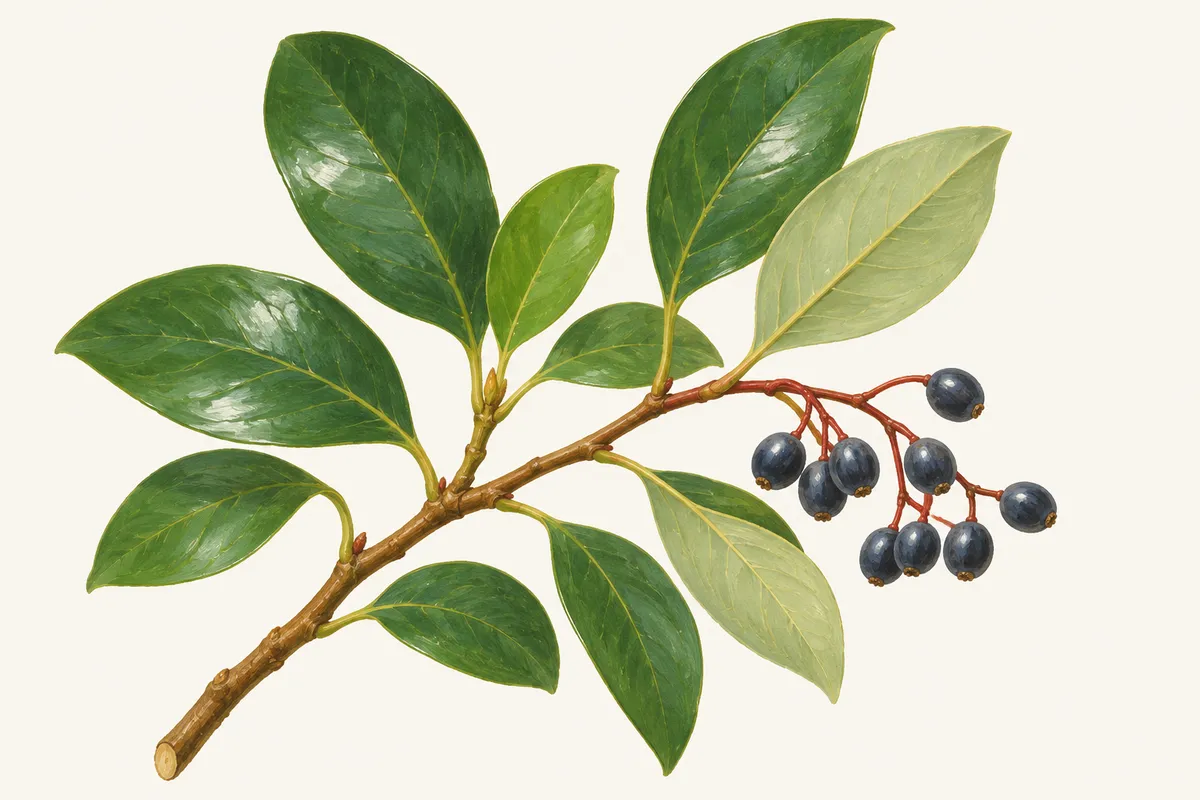
Redbay tree identification starts with the nose: the evergreen, smooth-edged leaves, 3 to 7 inches long and lance-shaped, give a spicy smell when crushed. They are dark green above and pale beneath, never white. Small dark blue fruits about 1/2 inch long ripen in early fall, and the reddish brown bark has irregular furrows and flat-topped ridges. Redbay grows on the southeastern Coastal Plain.
- Spicy smell plus a pale green, not white, leaf underside separates redbay from sweetbay magnolia.
- Swamp bay is its closest twin: its hairs under the leaf stand up, while redbay's lie flat.
- Laurel wilt, spread by an Asian ambrosia beetle, has killed an estimated 300 million redbays since the early 2000s (USDA Forest Service study).
Field marks at a glance
- Scientific name
- Persea borbonia
- Family
- Lauraceae (laurel family)
- Type
- Broadleaf, evergreen
- Leaves
- Alternate, simple, lance-shaped to elliptic, 3 to 7 inches long, smooth edges, dark green above and pale green below; spicy odor when crushed.
- Leaf hairs
- Tiny hairs on the underside lie flat against the leaf (swamp bay's stand up); they can wear off on old leaves.
- Flowers
- Small, light yellow-green, in small clusters in the leaf axils, in late spring and early summer.
- Fruit
- Dark blue to blue-black drupe, 1/3 to 1/2 inch, with a thin layer of dry flesh around one seed; ripens in early fall.
- Bark
- Reddish brown, quite thick, with irregular furrows and flat-topped ridges.
- Twigs
- Moderately stout, green, angled or ridged, with brownish hairs; buds short and covered in rusty hairs.
- Size
- Large shrub or tree of 30 to 40 feet (Virginia Tech); NC State and the USDA Forest Service cite trees up to 60 to 70 feet.
- Range
- Southern Delaware south through Florida and west to the lower Texas Gulf Coast; also the Bahamas.
Redbay is an evergreen of the southeastern coast that most people notice by smell. Crush one of its glossy leaves and it gives off the spicy scent of a kitchen bay leaf, though the tree is not the bay laurel of cooking. It belongs to the laurel family, alongside sassafras and avocado. It shares its swamps and dunes with two other trees called "bay", sweetbay magnolia and loblolly-bay, and since 2002 it has been one of the hardest-hit trees in North America, killed in vast numbers by laurel wilt.
How to identify a redbay
Work through these checks; the leaf smell and underside settle most cases.
1. Leaves: lance-shaped, smooth-edged and spicy. Virginia Tech Dendrology describes alternate, simple, lance-shaped evergreen leaves 3 to 7 inches long, dark green above and pale green below, with a spicy odor when crushed. NC State Extension adds that a few leaves turn yellow or red and drop during the season, so a scattering of colored leaves on an evergreen is normal.
2. Underside: pale green, not white. This separates redbay from sweetbay magnolia, whose leaf undersides are chalky white. Under a hand lens, redbay's tiny hairs lie flat against the leaf.
3. Fruit: small and dark blue. Virginia Tech describes a dark blue, round drupe 1/3 to 1/2 inch across, maturing in early fall. The USDA Forest Service gives about 1/2 inch (13 mm), bright blue or blue-black when ripe, with a thin layer of dry flesh around the seed.
4. Bark: red-brown with flat ridges. Both Virginia Tech and NC State describe reddish brown bark broken by irregular furrows into flat-topped ridges.
5. Twigs: green with rusty buds. Twigs are moderately stout, green, angled or ridged and covered with brownish hairs; the short buds wear rusty hairs.
Tree Identifier can name a redbay from a photo of a leaf, the fruit or the bark, and the follow-up chat can answer questions about laurel wilt symptoms. It shows one name and no confidence score, so add the crushed-leaf test before you trust it.
Redbay, swamp bay and silk bay
Redbay has close relatives that look almost the same. The UNF Botanical Garden in Jacksonville separates swamp bay (Persea palustris) from upland redbay by the hairs on the lower leaf surface: tiny upright hairs on swamp bay, hairs lying flat on redbay. Swamp bay grows in swamps and along waterways, redbay on sites from dry to moist. The Texas Invasive Species Institute lists a third, silk bay, as a variety of redbay. Because the hairs wear off older leaves, many trees can only be called "redbay or swamp bay"; field guides and apps also differ on whether these are species or varieties.
The other trees called bay are easier. Sweetbay magnolia has chalky white leaf undersides, creamy flowers and red seeds; our sweetbay magnolia page covers it. Loblolly-bay has finely toothed leaves and white, 5-petaled flowers in midsummer. Southern magnolia's leaves are thicker and larger, often rusty beneath, and its flowers are huge.
Laurel wilt: why so many redbays are dead
Laurel wilt is a disease of the laurel family caused by the fungus Raffaelea lauricola, carried into the wood by a tiny Asian beetle, the redbay ambrosia beetle (Xyleborus glabratus). The Texas Invasive Species Institute gives the history: the beetle, about 2 mm long, is native to India, Japan, Myanmar and Taiwan, probably arrived in solid wood packing such as crates or pallets, and was first found in 2002 in a survey trap near Port Wentworth, Georgia. It reached Texas by 2015, with a first detection in Hardin County.
The scale of the loss is hard to overstate. A USDA Forest Service study by Hughes and colleagues, using Forest Inventory and Analysis data, estimated that over 300 million redbays had died since the early 2000s, about one third of the population before the invasion. Genetic tests pointed to a single introduction. NC State notes that the beetle has almost wiped out redbay in parts of its range.
What to look for, from the Texas Invasive Species Institute:
- foliage that discolors and wilts, often while the leaves stay attached to the dead tree;
- dark staining in the sapwood under the bark;
- thin, noodle-like strings of sawdust where beetles bore into the trunk.
Infected trees can die within weeks or months. The same disease hits swamp bay, silk bay, sassafras and avocado, plus pondberry, camphor tree and pondspice. The Institute advises against moving firewood or wood chips from infested trees. A dead redbay with brown leaves hanging on is a strong sign, but only a laboratory confirms laurel wilt; our tree disease identification guide lists who to call in the US: an arborist, a state extension plant disease clinic or the state forestry agency.
Where redbay grows
The Forest Service maps redbay from southern Delaware south through Florida and west to the lower Texas Gulf Coast, and in the Bahamas. It grows on swamp margins and in swampy drains of the lower Coastal Plain, in rich, moist, mucky soils; NC State adds dunes, hammocks, maritime forests and sandy barrier islands, and calls it highly salt-tolerant. Along the Atlantic coast, pocosin plants are sometimes only shrubs.
Height figures vary. Virginia Tech describes a large shrub or small tree 30 to 40 feet tall; NC State gives 30 to 70 feet, and the Forest Service cites estimates up to 60 to 70 feet with trunks 2 to 3 feet across.
In spring, small light yellow-green flowers appear in clusters in the leaf axils of the new growth, pollinated mainly by bees. The fruit follows in early fall, and the Forest Service notes that redbay fruits every year. The UNF Botanical Garden notes that the caterpillars of the Palamedes swallowtail feed on redbay and its relative sassafras. When you find a living redbay, Tree Identifier's Tree Map pins it if location is on, so you can check on it again next season.
Look-alikes and how to tell them apart
Swamp bay (Persea palustris)
Swamp bay is nearly identical and grows in wetter ground. Look at the leaf underside with a hand lens: swamp bay's tiny hairs stand upright, while redbay's lie flat against the leaf, as the UNF Botanical Garden describes.
Sweetbay magnolia (Magnolia virginiana)
Sweetbay leaves are chalky silvery white beneath and have no spicy smell; its creamy flowers are 2 to 3 inches across and its fruit is a cone-like cluster with red seeds. Redbay leaves are pale green beneath and its fruit is a small dark blue drupe.
Loblolly-bay (Gordonia lasianthus)
Loblolly-bay leaves have finely toothed edges and no spicy smell, and it bears white 5-petaled flowers 2 to 3 inches across in midsummer, then woody 5-parted capsules. Redbay leaves are smooth-edged and its flowers are tiny and yellow-green.
Southern magnolia (Magnolia grandiflora)
Southern magnolia leaves are larger, thick and often rusty brown beneath, with huge white flowers and a cone-like fruit with red seeds. A redbay leaf is thinner, smells spicy when crushed and the tree bears small dark blue fruit.
What a photo can't settle
- Redbay and swamp bay are told apart by microscopic leaf hairs that a photo rarely shows; a photo app may name either one.
- Some botanists treat swamp bay and silk bay as varieties of Persea borbonia, others as species, so names differ between field guides and apps.
- A dead tree with hanging brown leaves suggests laurel wilt, but only a laboratory test confirms the disease; report suspected cases to your state forestry agency.
Questions people ask
Is redbay the same as bay leaf?
No. The kitchen bay leaf comes from bay laurel, Laurus nobilis, a Mediterranean tree. Redbay is a different member of the same laurel family, native to the southeastern US. Its leaves smell similarly spicy when crushed, which is why the name bay is shared.
How do I tell redbay from swamp bay?
Use a hand lens on the leaf underside. The UNF Botanical Garden describes tiny upright hairs on swamp bay and hairs lying flat on redbay. Swamp bay favors swamps and waterways, redbay drier to moist ground. On old leaves that have lost their hairs, the two can be impossible to separate.
What is killing the redbay trees?
Laurel wilt, a disease caused by the fungus Raffaelea lauricola, which the redbay ambrosia beetle carries into the wood. The beetle was first found in 2002 near Port Wentworth, Georgia. A USDA Forest Service study estimated in 2017 that over 300 million redbays had died since the early 2000s, about a third of the population.
Is redbay related to avocado?
Yes. Both are in the genus Persea of the laurel family; avocado is Persea americana. The Texas Invasive Species Institute lists avocado among the hosts of laurel wilt, along with redbay, swamp bay, silk bay and sassafras.
Sources
- Redbay (Persea borbonia), Silvics of North America — USDA Forest Service
- Redbay (Persea borbonia) fact sheet — Virginia Tech Dendrology
- Tamala borbonia (redbay) — North Carolina Extension Gardener Plant Toolbox, NC State University
- Persea palustris, swamp red bay — UNF Botanical Garden, University of North Florida
- No rest for the laurels: symbiotic invaders cause unprecedented damage to southern USA forests (Hughes et al., 2017) — USDA Forest Service, Treesearch
- Redbay ambrosia beetle (Xyleborus glabratus) — Texas Invasive Species Institute, Sam Houston State University
Keep reading
- Tree profileSweetbay magnolia (Magnolia virginiana): how to identify it
- Tree profileSassafras (Sassafras albidum): how to identify it
- Tree profileSouthern magnolia (Magnolia grandiflora): how to identify it
- Tree healthTree disease identification, symptom by symptom
- Tree profileLive oak (Quercus virginiana): how to identify it