Tree profile
Southern magnolia (Magnolia grandiflora): how to identify it
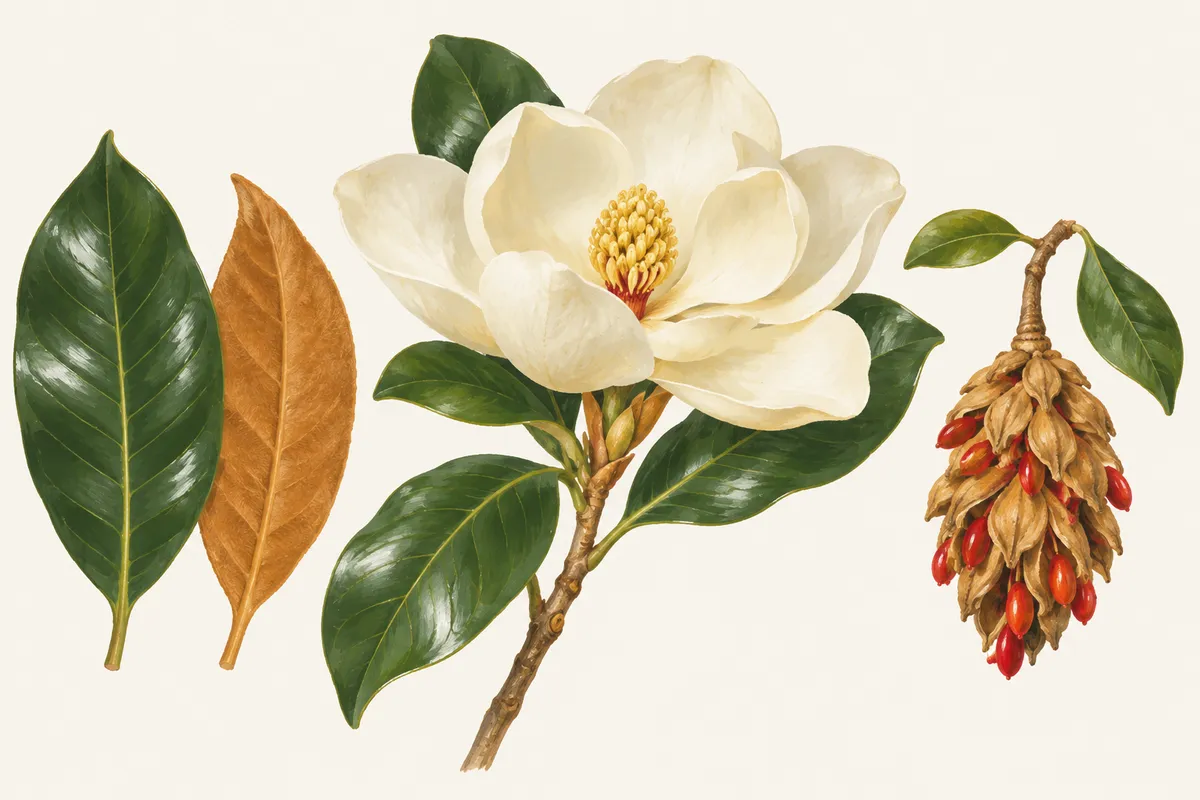
Turn a leaf over: rusty brown felt under a glossy, leathery evergreen blade is the first check. The plate-sized white flowers and the cone of red seeds confirm it.
In short
Southern magnolia identification starts with the leaf: evergreen, thick and leathery, 5 to 10 inches long, glossy dark green above and covered in rusty brown felt beneath. In late spring and early summer it bears creamy white, fragrant flowers 6 to 12 inches across. In fall a fuzzy, cone-like fruit 3 to 5 inches long splits to hang bright red seeds on threads.
- Rusty felt under an evergreen magnolia leaf means southern magnolia; a chalky white underside means sweetbay.
- The terminal bud is 1 to 1 1/2 inches long and silky with white to rusty hairs, visible all winter.
- Southern magnolia sheds old leaves in both fall and spring, so leaf litter under it does not mean it is deciduous.
Field marks at a glance
- Scientific name
- Magnolia grandiflora
- Family
- Magnoliaceae (magnolia family)
- Type
- Broadleaf, evergreen
- Leaves
- Alternate, simple, oval to elliptic, 5 to 10 inches long, smooth-edged, very thick and leathery, glossy dark green above, rusty brown and fuzzy beneath.
- Flowers
- Single, cup-shaped, creamy white, fragrant, 6 to 8 inches across (Virginia Tech) or 8 to 12 inches (NC State), with 6 to 12 petals; April to June, a few into summer or fall.
- Fruit
- Cone-like cluster of follicles 3 to 5 inches long, rusty-hairy, green turning red then brown; in September to October it splits and bright red seeds about 1/2 inch hang on threads.
- Buds and twigs
- Twigs stout, white to rusty hairy; terminal bud 1 to 1 1/2 inches, silky white to rusty red.
- Bark
- Thin, brown to gray; smooth or dotted with lenticels when young, later in close plates or scales.
- Form
- Pyramidal crown; open-grown trees dense, with low branches that may reach the ground.
- Size
- 60 to 80 ft and 2 to 3 ft across on good sites; heights of 100 to 125 ft are reported in Florida.
- Native range
- Coastal Plain from eastern North Carolina south to central Florida, west through southern Georgia, Alabama and Mississippi and Louisiana to southeast Texas; mostly below 200 ft elevation.
Southern magnolia is the evergreen magnolia of the Deep South, with leaves like polished leather and white flowers the size of a dinner plate. The USDA Forest Service lists other names for it: evergreen magnolia, bull-bay, big-laurel and large-flower magnolia. It is planted far outside its native Coastal Plain, so you meet it on lawns from the Mid-Atlantic to California. In every season one feature gives it away: the rusty brown felt on the underside of the leaf.
How to identify a southern magnolia in four checks
1. Turn a leaf over. Southern magnolia leaves are alternate, simple, smooth-edged, oval to elliptic and evergreen. The NC State Plant Toolbox gives them 5 to 10 inches long, glossy dark green above and pale green to gray-brown beneath, covered in rusty brown, fuzzy hairs. Virginia Tech calls them "very thick almost plastic-like". The rust underneath is the fastest check: few other trees combine a leaf this big, this stiff and this brown below.
2. Look for the big bud. At the tip of each twig sits a terminal bud 1 to 1 1/2 inches long, silky with white to rusty red hairs. The twigs themselves are stout and hairy. These buds are there all winter.
3. The flower. From late spring into summer the tree carries single, cup-shaped, creamy white flowers, strongly fragrant. Sources give different sizes: Virginia Tech's southern magnolia fact sheet says 6 to 8 inches wide, NC State 8 to 12 inches with 6 to 12 petals. The USDA Forest Service gives a flowering season of April through June; NC State adds sparse blooms through summer. Our guide to trees with white flowers lists the other white-flowered trees of the same months.
4. The cone and its red seeds. The fruit is a cone-like cluster of follicles, 3 to 5 inches long, rusty-hairy, green at first, then red and finally brown. In September and October it splits open and bright red seeds, about 1/2 inch long, hang out on slender threads. The empty brown cones stay on the tree or litter the ground into winter.
Southern magnolia is in the 138-species Collection of Tree Identifier, and a photo of a leaf turned to show its underside is usually enough for the app to name it. The app shows one name with no confidence score, so look at the underside yourself: rusty means southern magnolia, chalky white means sweetbay.
Bark, shape and size
The bark is thin, brown to gray, smooth or dotted with lenticels on young trees, and breaks into close plates or scales with age. It is not a strong clue on its own, so use it with the leaves.
The shape is more useful. Virginia Tech describes a pyramidal crown that is dense with low branches when the tree grows in the open, and NC State notes that the lower branches can reach the ground. A big yard magnolia is often a dark green pyramid skirted to the lawn, with a carpet of brown leaves and cones underneath.
On good sites the USDA Forest Service's Silvics of North America reports trees about 60 to 80 feet tall and 24 to 36 inches in diameter at 80 to 120 years old, and records of 100 to 125 feet in Florida. NC State gives 60 to 80 feet with a trunk about 3 feet across. Planted trees are usually smaller.
Southern magnolia vs sweetbay and great rhododendron
Sweetbay magnolia is the native look-alike that grows in the same Coastal Plain swamps. The NC State sweetbay profile gives leaves 3 to 5 inches long, chalky silvery white beneath, evergreen to semi-evergreen in the South and deciduous in colder areas. Its creamy flowers are only 2 to 3 inches across and the red-seeded fruit is up to 2 inches long. The tree is usually 10 to 35 feet tall. A white underside settles it, and the sweetbay magnolia page covers the tree in full.
Great rhododendron is the look-alike Virginia Tech names for southern magnolia, and it fools people because its leathery leaves also carry rusty hairs beneath. NC State's great rhododendron profile describes a shrub or small tree of 10 to 20 feet with leaves 4 to 8 inches long, rose-purplish to pink or white flowers, often spotted, from June to August, and an oblong seed capsule instead of a cone. It is a plant of the southern Appalachians, not the Coastal Plain. NC State reports it as poisonous to people (grayanotoxins) and lists it as a problem for cats, dogs and horses.
| Feature | Southern magnolia | Sweetbay | Great rhododendron |
|---|---|---|---|
| Leaf length | 5–10 in | 3–5 in | 4–8 in |
| Leaf underside | Rusty brown felt | Chalky silvery white | Rusty hairs |
| Flower | Creamy white, 6–12 in, single | Creamy white, 2–3 in | Rose-purple to white, clustered |
| Fruit | Fuzzy cone 3–5 in, red seeds | Cone up to 2 in, red seeds | Oblong capsule |
| Height | 60–80 ft | 10–35 ft | 10–20 ft |
The deciduous magnolias, saucer, star, cucumber and bigleaf, drop their leaves in fall and are covered on the magnolia page.
Where southern magnolia grows wild
The Forest Service maps the native range along the Coastal Plain from eastern North Carolina south along the Atlantic coast to the Peace River in central Florida, then west through much of southern Georgia, Alabama and Mississippi, across Louisiana into southeast Texas. It is most common in Louisiana, Mississippi and Texas, and most of the range lies below 200 feet in elevation.
In the wild it grows best on rich, moist, well-drained soils along streams and near swamps, and on uplands where fire is rare, but it cannot stand prolonged flooding. It rarely forms pure stands: look for it with beech, sweetgum, yellow-poplar, southern red oak, white oak and mockernut and pignut hickories, over an understory of flowering dogwood and beautyberry. It is shade tolerant when young and can reproduce under a closed canopy. The Southeast tree identification guide places it among the region's other trees.
Planted cultivars
Most southern magnolias in yards are named cultivars, and they still carry the species marks. NC State lists several:
- 'Little Gem': semi-dwarf, but can reach 30 feet.
- 'Bracken's Brown Beauty': compact, smaller leaves, winter hardy to zone 6.
- 'Kay Parris': semi-dwarf, 19 to 30 feet.
- 'Hasse': columnar, 25 to 40 feet tall and 6 to 12 feet wide.
- 'Teddy Bear': semi-dwarf, with rounded leaves NC State compares to teddy bear ears.
NC State lists the species as hardy in USDA zones 6a to 10b, and notes that the leaves drop in both fall and spring as old ones are replaced. A brown cone of red seeds or a rusty leaf underside is the same on all of them; only nursery records name the cultivar. With location turned on, Tree Identifier's Tree Map pins each identification, which helps if you want to come back in September for the seeds.
Look-alikes and how to tell them apart
Sweetbay magnolia (Magnolia virginiana)
Leaves smaller, 3 to 5 inches, thinner, and chalky silvery-white beneath rather than rusty. Flowers only 2 to 3 inches across; fruit up to 2 inches. Evergreen in the South, deciduous in colder areas, and usually 10 to 35 feet tall.
Great rhododendron (Rhododendron maximum)
A shrub or small tree of 10 to 20 feet in Appalachian woods with leathery leaves 4 to 8 inches long and rusty hairs beneath. Its flowers are rose-purplish to white, often spotted, in summer clusters, and its fruit is an oblong capsule, not a cone with red seeds.
Saucer magnolia (Magnolia × soulangeana)
Deciduous: thinner leaves that fall in autumn, and pink-and-white flowers on bare branches in late winter or early spring, before the leaves. Southern magnolia blooms white among evergreen leaves in late spring and summer.
What a photo can't settle
- Cultivars vary in leaf size and in how rusty the underside is; 'Bracken's Brown Beauty' and 'Teddy Bear' are selected for it. A photo names the species, not the cultivar.
- Southern magnolia has been crossed with sweetbay (USDA Forest Service), and a hybrid can show a pale underside with some rusty hairs.
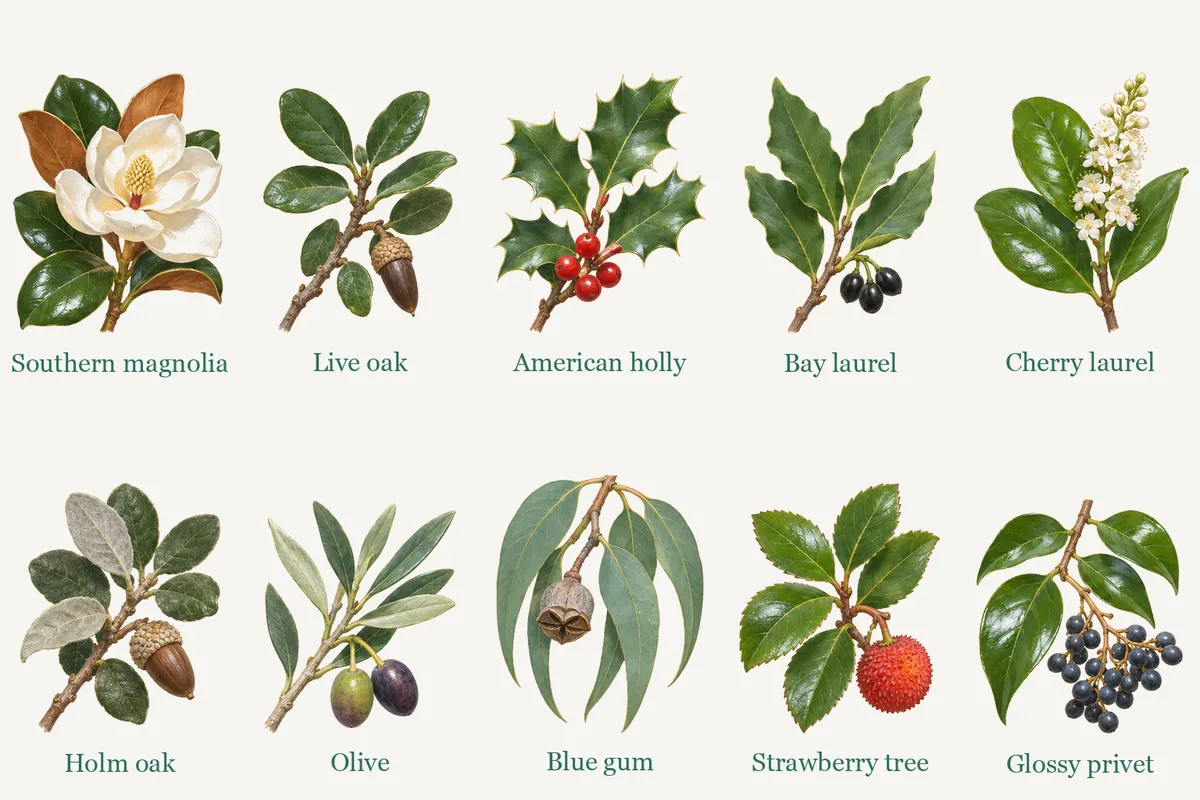
- A young southern magnolia out of flower can look like other glossy evergreens in a single leaf photo; include the leaf underside or a bud.
Questions people ask
How do you tell a southern magnolia from other magnolias?
Southern magnolia is the evergreen one with thick, glossy leaves 5 to 10 inches long and rusty felt beneath. Sweetbay is also evergreen in the South but its leaves are chalky white beneath. Saucer, star and cucumber magnolias drop their leaves in fall.
When does southern magnolia bloom?
The USDA Forest Service gives April through June. NC State describes the main bloom in May and June with sparse flowers through summer, and Virginia Tech notes an occasional few in fall. Each flower is solitary at a branch tip.
Why is my southern magnolia dropping leaves?
Some drop is normal. NC State notes that southern magnolia leaves fall in both fall and spring, as old leaves are replaced, so a carpet of brown, leathery leaves under an otherwise green tree is expected.
What is the red stuff on a magnolia cone?
Seeds. The cone-like fruit, 3 to 5 inches long, opens in September and October, and each follicle releases a bright red seed about 1/2 inch long that hangs for a while on a silky thread before falling. Birds and mammals spread most of them, according to the USDA Forest Service.
Is 'Little Gem' a southern magnolia?
Yes. 'Little Gem' is a semi-dwarf cultivar of Magnolia grandiflora, which NC State says can still reach 30 feet. It shares the species' leathery evergreen leaves and red-seeded cones.
Sources
- Southern Magnolia (Magnolia grandiflora), Silvics of North America — USDA Forest Service
- Southern magnolia fact sheet — Virginia Tech Dendrology
- Magnolia grandiflora (southern magnolia) — North Carolina Extension Gardener Plant Toolbox, NC State University
- Magnolia virginiana (sweetbay magnolia) — North Carolina Extension Gardener Plant Toolbox, NC State University
- Rhododendron maximum (great rhododendron) — North Carolina Extension Gardener Plant Toolbox, NC State University