Tree profile
Sweetbay magnolia (Magnolia virginiana): how to identify it
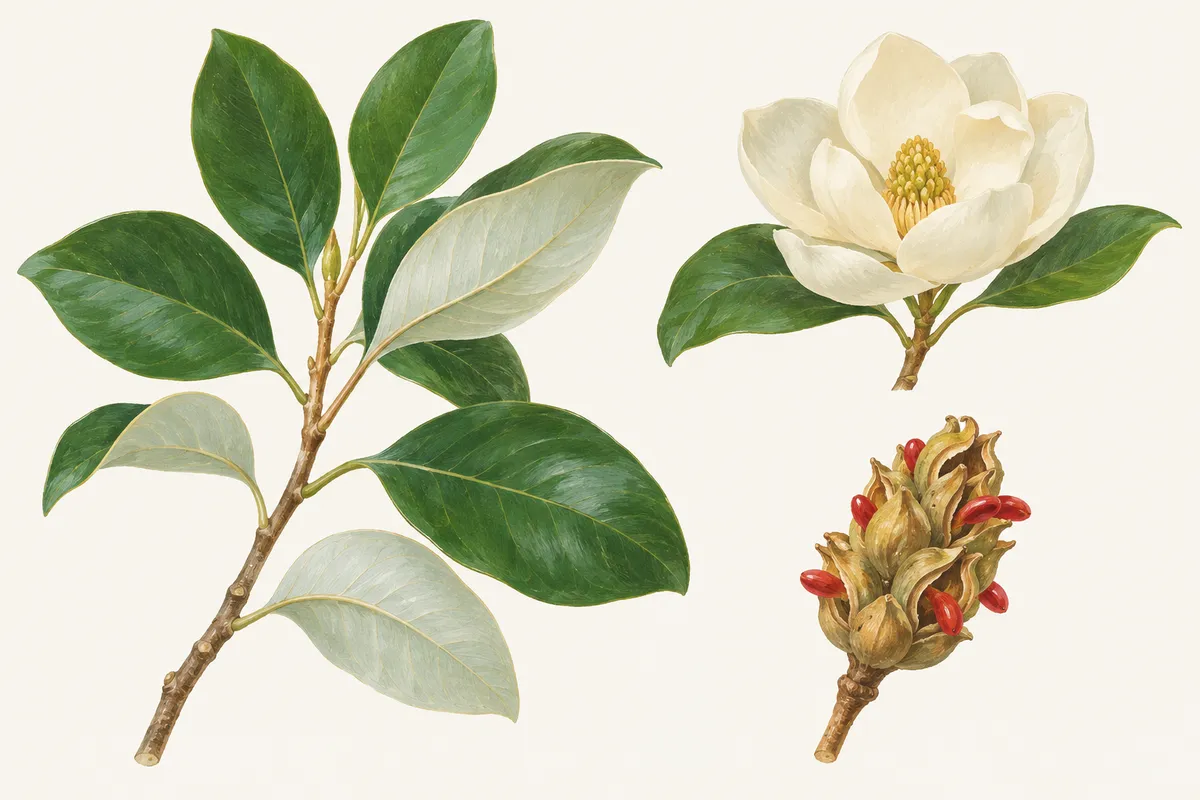
Turn a leaf over: a silvery white underside on a smooth-edged, glossy leaf in a southern swamp is the sweetbay's signature, long before its small creamy flowers open.
In short
Sweetbay magnolia identification starts under the leaf: the narrow, smooth-edged leaves, 3 to 5 inches long, are shiny dark green above and chalky silvery white beneath. Creamy white, lemon-scented flowers 2 to 3 inches across open from late spring into summer, and the cone-like fruit, about 2 inches long, releases scarlet seeds that hang on silky threads. The bark is smooth and gray.
- A silvery white leaf underside separates sweetbay from redbay, loblolly-bay and southern magnolia, which share its swamps.
- It keeps its leaves in the Deep South and drops them in colder areas, so leaf habit alone can mislead.
- In the north of its range it is often a multi-stemmed shrub; in Florida it can be a tree near 100 feet.
Field marks at a glance
- Scientific name
- Magnolia virginiana
- Family
- Magnoliaceae (magnolia family)
- Type
- Broadleaf, semi-evergreen
- Leaves
- Alternate, simple, narrow elliptic, 3 to 5 inches long, smooth edges, shiny dark green above and chalky silvery white beneath; clustered near the branch ends.
- Leaf habit
- Evergreen to semi-evergreen in the southern US, deciduous in colder climates (NC State Extension).
- Flowers
- Creamy white, cup-shaped, 2 to 3 inches across, 9 to 12 petals, mild lemony scent; borne singly at branch tips from April into July.
- Fruit
- Cone-like cluster of follicles about 2 inches long, pink to red ripening to reddish brown; scarlet seeds hang on fine silky threads in late summer and fall.
- Bark
- Smooth, thin, reddish brown to gray, often mottled.
- Twigs and buds
- Pale green and fuzzy; stipule scars ring the twig; buds about 1/2 inch with fuzzy silvery gray scales.
- Size
- Usually 10 to 35 feet and often multi-stemmed; in the South a tree of 50 to 100 feet (record 91 feet in Florida).
- Range
- Atlantic and Gulf Coastal Plains from Long Island to southern Florida, west to eastern Texas, north into southern Arkansas and southwest Tennessee.
- Habitat
- Wet, acidic, poorly drained soils of coastal swamps, bays and lowlands, usually below 200 feet elevation.
Three trees in southeastern swamps go by the name "bay": sweetbay, redbay and loblolly-bay. The USDA Forest Service notes that they are routinely confused, and all three have glossy, oval evergreen leaves. Sweetbay is the magnolia of the three, and one move settles it: turn a leaf over. If the underside is silvery white, as if dusted with chalk, you are looking at Magnolia virginiana. The flowers, the fruit and the twig confirm it.
How to identify a sweetbay magnolia
Check these in order; the first one decides most cases.
1. Leaf underside: chalky silvery white. Virginia Tech Dendrology describes alternate, simple, narrow elliptical leaves 3 to 5 inches long with smooth edges, shiny dark green above and silvery white below. The USDA Forest Service says sweetbay is "readily distinguished" from redbay and loblolly-bay by the white hairs on the lower leaf surface.
2. Flowers: small, creamy and lemony. The flowers are creamy white, cup-shaped and 2 to 3 inches across, with 9 to 12 petals and a mild lemon scent (Virginia Tech). They open one at a time at the branch tips over several weeks, from April into July according to the Forest Service. The NC State Extension profile notes that each flower opens in the afternoon, closes at night and lasts two or three days, with scattered blooms until frost.
3. Fruit: a small cone with red seeds on threads. After flowering comes a cone-like cluster of follicles about 2 inches long, pink to red, ripening to reddish brown. When the follicles open in late summer and fall, scarlet seeds dangle on fine silky threads. No redbay or loblolly-bay does this.
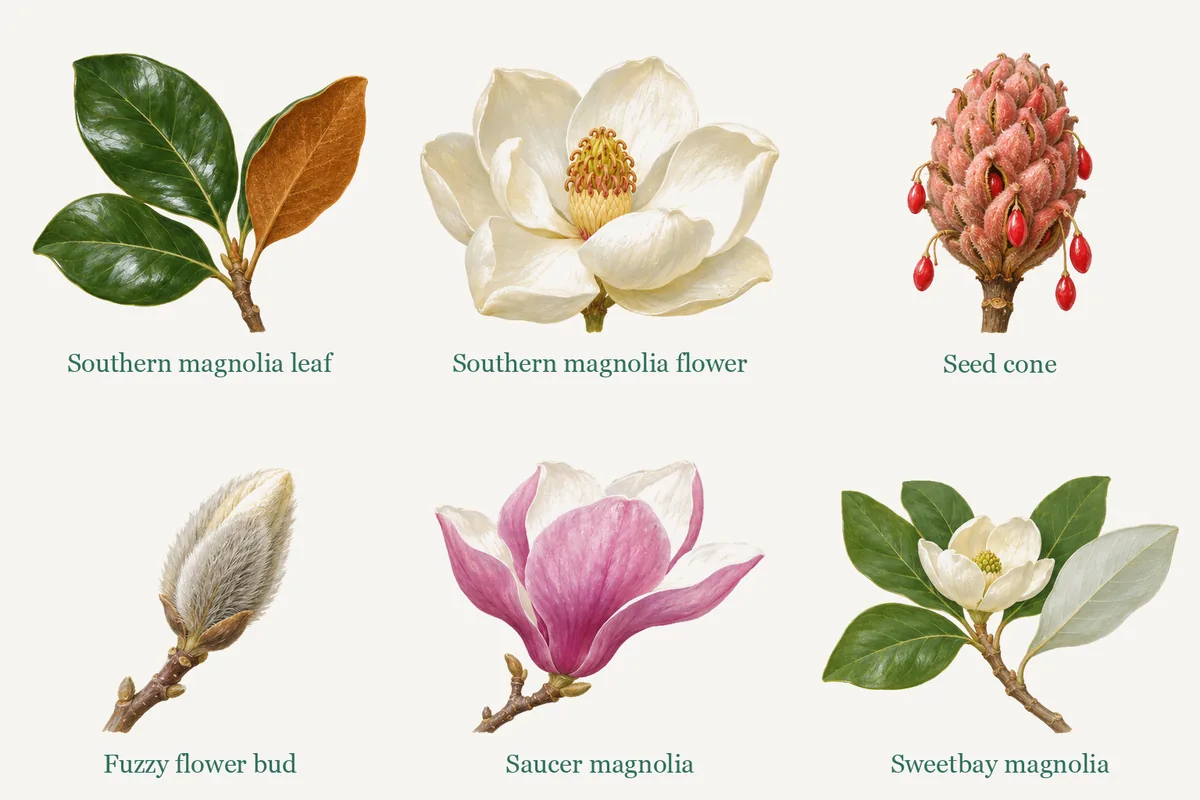
4. Twig: a ring around every bud. Like all magnolias, sweetbay has stipule scars that circle the twig at each leaf. Virginia Tech describes pale green, fuzzy twigs and buds about 1/2 inch long with fuzzy silvery gray scales. In winter, this ring separates a leafless northern sweetbay from almost any shrub around it.
5. Bark: smooth and gray. The bark is thin and smooth, reddish brown to gray and often mottled. It never breaks into the furrows and flat ridges of an old redbay.
A photo of a leaf turned over is the strongest single picture for Tree Identifier, which names the tree from one image of a leaf, a flower, the fruit or the bark. The app gives one name without a confidence score or a list of alternatives, so look at the underside yourself before you accept it.
Sweetbay vs southern magnolia, redbay and loblolly-bay
| Tree | Leaf underside | Leaf edge and length | Flower | Fruit |
|---|---|---|---|---|
| Sweetbay | Chalky silvery white | Smooth, 3–5 in | Creamy, 2–3 in, spring to summer | Cone-like, 2 in, red seeds |
| Southern magnolia | Rusty brown felt | Smooth, 5–10 in, thick | White, 8–12 in | Cone-like, larger, red seeds |
| Redbay | Pale green | Smooth, 3–7 in, spicy smell | Tiny, yellow-green, in clusters | Dark blue drupe, 1/3–1/2 in |
| Loblolly-bay | Pale and dull | Finely toothed, 3–6 in | White, 5 petals, 2–3 in, midsummer | Woody 5-part capsule |
The figures for redbay and loblolly-bay come from Virginia Tech's redbay and loblolly-bay fact sheets. Loblolly-bay is the closest match in flower, because both have white flowers 2 to 3 inches across, but its leaf edge is finely toothed and its flowers have 5 petals. Redbay is the closest match in leaf; crush a leaf and it smells spicy, like a kitchen bay leaf. Our redbay page covers it, and the laurel wilt disease that has killed so many of them.
Southern magnolia is the sweetbay's big cousin. The southern magnolia page shows the rusty underside and the dinner-plate flowers; a garden tree with a pale underside and a few rusty hairs can be a hybrid of the two.
Where sweetbay grows
The Forest Service maps sweetbay along the Atlantic and Gulf Coastal Plains, from Long Island south to southern Florida, west to eastern Texas, and north into southern Arkansas and southwest Tennessee; isolated trees in eastern Massachusetts may come from old plantings. It is most abundant in Alabama, Georgia, Florida and South Carolina.
Its home is wet: acidic, poorly drained soils in coastal swamps, bays and lowlands that flood in winter or in wet seasons, usually below 200 feet of elevation. Oddly, the Forest Service notes it is not usually found in major river bottoms. Its main forest type is sweetbay, swamp tupelo and redbay, with red maple, black gum and loblolly-bay among its common neighbors. If you are standing in a blackwater swamp and see red maple, tupelo and a glossy evergreen with white undersides, sweetbay is the likely answer.
Size, form and seasons
Sweetbay changes shape with latitude. In the north of its range the Forest Service describes it as mainly a shrub, often 2 to 5 feet tall; NC State gives a typical 10 to 35 feet for planted and wild trees, often multi-stemmed and suckering. In the South it becomes a real tree, 50 to 100 feet tall with a straight trunk and a narrow, round-topped crown. The record listed by the Forest Service, in Florida, is 91 feet tall and 50 inches in diameter.
Through the year:
- Spring: new leaves and the first flowers, with the lemon scent strongest in warm afternoons.
- Summer: scattered flowers continue; green fruit clusters swell.
- Late summer to fall: fruit turns pink to red, then reddish brown, and red seeds hang on threads; birds take them quickly.
- Winter: leaves stay on southern trees; northern trees are bare twigs with ringed nodes and silvery buds.
Sweetbay is also planted in yards, as a tree or a multi-stemmed shrub for moist, acidic soil (NC State). NC State lists it as a larval host for the spicebush swallowtail and eastern tiger swallowtail butterflies. Most garden sweetbays are the same species, so the same leaf underside test works in a yard as in a swamp.
For other trees in flower, our guide to trees with white flowers sets sweetbay beside dogwood, serviceberry, southern magnolia and others. And if you find one, with location turned on, Tree Identifier's Tree Map pins it, so you can come back in late summer to see the red seeds.
Look-alikes and how to tell them apart
Southern magnolia (Magnolia grandiflora)
Southern magnolia leaves are larger, 5 to 10 inches, thick, and coated with rusty brown felt beneath, and its flowers reach 8 to 12 inches across. Sweetbay leaves are thinner and chalky white beneath, with flowers only 2 to 3 inches across.
Redbay (Persea borbonia)
Redbay leaves are pale green beneath, not silvery white, and smell spicy when crushed. Its fruit is a dark blue drupe 1/3 to 1/2 inch across, not a cone-like cluster with red seeds, and its bark breaks into furrows with flat-topped ridges.
Loblolly-bay (Gordonia lasianthus)
Loblolly-bay leaves have finely toothed edges and are pale and dull beneath. Its white flowers have 5 petals and open in midsummer, and the fruit is a woody, 5-parted capsule on a long stalk.
What a photo can't settle
- From above, a sweetbay leaf is a plain glossy oval like many swamp evergreens; a photo needs to show the underside to be convincing.
- Sweetbay has been crossed with umbrella magnolia (the garden hybrid Magnolia x thompsoniana, USDA Forest Service) and with southern magnolia, and a hybrid can show mixed traits that a photo app will not sort out.
- Leaf habit changes with latitude, so an evergreen or a leafless sweetbay can both be normal.
Questions people ask
Is sweetbay magnolia evergreen?
It depends on the climate. NC State Extension describes sweetbay as evergreen to semi-evergreen in the southern US and deciduous in colder climates. A sweetbay in Florida keeps its leaves through winter; one in New Jersey usually drops most of them.
How big does a sweetbay magnolia get?
NC State gives 10 to 35 feet for a typical tree, often multi-stemmed. The USDA Forest Service describes trees of 50 to 100 feet in the South, with a record of 91 feet and 50 inches in diameter in Florida, while in the north of its range it is mostly a shrub.
What is the difference between sweetbay and redbay?
They are not related. Sweetbay is a magnolia with chalky white leaf undersides, creamy flowers and a cone-like fruit with red seeds. Redbay is a laurel with pale green undersides, a spicy smell when its leaves are crushed, tiny yellow-green flowers and dark blue fruit.
Why are the seeds of a sweetbay red and hanging?
The fruit is an aggregate of small follicles. When each one splits in late summer or fall, its scarlet seed, 1/4 to 1/2 inch long, drops out and hangs on a fine silky thread, as the USDA Forest Service describes. Birds and small mammals eat the seeds.
Sources
- Sweetbay (Magnolia virginiana), Silvics of North America — USDA Forest Service
- Magnolia virginiana (sweetbay magnolia) — North Carolina Extension Gardener Plant Toolbox, NC State University
- Sweetbay magnolia (Magnolia virginiana) fact sheet — Virginia Tech Dendrology
- Loblolly bay (Gordonia lasianthus) fact sheet — Virginia Tech Dendrology
- Redbay (Persea borbonia) fact sheet — Virginia Tech Dendrology
Keep reading
- Tree profileMagnolia tree identification: southern magnolia and its relatives
- Tree profileSouthern magnolia (Magnolia grandiflora): how to identify it
- Tree profileRedbay (Persea borbonia): how to identify it
- Clue guideWhich tree has white flowers? Start with the month
- Tree profileBlack gum tree (Nyssa sylvatica): black tupelo, sour gum, pepperidge