Tree profile
Rocky Mountain juniper (Juniperus scopulorum): how to identify it
The most widespread juniper of the West, from British Columbia to New Mexico. Scales, a blue berry with a white bloom, and a cone crop of two ages on one tree.
In short
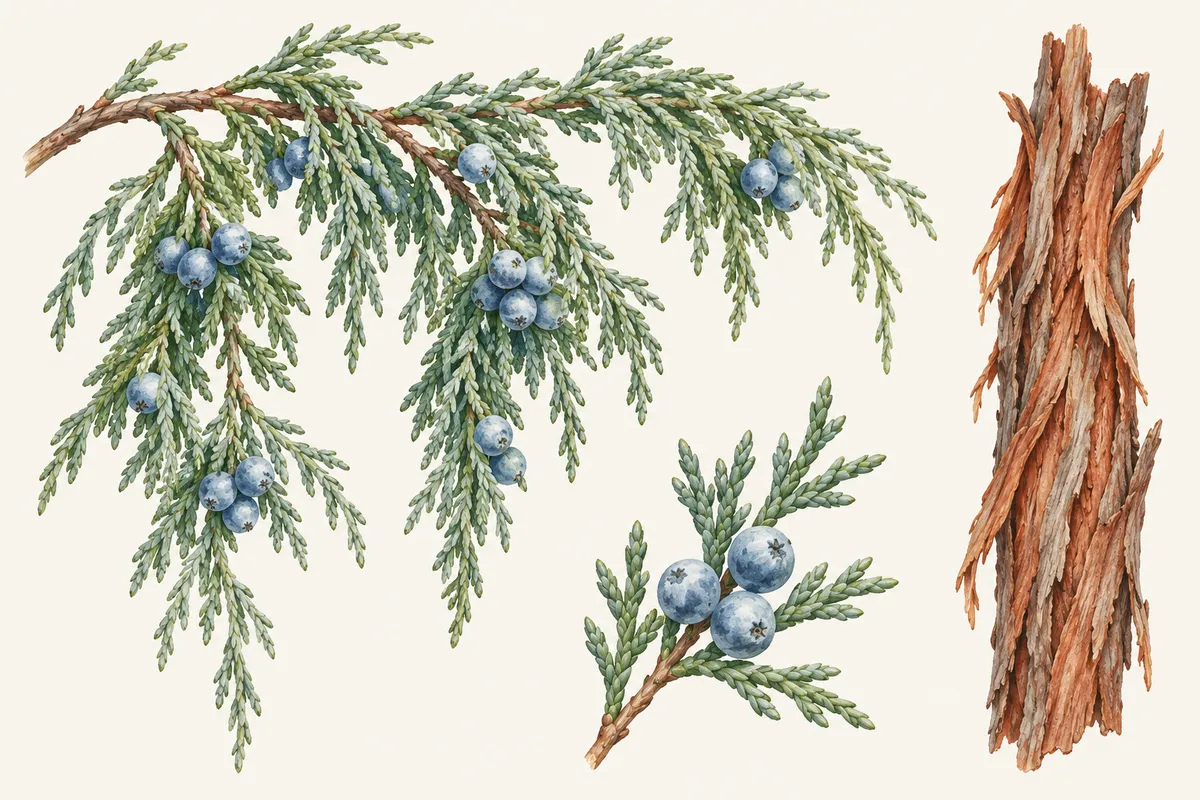
Rocky Mountain juniper identification rests on three marks: tiny scale leaves about 1/8 inch long, green to gray-green, pressed tight to the twig; round, bluish berry-like cones about 1/3 inch across with a white, powdery bloom, which take two seasons to ripen; and thin, reddish-brown bark in long, narrow, shreddy ridges that weathers gray. It is a small tree or large shrub, often with a rounded crown.
- Its berry-like cones need two seasons to ripen, so a female tree often carries green and blue cones at once; eastern red cedar's ripen in one.
- The Forest Service lists Rocky Mountain redcedar and even western redcedar among its names, but it is a juniper with berries, not a Thuja.
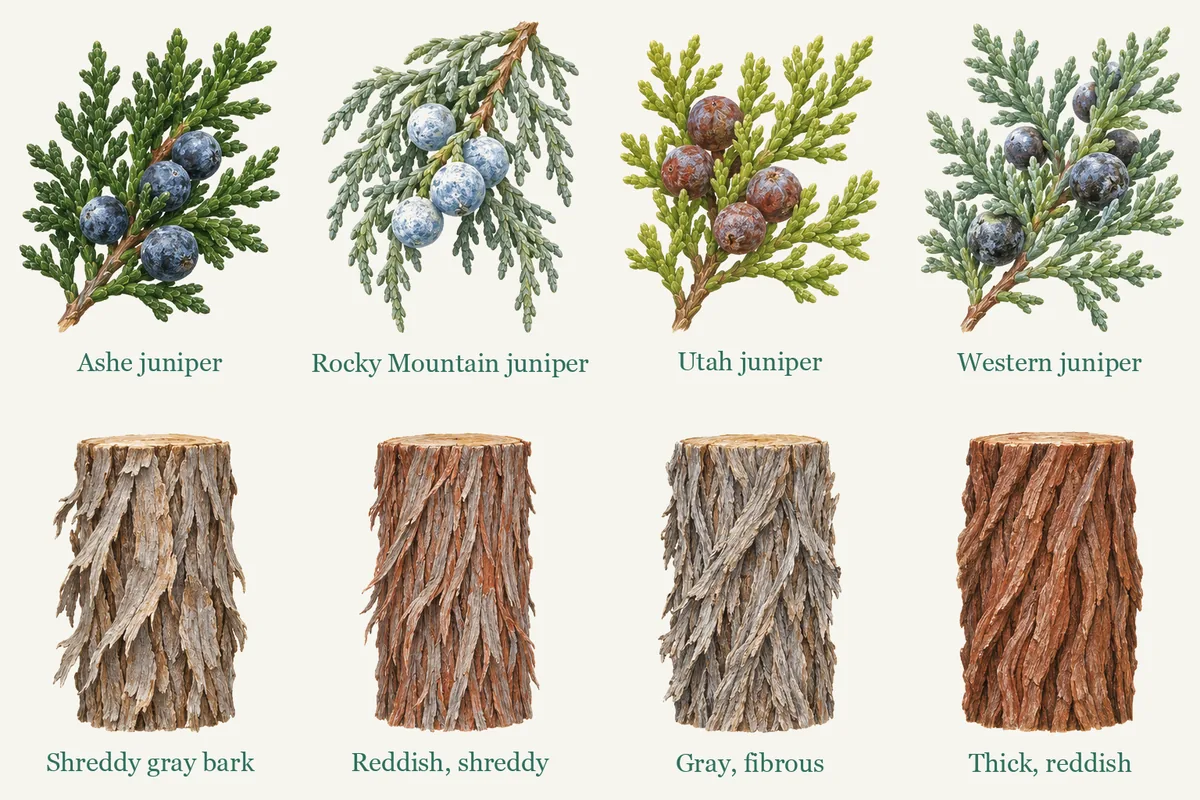
- Utah and oneseed juniper share its dry hills; their ripe cones are reddish brown or bluish brown rather than frosted blue.
Field marks at a glance
- Scientific name
- Juniperus scopulorum
- Family
- Cupressaceae (cypress family)
- Type
- Conifer, evergreen
- Leaves
- Scale leaves about 1/8 inch, green to gray-green, pressed tightly to the twig, with small glands beneath that are hard to see. Twigs covered in green scales turn light brown with age.
- Cones
- Round, bluish berry-like cones about 1/3 inch (5 to 8 mm), with a powdery whitish bloom; green and glaucous when young, bluish purple when ripe.
- Ripening
- Two seasons: berries ripen in the second year, mid-September to mid-December, and may stay on the tree until March or April.
- Sexes
- Dioecious: only female trees bear berries. Flowers mid-April to mid-June, about 1/8 inch, at the branch tips.
- Bark
- Thin, fairly scaly, in long narrow ridges; reddish brown when young, weathering gray.
- Form and size
- Small tree or large shrub, often short with a rounded crown. Southwest: 20 to 50 ft (6 to 15 m); Canada: usually 10 to 12 ft. Largest known: 36 ft tall and 78 in across, Utah.
- Age
- 300 years is not uncommon; a tree in Logan Canyon, Utah, is reported at 3,000 years (USDA Forest Service).
- Range
- Central British Columbia and southern Alberta down the Rockies to Colorado and northern New Mexico; western northern Great Plains; Utah's Uinta and Wasatch Mountains; northern Arizona to southwestern New Mexico; south to Sonora, Mexico.
- Other names
- Rocky Mountain redcedar, redcedar, western redcedar, river juniper, cedro rojo, sabino.
Rocky Mountain juniper (Juniperus scopulorum) is the juniper of the western foothills, canyons and rimrock, from the Canadian Rockies to New Mexico. It is the tree many Westerners call a cedar: a small, often rounded evergreen with gray-green scales and frosted blue "berries". Two checks name it, the cone and the leaves, and the range and cone timing separate it from its relatives.
How to identify Rocky Mountain juniper: scales, berries, bark
1. Look at the leaves. Virginia Tech's Rocky Mountain juniper fact sheet describes tiny scale leaves about 1/8 inch long, pressed tightly against the twig, green to gray-green, with small glands on the underside that are hard to see. The twigs look like braided green cord and turn light brown as they age.
2. Find the berry-like cones. They are round and bluish, about 1/3 inch across, with a powdery whitish coating, and they take two seasons to mature (Virginia Tech). The USDA Forest Service's Silvics of North America gives them as 5 to 8 mm (0.2 to 0.3 inch), green and glaucous when immature and bluish purple with a white, waxy bloom when ripe. They ripen in their second year, from mid-September to mid-December, and may stay on the tree until March or April. Because the crops overlap, a female tree often carries small green cones and ripe blue ones at the same time.
3. Check the bark. Thin and fairly scaly, in long, narrow ridges, reddish brown when young and gray as it weathers (Virginia Tech).
4. Look at the shape. Virginia Tech calls it a small tree or large shrub, variable but often short with a rounded crown. Only female trees bear cones, since the species is dioecious; a tree without berries may simply be male.
Size, age and range
The Forest Service describes a range of forms from shrub to small tree. In Canada it is usually 10 to 12 feet tall with a trunk about 12 inches across at the base; in the Southwest, 20 to 50 feet with basal diameters up to 18 inches. The largest known tree, in the Cache National Forest in Utah, is only 36 feet tall but 78 inches in diameter. It is long-lived: 300 years is not uncommon, a relic in western South Dakota was estimated at 750 years when it died, and a tree in Logan Canyon, Utah, is reported at 3,000 years.
Among the junipers of tree size in the United States, it has the widest distribution in western North America. The Forest Service maps it from central British Columbia and southern Alberta through northwestern Montana and southeastern Idaho into Colorado and northern New Mexico, generally following the Rocky Mountains. It is also concentrated in the western part of the northern Great Plains and in Utah's Uinta and Wasatch Mountains, and runs in a band about 60 miles wide from near the Grand Canyon southeast across the Arizona Plateau to southwestern New Mexico, reaching south into the Sierra Madre of Sonora.
It grows from near sea level to 9,000 feet, often on open, exposed bluffs, rocky points and south-facing slopes, but does best in sheltered ravines, canyons and draws (Forest Service). Its companions include ponderosa pine, interior Douglas-fir, limber pine and quaking aspen, and in the south the pinyon pines and other junipers. The Rocky Mountain tree identification guide places it by elevation among the other trees of the range.
Rocky Mountain juniper vs eastern red cedar
The two are close relatives with blue, bloom-covered cones, and where their ranges meet they interbreed. The Forest Service describes the population of the Missouri River Basin as a hybrid swarm in which neither parent appears in pure form, trending toward Rocky Mountain juniper from southeast to northwest.
Elsewhere, three checks help. Virginia Tech's eastern redcedar fact sheet gives its berry-like cones as about 1/4 inch, dark blue with a bloom, maturing in the fall of their first season: one crop on the tree, not two. Eastern red cedar commonly carries sharp, needle-like juvenile leaves about 1/4 inch long on young trees and vigorous shoots, and grows into a dense, egg-shaped or columnar tree up to 60 feet. And range settles most trees: eastern red cedar is the juniper of the East and the Plains, Rocky Mountain juniper the one of the mountains and plateaus. The eastern red cedar page covers it in full.
Rocky Mountain juniper vs the other western junipers
In the pinyon-juniper country of Utah, Arizona and New Mexico it grows with Utah, oneseed and alligator juniper. The cone tells them apart best:
- Utah juniper (J. osteosperma): yellow-green scales with no glands; cones 1/4 to 1/2 inch, bluish and waxy when young, reddish brown and dry when ripe, after two seasons (Virginia Tech).
- Oneseed juniper (J. monosperma): cones about 1/4 inch, bluish brown, soft and juicy, with one seed, ripening in a single season; branches turn up from near the ground (Virginia Tech).
- Western juniper (J. occidentalis): leaves mostly in whorls of three, with resin-dotted glands that make the foliage strongly aromatic; cones bluish black with a bloom (Virginia Tech). The Forest Service's western juniper silvics places its extensive, continuous stands in central Oregon, with a narrow, intermittent band from southern California to southeastern Washington and scattered stands in Idaho and Nevada.
The juniper page compares all of these, with alligator juniper's checkered bark, in one table.
Rocky Mountain juniper is not among the 138 species in Tree Identifier's Collection. If you photograph one for the app, include a shoot with cones and check the name it gives against the cone color and the scale leaves above; the follow-up chat can answer a question such as how it differs from the Utah juniper beside it. Never eat a berry-like cone from a tree identified from a photo or a web page.
Look-alikes and how to tell them apart
Eastern red cedar (Juniperus virginiana)
Its berry-like cones, about 1/4 inch and dark blue with a bloom, ripen in one season, so a female tree carries a single crop. Young trees carry sharp, needle-like leaves about 1/4 inch. In the Missouri River Basin the two hybridize, and range is often the better guide.
Utah juniper (Juniperus osteosperma)
Its scales are yellow-green with no glands, and its cones, 1/4 to 1/2 inch, are bluish and waxy when young but reddish brown and dry when ripe. Rocky Mountain juniper's ripe cones stay bluish purple with a white bloom.
Oneseed juniper (Juniperus monosperma)
Its cones are bluish brown, soft and juicy, about 1/4 inch, with one seed, and ripen in a single season. It is a shrubby tree with upturned branches from near the ground, up to about 25 feet.
Western juniper (Juniperus occidentalis)
Its leaves are mostly in whorls of three, with resin-dotted glands that make them strongly aromatic. Rocky Mountain juniper's scales are in pairs. Western juniper is most abundant in central Oregon, west of Rocky Mountain juniper's main range.
What a photo can't settle
- Rocky Mountain juniper and eastern red cedar hybridize in the Missouri River Basin, and a hybrid cannot be settled from a photo; range and cone timing are the best clues.
- Male trees carry no berry-like cones, and the scale foliage of the western junipers is similar, so a photo of a male tree may not separate Rocky Mountain, Utah and oneseed juniper.
- Tree Identifier gives one name from one photo, with no confidence score and no look-alike list; Rocky Mountain juniper is not in its 138-species Collection, so check any answer against the cones and leaves above.
Questions people ask
Is Rocky Mountain juniper a cedar?
Not botanically. It is Juniperus scopulorum, a juniper in the cypress family, although the USDA Forest Service lists Rocky Mountain redcedar, redcedar and western redcedar among its common names. True cedars have needles in tufts, and the western redcedar of the Pacific coast is a Thuja with small woody cones, not berries.
How do you tell Rocky Mountain juniper from eastern red cedar?
Count the cone crops. Rocky Mountain juniper's berry-like cones take two seasons to ripen and eastern red cedar's one, so a western female tree carrying green and blue cones together points to Rocky Mountain juniper. Where they meet in the Missouri River Basin, the Forest Service describes a hybrid swarm.
How old can a Rocky Mountain juniper get?
The USDA Forest Service calls it long-lived: 300 years is not uncommon, a relic in western South Dakota was estimated at 750 years when it died, and a tree in Logan Canyon, Utah, is reported at 3,000 years. Growth is slow: about 13 feet at 40 years in the Southwest.
Do all Rocky Mountain junipers have berries?
No. The species is dioecious, so only female trees bear the blue berry-like cones; male trees carry small yellow pollen cones in spring. A tree without berries can still be Rocky Mountain juniper: check the gray-green scale leaves, the shreddy bark and the range.
Sources
- Rocky Mountain Juniper, Silvics of North America — USDA Forest Service
- Rocky Mountain juniper fact sheet — Virginia Tech Dendrology
- Eastern redcedar fact sheet — Virginia Tech Dendrology
- Utah juniper fact sheet — Virginia Tech Dendrology
- Oneseed juniper fact sheet — Virginia Tech Dendrology
- Western juniper fact sheet — Virginia Tech Dendrology
- Western Juniper, Silvics of North America — USDA Forest Service
Keep reading
- Tree profileJuniper trees: how to identify them
- Tree profileEastern red cedar (Juniperus virginiana): how to identify it
- Regional guideRocky Mountain tree identification, from foothills to treeline
- Tree comparisonCedar vs juniper: how to tell the trees apart
- Regional guideDesert tree identification in the American Southwest