Tree profile
Smoke tree (Cotinus): how to identify it
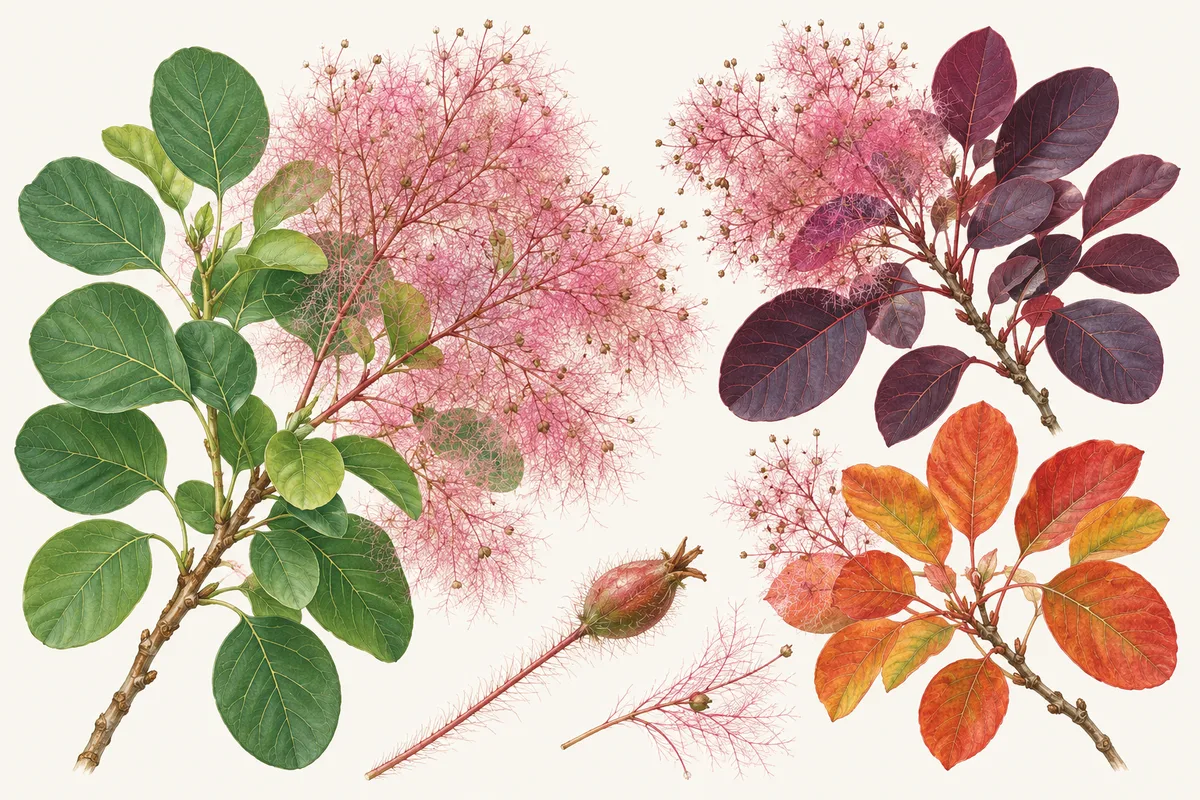
Round, smooth-edged leaves, often purple, and clouds of pink or purple hairs in summer: the smoke tree is easy to spot in bloom and easy to misname the rest of the year.
In short
For smoke tree identification, look for simple, rounded to oval leaves with smooth edges and no teeth, and in summer for airy plumes 6 to 10 inches long made of fine pink to purple hairs on the faded flower stalks. Common smokebush, the planted Eurasian species, has leaves 1.5 to 3.5 inches that smell like radish when crushed; the native American smoketree has longer leaves, 3 to 6 inches, widest above the middle.
- The smoke is not the flowers: the small yellow-green flowers fade, and the branched flower stalks then grow long pink to purple hairs.
- Most smoke trees in yards are the Eurasian Cotinus coggygria, often a purple-leaved cultivar such as 'Royal Purple'.
- The American smoketree, Cotinus obovatus, is a small native tree of Kentucky, Tennessee, Alabama, the Ozarks, Oklahoma and central Texas, with longer leaves and strong fall color.
Field marks at a glance
- Scientific name
- Cotinus coggygria and Cotinus obovatus
- Family
- Anacardiaceae (cashew or sumac family)
- Type
- Broadleaf, deciduous
- Leaves
- Alternate, simple, smooth-edged with no teeth. Common smokebush: rounded to oval, 1.5 to 3.5 in, blue-green or purple, radish smell when crushed. American smoketree: 3 to 6 in, widest above the middle, wedge-shaped base and a blunt or slightly notched tip.
- Smoke plumes
- Branched flower stalks 6 to 10 in long that, after the small flowers fade, grow long pink to purple hairs; midsummer. Showiest on male American smoketrees.
- Flowers
- Tiny, yellow-green, five-petaled and sparse; easy to overlook.
- Fruit
- Small, dry, kidney-bean-shaped drupe, about 1/8 to 1/4 inch, light brown when ripe; few per plume.
- Bark
- Young bark smooth, light gray to brown with pale lenticels; becomes scaly, flaky plates with age, especially on American smoketree.
- Fall color
- Common smokebush: reddish purple, yellow or red. American smoketree: gold, orange, red and purple, described by NC State as fantastic.
- Size
- Common smokebush: shrub or small tree 10 to 15 ft, often many-stemmed. American smoketree: 20 to 30 ft (Virginia Tech gives up to 40 ft), multi-trunked and gnarled.
- Range
- Common smokebush: native from south-central Europe to China, planted across the US. American smoketree: Kentucky, Tennessee and northern Alabama west to Oklahoma, the Missouri Ozarks and central Texas.
Smoke tree is the name for two close relatives in the genus Cotinus. The one in most yards is the common smokebush, Cotinus coggygria, a Eurasian shrub or small tree often grown for its purple leaves. The other is the American smoketree, Cotinus obovatus, a small native tree of the South-Central states. Both carry the same summer effect: clouds of pink or purple hairs that make the crown look wrapped in smoke. Both belong to the cashew and sumac family, which matters for anyone who prunes them.
How to identify a smoke tree
Check these features in order.
1. Leaves: smooth edges, no teeth. Both species have alternate, simple leaves with entire margins. NC State's common smoketree profile describes obovate to ovate leaves 1.5 to 3.5 inches long, medium blue-green, with parallel veins. Crush one: NC State notes it smells like radish.
2. Plumes: the smoke. In midsummer, branched clusters 6 to 8 inches long cover the outside of the shrub. The flowers themselves are tiny and yellow; the color comes from fine hairs. The WashU Arboretum explains that after the flowers fade, the clusters grow long pink-purple hairs along their length.
3. Fruit: tiny kidney beans. A few dry drupes form in each plume. Virginia Tech's American smoketree fact sheet gives light brown fruit about 1/8 inch long, kidney-bean shaped, on slender, branched, hairy stalks.
4. Leaf color. A smooth-edged purple shrub is often a smokebush cultivar. NC State lists 'Royal Purple', with deep purple, almost black foliage through the growing season, and 'Golden Spirit' with yellow leaves. Green-leaved plants are either the species or the American smoketree.
5. Bark and form. Young bark is smooth and light gray, rougher with age (NC State). Common smokebush is usually multi-stemmed, 10 to 15 feet tall and as wide.
When the plumes are gone, Tree Identifier can name a smoke tree from one photo of a leafy branch or the whole shrub. It shows the common and scientific names without a confidence score or a list of look-alikes, so check the leaf edge and, in summer, the plumes.
Common smokebush vs American smoketree
| Feature | Common smokebush (C. coggygria) | American smoketree (C. obovatus) |
|---|---|---|
| Origin | South-central Europe to China; planted | Native: KY, TN, AL west to OK, MO Ozarks, central TX |
| Size | Shrub or small tree, 10–15 ft | Small tree, 20–30 ft (to 40 ft) |
| Leaf | Nearly round, 1.5–3.5 in, radish smell | Elliptic to obovate, 3–6 in, widest above the middle, notched tip |
| Plumes | 6–8 in, smoky pink | 6–10 in, red to purple hairs, best on male plants |
| Leaf color | Green, or purple and gold in cultivars | Blue-green |
| Fall color | Reddish purple, yellow or red | Gold, orange, red and purple |
| Bark | Smooth gray, rougher with age | Furrowed, scaly, flaky plates |
Figures come from NC State's pages for common smoketree and American smoketree, with the larger height from Virginia Tech. The WashU Arboretum gives the simplest field test: the Eurasian species has much more circular leaves, about half the length of the American smoketree's.
The American smoketree is dioecious, with male and female plants, and NC State notes the plumes are showiest on males. NC State gives it USDA zones 3 to 8 and calls its fall color fantastic. The WashU Arboretum adds that it prefers dry, chalky soils and is the only Cotinus species native to the United States.
Smoke tree look-alikes
Out of bloom, the purple-leaved smokebush is most often confused with other purple trees; the guide to trees with purple leaves lines them up.
- 'Forest Pansy' redbud has purple leaves with smooth edges too, but NC State's redbud page describes them as heart-shaped, with 7 veins radiating from the base. Redbud blooms pink before the leaves in early spring and hangs flat pods 2 to 4 inches long. See the redbud page.
- Purple-leaf plum leaves are toothed, 1.5 to 3 inches long, with small glands near the base of the leaf stalk, according to NC State's cherry plum page. It flowers white to pale pink in April and has no summer plumes.
In bloom, a smoke tree is hard to mistake. Pink haze in July on a rounded shrub sets it apart from trees with true pink petals; our guide to trees with pink flowers covers those.
Sap, family and safety
Smoke trees belong to the Anacardiaceae, which NC State calls the cashew or poison ivy family; an older name for common smokebush was Rhus cotina, from its former placement among the sumacs. NC State warns that contact with the resinous sap "may cause contact dermatitis, especially to those sensitive to poison ivy." Wear gloves when you cut a smoke tree, and never eat any part of it on the strength of a web page or an app.
NC State lists common smokebush as generally free of pests and diseases, though susceptible to rust, leaf spot and verticillium wilt. It tolerates drought once established, takes a wide range of soil pH and grows best in full sun.
Neither smoke tree is one of the 138 species in Tree Identifier's Collection, though a photo still returns a name. The app's follow-up chat can answer questions about pruning or why a plant stopped producing plumes, and the Tree Map keeps track of where you saw a wild American smoketree.
Look-alikes and how to tell them apart
Eastern redbud 'Forest Pansy' (Cercis canadensis)
Forest Pansy also has purple, smooth-edged leaves, but they are heart-shaped with about 7 main veins fanning from the base, and it blooms pink on bare branches in early spring, then carries flat pods 2 to 4 inches long.
Purple-leaf plum (Prunus cerasifera)
Purple-leaf plum leaves are toothed along the edge and have small glands near the base of the stalk; it flowers white or pale pink in April, with no summer plumes, and bark carries horizontal lenticels.
Common smokebush vs American smoketree
Measure a leaf: the Eurasian smokebush has nearly round leaves about half the length of the American smoketree's longer, elliptic leaves, which are widest above the middle. Purple or golden foliage means a planted smokebush cultivar.
What a photo can't settle
- Out of flower, a smoke tree is a plain shrub with rounded leaves; a leaf photo is weaker evidence than the summer plumes or a crushed-leaf smell.
- Garden cultivars of common smokebush vary in leaf color from gold to near black; a photo app names the species, not the cultivar.
Questions people ask
What makes the smoke on a smoke tree?
Hairs on the flower stalks, not the flowers. The WashU Arboretum explains that after the small yellow-green flowers fade, the branched clusters grow long pink-purple hairs along their length, and that haze gives the tree its name. NC State gives plumes 6 to 8 inches long on common smokebush and 6 to 10 inches on American smoketree.
Is a smoke tree a tree or a bush?
Either, depending on species and pruning. NC State describes common smokebush as an upright shrub or small tree of 10 to 15 feet, often multi-trunked. The American smoketree is larger, 20 to 30 feet according to NC State and up to 40 feet according to Virginia Tech.
Is smoke tree native to the US?
One species is. The American smoketree, Cotinus obovatus, grows from Kentucky, Tennessee and northern Alabama west to Oklahoma and in central Texas (NC State), and the WashU Arboretum calls it a Missouri native most common in the southern Ozarks. The common smokebush in most yards is native from south-central Europe to China.
Is smoke tree poisonous to touch?
NC State Extension warns that contact with the resinous sap of common smokebush may cause contact dermatitis, especially in people sensitive to poison ivy, a relative in the same family. Wear gloves when pruning, and never eat any part of the plant.
Why does my smoke tree have no smoke?
It may be a female plant. The American smoketree has separate male and female plants, and NC State notes the plumes are showiest on males, so a female tree can look bare in midsummer.
Sources
- Cotinus coggygria (Common Smoketree, Smokebush) — North Carolina Extension Gardener Plant Toolbox, NC State University
- Cotinus obovatus (American Smoketree, Chittamwood) — North Carolina Extension Gardener Plant Toolbox, NC State University
- American smoketree (Cotinus obovatus) fact sheet — Virginia Tech Dendrology
- American Smoketree — WashU Arboretum, Washington University in St. Louis
- Cercis canadensis (Eastern Redbud) — North Carolina Extension Gardener Plant Toolbox, NC State University
- Prunus cerasifera (Cherry Plum, Purple Leaf Plum) — North Carolina Extension Gardener Plant Toolbox, NC State University