Tree profile
Striped maple (Acer pensylvanicum): how to identify moosewood
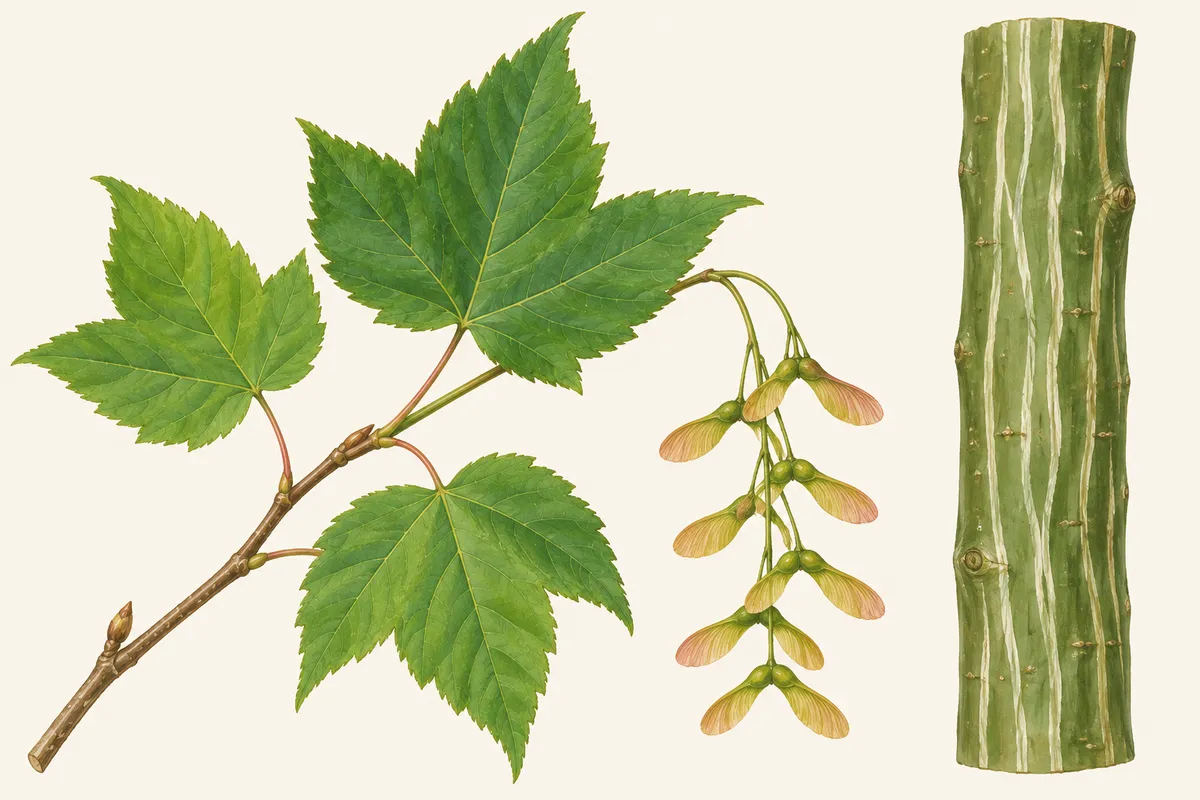
Green bark painted with white vertical stripes, a leaf as broad as a hand shaped like a goose's foot, and a small tree waiting in the shade of a cool northern forest.
In short
For striped maple identification, look at the bark: smooth and gray-green to greenish brown with conspicuous white vertical stripes, on a small understory tree rarely over 30 feet. The leaves are opposite, 5 to 8 inches long, finely toothed, with three short lobes at the tip like a goose's foot. Yellow flowers hang in slender chains 4 to 6 inches long in late spring.
- Striped maple, moosewood and goosefoot maple are one tree, Acer pensylvanicum.
- White vertical stripes on green bark are unique among native eastern trees; old trunks lose them and turn reddish brown.
- Mountain maple shares the shady understory but has gray-brown bark, smaller coarsely toothed leaves and upright flower spikes.
Field marks at a glance
- Scientific name
- Acer pensylvanicum
- Family
- Sapindaceae (soapberry family); Virginia Tech lists the older Aceraceae
- Type
- Broadleaf, deciduous
- Bark
- Young trunks smooth, gray-green to greenish brown with prominent white vertical stripes; older bark becomes reddish brown.
- Leaves
- Opposite, simple, nearly round, 5 to 8 inches long, with 3 lobes at the tip like a goose's foot; finely toothed margin; green above, paler below. Native Plant Trust gives blades 4.7 to 7 in (120 to 180 mm) long and up to 8 in wide.
- Fall color
- Pale golden yellow.
- Flowers
- Yellow-green, bell-shaped, about 1/4 inch, in long, slender, hanging chains 4 to 6 inches long; May and June, after the leaves are nearly full size.
- Fruit
- Paired, wide-spreading samaras 3/4 to 1 inch long in hanging clusters; ripen in late summer and fall (September to October), shed October and November.
- Twigs and buds
- Smooth, green turning red or reddish brown; reddish buds narrow, stalked, with two scales meeting edge to edge (valvate).
- Size
- Small tree or large shrub up to about 30 ft (Virginia Tech); maximum about 49 ft (15 m) per the USDA Forest Service. Lives to about 100 years.
- Range
- Nova Scotia and the Gaspé Peninsula west to southern Ontario, Michigan and eastern Minnesota; south to northeastern Ohio, Pennsylvania and New Jersey, and in the mountains to northern Georgia.
Striped maple is the small tree in a cool eastern forest that looks as if someone painted it: smooth green bark with thin white stripes running up the trunk. It lives in the shade of taller trees, often for decades, and carries broad leaves 5 to 8 inches long on a slender stem. Moose and deer browse it, which is where its other name, moosewood, comes from.
How to identify a striped maple
Three checks identify it in any season; the bark alone settles most trees.
1. Bark: green with white stripes. The Virginia Tech Dendrology fact sheet describes young bark as smooth gray-green with prominent white lengthwise stripes. The USDA Forest Service's Silvics of North America calls them conspicuous vertical white stripes on greenish-brown bark. On old trunks the bark turns reddish brown, so check younger stems if a large tree shows none.
2. Leaf: the goosefoot. Leaves are opposite, simple and nearly round, 5 to 8 inches long, with three short lobes at the tip that Virginia Tech compares to a goose's foot. The margin is finely toothed. The Native Plant Trust measures blades 120 to 180 mm long and up to 200 mm wide, and notes they turn pale golden in autumn. It also calls the tree goosefoot maple for that shape.
3. Flowers and seeds in chains. In May and June, after the leaves are almost full size, look for yellow, bell-shaped flowers about 1/4 inch long hanging in slender chains 4 to 6 inches long. They become hanging clusters of paired samaras 3/4 to 1 inch long, wings spread wide, ripening in September and October.
In winter, the twigs help: smooth, green turning red or reddish brown, with narrow, reddish buds on a short stalk, their two scales meeting edge to edge.
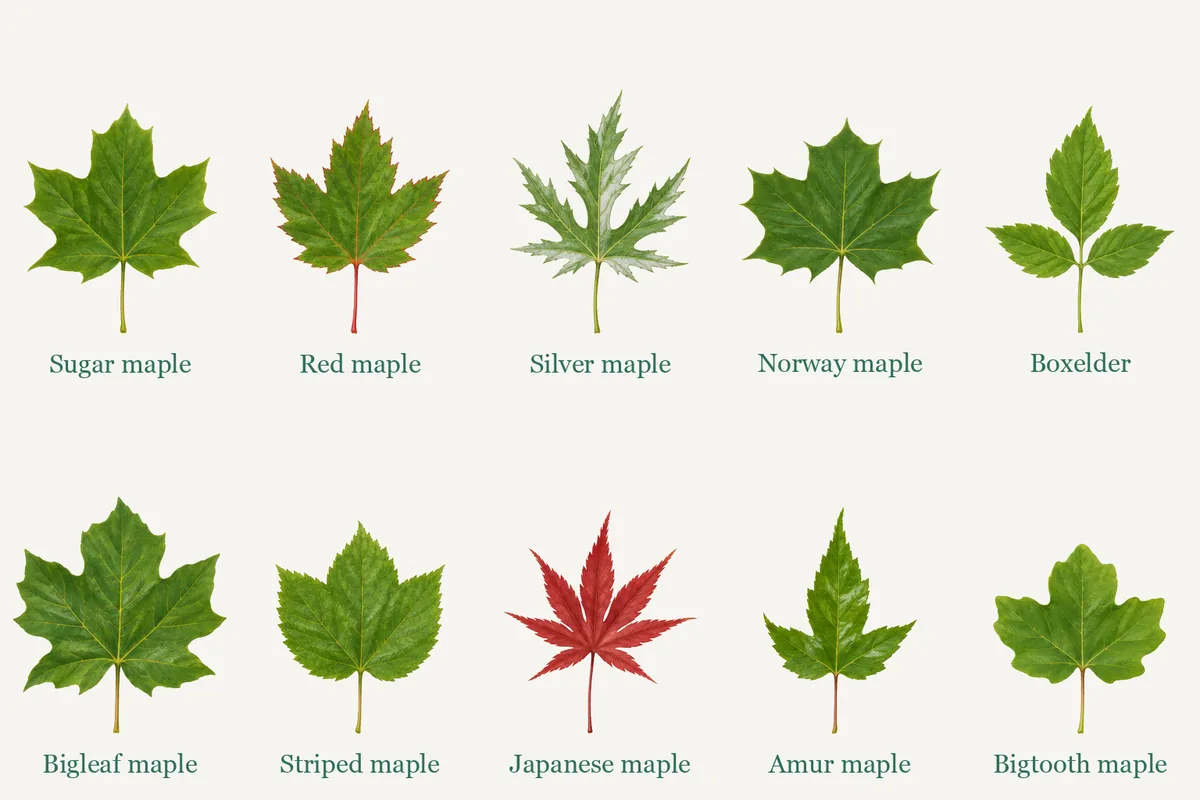
A photo of the trunk or a leaf is enough for Tree Identifier to suggest a name. The app gives one result, with no confidence score and no list of look-alikes, so confirm with the leaf shape, especially on a planted tree.
Striped maple vs mountain maple and red maple
| Tree | Bark | Leaf | Flowers |
|---|---|---|---|
| Striped maple | Smooth, gray-green, white vertical stripes | 5–8 in, 3 short lobes at the tip, fine teeth | Yellow, in hanging chains 4–6 in, late spring |
| Mountain maple | Thin, grayish to light brown, later shallow furrows | 3–4 in, 3 (sometimes 5) short lobes, coarse teeth, hairy beneath | Greenish yellow, in erect spikes 3–6 in, early summer |
| Red maple (young) | Smooth, light gray, no stripes | 2–4 in, 3–5 lobes, whitish beneath | Red, early spring, before leaves |
Mountain maple is the one that shares the same shady, cool woods. Virginia Tech's mountain maple sheet describes a large shrub or small tree up to 25 feet with plain grayish-brown bark, smaller leaves with coarse teeth and broad V-shaped sinuses, and flowers in upright spikes. Its samaras spread at less than 90 degrees.
Red maple saplings are common in the same forests and have smooth light gray bark when young, but no stripes. Virginia Tech's red maple sheet gives leaves 2 to 4 inches long with 3 to 5 lobes and whitened undersides, and red flowers before the leaves. The red maple page covers it fully, and the maple identification page compares all the common maples.
Smooth bark on its own leads to several trees: beech, hornbeam, young red maple, holly. The guide to trees with smooth gray bark sorts them by trunk size and leaf.
Where striped maple grows
The Forest Service describes a range across the northeastern quarter of the United States and southeastern Canada: Nova Scotia and the Gaspé Peninsula of Quebec west to southern Ontario, Michigan and eastern Minnesota, south to northeastern Ohio, Pennsylvania and New Jersey, and along the mountains to northern Georgia.
It does best on shaded, cool north-facing slopes in upland valleys, often on well-drained sandy loam. In the New England mountains it grows best between 1,800 and 2,600 feet and disappears around 2,720 to 2,820 feet in the White Mountains of New Hampshire; in the southern Appalachians it is common from 2,500 to 4,500 feet. The Native Plant Trust records it in all six New England states, from extremely rare in Rhode Island to fairly widespread in Massachusetts. It shares those forests with sugar maple, beech and yellow birch; the New England tree identification guide places it among the region's other trees.
A shade tree that waits, and changes sex
The Forest Service classes striped maple as very tolerant of shade: it survives decades of heavy understory shade, though it grows best under moderate light. It is a slow-growing tree that may live about 100 years, with a maximum height of about 49 feet (15 m), though Virginia Tech gives a more usual 30 feet. Because it can take over a site after cutting, foresters often consider it a serious problem for regenerating timber trees.
Its flowers are unusual. Virginia Tech calls the species dioecious, with male and female flowers on separate trees, but the Forest Service describes sex expression as variable: trees can be male, female or both, and they change. In one study, 27 of 243 trees switched sex in a single year, most of them from male to female. A striped maple that bore no seeds last year may carry them this year.
Wildlife use is its main value, according to the Forest Service: deer and moose browse it, rabbits prefer it and porcupines often feed on it. With location turned on, Tree Identifier's Tree Map pins the find, which helps you return in late spring to see the flower chains.
Hybrids, disease and history
The Forest Service notes that striped maple was introduced into England around 1760. In the wild it hybridizes with Tatarian maple, an introduced species, producing Acer × boscii, so a tree with striped bark and an odd leaf near plantings may be a cross. Its main disease threat is Verticillium wilt, which kills the trees it attacks.
Whatever the tree in front of you, compare the leaf with the goosefoot outline above: three short lobes at the tip of a broad, finely toothed blade, 5 to 8 inches long, on a stem with white stripes. Both together make the identification.
Look-alikes and how to tell them apart
Mountain maple (Acer spicatum)
Mountain maple shares cool, shady woods, but its bark is thin, grayish to light brown, never striped; its leaves are smaller, 3 to 4 inches, with coarse teeth and a somewhat hairy underside; and its flowers stand in erect spikes 3 to 6 inches long, not hanging chains.
Red maple (Acer rubrum)
Young red maple has smooth bark too, but it is light gray without white stripes, and the leaves are smaller, 2 to 4 inches, with 3 to 5 lobes and whitish undersides. Red maple flowers are red and open in early spring before the leaves.
What a photo can't settle
- Striped bark is the best clue, but a photo app gives a species name only; on a planted tree in a yard, check the goosefoot leaf as well.
- Old striped maple trunks lose their stripes and turn reddish brown, so a bark photo of a big trunk is weak evidence.
- Sex expression varies from year to year, so a tree without fruit this year may fruit next year.
Questions people ask
Why is striped maple called moosewood?
The USDA Forest Service gives moosewood as its other common name. Deer and moose browse it, and the Native Plant Trust adds that porcupines, cottontails, beaver, deer and moose eat the bark and young shoots.
Is striped maple a tree or a shrub?
Both descriptions are used. Virginia Tech calls it a small tree or large shrub up to 30 feet; the USDA Forest Service gives a maximum height of about 49 feet. It usually grows in the understory of taller hardwoods and conifers.
Can a striped maple change sex?
Yes. The USDA Forest Service describes variable sex expression: a tree can carry male and female flowers or only one kind, and trees switch. In one study, 27 of 243 trees changed sex in a single year, most of them from male to female.
Does striped maple keep its stripes?
Not forever. Virginia Tech describes smooth gray-green bark with prominent white lengthwise stripes on young stems, and older bark that turns reddish brown. Look at the younger branches and saplings nearby for the stripes on an old tree.
Sources
- Striped maple fact sheet — Virginia Tech Dendrology
- Striped Maple (Acer pensylvanicum), Silvics of North America — USDA Forest Service
- Acer pensylvanicum (goosefoot maple) — Native Plant Trust, Go Botany
- Mountain maple fact sheet — Virginia Tech Dendrology
- Red maple fact sheet — Virginia Tech Dendrology
Keep reading
- Tree profileMaple trees (Acer): how to identify them
- Clue guideWhich tree has smooth gray bark? Sort it by trunk size, shape and leaf
- Regional guideNew England tree identification, north to south
- Tree profileRed maple tree (Acer rubrum): how to identify it
- Tree profileYellow birch (Betula alleghaniensis): how to identify it