Tree profile
Yellow birch (Betula alleghaniensis): how to identify it
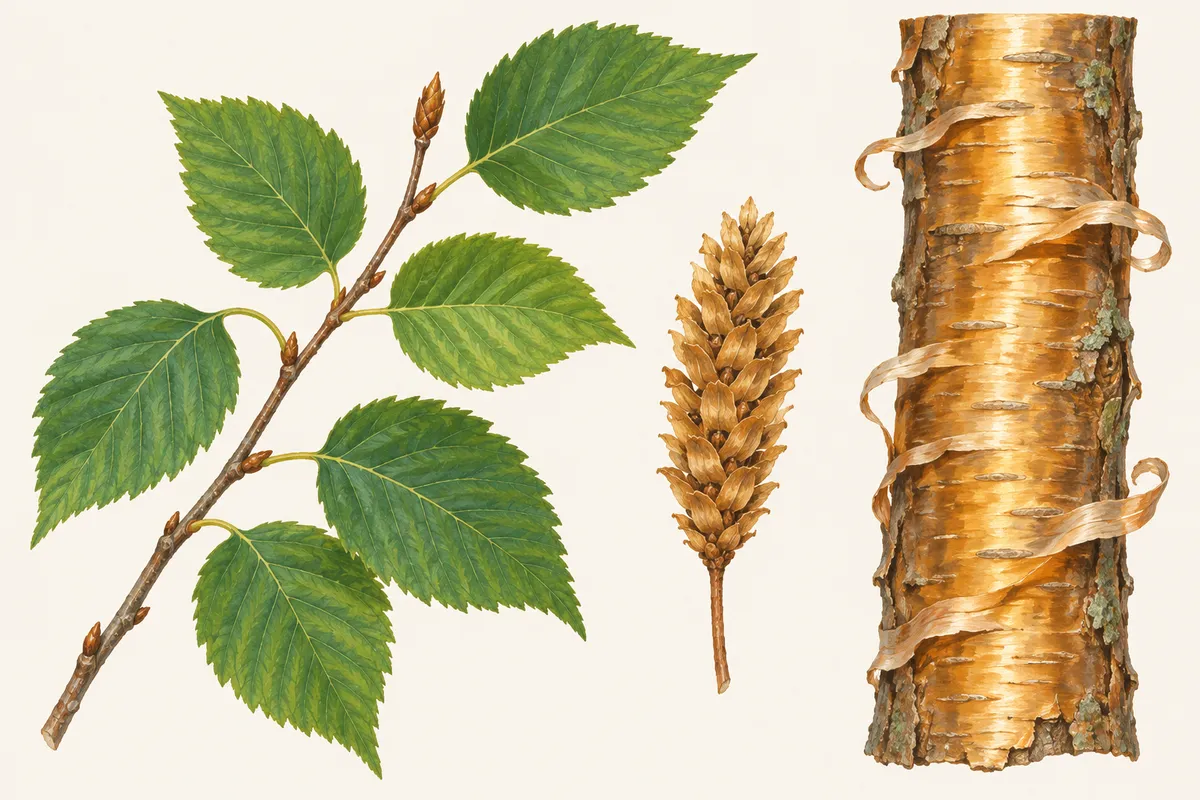
Shiny yellow-bronze bark that frays into thin curls, a soft doubly toothed leaf, and a twig that smells of wintergreen when you scratch it: the big birch of the northern hardwood forest.
In short
For yellow birch identification, look at the bark first: shiny yellowish bronze, sometimes gray, fraying horizontally into thin, papery curls, and breaking into red-brown plates on old trunks. The leaves are alternate, egg-shaped, 4 to 6 inches long and doubly toothed, and a scratched twig smells of wintergreen. Upright cone-like catkins about 1 inch long ripen in fall.
- Bronze bark in tight curls plus a wintergreen twig is yellow birch; dark plated bark with the same smell is sweet (black) birch.
- Paper birch peels in wide white sheets and its twigs have no wintergreen smell.
- Yellow birch often stands on stilt-like roots where it started life on a rotting log or stump.
Field marks at a glance
- Scientific name
- Betula alleghaniensis
- Family
- Betulaceae (birch family)
- Type
- Broadleaf, deciduous
- Bark
- Shiny yellowish bronze, sometimes gray, on young stems, peeling horizontally into thin, curly, papery strips that stay attached; red-brown scaly plates on old trunks.
- Leaves
- Alternate, simple, egg-shaped, 4 to 6 inches (8 to 11 cm per Natural Resources Canada) long, pointed tip, rounded base; doubly toothed, each vein ending in a large tooth with 2 or 3 smaller ones between; slightly soft to the touch.
- Twig smell
- Scratch or break a twig: wintergreen. Buds egg-shaped, sharply pointed, reddish brown, with fringed scale edges; older trees carry short spur shoots.
- Fruit
- Upright, plump, cone-like catkin 3/4 to 1 1/4 inches long with hairy scales; ripens in fall and breaks up over winter, releasing small two-winged nutlets.
- Flowers
- Male catkins about 1 inch long, reddish green, near twig tips; upright female catkins about 5/8 inch; both in spring, female ones with the new leaves.
- Size
- Up to 75 ft (Virginia Tech) or 100 ft on good New England sites (USDA Forest Service); record tree 114 ft in Michigan. Commonly over 300 years old.
- Range
- Newfoundland and Nova Scotia west to southeastern Manitoba, south to Minnesota, northeastern Iowa, northern Illinois, Ohio, Pennsylvania, New Jersey and New England; in the Appalachians to eastern Tennessee and northeastern Georgia, at high elevations.
Yellow birch is the birch you find in a cool, mixed northern forest, standing beside sugar maple and beech, with bark that catches the light like old brass. The bark makes it easy once you know what to look for: not white, not dark, but bronze, fraying into thin curls. Pair that with the wintergreen smell of a scratched twig and the identification is settled.
How to identify a yellow birch
Check these four things, in this order.
1. Bark: shiny bronze, in thin curls. The Virginia Tech Dendrology fact sheet describes young bark as shiny bronze, sometimes gray, peeling horizontally into thin, curly, papery strips. Natural Resources Canada adds that the papery shreds end in tight curls and do not peel off readily, so the trunk looks frayed rather than stripped. On old trees the bark breaks into red-brown scaly plates; the upper limbs keep the bronze curls longer than the base.
2. Twig smell: wintergreen. Scratch the bark of a small twig with a fingernail, or snap one, and smell it. Virginia Tech notes the wintergreen scent of broken twigs, and the USDA Forest Service says the inner bark is aromatic with a wintergreen flavor. Paper birch, the other common northern birch, has none.
3. Leaf: soft, egg-shaped, doubly toothed. Leaves are alternate and simple, 4 to 6 inches long with a pointed tip and rounded base, dark green above and paler beneath, and slightly soft to the touch. Natural Resources Canada gives 8 to 11 cm and describes the margin precisely: each vein ends in a large tooth, with 2 or 3 smaller teeth between. The straight, parallel side veins are typical of the birch family.
4. Fruit: plump upright catkins. In late summer and fall, look for cone-like catkins 3/4 to 1 1/4 inches long, standing upright on the twig, with hairy scales. They break apart over winter and scatter tiny two-winged nutlets on the snow.
When the twigs are out of reach, Tree Identifier can name a yellow birch from one photo of the bark or a leaf. It returns a single name with no confidence score and no list of look-alikes, so check the curls and, if you can reach a twig, the smell.
Yellow birch vs sweet, paper and other birches
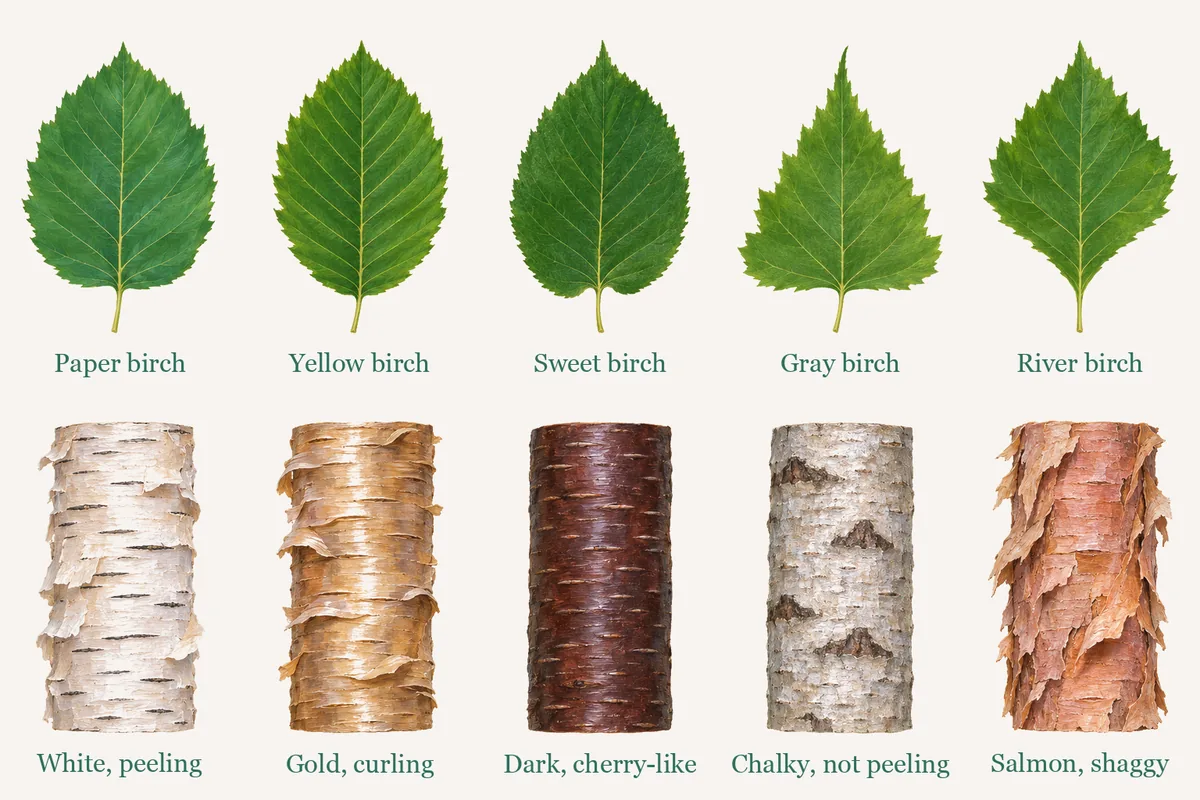
Two tests separate the eastern birches: the color and behavior of the bark, and the smell of the twig. The birch identification page has the full chart for six species; this is the short version for yellow birch.
| Tree | Bark on a mid-sized trunk | Leaf | Twig smell |
|---|---|---|---|
| Yellow birch | Shiny bronze to gray, fraying in thin horizontal curls | 4–6 in, rounded base, double teeth, soft | Wintergreen |
| Sweet (black) birch | Smooth reddish brown to black, then large thin dark plates | 2–4 in, heart-shaped base, sharp teeth | Wintergreen |
| Paper birch | Chalky to creamy white, peeling in wide sheets | 3–5 in, ovate, irregular double teeth | None |
| American hornbeam | Smooth gray to blue-gray at any age, twisted trunk | 3–5 in, double teeth | None |
Sweet birch is the one that causes doubt, because it shares the wintergreen smell and grows in the same forests. Virginia Tech describes sweet birch bark as reddish brown to black on young trees and gray to nearly black on old ones, breaking into large, thin, irregular plates, and its leaves have a heart-shaped base. Our sweet birch page covers that tree in detail. Paper birch is white, and Virginia Tech's paper birch sheet notes its twigs lack the wintergreen smell.
Hornbeam and hophornbeam, in the birch family too, have very similar doubly toothed leaves. Their bark gives them away: Virginia Tech describes hornbeam bark as smooth and blue-gray regardless of age, and hophornbeam bark as light brown and shreddy. The ironwood page separates those two.
Where yellow birch grows
The USDA Forest Service's Silvics of North America gives a northern range: Newfoundland, Nova Scotia and New Brunswick west to southeastern Manitoba, south to Minnesota and northeastern Iowa, east through northern Illinois, Ohio, Pennsylvania and New Jersey to New England. In the Appalachians it reaches eastern Tennessee and northeastern Georgia, but only high up: in the south it is restricted to moist gorges above 3,000 feet (914 m). The largest timber stands are in Quebec, Ontario, Maine, Upper Michigan, New York and New Brunswick.
It favors cool, moist, well-drained soils on uplands and in mountain ravines, mixed with other hardwoods and conifers. Natural Resources Canada lists beech, sugar maple, basswood and eastern white pine among its usual companions, the classic northern hardwood mix. If you are in that forest, our sugar maple page covers the tree you will most often see beside it, and the New England tree guide sets yellow birch among the region's other common trees.
Stilt roots, old age and other field clues
Some yellow birches look as if they stand on legs. The Forest Service explains why: in undisturbed stands the seedlings establish mainly on mossy logs, decayed wood, rotten stumps, cracks in boulders and the mounds left by windthrown trees. The roots grow down over the log or stump to reach the soil, and when the wood rots away they are left arching in the air. A birch with bronze bark perched on stilt roots is almost always yellow birch.
It is a slow, long-lived tree. The Forest Service calls it one of the slowest-growing components of the northern hardwood forest and reports trees commonly more than 300 years old, some over 366. On medium New England sites mature trees reach up to 100 feet and more than 30 inches across at 200 years; the record tree, near Gould City, Michigan, was 114 feet tall and 56.7 inches in diameter. Virginia Tech gives a more typical height of up to 75 feet, with an irregular crown.
In winter, without leaves, combine three clues: the bronze curls on the upper limbs, the upright, plump fruiting catkins or their scattered scales, and the wintergreen twig. Buds are egg-shaped, sharply pointed and reddish brown, with fringed scale edges, and older branches carry short spur shoots.
With location turned on, Tree Identifier's Tree Map pins the spot of your photo, so you can come back to the same trunk and watch the bark change with the light and the season.
Names and hybrids
The Forest Service lists gray birch, silver birch and swamp birch as other names for yellow birch, which is confusing, because gray birch and silver birch are also the names of other species. Natural Resources Canada uses swamp birch and gives the French name, bouleau jaune; older books call the species Betula lutea. Use the scientific name, Betula alleghaniensis, when names clash.
Yellow birch crosses with paper birch and with low birch (Betula × purpusii), and the Forest Service mentions variety fallax, with dark brown bark that peels less than the typical form. Trees with intermediate bark, or with the bronze color but little curling, may be one of these.
Look-alikes and how to tell them apart
Sweet birch, also called black birch (Betula lenta)
The twig smells of wintergreen too, so use the bark: sweet birch bark does not curl, it stays smooth and reddish brown to black, then breaks into large, thin, dark plates. Its leaves are smaller, 2 to 4 inches, with a heart-shaped base, and its catkin scales are nearly hairless.
Paper birch (Betula papyrifera)
Paper birch bark turns chalky to creamy white and peels in wide horizontal sheets with orange inner bark. Scratch a twig: Virginia Tech notes it lacks the wintergreen smell, and its cylindrical catkins fall apart at maturity.
American hornbeam (Carpinus caroliniana)
Hornbeam leaves are doubly toothed too, but the bark stays thin, smooth and gray to blue-gray at any age, on a twisted trunk, and the fruit is a nutlet on a three-lobed leafy bract. It is a small tree to about 25 feet, never peeling.
Eastern hophornbeam (Ostrya virginiana)
Hophornbeam has a similar leaf, but its bark turns light brown and shreddy rather than bronze and curling, and its fruit hangs in clusters of inflated papery sacs that look like hops.
What a photo can't settle
- Young yellow birch saplings are shiny reddish brown before the bronze color appears, and look much like young sweet birch; a photo can't carry the wintergreen smell that confirms either.
- Old yellow birch trunks lose their curls and turn to red-brown plates, closer to sweet birch; check the upper branches, which keep the bronze curls.
- Yellow birch hybridizes with paper birch and with low birch (USDA Forest Service), so an odd tree with intermediate bark may not match any one species.
Questions people ask
How do you tell yellow birch from black birch?
Both twigs smell of wintergreen, so look at the bark. Yellow birch is shiny bronze to gray and frays into thin horizontal curls; black (sweet) birch does not curl, and old trunks break into large, dark, thin plates. Yellow birch leaves are larger, 4 to 6 inches, and its catkin scales are hairy.
Why is it called yellow birch?
For its bark. The USDA Forest Service says the tree is named for its yellowish-bronze exfoliating bark, and Natural Resources Canada describes bark that is shiny reddish brown when young, becomes dull yellow and darkens to bronze with age.
Why does yellow birch grow on stilts?
Its seedlings often start on mossy logs, rotten stumps, cracks in boulders and windthrow mounds, according to the USDA Forest Service. When the log or stump rots away, the roots that grew over it are left standing in the air, so the trunk seems to sit on legs.
How old can a yellow birch get?
The USDA Forest Service says yellow birch is commonly more than 300 years old and some trees exceed 366 years, though unmanaged stands normally mature at 120 to 150 years. Natural Resources Canada gives a lower maximum age of 150 years, so expect the figures to vary by source and site.
Sources
- Yellow birch fact sheet — Virginia Tech Dendrology
- Yellow Birch (Betula alleghaniensis), Silvics of North America — USDA Forest Service
- Yellow birch — Natural Resources Canada, Trees, insects and diseases of Canada's forests
- Sweet birch fact sheet — Virginia Tech Dendrology
- Paper birch fact sheet — Virginia Tech Dendrology
- Hornbeam fact sheet — Virginia Tech Dendrology
- Hophornbeam fact sheet — Virginia Tech Dendrology
Keep reading
- Tree profileBirches (Betula): how to identify a birch tree
- Tree profileSweet birch (Betula lenta): how to identify black birch
- Tree profilePaper birch (Betula papyrifera): how to identify the white birch
- Tree profileSugar maple tree (Acer saccharum): how to identify it
- Regional guideNew England tree identification, north to south