Tree profile
Sweet birch (Betula lenta): how to identify black birch
A birch that doesn't look like one: dark bark that never peels, cherry-like lenticels on young trunks, and twigs so rich in wintergreen that the tree was once the only source of the oil.
In short
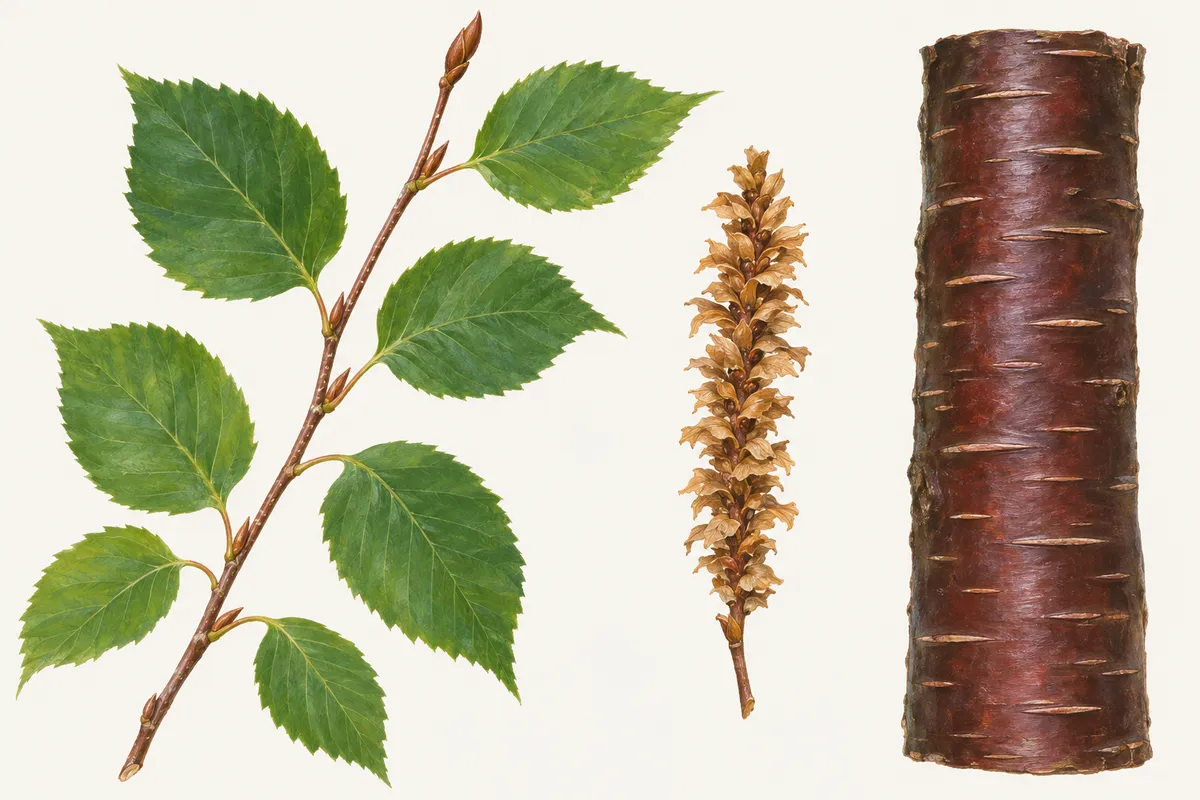
For sweet birch identification, scratch a twig first: it smells strongly of wintergreen. Then check the bark, smooth and reddish brown to black with horizontal lenticels on young trees, breaking into large, thin, dark, scaly plates on old ones, never peeling in curls. The leaves are alternate, 2 to 4 inches long, sharply toothed, with a heart-shaped base, on a single straight trunk up to about 60 feet.
- Sweet birch, black birch and cherry birch are one tree, Betula lenta.
- Wintergreen twig plus dark bark that does not curl is sweet birch; wintergreen plus bronze curls is yellow birch.
- Black cherry has similar young bark, but its scratched twig smells of bitter almond, not wintergreen.
Field marks at a glance
- Scientific name
- Betula lenta
- Family
- Betulaceae (birch family)
- Type
- Broadleaf, deciduous
- Twig smell
- Cut or scratch a twig: a strong wintergreen smell. Twigs slender, reddish brown with lenticels; no end bud; side buds two-toned, green and brown; spur shoots on older trees.
- Bark
- Young trees reddish brown to black, smooth, with horizontal lenticels; old trees gray to nearly black, broken into large, thin, irregular scaly plates. Does not peel in curls or sheets.
- Leaves
- Alternate, simple, ovate, 2 to 4 inches long, pointed tip, heart-shaped (cordate) base, sharply single- or double-toothed; dark shiny green above, paler beneath; stout, hairy leaf stalk.
- Fruit
- Brown, cone-like catkin 1 to 1 1/2 inches long with nearly hairless scales, full of tiny two-winged nutlets; ripens mid-August to mid-September and breaks apart in fall.
- Flowers
- Green male catkins 3/4 to 1 inch long near the twig tips; upright female catkins 1/2 to 3/4 inch, green tinged red; April and May, as the leaves open.
- Form
- Usually a single straight trunk; 50 to 60 ft in most places, 70 to 80 ft on the best sites.
- Range
- Southern Maine and southern Quebec west through New Hampshire, Vermont, New York and southeastern Ontario to eastern Ohio, south through the Appalachians to northern Alabama and Georgia.
- Elevation
- Near sea level on the New England coast up to 4,000 to 4,500 ft in the southern Appalachians, where it does best between 2,000 and 4,500 ft.
Sweet birch is the birch people walk past without noticing. It has none of the white or bronze peeling bark that makes other birches obvious: its young trunks are dark and glossy like a cherry, its old trunks break into dark plates. What gives it away is the smell. Scratch a twig and you get a sharp wintergreen scent, strong enough that this tree was once distilled for oil of wintergreen. Its other names, black birch and cherry birch, describe the bark.
How to identify a sweet birch
Run these checks in order; the first two settle most trees.
1. Smell a twig. Snap a small twig or scratch it with a fingernail. The Virginia Tech Dendrology fact sheet notes a wintergreen smell when cut, and the USDA Forest Service's Silvics of North America says crushed leaves and broken twigs give off the aroma. Among the common eastern birches, only yellow birch smells the same.
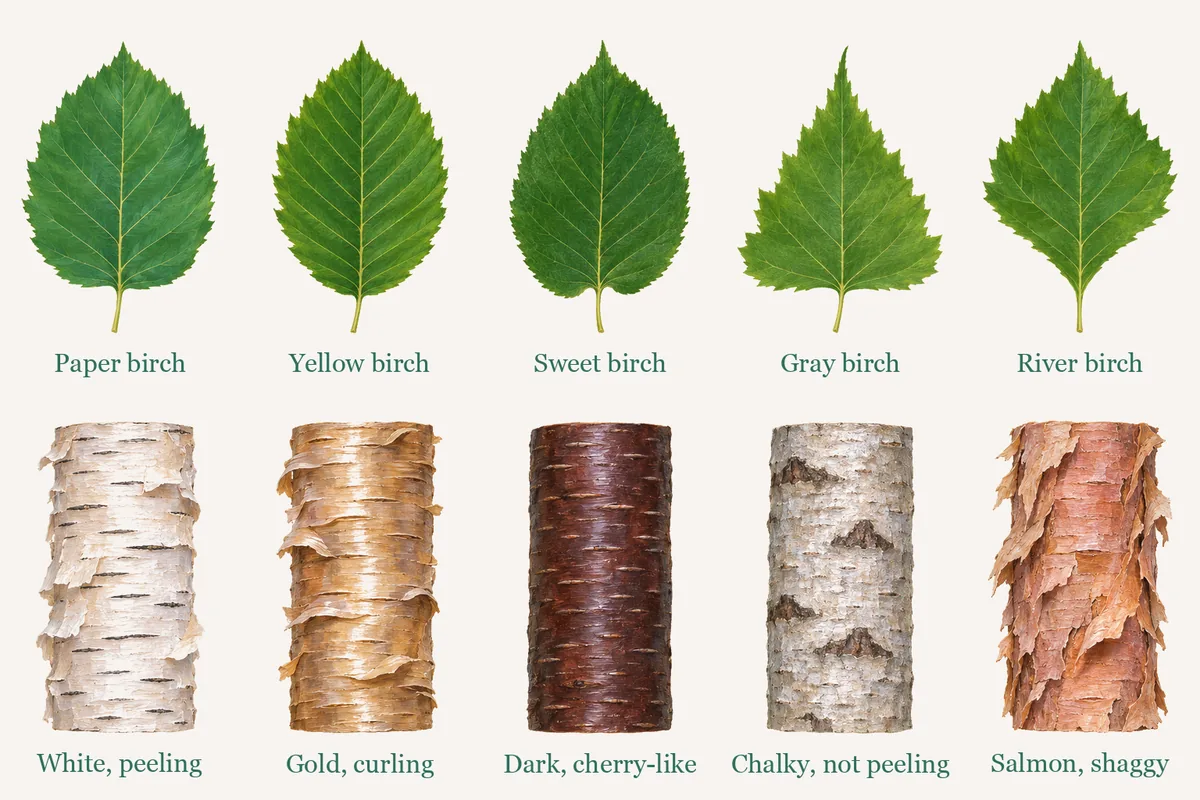
2. Read the bark. On young trees it is reddish brown to black, smooth, with horizontal lenticel lines, much like cherry bark. On older trees it turns gray to nearly black and breaks into large, thin, irregular, scaly plates. It never curls or peels in sheets, which separates it from every other common birch in the East.
3. Check a leaf. Leaves are alternate and simple, ovate, 2 to 4 inches long, with a pointed tip and a heart-shaped (cordate) base. The edges are sharply toothed, singly or doubly; the upper surface is dark, shiny green and the leaf stalk stout and hairy. The straight, parallel side veins are typical of the birch family; the birch identification page shows how leaf shape separates the other birches.
4. Look for the fruit and the trunk. In late summer, look for brown cone-like catkins 1 to 1 1/2 inches long with nearly hairless scales. Virginia Tech describes the form as a single straight trunk up to 60 feet, unlike the multi-stemmed habit of river or gray birch.
If you can't reach a twig, Tree Identifier can name a sweet birch from a photo of the bark or a leaf. It shows one name with no confidence score and no look-alike list, so a scratch-and-sniff test on a fallen twig is still worth doing before you trust it.
Sweet birch vs yellow birch, black cherry and paper birch
| Tree | Young bark | Old bark | Leaf | Scratched twig |
|---|---|---|---|---|
| Sweet birch | Reddish brown to black, horizontal lenticels | Gray-black, large thin scaly plates | 2–4 in, heart-shaped base | Wintergreen |
| Yellow birch | Shiny bronze, thin curling strips | Red-brown scaly plates | 4–6 in, rounded base, soft | Wintergreen |
| Black cherry | Smooth, short horizontal lenticels | Small upturned plates (burnt corn flakes) | 2–5 in, oblong to lance-shaped | Bitter almond |
| Paper birch | Reddish brown with pale lenticels | Chalky white, peeling in sheets | 3–5 in, ovate | No wintergreen |
Yellow birch shares the wintergreen twig, so use the bark: Virginia Tech's yellow birch sheet describes shiny bronze bark peeling into thin curly strips, where sweet birch stays dark and tight. Yellow birch leaves are larger and the catkin scales hairy. The yellow birch page covers it in full.
Black cherry is the reason for the name cherry birch. Virginia Tech's black cherry sheet describes young bark that is smooth with numerous short, horizontal lenticels, and old bark broken into small, rough, upturned plates it compares to burnt corn flakes. The twig settles it: cherry has a pronounced bitter almond odor. Cherry leaves are narrow and finely toothed, and the tree bears dark purple drupes about 1/3 inch across. See the cherry page for wild and planted cherries.
Paper birch starts out reddish brown with pale lenticels too, but turns white, and its twigs lack the wintergreen smell. The birch page compares six birches side by side, bark, leaf and twig.
Where sweet birch grows
The Forest Service places sweet birch mainly in the northeastern United States: southern Maine west through southern Quebec, New Hampshire, Vermont, New York and southeastern Ontario to eastern Ohio, then south along the Appalachians to northern Alabama and Georgia. It runs from near sea level on the New England coast to 4,000 to 4,500 feet in the southern Appalachians, where its optimum is 2,000 to 4,500 feet.
It grows best on moist, well-drained soil, on protected north- and east-facing slopes, but it also takes rocky, coarse or shallow soils. The Forest Service notes that sweet birch has replaced American chestnut in some stands where chestnut was once a major tree. The Appalachian tree identification guide sets it among the other trees of those slopes.
Size, seeds and winter clues
In most areas sweet birch is 50 to 60 feet tall and up to 24 inches across; on the best sites it reaches 70 to 80 feet and 24 to 60 inches. It grows slowly: the Forest Service gives average diameters of about 4 inches at 20 years, 7 inches at 40 and 10 inches at 80. Two Pennsylvania trees were found aged 192 and 265 years.
Flowers open in April and May, the female catkins with the leaves. Seeds ripen from mid-August to mid-September and fall from mid-September through November; the tree starts bearing at about 40 years and produces large crops every 1 or 2 years.
In winter, look for slender, reddish-brown twigs with lenticels, no end bud, and two-toned green and brown side buds, along with the spur shoots of older branches. The winter tree identification guide shows how to read buds and twigs on other trees. With location turned on, Tree Identifier's Tree Map pins the find, a simple way to return to the same tree in spring and check the leaves.
Wintergreen oil, wood and a rare relative
The Forest Service says sweet birch was at one time the only source of oil of wintergreen, and that birch oil was produced commercially from the bark until synthetic wintergreen took over. Its wood darkens to a mahogany-like color in air and was once sold as a cheap substitute for tropical mahogany. The bark is extremely thin, so ground fires easily damage the trunk, and the Forest Service rates the species as one of the most susceptible to Nectria canker.
A close relative, Virginia round-leaf birch (Betula uber), was once treated as a variety of sweet birch. The Forest Service notes it was listed as endangered in 1978, when the known population was 12 mature trees in Smyth County, Virginia.
Look-alikes and how to tell them apart
Yellow birch (Betula alleghaniensis)
Yellow birch twigs smell of wintergreen too. Its bark is shiny bronze to gray and frays into thin horizontal curls; sweet birch bark stays dark and breaks into plates. Yellow birch leaves are larger, 4 to 6 inches, with a rounded base and hairy catkin scales.
Black cherry (Prunus serotina)
Young black cherry bark is smooth with short horizontal lenticels, like sweet birch, and old bark breaks into small upturned plates. Scratch a twig: cherry smells of bitter almond, not wintergreen. Cherry leaves are narrow, oblong to lance-shaped and finely toothed, and it bears dark purple drupes.
Paper birch (Betula papyrifera)
Young paper birch stems are reddish brown with pale lenticels too, but the bark turns chalky white and peels in sheets, and Virginia Tech notes that its cut twigs lack the wintergreen smell.
Eastern hophornbeam (Ostrya virginiana)
Hophornbeam's young bark is smooth and reddish brown with horizontal lenticels, which Virginia Tech calls cherry-like, but it soon turns light brown and shreddy. The fruit is a cluster of inflated papery sacs like hops, not a birch catkin.
What a photo can't settle
- A photo can't carry the wintergreen smell, which is the single best test; scratch a twig whenever one is in reach.
- Young sweet birch and young yellow birch look much alike before the yellow birch bark turns bronze, and both smell of wintergreen.
- Old sweet birch plates and old black cherry plates can look alike in a bark-only photo; check the leaves or a twig.
Questions people ask
Is black birch the same as sweet birch?
Yes. The USDA Forest Service gives sweet birch, black birch and cherry birch as names for one species, Betula lenta. Sweet refers to the wintergreen smell of crushed leaves and broken twigs; black and cherry describe the dark, cherry-like bark of young trees.
Why does sweet birch smell like wintergreen?
The aroma of crushed leaves and broken twigs is wintergreen oil. The USDA Forest Service says sweet birch was at one time the only source of oil of wintergreen, distilled commercially from the bark, a use that declined once a synthetic product took over.
How do you tell sweet birch from black cherry?
Scratch a twig. Sweet birch smells of wintergreen; black cherry has a bitter almond smell, according to Virginia Tech. Cherry leaves are narrow and lance-shaped, sweet birch leaves ovate with a heart-shaped base, and only cherry bears dark purple fruit.
Does sweet birch bark peel?
No. Unlike paper, yellow and river birch, sweet birch bark does not peel in sheets or curls. Virginia Tech describes it as reddish brown to black on young trees, becoming gray to nearly black and breaking into large, thin, irregular scaly plates with age.
Sources
- Sweet birch fact sheet — Virginia Tech Dendrology
- Sweet Birch (Betula lenta), Silvics of North America — USDA Forest Service
- Yellow birch fact sheet — Virginia Tech Dendrology
- Black cherry fact sheet — Virginia Tech Dendrology
- Paper birch fact sheet — Virginia Tech Dendrology
- Hophornbeam fact sheet — Virginia Tech Dendrology
Keep reading
- Tree profileBirches (Betula): how to identify a birch tree
- Tree profileYellow birch (Betula alleghaniensis): how to identify it
- Tree profileCherry trees (Prunus): how to identify them
- Regional guideAppalachian tree identification, from the peaks down to the coves
- Winter field guideWinter tree identification, from buds to bark