Tree comparison
Sweetgum vs maple: how to tell the star-shaped leaves apart
The leaves look alike, the trees are not related. Check how the leaves sit on the twig, then what hangs from the branches or lies on the ground.
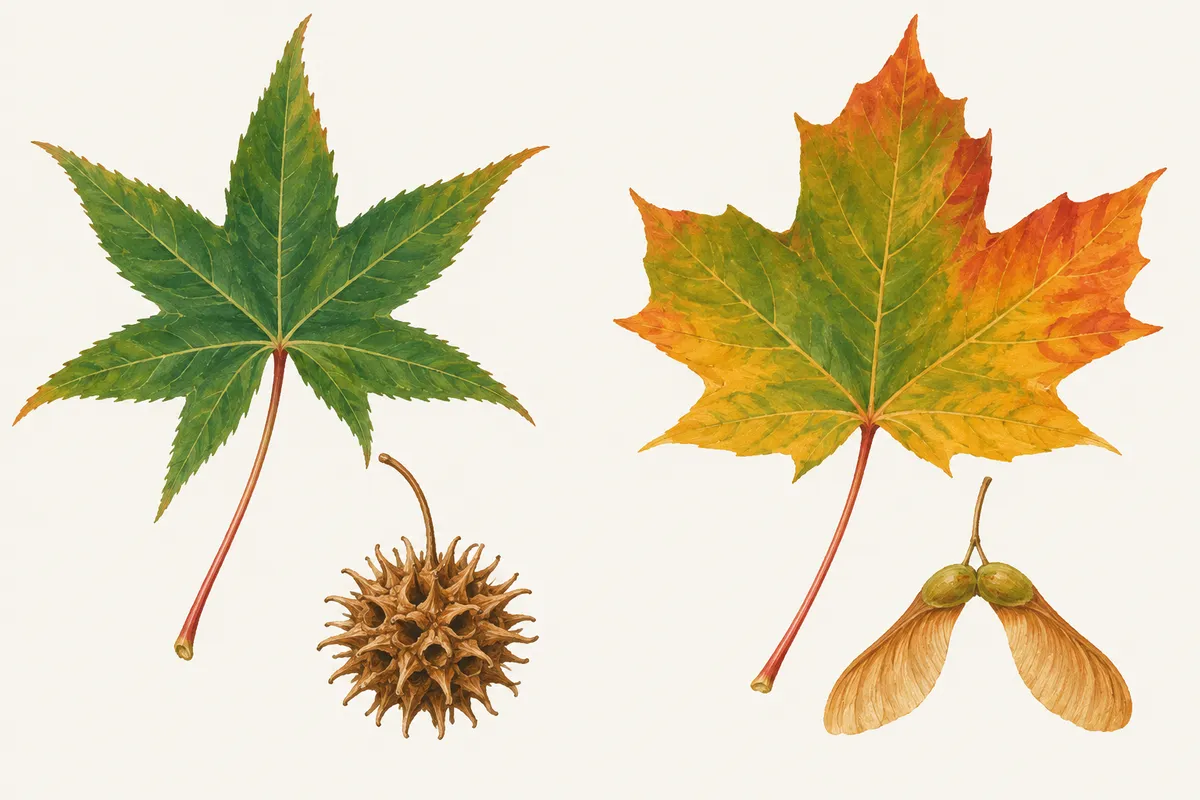
In short
Sweetgum vs maple is settled where the leaf joins the twig: sweetgum leaves are alternate, one per node, and maple leaves are opposite, in pairs. Confirm with the fruit: sweetgum bears a spiny brown ball 1 to 1.5 inches across that hangs on through winter, maples bear paired winged seeds. A crushed sweetgum leaf also smells of camphor, and its 5 to 7 lobes form a neat star.
- Alternate leaves mean sweetgum; opposite leaves mean maple. The test works on every maple, in every season, even from the buds.
- Spiny gumballs under the tree mean sweetgum; paired helicopter seeds mean maple.
- Sweetgum is not a maple at all: it belongs to its own family, Altingiaceae.
Field marks at a glance
- Scientific name
- Liquidambar styraciflua and Acer spp.
- Family
- Altingiaceae (sweetgum); Sapindaceae (maples)
- Type
- Broadleaf, deciduous
- Leaf arrangement
- Sweetgum: alternate, one leaf per node. Maples: opposite, leaves, buds and twigs in pairs.
- Leaf shape
- Sweetgum: a star of 5 to 7 deeply separated, pointed lobes, finely toothed, glossy. Maples: usually 3 to 5 lobes (5 to 7 on Japanese maple) spreading like a hand, edges smooth or toothed by species.
- Leaf size
- Sweetgum: 4 to 8 inches long and wide. Sugar maple: 3 to 6 inches. Red maple: 2 to 4 inches. Japanese maple: 2 to 5 inches.
- Smell
- Sweetgum: crushed leaves smell camphor-like. Maples: no such smell from the leaves.
- Fruit
- Sweetgum: a hard, spiny ball 1 to 1.5 inches across, on a long stalk, brown by fall and hanging on into winter. Maples: paired winged seeds (samaras), from 1/2 inch on red maple to 2 1/2 inches on silver maple.
- Twigs
- Sweetgum: from the second year, often 2 to 4 corky wings along the twig. Maples: no corky wings; buds in opposite pairs.
- Bark
- Sweetgum: grayish brown, deeply furrowed into narrow ridges. Maples: smooth gray when young, later plates (red), strips (silver) or firm ridges (sugar).
- Fall color
- Sweetgum: yellow, orange, red and purple, often all on one tree. Maples: red on red maple, yellow to orange on sugar maple, yellow on Norway maple.
- Family
- Not related: sweetgum is in the sweetgum family (Altingiaceae), maples in the soapberry family (Sapindaceae).
Sweetgum (Liquidambar styraciflua) and the maples share a palm-shaped leaf, red and orange fall color and the same streets and yards across the eastern United States, and people mix them up every autumn. They are not related, and two checks separate them in seconds: how the leaves sit on the twig, and what fruit the tree carries.
Sweetgum vs maple, side by side
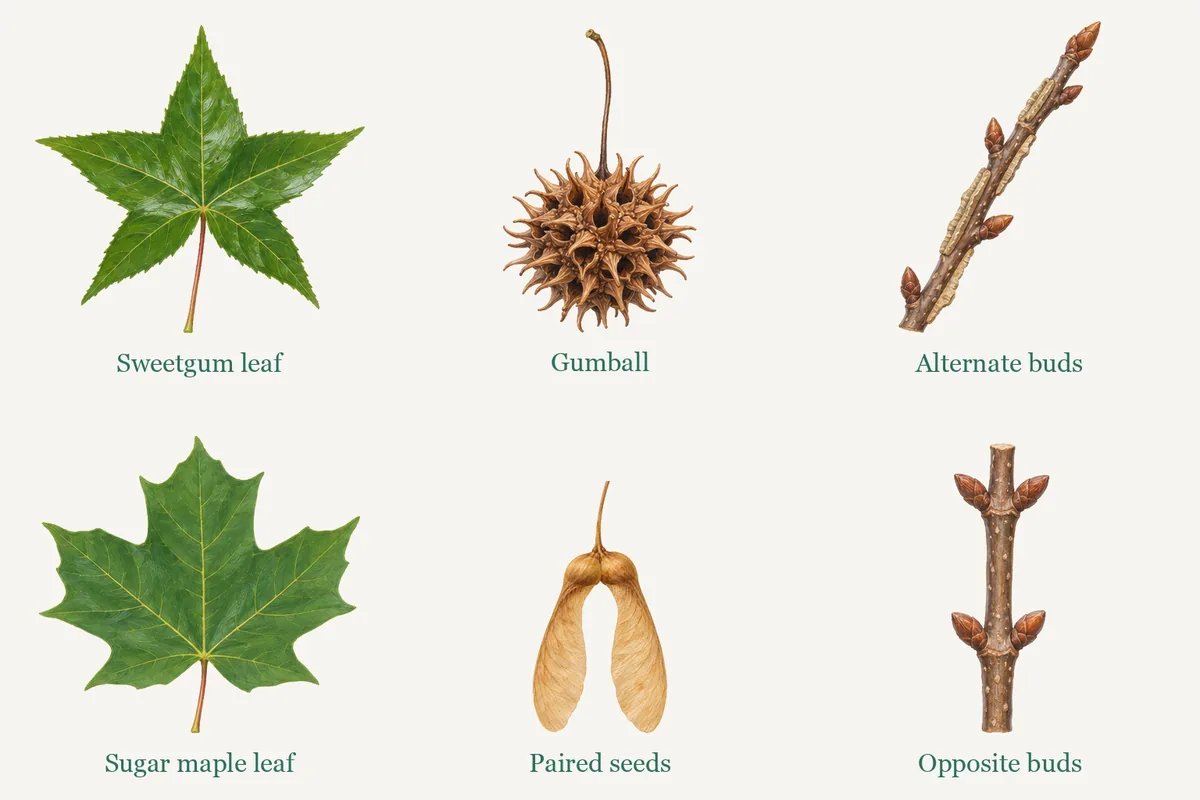
Follow a twig to the point where a leaf attaches. If the leaves come off one at a time, alternating sides, it is a sweetgum. If they come off in pairs facing each other, it is a maple. That single check works for every maple, from sugar and red to Norway and Japanese, and it still works in winter, because the buds follow the same pattern.
| Feature | Sweetgum | Maples |
|---|---|---|
| Leaf arrangement | Alternate, one per node | Opposite, in pairs |
| Leaf outline | Star, 5–7 deeply separated pointed lobes | Hand-shaped, usually 3–5 lobes; 5–7 on Japanese maple |
| Leaf size | 4–8 in long and wide | 2–4 in (red), 3–6 in (sugar), 2–5 in (Japanese) |
| Edge | Finely toothed | Smooth (sugar) or toothed (red, silver, Japanese) |
| Crushed leaf | Camphor-like smell | No camphor smell |
| Fruit | Spiny woody ball, 1–1.5 in | Paired winged seeds, 1/2 in to 2 1/2 in |
| Fruit timing | Brown Sept–Nov, hangs on into winter | Spring (red, silver) or fall (sugar, Norway) |
| Twigs | Often 2–4 corky wings from year two | No corky wings |
| Mature bark | Gray-brown, deeply furrowed, narrow ridges | Plates, strips or firm ridges by species |
| Fall color | Yellow, orange, red and purple on one tree | Red, orange or yellow by species |
Sweetgum figures come from the Morton Arboretum and the USDA Forest Service; maple figures from Virginia Tech Dendrology's fact sheets for red maple, sugar maple and Japanese maple.
The leaves: a star or a hand
Once the arrangement is clear, the leaf itself confirms it. NC State Extension's sweetgum page describes glossy, deep green leaves with 5 to 7 deeply separated, pointed, star-shaped lobes and toothed edges, on long stalks. Morton gives 4 to 8 inches long and wide. The lobes are long and narrow and radiate evenly from the base, so the leaf looks like a five- or seven-pointed star.
Most maple leaves are built differently. Red maple has three main lobes, sometimes five with two small basal ones, 2 to 4 inches long and finely toothed; sugar maple has five lobes and smooth edges, 3 to 6 inches. The lobes spread like fingers from a broad palm rather than from a point, and the notches between them are wider. Japanese maple is the exception that comes closest: Virginia Tech gives it 5 to 7 deep, toothed lobes, but on a leaf only 2 to 5 inches long, often red all season, on a small tree of 10 to 25 feet.
The smell test. Crush a leaf and sniff. Morton describes a camphor-like smell, and NC State calls the leaves fragrant when bruised. No common maple leaf smells like that, so this is a good check when you have only a fallen leaf and cannot see the twig.
When you photograph the tree for Tree Identifier, include a whole twig rather than a single leaf: the arrangement is the decisive clue, and one leaf on a white background does not show it. Sweetgum and four maples (sugar, red, Norway and Japanese) are among the 138 species in the app's Collection.
The fruit: gumballs or helicopters
Fruit is the easiest clue from the ground, because both trees drop theirs where you can pick it up.
Sweetgum gumballs. The USDA Forest Service's Silvics of North America describes a woody head 1 to 1.5 inches (2.5 to 3.8 cm) across made of many small capsules, each releasing one or two small winged seeds. The heads mature from September to November, and many stay on the tree into winter; NC State says most fall between December and April. A spiny brown ball under a star-leaved tree is close to proof of sweetgum. Our guide to trees with spiky balls separates it from sycamore, buckeye and chestnut.
Maple samaras. Every maple bears double samaras, two winged seeds joined at the base. Their size and timing vary: red maple's are 1/2 to 3/4 inch and fall in late spring, sugar maple's about 1 inch in a horseshoe that ripens in fall, and Virginia Tech's silver maple fact sheet gives wings of 1 1/2 to 2 1/2 inches. A maple never has a ball.
Two cases break the fruit test. Young sweetgums carry no balls: the Forest Service says trees start bearing seed at 20 to 30 years. And NC State lists a fruitless cultivar, 'Rotundiloba', planted where gumballs would be a nuisance. On either, go back to the leaf arrangement and the smell.
Twigs, bark and buds in winter
Without leaves, the arrangement test still works on the buds: maples carry them in opposite pairs, sweetgum one at a time along the twig.
Sweetgum adds a mark no maple has. NC State notes that after the second year its twigs may grow two to four corky, wing-like ridges, and Morton describes corky ridges on two-year-old stems. Not every sweetgum shows them, but a twig with corky wings and an alternate bud is not a maple.
Bark is weaker evidence. Morton describes mature sweetgum bark as grayish brown and deeply furrowed into narrow ridges. Maples start smooth and gray, then go their own ways by species: red maple breaks into long scaly plates, silver maple into loose strips, and sugar maple into firm ridges that curl outward. The maple identification page has the bud and bark marks for each maple.
Fall color and where each grows
Both trees are prized for fall color, which is why the confusion peaks in October. NC State describes sweetgum at its best as a brilliant mixture of yellows, oranges, purples and reds, often on one tree at the same time. Among maples, red maple is the red one, sugar maple runs from yellow to burnt orange, and Norway maple turns yellow. A single crown mixing purple, red and yellow leaves leans toward sweetgum; the guide to trees with red leaves in fall compares the other red trees of the same woods.
Range helps in the wild, less in towns. The Forest Service gives sweetgum's native range from Connecticut south to central Florida and eastern Texas, west to Missouri, Arkansas and Oklahoma, and north to southern Illinois, mostly on moist river-bottom soils. Sugar maple is a northern and Appalachian tree, red maple grows nearly everywhere in the East, and planted trees of both genera turn up far outside their native ranges. A star-leaved tree in a Southern bottomland forest is very likely sweetgum; on a Northern street, check the twig.
For everything else about the star-leaved tree, its flowers, cultivars and size, see the sweetgum page. If your leaf is alternate but not star-shaped, and the tree has peeling white bark, the sycamore vs maple page covers the other alternate-leaved maple look-alike.
Look-alikes and how to tell them apart
American sycamore (Platanus occidentalis)
Alternate like sweetgum, but its leaves are usually wider than long, with 3 to 5 shallow, coarsely toothed lobes, and the base of the leaf stalk covers the bud. Its seed ball is fuzzy, 0.5 to 1 inch, on a stalk 3 to 6 inches long, and the bark peels to cream.
Japanese maple (Acer palmatum)
Its 5 to 7 deep, toothed lobes make the most star-like maple leaf, but the leaves are opposite and only 2 to 5 inches long, often red all season, on a small tree of 10 to 25 feet with paired winged seeds.
What a photo can't settle
- A single leaf photo does not show whether leaves are alternate or opposite; photograph a whole twig, or check it on the tree.
- Young sweetgums and the fruitless cultivar 'Rotundiloba' carry no gumballs, so a tree without them can still be a sweetgum.
- Tree Identifier names one tree from one photo, with no confidence score and no look-alike list; confirm a sweetgum or maple answer with the leaf arrangement.
Questions people ask
Is a sweetgum tree a type of maple?
No. Sweetgum (Liquidambar styraciflua) belongs to the sweetgum family, Altingiaceae, and maples to the genus Acer in the soapberry family. The leaves look alike, but sweetgum leaves are alternate and its fruit is a spiny ball, while maple leaves are opposite and maple fruit is a pair of winged seeds.
How can you tell a sweetgum from a maple in winter?
Look at the buds and twigs: maple buds sit in opposite pairs, sweetgum buds one at a time. Sweetgum twigs often carry two to four corky wings from their second year, and brown gumballs usually hang in the bare crown; NC State Extension says most fall between December and April.
Which maple looks most like a sweetgum?
Japanese maple, whose leaf has 5 to 7 deep, toothed lobes in a star-like spread, and red maple, whose three-lobed, toothed leaves turn red in the same woods. Both have opposite leaves and winged seeds.
Do sweetgum leaves smell?
Yes. The Morton Arboretum describes a camphor-like smell from crushed leaves, and NC State Extension calls them fragrant when bruised. Crushing a leaf is a quick field check, because maple leaves do not smell like that.
Is there a sweetgum without gumballs?
Yes. NC State Extension lists the cultivar 'Rotundiloba' as producing no gumballs, and the USDA Forest Service says sweetgums only start bearing seed at 20 to 30 years. On a tree without balls, use the alternate leaves and the camphor smell.
Sources
- Sweet-gum (Liquidambar styraciflua) — The Morton Arboretum
- Liquidambar styraciflua (American sweetgum) — North Carolina Extension Gardener Plant Toolbox, NC State University
- Sweetgum (Liquidambar styraciflua), Silvics of North America — USDA Forest Service
- Red maple fact sheet — Virginia Tech Dendrology
- Sugar maple fact sheet — Virginia Tech Dendrology
- Japanese maple fact sheet — Virginia Tech Dendrology
- Platanus occidentalis (American sycamore) — North Carolina Extension Gardener Plant Toolbox, NC State University
- Silver maple fact sheet — Virginia Tech Dendrology
Keep reading
- Tree profileSweetgum tree (Liquidambar styraciflua): how to identify it
- Tree profileMaple trees (Acer): how to identify them
- Clue guideWhich tree has spiky balls? Six candidates and how to tell them
- Tree comparisonSycamore vs maple: how to tell them apart
- Clue guideWhich trees have red leaves in fall? Sort them by leaf shape