Tree profile
Utah juniper (Juniperus osteosperma): how to identify it
The squat, gray-barked juniper of the Great Basin and the Colorado Plateau, with brown, dry "berries" where most junipers carry blue ones.
In short
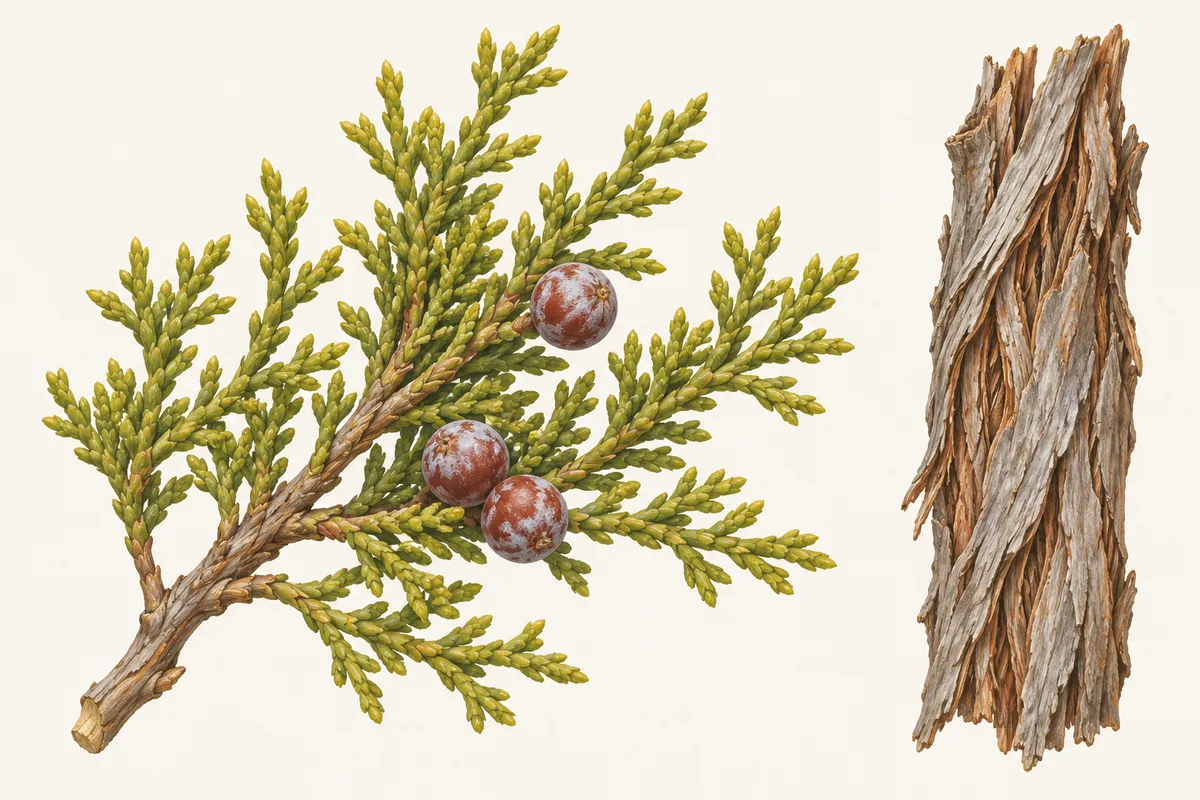
Utah juniper identification rests on three checks: yellow-green scale leaves in opposite pairs with no resin dot, berry-like cones 1/4 to 1/2 inch across that turn reddish brown and dry after two seasons, and a short, often many-stemmed tree under about 25 feet with gray, shreddy bark. Most trees carry both pollen and seed cones.
- Brown, dry, mealy cones with a whitish bloom set Utah juniper apart from the blue, juicy cones of Rocky Mountain, oneseed and western juniper.
- Its scale leaves have no active resin gland; western juniper's carry an obvious resin dot.
- About 90% of Utah junipers are monoecious, so almost every tree can carry cones.
Field marks at a glance
- Scientific name
- Juniperus osteosperma
- Family
- Cupressaceae (cypress family)
- Type
- Conifer, evergreen
- Leaves
- Tiny scale leaves in opposite pairs, pressed tight to the twig so it looks slightly four-sided; yellow-green; no resin gland on the back. A few sharp awl-like leaves on vigorous shoots.
- Cones
- Berry-like, round, 1/4 to 1/2 inch (Virginia Tech; USU gives up to 3/4 inch); bluish with bloom when young, reddish brown and dry when ripe; two seasons to mature; 1 or 2 seeds.
- Sexes
- Usually monoecious: pollen cones and seed cones on the same tree, in about 90% of plants (Gymnosperm Database).
- Bark
- Thin, gray, fibrous, with irregular furrows and scaly ridges that peel in long strips; pale reddish brown underneath.
- Twigs
- Slender and angular, densely clumped at branch ends; coarser and stiffer than Rocky Mountain juniper's.
- Form
- Shrubby tree, often several stems from a low fork, with low branches and a rounded crown; usually about 15 feet, up to about 25 feet (Virginia Tech).
- Range
- Arizona, California, Colorado, Idaho, Montana, Nevada, New Mexico, Utah and Wyoming, mostly between about 4,300 and 8,500 feet (1,300 to 2,600 m); the dominant juniper of Utah.
- Habitat
- Dry, rocky soils and slopes, often in pure stands or with singleleaf pinyon; shade intolerant.
Utah juniper is the low, gray, many-stemmed evergreen that dots the hills between the Rockies and the Sierra Nevada, often with a pinyon pine for company. It is one of the most numerous trees in the American West: the USDA Forest Service's inventory (EVALIDator) counts about 2.7 billion live Utah junipers on forest land in the lower 48 states, 34th of all species. Telling it from the other western junipers takes a ripe cone, a look at the leaf backs and a glance at the trunk.
How to identify Utah juniper
Work through these checks in order. The first two settle most trees.
1. Ripe cones: reddish brown and dry. Junipers carry small, fleshy cones that look like berries. Virginia Tech's Utah juniper fact sheet describes them as round, 1/4 to 1/2 inch across, bluish and frosted with a bloom when young, then reddish brown and dry when mature, usually with two seeds, sometimes one. Utah State University Extension's Utah juniper page gives a wider range, 1/4 to 3/4 inch, red-brown, often with a white waxy coat and usually one seed. The cones take two growing seasons to ripen, so a tree can carry small bluish cones and larger brown ones at once. Crush a ripe one: it is mealy, not juicy.
2. Leaves: yellow-green scales with no resin dot. Adult foliage is tiny scales pressed tight to the twig in opposite pairs, which makes the shoot look slightly four-sided. Virginia Tech notes that the scales have no glands, so they lack the resin dot that other junipers show on the back of each scale. The Gymnosperm Database puts it more precisely: Utah juniper is the only species in its group with no active glands on its scale leaves. Vigorous shoots carry a few sharp, awl-like leaves.
3. Form: short, stout and often many-stemmed. Utah juniper is a small, shrubby tree with low branches and a rounded crown. USU gives a typical height of about 15 feet, Virginia Tech up to 25 feet. Trunks often fork near the ground into several stems.
4. Bark: gray and stringy. The bark is thin, gray and fibrous, with irregular furrows and scaly ridges. The Gymnosperm Database describes it peeling in long strips, pale reddish brown underneath and weathering pale gray or ashy white.
5. Cones on almost every tree. Most junipers are dioecious, with berries only on female trees. Utah juniper is usually monoecious: the Gymnosperm Database counts about 90% of plants carrying both pollen and seed cones. A large juniper with no cones anywhere on it is less likely to be this species.
If the scales are on flat, fern-like sprays and the cones are woody and open, you are looking at an arborvitae or a cypress instead; the juniper overview sorts the genus from its relatives.
Utah juniper vs Rocky Mountain, oneseed and western juniper
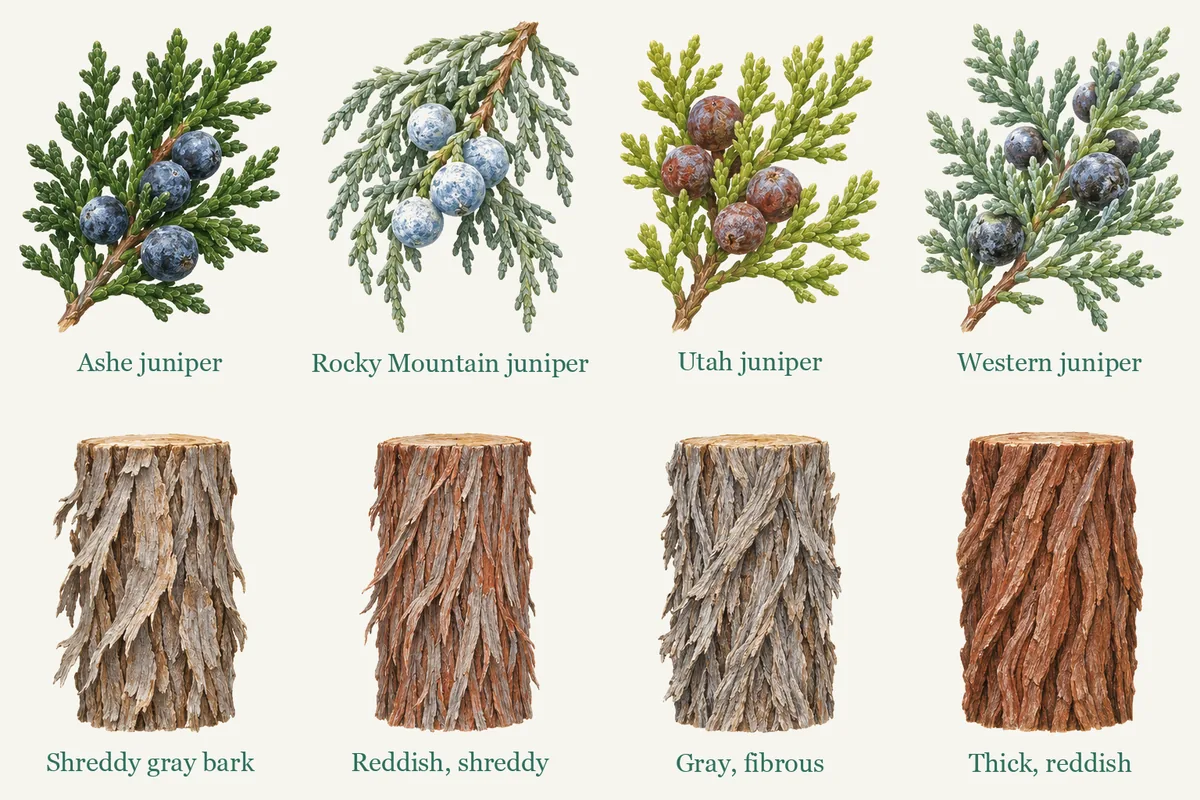
Four scale-leaved junipers share the interior West, and their ranges overlap. Cone color and juiciness, glands and growth habit separate them.
| Juniper | Ripe cone | Scale leaves | Sexes | Form |
|---|---|---|---|---|
| Utah (J. osteosperma) | Reddish brown, dry, 1/4–1/2 in, 1–2 seeds, two seasons | Opposite pairs, yellow-green, no active gland | Usually on one tree | Often several stems, to about 25 ft |
| Rocky Mountain (J. scopulorum) | Blue with bloom, juicy | Opposite pairs, darker green, no resin dot | Separate trees | Usually one trunk |
| Oneseed (J. monosperma) | Bluish brown, soft and juicy, about 1/4 in, one seed, one season | Opposite pairs, yellow- to gray-green | Separate trees | Shrubby, to 25 ft |
| Western (J. occidentalis) | Bluish black with bloom, about 1/4 in, two seasons | Mostly in threes, resin-dotted, aromatic | Mixed | One short, thick trunk, 20 to 60 ft |
Sources: Virginia Tech fact sheets for Utah, oneseed and western juniper; the Gymnosperm Database for Rocky Mountain juniper's sex, stem habit and color, and Oregon State University's Trees of the Pacific Northwest for its lack of resin dots.
The Gymnosperm Database adds two checks for Rocky Mountain juniper: it usually grows at higher elevations than Utah juniper, and its scale margins are smooth under 20x magnification. USU notes that Rocky Mountain juniper's twigs are finer and less stiff, and the trees can grow larger. Rocky Mountain juniper also appears in our Rocky Mountain tree guide, at 5,000 to 9,000 feet in the foothills.
Western juniper is the one to check in northeastern California, Oregon and southwestern Idaho. It is usually single-stemmed, averages about 7 m (23 feet) against Utah juniper's 4 m (13 feet), has browner bark and carries active resin glands. In northwestern Nevada the two species hybridize, and the Gymnosperm Database describes the hybrids as intermediate in stem number, height, gland visibility and cone size.
Where Utah juniper grows
The Gymnosperm Database lists Utah juniper in Arizona, California, Colorado, Idaho, Montana, Nevada, New Mexico, Utah and Wyoming, at about 1,300 to 2,600 m (4,300 to 8,500 feet) on dry, rocky soils and slopes. USU places it in the west-central Rockies and the Great Basin at middle elevations, including most of Utah, and calls it tolerant of drought, cold, heat and poor soil but intolerant of shade.
It is the juniper half of the pinyon-juniper woodland, the characteristic forest of the interior West. The Gymnosperm Database calls the pairing of singleleaf pinyon (Pinus monophylla) and Utah juniper the most common version, and describes Utah juniper as "the dominant juniper of Utah", often in pure stands. It also spreads into sagebrush grassland, typically where yearly precipitation is about 305 to 457 mm (12 to 18 inches). Low, scattered evergreens on a dry hillside in Nevada or Utah are a good first guess; our desert tree guide covers palo verde, mesquite, ironwood and the other trees of the hotter Sonoran and Mojave deserts.
Age, size and wood
Utah juniper grows slowly and lives long. The Gymnosperm Database reports a tree from the Crawford Mountains of Utah crossdated at 1,967 years, and maximum sizes of about 12 m (39 feet) tall and 100 cm (39 inches) through the trunk. Most trees are much smaller; a twisted, half-dead juniper on a ridge can be very old without being big.
USU notes the wood is little used except for fence posts and firewood: yellow-brown, very durable heartwood and white sapwood. Fire is the most common cause of death, according to the Gymnosperm Database, and the tree has low fire resistance.
Never eat juniper cones on the strength of a web page or an app. Juniper "berries" from different species vary, and identification from a photo is not a safe basis for tasting anything.
Photographing a Utah juniper
Pick a branch tip with ripe cones and take one sharp photo of the cones and scale leaves together, then a second of the trunk base showing the stems and bark. Tree Identifier names the tree from one photo, with common and scientific names but no confidence score and no list of look-alikes, so check the result against the cone color and leaf tests above. If the answer is a juniper you did not expect, ask the follow-up chat what separates it from Utah juniper. With location turned on, Tree Identifier's Tree Map pins the find, which helps in pinyon-juniper country where one hillside can hold several species. For other scale-leaved trees, the cedar vs juniper page and the conifer identification guide are the next stops.
Look-alikes and how to tell them apart
Rocky Mountain juniper (Juniperus scopulorum)
Rocky Mountain juniper carries blue, juicy cones with a bloom, is dioecious, usually grows on one trunk and is a darker green. Its twigs are finer and less stiff, and it tends to grow higher up the slope than Utah juniper.
Oneseed juniper (Juniperus monosperma)
Oneseed juniper's cones are about 1/4 inch, bluish brown, soft and juicy, with one seed, and ripen in one season. It is dioecious, so only female trees fruit. Squeeze a ripe cone: juicy points to oneseed, dry and mealy to Utah.
Western juniper (Juniperus occidentalis)
Western juniper's scales sit mostly in threes, each with a conspicuous resin dot, and its ripe cones are bluish black. It usually grows on one trunk with brownish bark, and it replaces Utah juniper north and west, in Oregon and northeastern California.
Alligator juniper (Juniperus deppeana)
Alligator juniper's bark breaks into square, checkered plates like alligator skin. Utah juniper's bark is gray and peels in long, fibrous strips.
Arizona cypress (Cupressus arizonica)
Arizona cypress also has scale leaves, but its cones are woody balls whose scales split apart when ripe. A juniper cone stays closed and fleshy, like a berry, and never opens.
What a photo can't settle
- Utah juniper hybridizes with western juniper in northwestern Nevada (Gymnosperm Database); intermediate trees there do not match either description, and no photo app can sort them.
- Resin glands and leaf margins are best seen with a 10x to 20x hand lens; a phone photo of foliage rarely shows them.
- Young cones of Utah juniper are bluish, like other junipers; the brown, dry test only works on ripe, second-year cones.
Questions people ask
Why are the berries on my juniper brown instead of blue?
If you are in the Great Basin or on the Colorado Plateau, it is probably a Utah juniper. Virginia Tech describes its cones as bluish when young, turning reddish brown and dry at maturity. Rocky Mountain, oneseed and western juniper all ripen blue or bluish black cones.
Is Utah juniper a cedar?
No, though many people in the West call junipers cedars. Utah juniper is Juniperus osteosperma, in the cypress family. True cedars (Cedrus) are planted Old World trees with needles in tufts and upright, barrel-shaped cones.
How old can a Utah juniper get?
Very old. The Gymnosperm Database lists a Utah juniper from the Crawford Mountains of Utah dated by tree rings at 1,967 years. Most trees are far younger, but a squat, twisted juniper on a rocky ridge can easily be centuries old.
Does Utah juniper have male and female trees?
Mostly not. Virginia Tech calls it usually monoecious, and the Gymnosperm Database puts monoecious plants at about 90%. That sets it apart from Rocky Mountain and oneseed juniper, where pollen and seed cones grow on separate trees.
How tall does a Utah juniper grow?
Usually small. Utah State University Extension gives about 15 feet, Virginia Tech up to 25 feet, and the Gymnosperm Database an average of about 4 m (13 feet) with a maximum near 12 m (39 feet). Many trees are wider than they are tall.
Sources
- Utah juniper fact sheet — Virginia Tech Dendrology
- Utah Juniper — Utah State University Forestry Extension
- Juniperus osteosperma (Utah juniper) — The Gymnosperm Database
- Oneseed juniper fact sheet — Virginia Tech Dendrology
- Western juniper fact sheet — Virginia Tech Dendrology
- Juniper species: western, Rocky Mountain and common juniper — Oregon State University, Trees of the Pacific Northwest
- EVALIDator (FIADB-API 2.0): number of live trees on forest land by species, 48 conterminous states — USDA Forest Service, Forest Inventory and Analysis
Keep reading
- Tree profileJuniper trees: how to identify them
- Tree comparisonCedar vs juniper: how to tell the trees apart
- Regional guideRocky Mountain tree identification, from foothills to treeline
- Regional guideDesert tree identification in the American Southwest
- Field guideConifer identification: three questions about the needles, then the cone