Tree profile
Western juniper (Juniperus occidentalis): how to identify it
The juniper of eastern Oregon's high desert, scattered over sagebrush hills like polka dots, with aromatic, resin-dotted foliage and frosted blue-black berries.
In short
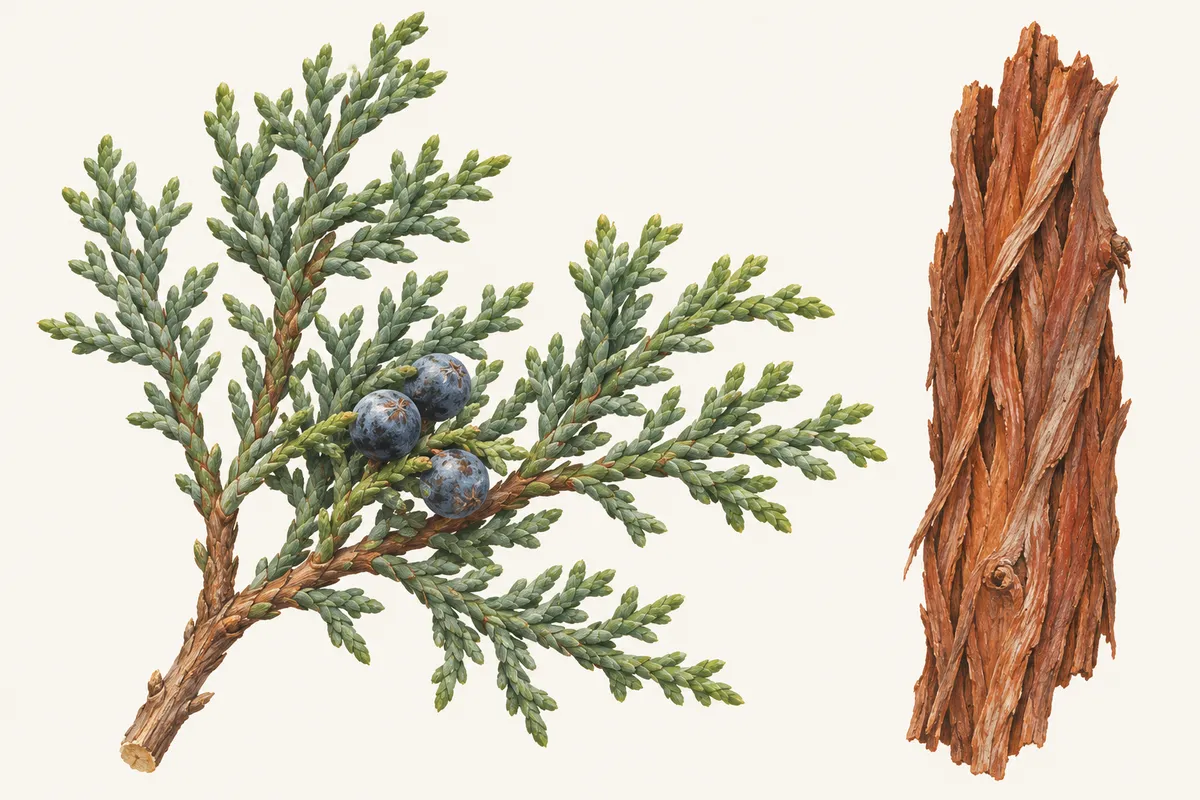
Western juniper identification: look for scale and awl leaves mostly in whorls of three, each with a white or clear resin dot on its back and a strong smell when crushed; bluish-black berry-like cones about 1/4 inch with a white bloom, ripening in their second year; thin reddish-brown fibrous bark; and a short, thick, single trunk on a tree 20 to 60 feet tall.
- A resin dot on the back of each scale separates western juniper from Rocky Mountain and Utah juniper, which lack an active one.
- Western juniper is the common juniper of the high desert of eastern Oregon, southwestern Idaho and northeastern California.
- The Sierra Nevada's big junipers, once treated as a southern subspecies, are now usually called Sierra juniper, Juniperus grandis.
Field marks at a glance
- Scientific name
- Juniperus occidentalis
- Family
- Cupressaceae (cypress family)
- Type
- Conifer, evergreen
- Leaves
- Scale leaves and short awl leaves, mostly in whorls of three, some in pairs, pressed to the twig; each with a white or clear resin dot on the back; very aromatic. Scales 2 to 3 mm; foliage can bronze in winter.
- Cones
- Berry-like, about 1/4 inch (6 to 8 mm), bluish black with a white bloom, ripening in September of the second season; usually 2 or 3 seeds, sometimes 1.
- Bark
- Thin, under 1 inch, reddish brown and fibrous, weathering grayish brown, with broad, shallow furrows and flat ridges.
- Form
- Small tree 20 to 60 feet tall with a short, thick, many-branched trunk, usually single-stemmed; young trees pyramidal, old ones round-crowned, gnarled and often dead-topped.
- Sexes
- Mixed: Virginia Tech calls it usually dioecious, occasionally monoecious; the USDA Forest Service calls the northern form submonoecious.
- Range
- Southeastern Washington and central Oregon south through southwestern Idaho, northwestern Nevada and northeastern California; most abundant in central Oregon.
- Habitat
- Semiarid hills and plateaus with 9 to 14 inches of precipitation, mostly with big sagebrush; about 600 to 10,000 feet in elevation.
Drive east over the Cascades into central Oregon and the hills fill with round, dark evergreens spaced across the sagebrush, the trees an Oregon State University fact sheet says have been described as "polka-dots on the hillsides". They are western junipers, Juniperus occidentalis. The USDA Forest Service's inventory (EVALIDator) counts about 448 million live western junipers on US forest land, 116th of all species, and the number has been growing.
How to identify western juniper
Check the foliage first, then the cones, then the trunk.
1. Scales mostly in threes, each with a resin dot. Virginia Tech's western juniper fact sheet describes a mix of scale-like and awl-like leaves, mostly in whorls of three with some in opposite pairs, pressed to the twig but with free awl tips. Their backs are glandular, resin-dotted and very aromatic. Oregon State University's Trees of the Pacific Northwest describes a white or clear resin dot on the back of each, and gives it as the key difference from Rocky Mountain juniper, which has none. Crush a twig: the smell is strong.
2. Bluish-black, frosted cones. The berry-like cones are round, about 1/4 inch, green when young and bluish black at maturity, "always with a white bloom" according to Virginia Tech. The USDA Forest Service's Silvics of North America gives 6 to 8 mm, very glaucous, ripening in September of the second season in Oregon, Washington and Idaho, with 2 or 3 seeds, rarely one. Because cones take two years, a branch often carries green and blue-black cones together.
3. A short, thick trunk. Virginia Tech describes a small tree of dry sites, 20 to 60 feet tall and 1 to 3 feet through, with a short, thick, many-branched trunk. The Forest Service adds that the trunk tapers sharply and is often slightly fluted at the base. The Gymnosperm Database notes it is usually single-stemmed, with thick branches that are often curved or contorted.
4. Reddish-brown, fibrous bark. The bark is thin, under an inch, reddish brown and weathering grayish brown, with broad, shallow furrows and flattened ridges (Virginia Tech); older bark peels in thin strips (Gymnosperm Database).
5. Age shows in the crown. The Forest Service describes saplings with straight trunks and pointed to rounded crowns, mature trees with full crowns and heavy limbs, and old trees that are ragged, gnarled and dead-topped.
Western juniper vs Utah, Rocky Mountain and Sierra juniper
| Juniper | Scales | Ripe cone | Trunk | Where |
|---|---|---|---|---|
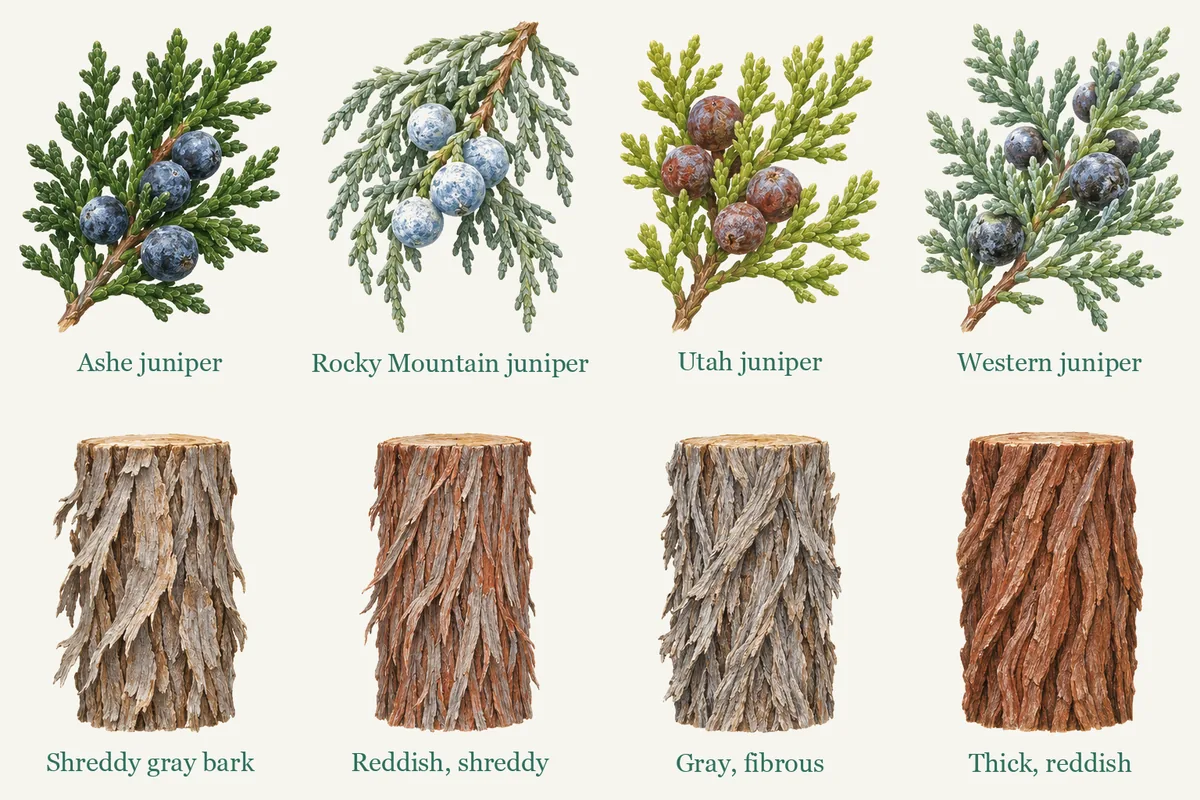
| Western (J. occidentalis) | Mostly in threes, resin dot on each, very aromatic | Bluish black with white bloom, about 1/4 in, 2 seasons | One short, thick trunk, reddish-brown bark | Eastern Oregon, SW Idaho, NE California |
| Utah (J. osteosperma) | Opposite pairs, yellow-green, no active gland | Reddish brown and dry, 1/4–1/2 in | Often several stems, gray bark | Great Basin and Colorado Plateau |
| Rocky Mountain (J. scopulorum) | Pairs, often blue or blue-gray, no resin dot | Blue, juicy, with bloom | Usually one trunk | In and near the Rocky Mountains |
| Common (J. communis) | Only needles, about 1/2 in | Blue | Matted shrub in the Northwest | Limited in Oregon; one of the widest ranges of any woody plant |
Utah juniper is the one to check in northwestern Nevada and the eastern edge of the range. The Gymnosperm Database's Utah juniper page describes western juniper as often single-stemmed and larger, averaging 7 m (23 feet) against Utah juniper's 4 m, with browner bark and active glands. The two hybridize in northwestern Nevada, and the hybrids are intermediate in stem number, height, gland visibility and cone size. Our Utah juniper page covers its dry brown cones in detail, and the juniper overview sets out the rest of the genus.
Sierra juniper. The Forest Service's Silvics divides western juniper into two subspecies: occidentalis in the north, submonoecious, and australis in the south, dioecious, which it also calls Sierra juniper. The Gymnosperm Database reports that Adams and colleagues raised the southern form to species rank in 2006 as Juniperus grandis, citing consistent differences in form and DNA. The giant junipers of the high Sierra Nevada belong to that tree; the scattered junipers of the Oregon high desert are western juniper in the strict sense.
Where western juniper grows
The Silvics gives the range as southeastern Washington south into California, with its greatest abundance and largest continuous stands in central Oregon: about 2,816,000 acres from north-central to south-central Oregon and about 400,000 acres in southwestern Idaho. The only native stand west of the Cascades in Oregon is near Mount Ashland. Elevations run from about 600 feet along the Columbia River to over 10,000 feet in the Sierra Nevada, with the big central Oregon stands at 2,200 to 5,000 feet.
The climate is semiarid, with 9 to 14 inches of precipitation a year, mostly snow in winter and rain in spring and fall. Big sagebrush is its most common shrub companion; at the lower edge of the forest it meets ponderosa pine and curlleaf mountain-mahogany. Our Pacific Northwest tree guide covers the wetter forests west of the Cascades.
Western juniper has been on the move. The Forest Service explains that fire once confined it to rocky, protected sites; fire control and intensive grazing, which removed the grass that carried fire, let it spread into mountain big sagebrush in Oregon, Idaho and northeastern California. Oregon State University's western juniper fact sheet puts the increase in population and area at three- to ten-fold over about the last 150 years, and notes that dense stands often have little understory left.
Age, wood and a photo to take
The Forest Service estimates western junipers live more than 1,000 years, with old-growth stands in central Oregon 200 to 400 years old; the Gymnosperm Database reports a sampled tree aged at 1,600 years. Old trees are the gnarled, dead-topped ones on rock outcrops and thin soils, where fire rarely reached.
Oregon State University describes the heartwood as highly durable and aromatic, like that of its relative eastern red cedar, varying from milky white to deep reddish brown, and used mostly for fence posts and firewood.
Never eat juniper cones on the strength of a web page or an app; a photo identification is not a basis for tasting anything.
For identification, photograph a twig with cones close enough to show the leaf arrangement, then the trunk. Tree Identifier names a tree from one photo, with common and scientific names but no confidence score and no list of look-alikes, so check the resin dots and cone color yourself. With location turned on, its Tree Map pins where you found the tree, and the follow-up chat answers questions about the species it names.
Look-alikes and how to tell them apart
Utah juniper (Juniperus osteosperma)
Utah juniper's scales sit in opposite pairs with no active resin gland, its ripe cones are reddish brown and dry, and it often grows as several short stems. Western juniper has resin-dotted scales mostly in threes and bluish-black cones on one thick trunk.
Rocky Mountain juniper (Juniperus scopulorum)
Oregon State University's key gives the difference in one line: Rocky Mountain juniper has no resin dots on its scales. Its scales sit in pairs and are often blue or blue-gray, and it grows mainly in and near the Rocky Mountains.
Sierra juniper (Juniperus grandis)
Sierra juniper is the high-elevation juniper of the Sierra Nevada, once treated as a southern subspecies of western juniper. The USDA Forest Service describes that southern form as dioecious; where you are in California is the practical test.
Common juniper (Juniperus communis)
Common juniper has only sharp needles, about 1/2 inch long, never scales, and in the Pacific Northwest it grows as a low, matted shrub rather than a tree.
What a photo can't settle
- Resin dots are tiny; a phone photo of a branch rarely shows them clearly, so check with a hand lens before ruling out Utah or Rocky Mountain juniper.
- Western juniper hybridizes with Utah juniper in northwestern Nevada (Gymnosperm Database); intermediate trees there fit neither description.
- Botanists disagree on whether Sierra juniper is a subspecies of western juniper or its own species; a photo app may give either name for a Sierra Nevada tree.
Questions people ask
Is western juniper a cedar?
No. It is Juniperus occidentalis, a juniper in the cypress family. Its fleshy, berry-like cones are the giveaway: true cedars and western redcedar both carry woody cones.
Why is western juniper spreading?
The USDA Forest Service says fire once kept western juniper on rocky, protected sites; fire control and heavy livestock grazing, which removed the grass that carried fire, let it move into sagebrush. Oregon State University puts the increase in area at three- to ten-fold over about the last 150 years.
How old can a western juniper be?
The USDA Forest Service estimates more than 1,000 years, and the Gymnosperm Database reports a sampled tree aged at 1,600 years. Old-growth stands in central Oregon are mostly 200 to 400 years old, so a gnarled, dead-topped tree on a rock outcrop may be ancient.
How big does western juniper get?
Virginia Tech gives 20 to 60 feet tall and 1 to 3 feet through the trunk. The USDA Forest Service's record tree, on the Stanislaus National Forest in California, measured 87 feet tall and 163 inches in diameter; Sierra Nevada junipers like it are now often treated as a separate species, Sierra juniper.
Where does western juniper grow?
In the high desert of eastern Oregon, southwestern Idaho and northeastern California, with outliers in southeastern Washington and northwestern Nevada. The USDA Forest Service counts about 2.8 million acres from north-central to south-central Oregon, its center, and about 400,000 acres in southwestern Idaho.
Sources
- Western Juniper, Silvics of North America — USDA Forest Service
- Western juniper fact sheet — Virginia Tech Dendrology
- Juniper species: western, Rocky Mountain and common juniper — Oregon State University, Trees of the Pacific Northwest
- Western Juniper Factsheet — Oregon State University, College of Forestry
- Juniperus occidentalis (western juniper) — The Gymnosperm Database
- Juniperus osteosperma (Utah juniper) — The Gymnosperm Database
- EVALIDator (FIADB-API 2.0): number of live trees on forest land by species, 48 conterminous states — USDA Forest Service, Forest Inventory and Analysis