Tree profile
Western larch (Larix occidentalis): how to identify it
The biggest larch in the world, and a conifer that turns gold and drops every needle in fall. Find the tufts, turn over a cone, then read the bark.
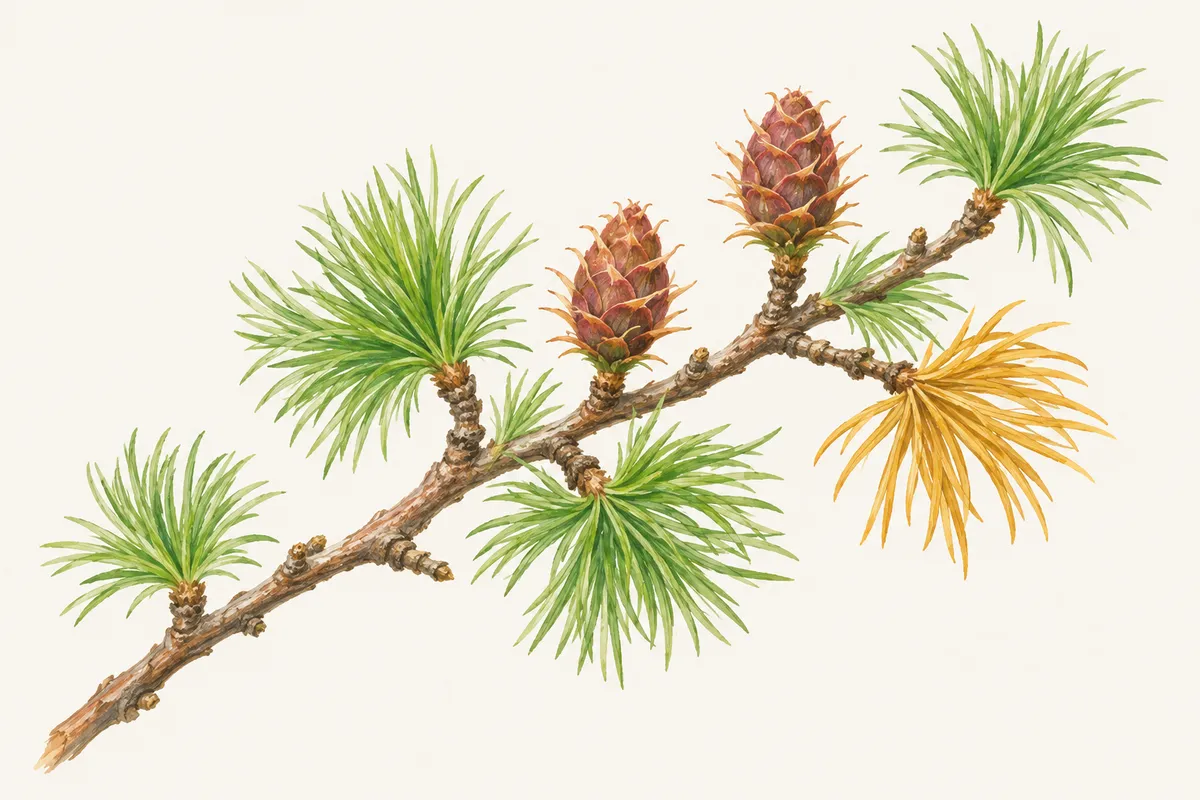
In short
Western larch identification starts with the needles: soft, pale green, 3-angled, 1 to 2 inches (2 to 5 cm) long, in tufts of 15 to 30 on short spur shoots, turning gold and falling each autumn. The cones are 1 to 1.8 inches (2.5 to 4.5 cm), with a pointed bract poking out past every scale, and old trunks carry thick, deeply furrowed, cinnamon to reddish-brown bark.
- A conifer in the inland Northwest that turns gold and goes bare in autumn is a larch; the Montana Field Guide calls western larch very common at low to moderate elevations.
- Western larch cones are 3 to 5 cm with bracts sticking out beyond the scales; tamarack cones are under 2 cm with hidden bracts.
- Subalpine larch grows higher, near timberline, with densely woolly twigs that stay hairy for 2 to 3 years.
Field marks at a glance
- Scientific name
- Larix occidentalis
- Family
- Pinaceae (pine family)
- Type
- Conifer, deciduous
- Needles
- Soft, 3-angled, shiny pale green, 3 to 5 cm (NRCan; 2 to 5 cm in the Montana Field Guide), in tufts of 15 to 30 on short spur shoots; single along new long shoots.
- Fall
- Needles turn gold in autumn and fall; the tree stands bare all winter (USDA Forest Service).
- Cones
- Egg-shaped, 2.5 to 4.5 cm (1 to 1.8 in), reddish-brown, about 30 scales; a bract tip sticks out past every scale. Young cones are red, 1 to 2 cm.
- Cone timing
- Ripe by mid to late August, opening in early September; most seed is shed by mid-October, and cones fall the following winter.
- Twigs and buds
- Young twigs hairy, turning hairless during the summer, orange-brown; buds dark brown; spur shoots downy.
- Bark
- Scaly when young; on old trees thick (up to 15 cm), deeply furrowed, reddish-brown, with flat, flaky, cinnamon-colored plates.
- Form
- Tall, straight trunk, often without branches for most of its height on old trees; a short, open crown.
- Size and age
- Usually 100 to 180 ft (30 to 55 m), occasionally over 200 ft; trees over 90 in in diameter and 900 years old have been found (USDA Forest Service).
- Native range
- Northwestern Montana, northern and west-central Idaho, northeastern Washington and southeastern British Columbia into Alberta; east slopes of the Cascades in Washington and north-central Oregon; Blue and Wallowa Mountains.
Western larch (Larix occidentalis) is the tree that turns the mountainsides of western Montana, Idaho and eastern Washington gold in October. It is a conifer, but it drops all its needles each year, and the USDA Forest Service calls it the largest of the world's larches. In summer it hides among Douglas-fir and ponderosa pine; in fall it stands out for miles. Our larch identification page covers the genus and the planted European and Japanese larches; this page is about the native tree of the inland Northwest.
How to identify a western larch
Check these four things in order.
1. Needles in tufts. Natural Resources Canada's western larch fact sheet describes soft, shiny, pale green needles 3 to 5 cm long, flattened on top and keeled beneath so they look triangular in section, in tufts of 15 to 30 on short spur shoots. The Montana Field Guide gives 2 to 5 cm. Along the new shoots of the year, needles grow singly.
2. The season. The Forest Service's Silvics of North America describes the delicate foliage changing from light green to gold in fall. Then the needles drop and the tree stands bare until spring. A conifer that is gold all over in October, among green pines and firs, is the easiest larch clue there is.
3. The cone. Mature cones are egg-shaped, 3 to 5 cm long, reddish-brown, with about 30 scales, and the tip of a bract sticks out past each scale (NRCan). The Forest Service gives 2.5 to 4.5 cm. Young cones in early summer are red and only 1 to 2 cm. Cones ripen by mid to late August, open in early September, and usually fall the following winter, so look on the ground under the tree.
4. The bark. Young bark is scaly. On old trees it becomes very thick, up to 15 cm according to NRCan, deeply furrowed into flat, flaky ridges, reddish-brown; the Montana Field Guide describes cinnamon-colored plates. Old trees are often bare of branches for most of their height.
If the tufts are out of reach, Tree Identifier can name a conifer from one photo of a fallen cone, a branch or the bark. Western larch is not among the 138 species in the app's Collection, and the app shows no confidence score or alternatives, so check the cone bracts and the tuft count yourself.
Western larch vs subalpine larch, tamarack and Douglas-fir
| Tree | Needles | Cone | Twigs | Where |
|---|---|---|---|---|
| Western larch | 15–30 per tuft, 3–5 cm, fall in autumn | 3–5 cm, about 30 scales, bracts stick out | Hairy when young, hairless by late summer | Low to middle elevations, inland Northwest |
| Subalpine larch | About 30–40 per tuft, 2–3.5 cm, fall in autumn | 2.5–4 cm, 45–55 scales, bracts stick out about 6 mm | Densely woolly, white to yellow, for 2–3 years | Rocky slopes up to timberline |
| Tamarack | 15–60 per tuft, 2–5 cm, fall in autumn | 1–2 cm, up to 20 scales, bracts hidden | Hairless | Cold, wet sites such as bogs |
| Douglas-fir | Single, 3/4–1 1/4 in, evergreen | 3–4 in, three-lobed bracts | Needles never in tufts | Often in the same stands as western larch |
Figures from the Gymnosperm Database's subalpine larch page, NRCan's tamarack fact sheet and Virginia Tech's Douglas-fir fact sheet.
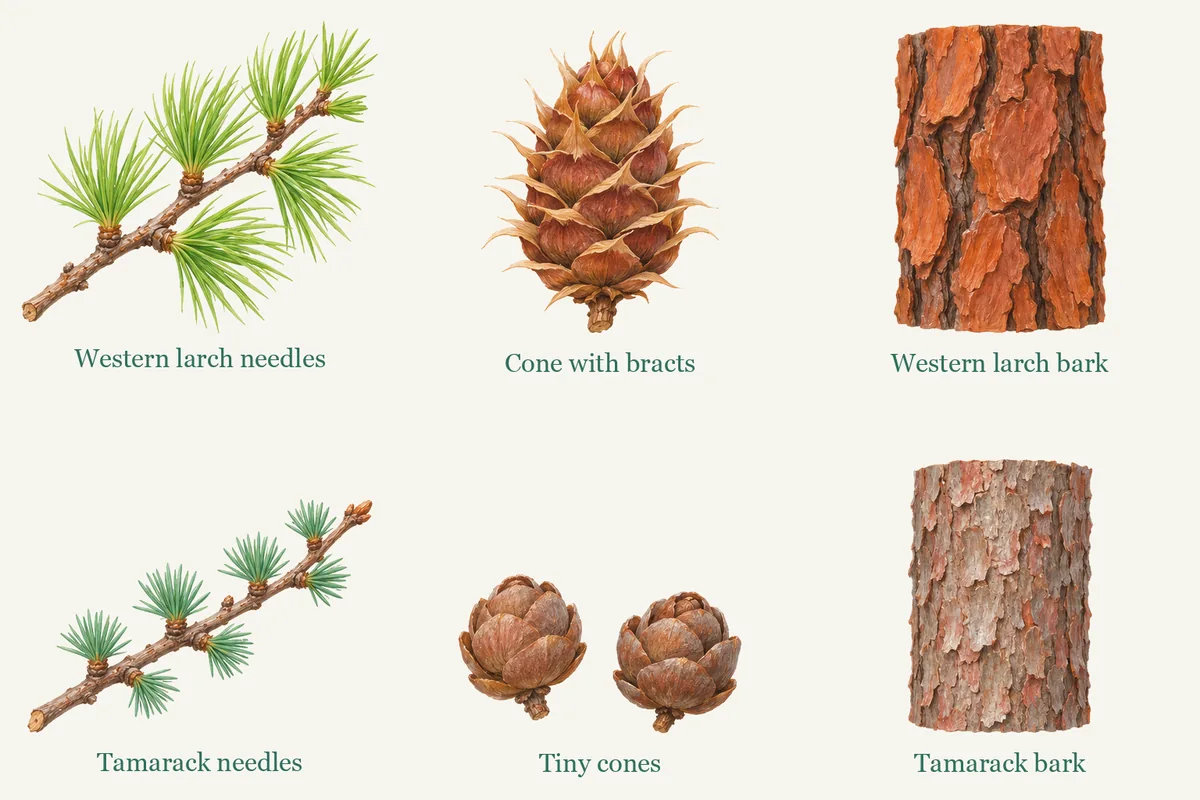
Subalpine larch is the hard one, because the needles and cones overlap. The Gymnosperm Database says the two are usually separated by 150 to 300 m of elevation, and the Forest Service gives 1,000 feet or more. Subalpine larch grows on exposed, rocky slopes near timberline; western larch grows in valleys and on lower slopes. Check a twig: on subalpine larch it is densely woolly and stays that way for two or three years.
Tamarack is the larch of the North and East. Its cones are tiny, with smooth scales and hidden bracts, and it grows on bogs. The tamarack page compares it with every larch you are likely to meet.
Douglas-fir shares the bracts that poke out of its cones, but it is evergreen, with single needles; see the Douglas-fir page.
Fire, size and age
The Forest Service calls mature western larch the most fire-resistant tree in the Northern Rockies, thanks to its thick bark, high open branching and foliage that burns poorly. Seedlings and saplings have very little resistance, so the thick-barked old trees are the ones that survive a fire.
It is also huge. Normal mature height is 100 to 180 feet (30 to 55 m), occasionally over 200 feet, and trees over 90 inches in diameter and 900 years old have been found. NRCan gives up to 70 m and a maximum age of 400 years for Canadian trees. Cone crops are infrequent before age 25 and abundant from about 40 to 50 years on.
Its most damaging parasite is a dwarf mistletoe, Arceuthobium laricis, according to the Forest Service. Heavy infection cuts the tree's basal-area growth by about 69%, light infection by about 14%.
Where western larch grows
The Forest Service range covers the upper Columbia River Basin in northwestern Montana, northern and west-central Idaho, northeastern Washington and southeastern British Columbia, plus the east slopes of the Cascades in Washington and north-central Oregon and the Blue and Wallowa Mountains of southeastern Washington and northeastern Oregon. NRCan adds that it extends east into Alberta and that small pure stands grow at 400 to 1,500 m, usually mixed with Douglas-fir, western white pine, lodgepole pine, Engelmann spruce, subalpine fir, western hemlock and ponderosa pine. Cold limits it upslope and dry soil limits it downslope.
The Rocky Mountain tree guide and the Pacific Northwest tree guide place it among the other trees of the region. Identify one in summer with location turned on and Tree Identifier's Tree Map pins it, so you can return in October to see it turn.
Look-alikes and how to tell them apart
Subalpine larch (Larix lyallii)
Grows higher, on rocky slopes up to timberline, usually 150 to 300 m or more above western larch. Its twigs are densely woolly, white to yellow, and stay hairy for 2 to 3 years, and it carries 30 to 40 needles per tuft. Western larch twigs lose their hairs in the first summer.
Tamarack (Larix laricina)
Tamarack cones are tiny, 1 to 2 cm, with up to 20 smooth scales and bracts hidden except at the base. Its twigs are hairless, and NRCan places it on cold, wet sites such as bogs. Western larch cones are 3 to 5 cm with bracts sticking out.
Douglas-fir (Pseudotsuga menziesii)
Also has bracts poking out of its cones, three-lobed like mouse tails, on hanging cones 3 to 4 inches long. But it is evergreen, with single flat needles 3/4 to 1 1/4 inches long, never in tufts.
What a photo can't settle
- From late fall to spring the tree is bare: a winter photo shows only the twigs, spur shoots and bark, which are weaker clues than the needle tufts.
- Western and subalpine larch overlap in a narrow band where intermediate trees and possible hybrids occur; neither a photo nor one twig settles those.
- Old trees drop their lower branches, so needles and cones are often far out of reach; look for fallen cones under the tree.
Questions people ask
How do you identify a western larch?
Look for soft needles in tufts of 15 to 30 on short spur shoots, which turn gold and fall in autumn. Then find a cone: 2.5 to 4.5 cm, with a pointed bract sticking out past each scale. Old trees have thick, deeply furrowed bark with cinnamon-colored plates, according to the Montana Field Guide.
Is western larch evergreen?
No. Western larch is a deciduous conifer: the USDA Forest Service describes foliage that changes from light green to gold in fall before the needles drop. A gold or bare conifer among green pines and firs in October may well be a healthy larch rather than a dead tree.
What is the difference between western larch and subalpine larch?
Elevation first: the USDA Forest Service says the two are usually separated by 1,000 feet or more, with subalpine larch near timberline. Subalpine larch twigs are densely woolly and stay hairy for 2 to 3 years, and the Gymnosperm Database notes that intermediate trees occur where the two meet in Washington and Montana.
Is western larch the same as tamarack?
Not the same species, though tamarack and western tamarack are among western larch's local names. True tamarack, Larix laricina, has cones only 1 to 2 cm long with hidden bracts and grows on cold, wet sites such as bogs; western larch has cones 3 to 5 cm with bracts sticking out.
How big does a western larch get?
The USDA Forest Service gives 100 to 180 feet at maturity, occasionally more than 200 feet, and calls it the largest of the world's larches. Trees over 90 inches in diameter and 900 years old have been found.
Sources
- Western Larch (Larix occidentalis), Silvics of North America — USDA Forest Service
- Western larch (Larix occidentalis), Trees, insects and diseases of Canada's forests — Natural Resources Canada, Canadian Forest Service
- Western Larch - Larix occidentalis — Montana Field Guide, Montana Natural Heritage Program
- Larix lyallii (subalpine larch) — The Gymnosperm Database
- Tamarack (Larix laricina), Trees, insects and diseases of Canada's forests — Natural Resources Canada, Canadian Forest Service
- Douglas-fir fact sheet — Virginia Tech Dendrology
Keep reading
- Tree profileLarch (Larix): how to identify a larch tree
- Tree profileTamarack (Larix laricina): how to identify it
- Regional guideRocky Mountain tree identification, from foothills to treeline
- Regional guideTrees of the Pacific Northwest, by region
- Tree profileDouglas-fir (Pseudotsuga menziesii): how to identify it