Tree profile
Whitebark pine (Pinus albicaulis): how to identify it
A five-needle pine of timberline whose cones stay shut until a bird or a squirrel breaks them open. Count the needles, then look for purple cones or their scattered scales.
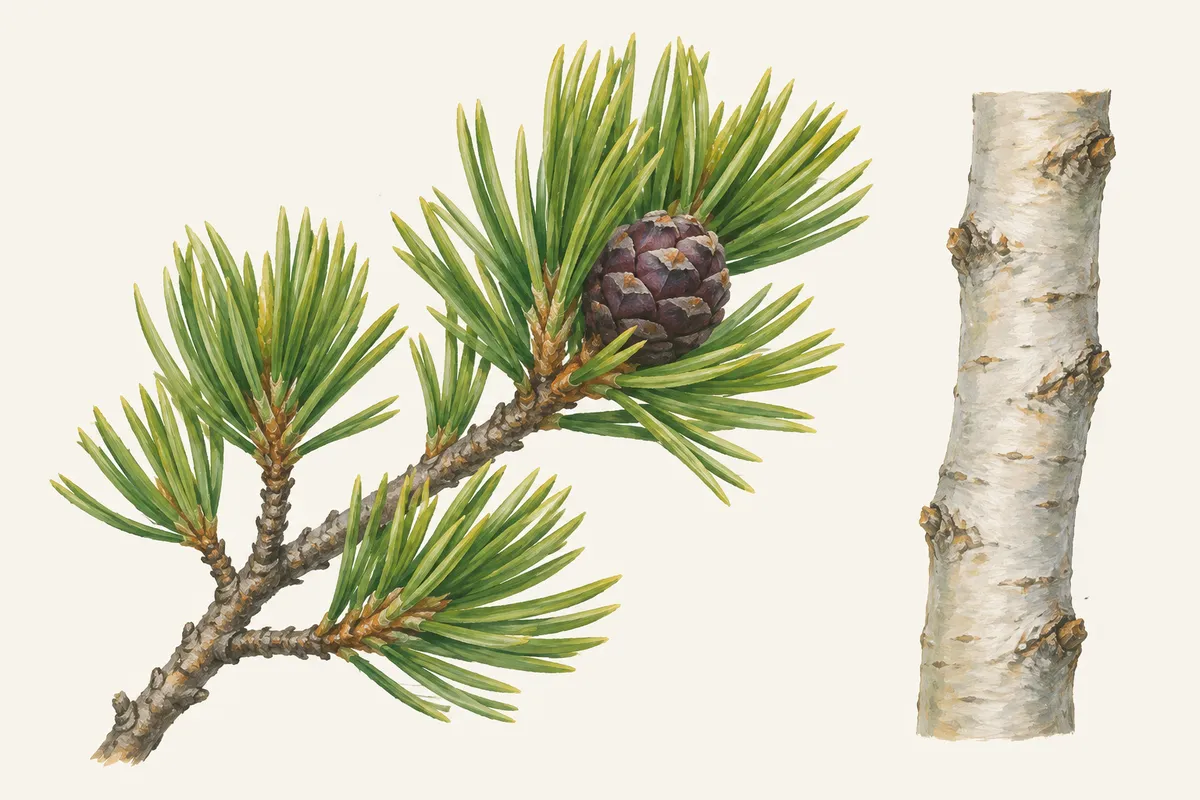
In short
Whitebark pine identification starts high in the western mountains: five needles per bundle, 3 to 7 cm long, curved and deep yellow-green, on a pine near timberline. Its cones are 5 to 8 cm, dark purple, nearly round and stay closed, so you mostly find broken scales on the ground. Young bark is pale gray, and wind-exposed trees grow multi-stemmed or as low krummholz.
- Five needles per bundle near timberline means whitebark or limber pine; the cone settles which.
- Whitebark cones are dark purple, 5 to 8 cm and stay closed; limber pine cones are 7 to 15 cm, yellow-brown and open to drop their seed.
- Whitebark pine has been listed as threatened under the US Endangered Species Act since December 2022.
Field marks at a glance
- Scientific name
- Pinus albicaulis
- Family
- Pinaceae (pine family)
- Type
- Conifer, evergreen
- Needles
- Five per bundle, 3 to 7 cm long, mostly curved, deep yellow-green, with white lines of stomata; they last 5 to 8 years, and the bundle sheath falls early (Gymnosperm Database).
- Cones
- 5 to 8 cm (USDA Forest Service; 4 to 8 cm in the Gymnosperm Database), broadly egg-shaped to nearly round, dark purple turning brown as they cure, nearly stalkless, in the upper crown; they stay closed after ripening.
- Seeds
- Large, heavy and wingless, 7 to 11 mm; spread mainly by Clark's nutcrackers, which cache them in the ground.
- Pollen cones
- Scarlet to carmine in early summer; limber pine's are usually paler red or yellow.
- Bark
- Pale gray and smooth when young, darkening a little with age into thin plates; light brown and platy without deep fissures on big trees.
- Twigs
- Stout, pale red-brown, with fine light brown hairs; buds egg-shaped, light red-brown, 8 to 10 mm.
- Form
- A single-trunked tree up to about 70 ft (21 m) on good sites; multi-stemmed clumps upslope; low krummholz on wind-swept ridges.
- Elevation
- Near timberline: about 5,900 to 8,200 ft in northwestern Montana, 8,000 to 10,500 ft in western Wyoming, 10,000 to 11,500 ft in the Sierra Nevada (USDA Forest Service).
- Status
- Listed as threatened under the US Endangered Species Act on December 15, 2022 (US Fish and Wildlife Service).
Whitebark pine (Pinus albicaulis) is the pine at the top of the forest in the western mountains, from the Sierra Nevada and the Cascades to the Rockies of Wyoming, Montana and Alberta. It shares its five-needle bundles with limber pine and western white pine, so the needle count alone narrows it down but does not settle it. What sets it apart is a cone that never opens, a partnership with a bird that plants its seeds, and a twisted, many-stemmed shape at timberline. Our pine identification chart covers needle counts across US pines; this page covers the high-mountain five-needle group.
How to identify a whitebark pine
Check these in order. Binoculars help, because the cones sit at the top of the crown.
1. Count the needles. The Gymnosperm Database gives five needles per bundle, 3 to 7 cm long, mostly curved, deep yellow-green, with the upper surface conspicuously whitened by stomata. They stay on the tree 5 to 8 years. The papery sheath at the base falls early.
2. Look for cones, or what is left of them. The USDA Forest Service's Silvics of North America describes cones usually 5 to 8 cm long, dark purple, turning brown as they cure in late summer. They stay essentially closed after ripening, so animals harvest most of the crop. The US Fish and Wildlife Service notes that they grow in clusters of two to four at the ends of upper branches. Whole cones are rarely found on the ground; broken scales and cone cores under the tree are the usual sign.
3. Read the bark. Young bark is pale gray and darkens a little with age into thin plates. On big trees the Gymnosperm Database describes light brown, platy bark without conspicuous fissures.
4. Read the shape and the site. On sheltered sites near the forest line, whitebark pine grows as a single-trunked tree. Upslope it becomes shorter and multi-stemmed, and on wind-swept ridges it creeps as krummholz, a low, shrub-like mat (Forest Service).
Tree Identifier can name a pine from one photo of a needle bundle, a cone or the bark, which helps on a trail where you cannot carry a field guide. It needs an internet connection, which may be missing at timberline, so take the photo and identify it later from the library. Whitebark pine is not among the 138 species in the app's Collection, and the app shows no confidence score or alternatives, so count the needles and look for the cone yourself.
Whitebark vs limber, western white and lodgepole pine
| Pine | Needles per bundle | Needle length | Cone |
|---|---|---|---|
| Whitebark | 5, curved | 3–7 cm | 4–8 cm, nearly round, dark purple, stays closed |
| Limber | 5, slightly stiffer | 3–7 cm | 7–15 cm, yellow-brown, resinous, opens and falls |
| Western white | 5, blue-green, slightly twisted | 4–10 cm | 10–25 cm, slender, hanging, creamy brown, stalked |
| Lodgepole | 2, twisted | 1 1/2–3 in (4–8 cm) | 1–2 in (2.5–5 cm), lopsided, may stay closed for years |
Figures from the Gymnosperm Database's limber pine and western white pine pages and Virginia Tech's lodgepole pine fact sheet.
Limber pine is the real problem. Without cones the two strongly resemble each other. The Gymnosperm Database suggests four checks: old limber pines have reddish-brown bark plates separated by fissures; limber pine twigs roughen at a smaller diameter; limber pine pollen cones are often paler red or yellow, against the striking red of whitebark (the Forest Service calls whitebark's carmine); and whitebark saplings often grow several stems from one seed cache, which is rare in limber pine. The Rocky Mountain tree guide places both by elevation, and the Alberta tree guide covers them as the province's two endangered trees.
Western white pine has longer, blue-green needles and long, slender cones that hang from the branch tips and fall soon after shedding their seed.
Lodgepole pine is easy to rule out once you count: its needles come in pairs.
Clark's nutcracker and the multi-stemmed clumps
Because the cones stay shut, whitebark pine depends on animals. The Forest Service describes Clark's nutcracker as essential to planting its seeds: a bird carries up to 150 seeds in a pouch under its tongue and buries them in caches of one to several seeds about 2 to 3 cm deep. Nutcrackers and red squirrels attack most of the ripening crop in August and September.
Seeds the birds never come back for sprout together. That is why whitebark pine often grows as a clump of several trunks from one spot; the Forest Service notes that the members of a clump are often siblings. A cluster of five-needle pines growing from one base, high on a ridge, is a strong hint of whitebark rather than limber pine.
Where it grows, and why many trees are dying
The Forest Service describes two main sections of the range: one along the British Columbia Coast Ranges, the Cascades and the Sierra Nevada, the other in the Rocky Mountains from Wyoming to Alberta, with outliers in northeastern Oregon, northern California, northern Nevada and the Sweetgrass Hills of north-central Montana. Elevations rise southward: about 5,900 to 8,200 feet in northwestern Montana, 8,000 to 10,500 in western Wyoming, 10,000 to 11,500 in the Sierra Nevada. The lowest natural stand reported is at 3,600 feet near Mount Hood, Oregon.
It is slow-growing and long-lived: 500 years or more on good sites, perhaps 1,000 on cold, dry ones. Dominant trees in Montana are 70 to 100 feet tall at 250 to 300 years; the largest recorded, in Idaho's Sawtooth Range, measured 8 feet 9 inches in diameter and 69 feet tall.
Many of the trees you meet will be sick or dead. The Forest Service says introduced white pine blister rust has killed up to 90% of trees in some stands and that whitebark has been rated among the most susceptible of the world's white pines; mountain pine beetle killed much mature whitebark in the northern Rockies between 1909 and 1940. The US Fish and Wildlife Service listed the species as threatened on December 15, 2022, naming blister rust as the main threat, with mountain pine beetle, altered fire regimes and climate change. With location turned on, Tree Identifier's Tree Map pins the tree, so you can find it again on a later hike.
Look-alikes and how to tell them apart
Limber pine (Pinus flexilis)
Also five needles 3 to 7 cm, slightly stiffer, so without cones the two look almost the same. Limber pine cones are longer, 7 to 15 cm, yellow-brown and resinous, and they open and drop their seed; old limber pines have reddish-brown bark plates separated by fissures.
Western white pine (Pinus monticola)
Another five-needle pine of the West, but its blue-green needles reach 4 to 10 cm and its hanging cones are long and slender, 10 to 25 cm, creamy brown, on a stalk up to 2 cm. Whitebark cones are short, round and purple.
Lodgepole pine (Pinus contorta)
A common pine of the western mountains, but it has only two twisted needles per bundle, 1 1/2 to 3 inches long, and small lopsided cones 1 to 2 inches that may stay closed on the branch for years.
What a photo can't settle
- Without cones, whitebark and limber pine are very hard to separate; the Gymnosperm Database calls them very similar, and stunted timberline trees rarely show textbook features.
- Whitebark cones are high in the crown and animals take most of them before they fall, so you may only find scattered scales.
- Many whitebark pines are dead or dying from blister rust and beetles; needles on a dying tree may be sparse or discolored, which a photo app can misread.
Questions people ask
How do you identify a whitebark pine?
Count the needles: five per bundle, 3 to 7 cm, mostly curved and deep yellow-green. Then look for dark purple cones, 5 to 8 cm, that stay closed in the upper crown, or for their broken scales on the ground. Pale gray bark on younger trees and a high-elevation site near timberline support it.
What is the difference between whitebark pine and limber pine?
The cone. Whitebark cones are 5 to 8 cm, dark purple and stay closed; limber pine cones are 7 to 15 cm, yellow-brown and open to shed their seed. Without cones, the Gymnosperm Database points to bark (fissured reddish plates on old limber pine) and pollen cones (scarlet on whitebark, often yellow on limber).
Why don't whitebark pine cones open?
They are indehiscent: they stay essentially closed after ripening, unlike most North American pines, according to the USDA Forest Service. Clark's nutcrackers and red squirrels tear them apart in August and September, and the nutcrackers bury the large, wingless seeds, some of which grow into new trees.
Is whitebark pine endangered?
The US Fish and Wildlife Service listed it as threatened under the Endangered Species Act in a final rule published December 15, 2022. The main threat is the non-native white pine blister rust, with mountain pine beetle, altered fire regimes and climate change.
How old can whitebark pine get?
The USDA Forest Service gives a lifespan of 500 years or more on favorable sites and says the oldest trees on cold, dry sites probably reach 1,000 years. It is slow-growing: dominant trees in Montana are 70 to 100 feet tall at 250 to 300 years.
Sources
- Whitebark Pine (Pinus albicaulis), Silvics of North America — USDA Forest Service
- Pinus albicaulis (whitebark pine) — The Gymnosperm Database
- Whitebark pine (Pinus albicaulis) — US Fish and Wildlife Service
- Pinus flexilis (limber pine) — The Gymnosperm Database
- Pinus monticola (western white pine) — The Gymnosperm Database
- Lodgepole pine fact sheet — Virginia Tech Dendrology
Keep reading
- Tree profilePines (Pinus): how to identify a pine tree
- Regional guideRocky Mountain tree identification, from foothills to treeline
- Alberta field guideAlberta trees, natural region by natural region
- Regional guideTrees of the Pacific Northwest, by region
- Field guideConifer identification: three questions about the needles, then the cone