Tree profile
Witch hazel (Hamamelis virginiana): how to identify it
A small, many-stemmed tree that blooms yellow when every other tree is losing its leaves. Its lopsided leaf base and woody seed capsules name it the rest of the year.
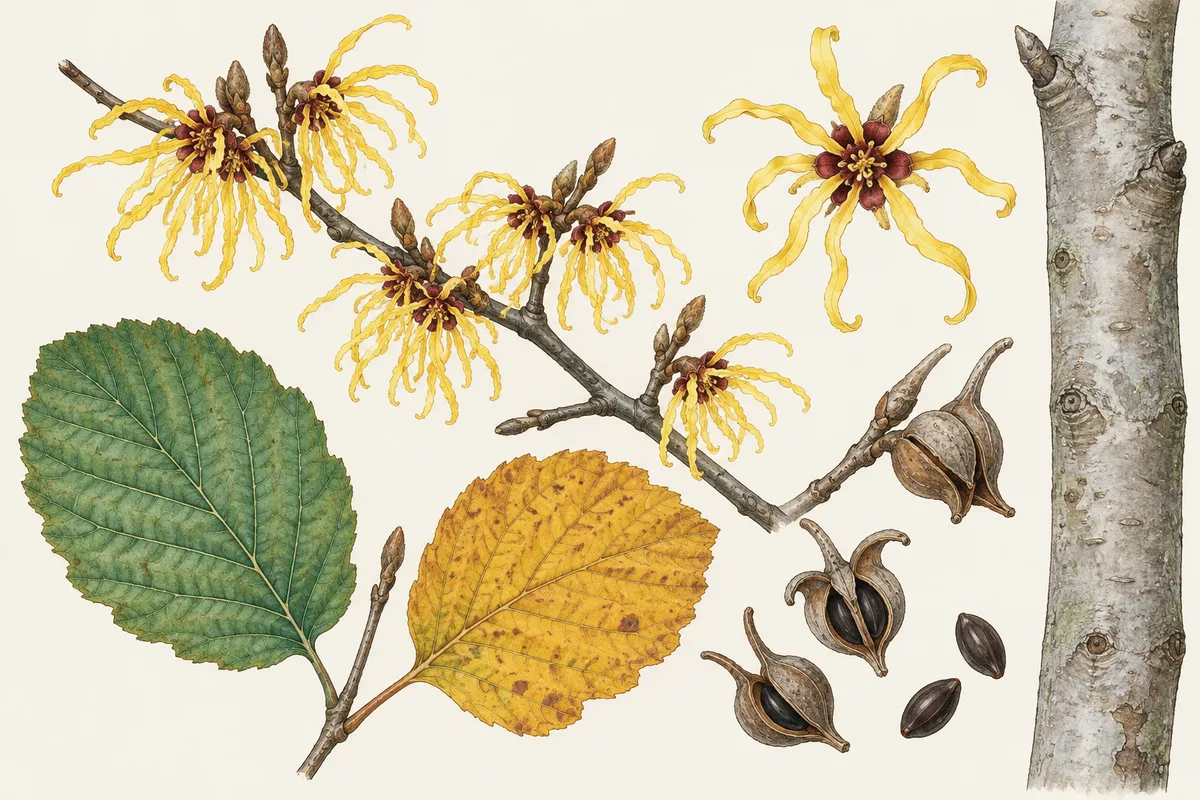
In short
Witch hazel tree identification is easiest in fall: common witch hazel is the only native eastern tree that opens spidery yellow flowers with four crinkled, ribbon-like petals from October to December, often as its leaves turn gold. The rest of the year, look for oval leaves 3 to 6 inches long with wavy, scalloped edges and a lopsided base, and small woody capsules that split to shoot out shiny black seeds.
- Yellow, four-petaled, ribbon-like flowers in October to December mean common witch hazel; ones opening January to March are vernal or hybrid witch hazel.
- The leaf base is uneven: one side meets the stalk lower than the other, and the edge is wavy or scalloped rather than sharply toothed.
- Flowers and last year's woody capsules sit on the twigs at the same time, because the fruit takes a year to ripen.
Field marks at a glance
- Scientific name
- Hamamelis virginiana
- Family
- Hamamelidaceae (witch-hazel family)
- Type
- Broadleaf, deciduous
- Flowers
- Yellow and spidery, with four crinkled, ribbon-like petals, in clusters along the twigs from October to December, sometimes while the leaves are still on and turning gold. Each flower is under an inch across.
- Leaves
- Alternate, simple, oval to egg-shaped, 3 to 6 inches long (50 to 150 mm), with a wavy, scalloped edge and an oblique, lopsided base. Fall color gold to yellow.
- Fruit
- A small, two-chambered woody capsule that ripens the year after flowering and splits to shoot out two shiny black seeds, sometimes as far as 30 feet (10 m). Empty capsules can stay on the twigs for years.
- Buds
- Naked, with no scales: brown, somewhat flattened and covered in dense yellowish-brown hairs. The University of Vermont notes the nickname "winged foot" for their shape.
- Bark
- Thin, smooth to slightly scaly, light brown to light gray, with horizontal lenticels.
- Size and form
- A large shrub or small tree, 15 to 30 feet tall and 15 to 20 feet wide, usually with several stems from the base and an open, spreading crown.
- Habitat
- Woodland edges, stream banks, floodplains and rocky slopes, usually as a subcanopy plant under taller trees.
- Range
- Eastern North America, from Quebec and New England south to Florida, west to Texas and Oklahoma, and north through Missouri, Iowa and Minnesota.
Witch hazel is the tree that blooms when the woods are shutting down. On an October or November walk in eastern North America, a small, many-stemmed tree with threads of yellow along bare or golden twigs is almost certainly common witch hazel. The rest of the year it is easy to walk past, so it helps to know its leaf and fruit too. Witch hazel lotion is made from this plant, but never eat or brew any part of a plant on the strength of a web page or an app.
The fastest checks for witch hazel
- Flowers in fall. Yellow, spidery flowers with four narrow, crinkled petals, like short ribbons, in small clusters along the twigs. NC State Extension gives the bloom as October to December. No other native eastern tree flowers like this so late.
- The leaf base. Pick up a leaf and look where it meets the stalk: one side starts lower than the other. NC State describes the base as oblique, and the University of Vermont as "inequal".
- The leaf edge. Wavy, with rounded scallops or shallow lobes rather than fine sharp teeth. Leaves are oval, about 3 to 6 inches long, and turn gold to yellow in fall.
- Woody capsules. Small, hard, two-chambered capsules on the twigs, often next to the flowers. They ripen a year after flowering and split open; empty ones stay on for years.
- The shape. A large shrub or small tree, 15 to 30 feet tall, usually with several stems from one base.
Flowers alone are enough from October to December. The rest of the year, the lopsided wavy leaf plus a woody capsule is the combination to look for.
Flowers and fruit through the year
Witch hazel runs on an unusual calendar. The flowers open in fall, are pollinated, and then the fruit waits a full year to mature. That is why, in October, you can see this year's yellow flowers and last year's ripening capsules on the same twig.
When the capsules are ripe they split and fire their seeds. The University of Vermont describes shiny black, wingless seeds being "forcibly ejected", and the Native Plant Trust's Go Botany says the seeds are sometimes hurled 30 feet (10 m) from the parent tree. NC State notes two black seeds per capsule.
In winter, look at the buds. The University of Vermont describes them as brown, flattened and naked, meaning they have no protective scales, and covered in dense yellowish-brown hairs. Naked, hairy, slightly curved buds with old capsules nearby make witch hazel easy to name on a bare twig. The winter tree identification guide explains how to read buds and twigs on other species. For trees named by their fall color, see fall tree identification.
Where it grows
NC State gives the native range as eastern North America: from Quebec through New England, south to Florida, west to Texas and Oklahoma, and north through Missouri, Iowa and Minnesota. It grows along woodland margins and stream banks, and Go Botany adds floodplains, swamps and rocky slopes. It usually lives under taller trees as part of the subcanopy, which is why it tends to look open and leggy in the wild and denser in a sunny garden.
Bark is not a strong clue: thin, smooth to slightly scaly, light brown to gray, with horizontal lenticels. Plenty of small trees share that look, so use the leaves, buds or capsules instead.
Common, vernal and hybrid witch hazels
Three witch hazels are common in North America, and the month they bloom is the quickest separator.
| Witch hazel | Bloom | Flower color | Where you see it | Height |
|---|---|---|---|---|
| Common (H. virginiana) | October to December | Yellow | Native woods across the East | 15 to 30 ft |
| Vernal (H. vernalis) | January to early March | Red, orange or yellow | Native to the Ozarks; planted elsewhere | 6 to 16 ft |
| Hybrid (H. x intermedia) | Late January to March | Yellow, orange or red by cultivar | Gardens and parks | 15 to 20 ft |
NC State's page on vernal witch hazel places its wild range on the Ozark Plateau of Missouri, Oklahoma and Arkansas, with fragrant flowers on zig-zag twigs. The hybrid witch hazel is a cross of the Japanese and Chinese witch hazels; NC State notes that its leaves may turn brown but often stay on the plant, and that the flowers can open and close with the weather. A witch hazel flowering in a front yard in February is almost always one of these two, not the native fall bloomer.
Witch hazel, hazel and other look-alikes
The name causes most mix-ups. Hazel (Corylus) is a different plant in the birch family: it also grows as a clump of stems and also flowers in late winter, but with dangling yellow catkins, and it bears nuts in leafy husks. Its leaves are rounder and doubly toothed. See the hazel page for the details.
Elm leaves are lopsided at the base too, which can fool a leaf-only check. But elm leaves have a sharp, doubly toothed edge, the trees grow tall on a single trunk, and the fruit is a round, papery wafer in spring; see the elm page.
For other yellow-flowering trees, mostly spring and summer bloomers such as tulip tree, golden chain tree and golden rain tree, see the guide to trees with yellow flowers.
When a photo helps
Tree Identifier names a plant from one photo, and the best witch hazel photo is a twig with flowers, or a leaf that shows its base and edge together with a capsule. Common witch hazel is not one of the 138 species in the app's Collection, so the result is saved to your History and Wild Discoveries. The app does not show a confidence score or a look-alike list, so check its answer against the bloom month: a fall bloomer in the woods is common witch hazel, a winter bloomer in a garden is a vernal or hybrid. Tree Identifier's follow-up chat can answer questions such as why the fruit takes a year to ripen, and the Tree Map saves the spot so you can come back next October for the flowers.
Look-alikes and how to tell them apart
Vernal or Ozark witch hazel (Hamamelis vernalis)
Same ribbon petals, but it flowers from January to early March, often red or orange as well as yellow, and stays smaller, 6 to 16 feet. In the wild it is native only to the Ozark Plateau of Missouri, Oklahoma and Arkansas.
Hybrid witch hazel (Hamamelis x intermedia)
A garden hybrid of Japanese and Chinese witch hazels that blooms from late January through March in yellow, orange or red, depending on the cultivar. Planted beside houses and in parks, not in the woods, and old brown leaves often hang on through winter.
Hazel or hazelnut (Corylus)
Hazel shares the name and the many-stemmed habit, but it flowers in late winter with dangling yellow catkins, not ribbon petals, its leaves are rounder and doubly toothed, and it bears nuts in leafy husks, not woody capsules.
Elm (Ulmus)
Elm leaves are lopsided at the base too, but their edges are sharply doubly toothed rather than wavy, elms grow into tall single-trunked trees, and their fruit is a flat, round, papery wafer in spring.
What a photo can't settle
- Out of flower, a photo of a single leaf can be confused with other lopsided-leaved trees such as elm; include the leaf base, the twig and any capsules in the shot.
- Common, vernal and hybrid witch hazels look alike in leaf; the bloom month and the setting (woods or garden) separate them better than a photo does.
- Common witch hazel is not in Tree Identifier's 138-species Collection, so a correct answer is saved in History and Wild Discoveries rather than filling a Collection slot.
Questions people ask
What does a witch hazel tree look like?
Usually a large shrub or small tree 15 to 30 feet tall with several stems and a spreading crown. In fall it carries yellow, spidery flowers with four ribbon-like petals. Its oval leaves are 3 to 6 inches long with a wavy edge and a lopsided base, and its twigs hold small woody seed capsules.
When does witch hazel bloom?
Common witch hazel blooms from October to December, which is unusual for a native tree. Vernal witch hazel blooms from January to early March, and the garden hybrid witch hazels from late January through March. So the month you see the flowers already narrows the species.
How do you identify witch hazel leaves?
Look at the base and the edge. A witch hazel leaf is oval, 3 to 6 inches long, with one side of the base meeting the stalk lower than the other, and an edge that is wavy or scalloped rather than finely saw-toothed. The leaf turns gold to yellow in fall.
Is witch hazel the same as hazel?
No. Witch hazel (Hamamelis) is in the witch-hazel family, while hazel or hazelnut (Corylus) is in the birch family. Hazel has catkins in late winter and nuts in leafy husks; witch hazel has ribbon-petaled flowers and woody capsules that shoot out their seeds.
Does witch hazel really shoot its seeds?
Yes. The University of Vermont describes a woody, two-chambered capsule that forcibly ejects shiny black seeds, and the Native Plant Trust says it sometimes hurls them 30 feet (10 m) from the parent plant. The capsules ripen about a year after the flowers.
Sources
- Hamamelis virginiana (Common Witchhazel) — North Carolina Extension Gardener Plant Toolbox, NC State University
- Hamamelis virginiana (American witch-hazel) — Go Botany, Native Plant Trust
- Witch-Hazel (Hamamelis virginiana), Plant Identification — University of Vermont
- Hamamelis vernalis (Vernal Witch Hazel) — North Carolina Extension Gardener Plant Toolbox, NC State University
- Hamamelis x intermedia (Hybrid Witchhazel) — North Carolina Extension Gardener Plant Toolbox, NC State University