Also in Español
Garden guide
The best shade trees for a yard, according to extension lists
A good shade tree is tall, sturdy and long-lived, and it needs room. Here is what several extension services and an arboretum recommend, and what each tree asks of your yard.
In short
The best shade trees, in extension lists, are tall, sturdy, long-lived species: white oak, red oak, sugar maple, ginkgo, linden, Kentucky coffeetree, honeylocust and hackberry. Virginia Cooperative Extension puts large shade trees above 60 feet at maturity. Plant them on the south or southwest side of the house to cool it in summer, at least half the mature canopy width away from the walls.
- Virginia Cooperative Extension: shade usually requires tall, sturdy, long-living species, and many will live 100 years or more if given the chance.
- Nebraska Extension: deciduous trees on the south and southwest sides cool a house in summer and let winter sun through; plant at least half the mature canopy width from the home.
- Fast growers such as silver maple and poplars have weak wood and often short lives, according to the same Nebraska guide.
A shade tree is a big commitment: it takes years to cast real shade and, if it is chosen well, it outlives the person who planted it. Extension services agree on what makes a good one and broadly agree on the species. This guide sets out their lists, what each tree needs, and how to recognise the shade trees you already have.
Shade trees that extension services recommend
Virginia Cooperative Extension states that providing shade usually requires tall, sturdy, long-living species, and that many will live 100 years or more if given the chance. It classes large shade trees as reaching more than 60 feet at maturity. Its list, with mature heights and spreads:
| Tree | Height | Spread | Note from the list |
|---|---|---|---|
| White oak | 100 ft | 50 to 80 ft | Majestic; hard to transplant, best moved in spring |
| Red oak | 65 to 75 ft | 40 to 50 ft | Fast-growing, city-tolerant |
| Sugar maple | 60 to 75 ft | About two-thirds of height | Less city-tolerant; pests and disease |
| Ginkgo | 50 to 80 ft | 30 to 40 ft | Pest-free, city-tolerant, slow; plant male or nonfruiting types |
| Linden | 60 to 70 ft | Half to two-thirds of height | Few pests, fragrant flowers |
| Honeylocust | 30 to 70 ft | Up to height | Light, open shade; choose thornless, podless cultivars |
| Bald cypress | 50 to 70 ft | 20 to 30 ft | Fast, few pests, suits wet sites |
| Red maple | 40 to 60 ft | Up to height | Good fall color, but weak-wooded |
| Tuliptree | 70 to 90 ft | 35 to 50 ft | Needs deep, moist soil; too big for average yards |
| Black gum | 30 to 50 ft | 20 to 35 ft | Brilliant fall color, tolerates wet sites; hard to transplant |
Nebraska Extension lists maples, ginkgo, Kentucky coffeetree, honeylocust, walnut, hackberry and oaks as good large shade trees for that state, excluding pin, shingle and sawtooth oak. In the Southeast, the University of Georgia describes Shumard oak, 80 to 100 feet tall and fast-growing on well-drained soils, as often used as a shade tree, and live oak as 40 to 80 feet tall and 60 to 100 feet wide. In western Oregon, Oregon State University Extension names bigleaf maple as a fast-growing native that makes a shade tree.
What makes a good shade tree
The Virginia list explains its choices with a short checklist:
- Height and lifespan. Tall, sturdy, long-lived species give the most shade for the longest time.
- Density of foliage. It decides how much shade the tree casts. Honeylocust's light, open shade lets grass grow beneath it; a sugar maple's dense shade does not, which the University of Georgia also notes, saying it can hinder sun-loving plants below.
- Room for top and roots. The site has to fit the tree at maturity, above and below ground.
- Resistance to storms and pests. Avoid trees susceptible to storm damage or that host destructive insects and diseases.
The Morton Arboretum's tree list adds a fifth point: diversity. It recommends no more than 5 percent of any one species, 10 percent of any one genus and 15 percent of any one family in a community, so that a single pest cannot strip a street of shade, as emerald ash borer did with ash.
Where to plant a shade tree
Placement decides whether a shade tree cools your house or just your lawn.
- South or southwest side. Nebraska Extension says large shade trees planted there can cool the home and reduce summer energy costs.
- Deciduous, wide and upright. On those sides, choose trees with wide upright or vase-shaped growth habits and avoid evergreens or trees that hold their leaves, so winter sun can warm the house.
- Half the canopy width away. Plant at least half the mature canopy width from the home; closer, branches damage the roof and fill gutters.
- Large trees need large yards. The Morton Arboretum says large trees, over 40 feet, are often best in large yards or park-like spaces, and only trees up to 25 feet tall belong under utility lines.
- Soil space. Trees in openings cut into pavement will have their growth restricted within 20 years unless they have at least 200 square feet of open soil, according to the Morton list.
Shade patterns move through the day and the year. Nebraska Extension notes that midsummer afternoon shade falls to the north and northeast of the tree, so a tree directly south of a patio shades the patio at noon but not at 4 p.m.
Fast-growing shade trees and their trade-offs
Many people want shade within a few years, and the lists are frank about the cost. The Morton Arboretum classes growth in a tree's first 10 years as slow (under 10 inches a year), moderate (10 to 20 inches) or fast (over 20 inches), and notes that fast-growing trees often have shorter life spans and weaker branches.
- Silver maple and poplars. Nebraska Extension says they have weak wood and are often short-lived. The Morton list also marks silver maple as aggressive, messy and prone to roots invading sewer pipes; the silver maple page shows how to recognise one.
- Red maple. Fast enough to be popular, but the Virginia list calls it weak-wooded.
- Pin oak. Fast, but it develops iron chlorosis in high-pH soils, according to the Virginia list, and the Morton Arboretum notes that it requires acidic soil.
- Bradford pear and yellowwood. Nebraska Extension says their narrow branch angles leave them prone to limb damage from snow and ice that pruning cannot fix.
- Willows and cottonwoods. Nebraska Extension advises keeping these shallow-rooted, moisture-loving trees away from septic systems.
Moderate growers such as bur oak, swamp white oak, Kentucky coffeetree and linden are the usual compromise in the Morton list: they reach a large size, with mature widths of 30 to 80 feet in the list, without the weak wood of the fastest trees.
How to recognise the shade trees in your yard
Knowing which shade tree you already have tells you how big it will get and what to watch for. Quick marks for the trees above:
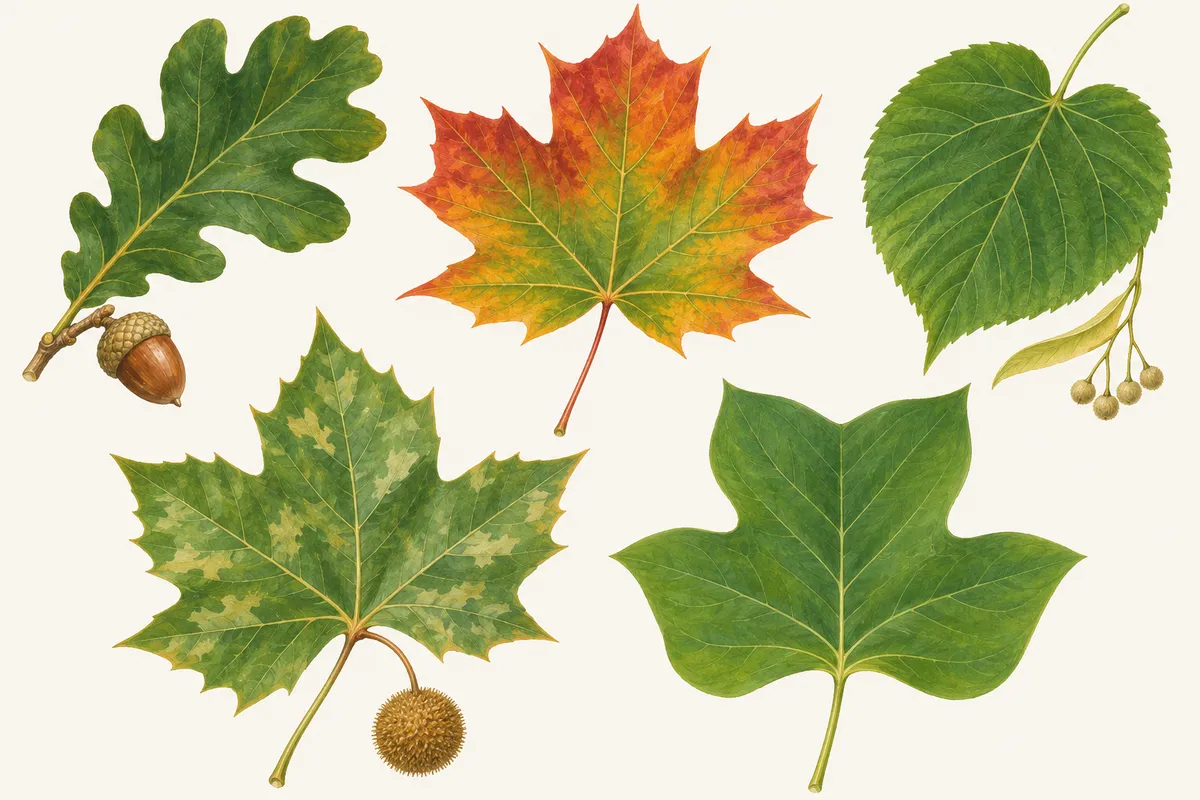
- White oak: rounded lobes without bristle tips, acorns in shallow caps; see the white oak page.
- Sugar maple: opposite, five-lobed leaves with U-shaped gaps between the lobes and smooth edges; the sugar maple page separates it from Norway and red maple.
- Kentucky coffeetree: huge, doubly compound leaves and thick, leathery pods on female trees; see the Kentucky coffeetree page.
- Linden: heart-shaped, toothed leaves with a lopsided base and small fragrant flowers hanging from a leafy strap; the linden page covers American basswood and littleleaf linden.
- Honeylocust: fine, feathery compound leaves and, on wild trees, branched thorns on the trunk; planted cultivars are thornless.
- Ginkgo: fan-shaped leaves on short spur shoots, turning bright yellow in fall.
To compare with the native trees recommended for your region, see native trees to plant.
Using a photo
Tree Identifier names a tree from one photo of a leaf, the bark, flowers or fruit, and gives its origin and growing conditions, which tells you roughly how large a young yard tree will become. Its Diagnose tool gives an AI estimate of a tree's health with a severity rating; treat it as a prompt to look closer, not as a verdict on whether a big shade tree is safe. For a large tree near a house, ask an ISA Certified Arborist. Tree Identifier shows no list of look-alikes, so for a young nursery tree with few features, check its answer against the leaf marks above.
What a photo can't settle
- Recommended species change with climate and soil: a shade tree that does well in Virginia may struggle in Nebraska or Georgia. Check your own state's extension list.
- Mature sizes in the lists are typical figures, not promises. Nebraska Extension says trees grown there often reach only about 75 percent of the size given in references from elsewhere.
- A photo app can identify a shade tree you already have, but it cannot judge whether a tree is structurally safe; for that, ask an ISA Certified Arborist.
Questions people ask
What is the fastest-growing shade tree?
Fast growers on extension lists include silver maple, hybrid catalpa, tulip tree, river birch and bald cypress. Speed has a cost: the Morton Arboretum notes that fast-growing trees often have shorter life spans and weaker branches, and Nebraska Extension says silver maple and poplars have weak wood and are often short-lived.
How far from the house should I plant a shade tree?
Nebraska Extension says at least half the tree's mature canopy width. A tree that will spread 60 feet should go at least 30 feet from the wall. Planted closer, it can damage the roof and fill gutters with debris.
Which side of the house should a shade tree go on?
The south or southwest side, according to Nebraska Extension: large shade trees there cool the house and cut summer energy costs. Choose a deciduous tree, so that winter sun reaches the house after the leaves fall, and avoid evergreens on those sides.
What shade trees should I avoid?
Extension lists flag weak-wooded fast growers such as silver maple and poplars, trees with narrow branch angles such as Bradford pear, and ashes, which emerald ash borer kills. Nebraska Extension also advises keeping willows and cottonwoods away from septic systems.
How long does a shade tree take to give shade?
It depends on the growth rate. The Morton Arboretum classes growth in the first 10 years as slow (under 10 inches a year), moderate (10 to 20 inches) or fast (over 20 inches). Most of the long-lived shade trees on its list, including the oaks and Kentucky coffeetree, are moderate growers.
Sources
- Selecting Landscape Plants: Shade Trees (426-610) — Virginia Cooperative Extension, Virginia Tech
- Trees in the Home Landscape (NebGuide G1747) — University of Nebraska–Lincoln Extension
- Northern Illinois Tree Species List — The Morton Arboretum
- Native Plants for Georgia Part I: Trees, Shrubs, and Woody Vines (B 987) — University of Georgia Extension
- Native trees thrive in waterwise Oregon landscapes — Oregon State University Extension Service
Keep reading
- Tree profileWhite oak (Quercus alba): how to identify it
- Tree profileSugar maple tree (Acer saccharum): how to identify it
- Tree profileKentucky coffeetree (Gymnocladus dioicus): how to identify it
- Tree profileLinden tree (Tilia): basswood, lime and littleleaf linden
- Garden guideNative trees to plant in your yard, region by region