Garden guide
Native trees to plant in your yard, region by region
Extension services and arboretums publish lists of native trees that do well in yards. Here is what several of them recommend, what each tree needs, and how to recognise it.
In short
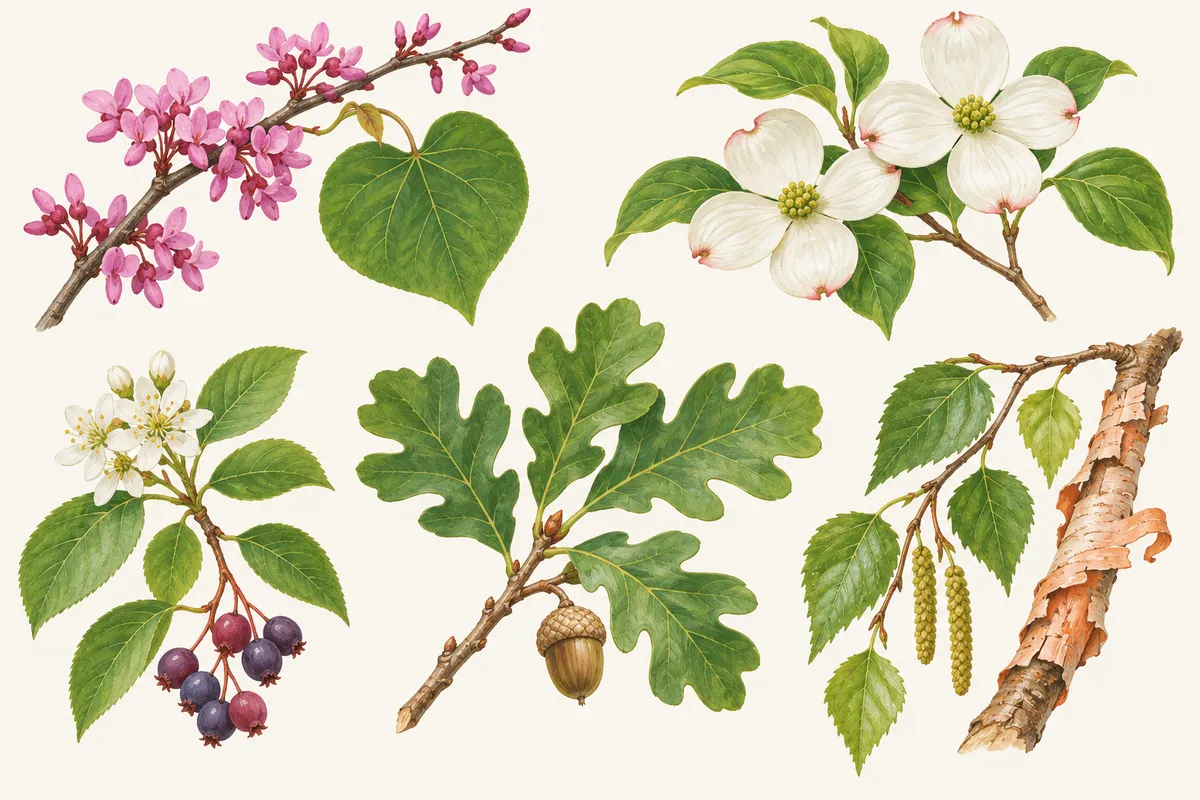
Native trees to plant depend on your region, soil and space. Extension lists name oaks such as white oak, bur oak and swamp white oak, Kentucky coffeetree, black gum and hackberry as large native trees in the East and Midwest; serviceberry, redbud and American hornbeam as small ones; and Oregon white oak, vine maple and ponderosa pine in western Oregon. Oaks feed more caterpillar species than any other North American tree.
- Start from a list for your own state or region: a tree native to the eastern US can fail in your soil or climate even if it is native to your state.
- Oaks are the strongest wildlife choice where they fit: the National Wildlife Federation reports that they host 952 caterpillar species, more than any other North American tree.
- Native does not mean trouble-free: silver maple, black walnut, sweetgum and all native ashes come with warnings in the same lists.
A native tree is one that grows wild in your region on its own: the Texas A&M Forest Service defines native species as ones that "have evolved and occur naturally in a region, ecosystem or habitat". The case for planting them is wildlife and fit, and the case is strongest when the tree is native not just to the country but to your part of it. This guide gathers what extension services and arboretums actually recommend, region by region, and adds how to recognise each tree once it is in the ground.
Native trees recommended by region
The table lists trees named in published lists. It is not a ranking, and every list it draws from asks you to match the tree to your site.
| Region and source | Large native trees named | Smaller native trees named |
|---|---|---|
| Midwest (Morton Arboretum, northern Illinois) | Bur oak, swamp white oak, white oak, northern red oak, Kentucky coffeetree, hackberry, shagbark hickory, American basswood | Allegheny serviceberry, eastern redbud, pagoda dogwood, American hornbeam, pawpaw |
| Mid-Atlantic (University of Maryland Extension) | White oak, blackgum, eastern redcedar | Serviceberry, eastern redbud, flowering dogwood, green hawthorn, American hornbeam |
| Southeast (University of Georgia Extension) | White oak, Shumard oak, southern magnolia, tulip poplar, black gum, longleaf and loblolly pine | American holly (20 to 50 ft), American yellowwood (30 to 50 ft) |
| Western Oregon (Oregon State University Extension) | Bigleaf maple, Oregon white oak, ponderosa pine, incense cedar | Vine maple, tanbark-oak, shore pine |
| Texas (Texas A&M Forest Service) | County-by-county lists in the Texas Tree Planting Guide | Same tool, filtered by site |
The Morton Arboretum's Northern Illinois Tree Species List marks every tree native to Illinois and says such species "are typically well-suited to this climate, while also providing food and shelter for native wildlife". The University of Maryland Extension calls serviceberry a small native tree or large shrub suitable for home gardens and white oak, Maryland's state tree, highly valuable to native wildlife. The University of Georgia's bulletin B 987 gives heights for each tree, such as 60 to 100 feet for white oak and 80 to 100 feet for Shumard oak, which it notes is often used as a shade tree. For the West, Oregon State University Extension says native trees "are already adapted" to western Oregon's mix of wet winters and dry summers, and names bigleaf maple as a fast-growing shade tree and ponderosa pine as tall, drought tolerant and relatively fast growing.
If your region is not in the table, use a tool that starts from your location. The Audubon Native Plants Database and the National Wildlife Federation's Native Plant Finder take a ZIP code. The Texas Tree Planting Guide was compiled from dozens of regional and local Texas planting guides. Desert and dry-West readers can start from the desert tree identification guide to see which natives grow wild near them.
Why oaks lead most native lists
Oaks turn up on almost every regional list for a reason that has been measured. The National Wildlife Federation reports research by Doug Tallamy, Kimberley Shropshire and Desiree Narango of the University of Delaware, published in Nature Communications in 2020: 90 percent of the nation's caterpillars rely on just 14 percent of native plant species. Oaks top that list, nurturing 952 caterpillar species, more than any other North American tree. Willows and cherry trees also appear among the top plants in nearly every region.
The practical reading: if you have room for one large tree and an oak suits your soil, it feeds more caterpillar species than any other tree you could choose. The white oak page and the bur oak page show how to recognise the two oaks named most often. Swamp white oak, also on the Morton list, is a white-group oak too.
Matching a native tree to your yard
Native trees fail for the same reasons as any other tree: wrong size, wrong soil, wrong light. The Morton Arboretum sorts trees by mature height and gives a rule for each:
- Compact (10 to 15 ft) and small (15 to 25 ft): suitable under utility lines. The Morton list says to plant only trees with mature heights up to 25 feet there.
- Medium (25 to 40 ft): usable in many locations.
- Large (over 40 ft): often best in large yards or park-like spaces.
Then check the soil. The Morton Arboretum notes that urban soils in northern Illinois are often alkaline, while pin oaks require acidic soil; the list flags pin oak for chlorosis, yellowing leaves, on such soils. Test the soil before you buy.
Then check the range within your state. The University of Georgia warns that eastern white pine, a mountain species, may live only 10 to 15 years outside its natural range, even inside Georgia. The same bulletin says live oak prefers sandy, moist soil and grows poorly in Piedmont clay.
Finally, look at what your neighbors already have. The Morton Arboretum recommends the 5-10-15 guideline, no more than 5 percent of any one species, 10 percent of any one genus and 15 percent of any one family, so that one pest cannot wipe out a street, as emerald ash borer did with ash and Dutch elm disease did with elm.
Native trees that come with warnings
The same lists that recommend native trees flag some of them:
- Ashes. The Morton Arboretum does not recommend planting white, green, black or blue ash anywhere in its region because of emerald ash borer.
- Silver maple. Native, but the Morton list marks it aggressive, messy and prone to roots invading sewer pipes, with weak wood and ice-storm damage. The silver maple page shows how to recognise one you may already own.
- Black walnut. The University of Georgia says its roots and leaves release juglone, which harms nearby plants, and its falling fruit can dent cars.
- Sweetgum. Its spiny fruit can be a maintenance problem, according to UGA.
- Water oak and willow oak. UGA describes water oak wood as weak and prone to limb breakage in storms, and willow oak's shallow roots as able to heave concrete, so it advises against street planting.
- Hackberry. Native and tough, but the Morton list notes weak wood and ice-storm damage.
None of these rules a tree out everywhere; they tell you where not to put it. Non-native trees that escape into the wild are a separate problem, covered in the invasive trees guide.
How to recognise the native trees on these lists
Planting a native tree is also a good reason to learn to identify it, and the neighbors' trees too. A few quick marks:
- Oaks: acorns; rounded lobes without bristle tips for the white oak group, pointed bristle-tipped lobes for the red oak group.
- Eastern redbud: heart-shaped leaves and pink-purple flowers along bare branches in early spring; see the redbud page.
- Serviceberry: small white flowers before or with the first leaves, then small purple fruit in early summer; see the serviceberry page.
- Black gum: glossy, smooth-edged leaves that turn scarlet in fall; UGA calls its fall color crimson red.
- American hornbeam: smooth, blue-gray, fluted trunk; the hornbeam vs hophornbeam page separates it from the other "ironwood".
- Kentucky coffeetree: very large, doubly compound leaves and thick, leathery pods on female trees.
If you have just moved and do not know what is already growing, the guide to identifying the trees in your yard starts with nursery tags and landscape plans before the leaves.
Using a photo before you plant
Tree Identifier names a tree or other plant from one photo of a leaf, the bark, flowers or fruit, and gives its common and scientific names, origin and growing conditions. That helps in two ways: checking that a nursery tree is the species on its label, and learning which natives already grow wild near you, which is a good guide to what will thrive in your soil. Tree Identifier's Care Guide gives AI-written care notes for an identified tree; for planting decisions, confirm them with your county extension office or a local arborist. The app shows no list of look-alikes, so for a young tree with few features, compare its answer with the marks above.
What a photo can't settle
- No single list covers the whole country. The trees here come from lists written for Illinois, Maryland, Georgia and western Oregon; check a list for your own state before buying.
- Native status is about where a species grew before settlement, not about your lot. Soil pH, drainage, sun, salt from roads and space for roots decide whether a native tree will thrive.
- Planted nursery trees are often named cultivars of native species; a photo app can name the species but not the cultivar on the tag.
Questions people ask
What is the best native tree to plant for wildlife?
Where it fits, an oak. The National Wildlife Federation, drawing on research by Doug Tallamy's team at the University of Delaware, reports that oaks support 952 caterpillar species, more than any other North American tree. Willows and cherries also rank high in nearly every region.
How do I find which trees are native to my area?
Use a tool that works from your ZIP code or county: the Audubon Native Plants Database and the National Wildlife Federation's Native Plant Finder take a ZIP code, and the Texas A&M Forest Service's Texas Tree Planting Guide works by county. Then check the shortlist with your county extension office.
What native trees are good for small yards?
Lists from the Morton Arboretum and the University of Maryland Extension name small native trees such as serviceberry, eastern redbud, American hornbeam and pagoda dogwood. The Morton Arboretum counts trees up to 25 feet as suitable under utility lines.
Are native trees drought tolerant?
Some are, once established. Oregon State University Extension says many of western Oregon's native hardwoods are drought tolerant and perform well in cities, and names ponderosa pine as drought tolerant. Others, such as sugar maple and tulip poplar, need moist soil according to the University of Georgia.
Is a tree native to my state always a good choice?
No. States are large and soils vary. The University of Georgia notes that eastern white pine, a mountain species, may live only 10 to 15 years outside its natural range, and the Morton Arboretum warns that pin oaks need acidic soil while urban soils in northern Illinois are often alkaline.
Sources
- Power Plants: keystone plants — National Wildlife Federation, National Wildlife magazine
- Northern Illinois Tree Species List — The Morton Arboretum
- Native Trees — University of Maryland Extension
- Native Plants for Georgia Part I: Trees, Shrubs, and Woody Vines (B 987) — University of Georgia Extension
- Native trees thrive in waterwise Oregon landscapes — Oregon State University Extension Service
- Texas Tree Planting Guide: more information — Texas A&M Forest Service
- Invasive, non-native and native species explained — Texas A&M Forest Service
- Native Plants Database — National Audubon Society
Keep reading
- Yard guideHow to identify the trees in your yard
- Field guideInvasive tree identification, one field test per tree
- Tree profileWhite oak (Quercus alba): how to identify it
- Tree profileServiceberry (Amelanchier): juneberry, shadbush and saskatoon
- Tree profileRedbud tree (Cercis canadensis): how to identify it