Tree profile
Kentucky coffeetree (Gymnocladus dioicus): how to identify it
A tall tree with enormous twice-divided leaves, thick dark pods that hang all winter, and bare, stubby branches for half the year. Every part of the pod is reported poisonous.
In short
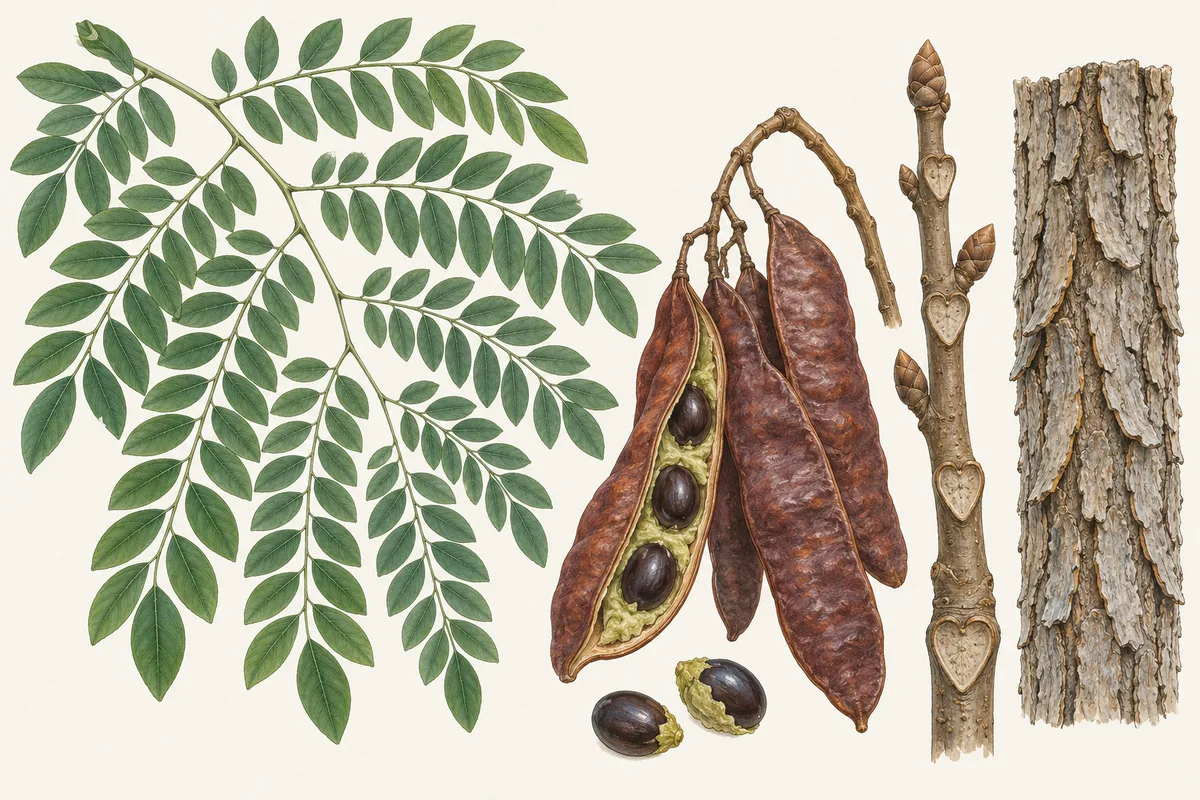
Kentucky coffeetree identification rests on three features. Its leaves are twice compound and huge, up to 3 feet long, with smooth-edged leaflets 1 to 3 inches long. Female trees hang thick, leathery, brownish-black pods 4 to 10 inches long that stay on through winter. The bark is gray-brown with scaly ridges that curl away on one edge. The seeds and pulp are reported poisonous: never eat them.
- Leaves up to 3 feet long, divided twice, with leaflets 1 to 3 inches: much bigger than honey locust's.
- Only female trees bear the thick, dark, leathery pods; planted street trees are often seedless males such as 'Espresso'.
- NC State reports the leaves, seeds and pulp poisonous to livestock, humans and pets; never eat any part of the tree.
Field marks at a glance
- Scientific name
- Gymnocladus dioicus
- Family
- Fabaceae (pea family)
- Type
- Broadleaf, deciduous
- Leaves
- Alternate and twice compound (bipinnate), up to 3 feet long and 2 feet wide, with 5 to 9 side branches. Leaflets oval, 1 to 3 inches long, smooth-edged, blue-green; the lowest leaflets are single. Pinkish-bronze in spring, yellow in fall.
- Pods
- Female trees only: thick, leathery, brownish-black to red-brown pods 4 to 10 inches (15 to 25 cm) long and 1 to 3 inches wide. They ripen in fall, hang on through winter and fall unopened. Poisonous; never eat.
- Seeds
- 3 to 7 per pod, dark brown to blackish, rounded and flattened, about 3/4 inch long, with a very hard shell, set in a sweet, sticky pulp. Reported toxic by NC State, the Morton Arboretum and the Missouri Department of Conservation.
- Bark
- Gray to dark brown, with shallow grooves and scaly ridges that curl away from the trunk on one edge.
- Twigs
- Short, blunt, stout and contorted, reddish brown, with orange pores and a large heart-shaped leaf scar. Buds barely poke out of a silky-lined pit. Few twigs, so the crown looks sparse and coarse in winter.
- Flowers
- Greenish-white, star-shaped, in May and June. Male and female flowers usually on separate trees; female clusters up to 12 inches long and fragrant.
- Size and form
- 60 to 80 feet tall and 40 to 55 feet wide (NC State); 15 to 25 m in Ontario. Slow-growing, with an open, irregular crown.
- Range
- Southeastern Canada and the central and eastern United States; bottomland forests and moist woods along streams, often in small colonies. Widely planted as a street and park tree.
Kentucky coffeetree is easy to miss in summer, when its giant leaves read as just another fern-like canopy, and hard to miss in winter, when it stands with thick dark pods and a handful of stubby branches that look almost dead. It grows wild along streams in the Midwest and in southern Ontario and is planted as a tough street tree far beyond that. Its pods, seeds and pulp are reported poisonous. Never eat a seed, pod or leaf on the strength of a web page or an app, and keep pets away from fallen pods.
The fastest checks for Kentucky coffeetree
- The leaf. Pull down one whole leaf: it is huge and divided twice. NC State Extension gives up to 3 feet long and 2 feet wide, with smooth-edged leaflets 1 to 3 inches long. What looks like a single leafy twig is often just one side branch of one leaf.
- The pods. On a female tree, thick, leathery, brownish-black pods 4 to 10 inches long and 1 to 3 inches wide hang in fall and through the winter. The Missouri Department of Conservation notes that they drop unopened in late winter, each with 3 to 5 hard seeds in a sticky pulp.
- The bark. Gray to brown, with shallow grooves and narrow scaly ridges that curl away from the trunk along one edge, a texture you can feel.
- The twigs. Short, blunt, stout and contorted, with few side branches. The buds barely show, sunk into a silky-lined pit above a large heart-shaped leaf scar.
Leaf size plus pods settles it in fall. In winter, the pods or the coarse, stubby twigs plus curling scaly bark do the job.
Leaves: huge and divided twice
The leaf is the feature people underestimate. It is bipinnately compound: a main stalk carries 5 to 9 side branches, and each side branch carries its own row of oval leaflets. The Missouri Department of Conservation counts 7 to 14 leaflets per branch, and the Morton Arboretum notes that the lowest leaflets are single, attached straight to the main stalk.
Leaves come out pinkish-bronze in spring, turn blue-green in summer and plain yellow in fall. Once the leaves are down, the bare crown is made of a few thick branches with short, blunt twigs. If you see a fern-like leaf in a Midwestern town, the guide to trees with fern-like leaves lists the other candidates. The guide to trees with compound leaves sorts once- and twice-divided leaves.
Pods, seeds and toxicity
Kentucky coffeetree is dioecious: male and female flowers usually grow on separate trees, and only females make pods. The greenish-white flowers open in May and June; NC State describes fragrant female clusters up to 12 inches long.
The pods are the tree's signature. They are thick and leathery, not thin and papery, brownish-black to red-brown, and stay on the tree all winter. Inside are hard, dark, rounded seeds about 3/4 inch long in a sweet, sticky green pulp. NC State gives 4 to 7 seeds per pod and the Missouri Department of Conservation 3 to 5.
On toxicity, the sources agree. NC State states that "the leaves, seeds, and pulp of this tree are poisonous to livestock, humans, and pets." The Morton Arboretum says the leaves and seeds are poisonous, and the Missouri Department of Conservation says raw seeds are toxic. The common name comes from a historical use of the seeds as a coffee substitute; that history is not a guide to safety. Do not eat, brew or experiment with any part of the tree, and pick up fallen pods where dogs or children play.
Many planted trees never fruit. The Morton Arboretum lists seedless male cultivars, including 'Espresso', 'J.C. McDaniel' (Prairie Titan), 'Morton' (Skinny Latte) and 'Stately Manor', which are chosen for streets because they drop no pods.
Where it grows, and its status in Ontario
NC State gives the native range as southeastern Canada and the central and eastern United States. In Missouri, the Department of Conservation describes it as "widespread, but nowhere common", growing in bottomland forests along streams and moist woods at the base of bluffs, usually in small colonies. Planted trees are much more common than wild ones in most cities.
In Canada it is a species at risk. The Government of Ontario lists it as threatened in Elgin, Essex, Lambton, Middlesex, Norfolk and Oxford counties and the Municipality of Chatham-Kent (classified in 2021), and says native subpopulations are limited to southwestern Ontario, mainly Essex, Lambton, Middlesex and Chatham-Kent. Planted trees grow across southern Ontario as far as Ottawa. Ontario describes the tree as 15 to 25 m tall, with leaves up to 60 by 90 cm and pods 15 to 25 cm long holding four to seven seeds.
Telling it from look-alikes
Honey locust is the most common confusion: both are pea-family trees with fern-like leaves, and both are planted on streets. Honey locust leaflets are far smaller, wild trees carry large branched thorns, and its pods are thin and flat and twist as they dry. The locust page covers honey locust and black locust in detail.
Black walnut shares the big compound leaf and the bottomland habitat, but its leaves are divided only once, the leaflets are toothed, and its fruit is a round nut in a green husk; see the walnut page. Tree of heaven has once-divided leaves with a small glandular tooth at the base of each leaflet and papery winged seeds. Catalpa hangs winter pods too, but they are long and pencil-thin, and its leaves are single and heart-shaped. The guide to trees with long seed pods lines up every podded tree by pod shape.
When a photo helps
Tree Identifier names a tree from one photo, and for Kentucky coffeetree the best shot is a whole leaf laid flat, or a pod beside a piece of bark. A single leaflet carries too little information. Kentucky coffeetree is not one of the 138 species in the app's Collection, so the result is saved to your History and Wild Discoveries. The app shows no confidence score or look-alike list, so check its answer against leaf size and pod shape. Tree Identifier's Toxicology tool gives AI-written notes on risks to people, dogs and cats, which is a starting point, not a substitute for a vet or a poison control center if a pet has chewed a pod.
Look-alikes and how to tell them apart
Honey locust (Gleditsia triacanthos)
Honey locust leaves are also fern-like but far smaller, with leaflets about 1/2 to 1 1/2 inches; wild trees carry large branched thorns, and the pods are thin, flat and twist as they dry, not thick and leathery.
Black walnut (Juglans nigra)
Walnut leaves are divided only once into a single row of toothed leaflets, and the fruit is a round green ball, a nut in a husk, not a pod.
Tree of heaven (Ailanthus altissima)
Its leaves are divided only once, and each leaflet has one or two small glandular teeth at the base; the fruit is clusters of papery, twisted winged seeds, never a thick pod.
Catalpa (Catalpa)
Catalpa also hangs pods through winter, but they are long and thin like pencils, and its leaves are single, large and heart-shaped, not compound.
What a photo can't settle
- Young leaves and seedlings can look like thornless honey locust in a photo; leaflet size and, later, the pods settle it.
- Male trees never have pods, so in winter a male must be named from twigs, buds and bark alone.
- A name from a photo, a page or an app is never permission to eat any part of a tree. Kentucky coffeetree seeds and pulp are reported poisonous.
- Kentucky coffeetree is not in Tree Identifier's 138-species Collection, so a correct answer is saved in History and Wild Discoveries.
Questions people ask
How do you identify a Kentucky coffeetree?
Look for leaves divided twice and up to 3 feet long with smooth leaflets 1 to 3 inches, thick brownish-black leathery pods 4 to 10 inches long on female trees, and gray-brown bark with scaly ridges that curl away on one edge. In winter, the stubby, sparse twigs give the crown a coarse, dead-looking outline.
Are Kentucky coffeetree pods and seeds poisonous?
Yes, they are reported poisonous. NC State says the leaves, seeds and pulp are poisonous to livestock, humans and pets, the Morton Arboretum says the leaves and seeds are poisonous, and the Missouri Department of Conservation says raw seeds are toxic. Never eat any part of the tree, and keep pets away from fallen pods.
Why does my Kentucky coffeetree have no pods?
It is probably a male tree. Male and female flowers usually grow on separate trees, and only females make pods. Many planted coffeetrees are seedless male cultivars such as 'Espresso', 'Prairie Titan', 'Skinny Latte' and 'Stately Manor', chosen so they drop no pods.
How do you tell a Kentucky coffeetree from a honey locust?
Compare leaflets and pods. Kentucky coffeetree leaflets are 1 to 3 inches long on leaves up to 3 feet; honey locust leaflets are much smaller. Coffeetree pods are thick, dark and leathery, up to 10 inches; honey locust pods are thin, flat and twist as they dry, and wild honey locusts have branched thorns.
Is Kentucky coffeetree rare?
It is uncommon. The Missouri Department of Conservation calls it widespread but nowhere common. In Ontario it is listed as threatened in Elgin, Essex, Lambton, Middlesex, Norfolk and Oxford counties and Chatham-Kent, with native trees limited to the southwest of the province.
Sources
- Gymnocladus dioicus (Kentucky Coffeetree) — North Carolina Extension Gardener Plant Toolbox, NC State University
- Kentucky Coffee Tree — Missouri Department of Conservation, Field Guide
- Kentucky coffeetree (Gymnocladus dioicus) — The Morton Arboretum
- Kentucky Coffee-tree (Species at Risk) — Government of Ontario
Keep reading
- Tree profileLocust trees: how to identify black locust and honey locust
- Clue guideWhich tree has long seed pods? Sort it by leaf, pod and region
- Clue guideWhich tree has fern-like leaves? Count the divisions first
- Tree profileWalnut trees (Juglans): how to identify them
- Winter field guideWinter tree identification, from buds to bark