Printables
Printable tree identification charts: 11 free PDFs and a worksheet
Labelled charts of leaves, bark, needles, seeds and acorns on US Letter sheets, free to print and copy for home and classroom use, with a three-tree leaf-walk worksheet.
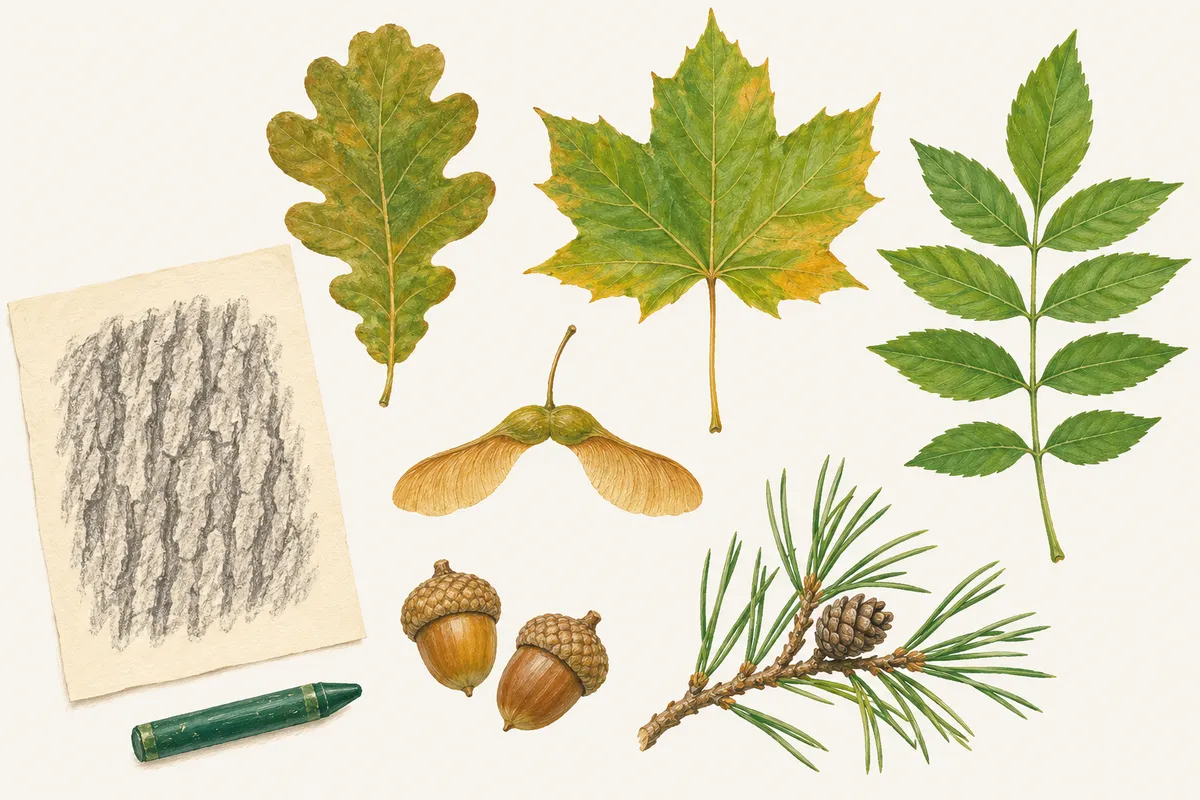
In short
Each tree identification chart PDF here is a single landscape US Letter sheet in color, free to print and copy for personal and classroom use. There are 11: leaf types, leaf shapes, leaf edges, leaf arrangement, compound leaves, 12 common North American leaves, 12 North American barks, conifer needles, winged seeds, acorns and maple leaves. A portrait leaf-walk worksheet and one 12-page file with everything are also available.
- Start a beginner on the leaf types and leaf arrangement sheets: they sort a tree into a group before any name comes up.
- Print the bark, acorn and compound-leaf sheets in color; the leaf shape and edge outlines still read in black and white.
- Choose "Fit to page" in the print dialog and the Letter sheets print on A4 paper too.
Every chart on this page is a labelled drawing the site already uses in its guides, printed one per sheet with its caption, so the PDF shows the same thing as the web page. Teachers, parents and anyone heading out on a walk can download them, print them and copy them for personal and classroom use.
Download the charts
The fastest way to get everything is one file: all 11 tree identification charts and the leaf-walk worksheet (PDF, 1,542 KB, 12 pages, US Letter). Or pick single sheets below. Each chart is one landscape page in color on a white background, and the footer links back here.
| Chart | What it shows | Download |
|---|---|---|
| Leaf types | Eight leaf types, from one undivided blade to leaflets and scales | PDF, 204 KB |
| Leaf shapes | Eight leaf outlines, from linear to triangular | PDF, 151 KB |
| Leaf edges | Six edges: smooth, saw-toothed, round-toothed, wavy and more | PDF, 149 KB |
| Leaf arrangement | One, two, or three or more leaves per node on a twig | PDF, 144 KB |
| Trees with compound leaves | Eight trees, sorted by toothed or smooth leaflets: ash, rowan, black walnut, boxelder, black locust, English walnut, tree of heaven, honey locust | PDF, 203 KB |
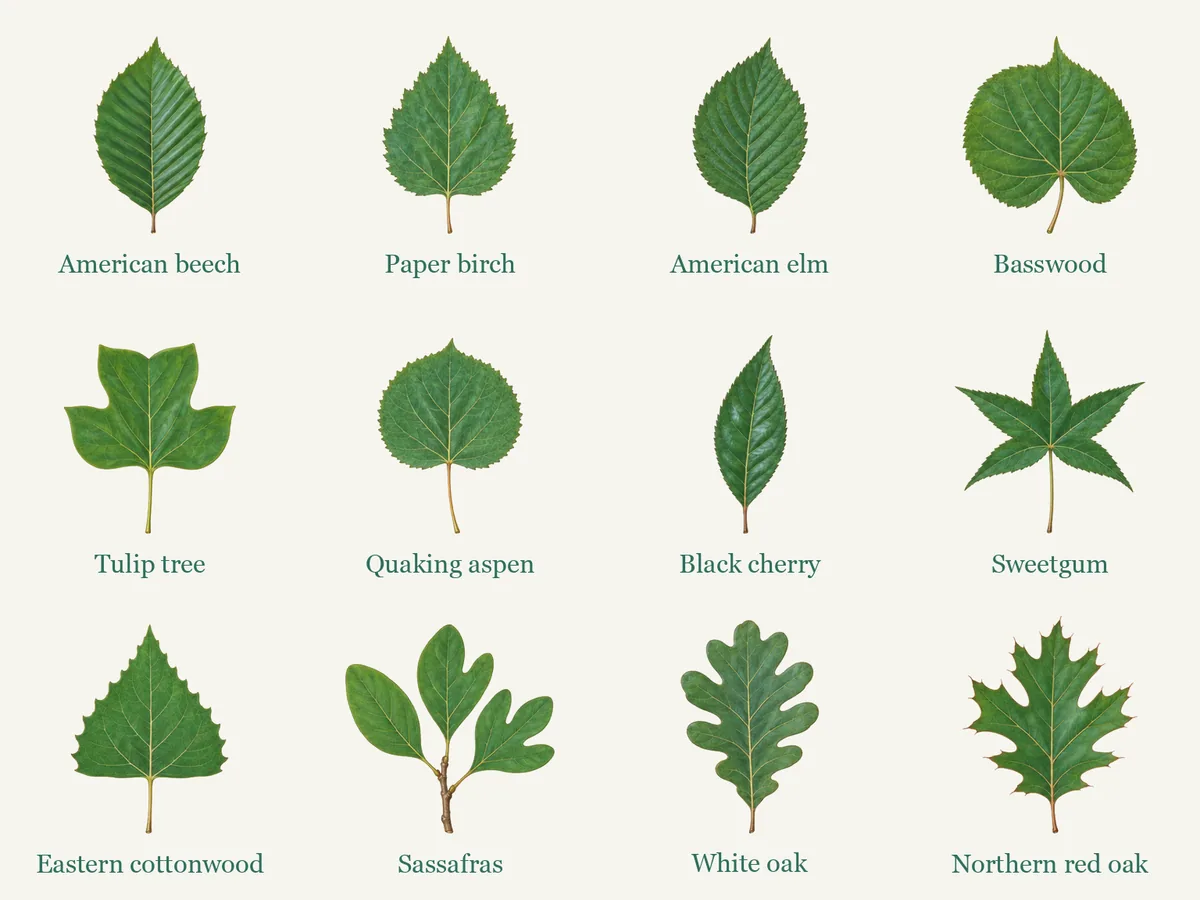
| Common North American tree leaves | Twelve leaves, with the edge and base to check first | PDF, 164 KB |
| Tree bark of North America | Twelve barks of mature trees at chest height | PDF, 211 KB |
| Conifer needles | How needles attach on pine, larch, spruce and fir | PDF, 230 KB |
| Winged seeds | Paired maple wings; single wings of ash, elm and tree of heaven | PDF, 137 KB |
| Acorns | Acorn caps and stalks, including English oak and bur oak | PDF, 182 KB |
| Maple leaves | Six hand-shaped leaves: Norway, sycamore, field, sugar and red maple, and American sycamore | PDF, 159 KB |
The leaf walk worksheet (PDF, 70 KB, portrait) has room for three leaves. For each one there is a box to tape the leaf in or trace around it, a line for where it was found, tick boxes for leaf type (simple, compound, needle or scale), edge (smooth, toothed, wavy) and position on the twig (alternate, opposite), and a line for the tree's name.
Printing tips
- Paper size. The charts are US Letter, landscape. On A4 paper, choose "Fit to page" or "Scale to fit" in the print dialog; the whole sheet prints with slightly wider margins. The worksheet is portrait, so switch orientation if your printer remembers the last job.
- Color. The bark, acorn, compound-leaf, maple and winged-seed sheets rely on color and tone: bark texture and the shade of a cap or a seed wing are part of the clue. The leaf shape, edge, type and arrangement sheets are outlines and still work in grayscale, which saves toner for a class set.
- Outdoors. Paper does not survive a damp morning. Slip each chart into a clear sheet protector, or laminate it, and clip a set to a board. A wet-erase marker on a laminated worksheet lets a class reuse it.
- One set per group. For a class, the all-in-one file prints 12 pages per set. Groups of three or four with one set each share charts more easily than a whole class crowded around one.
A leaf walk with the worksheet
The worksheet asks for three leaves from three different trees. It takes about half an hour around a schoolyard, a park or a street. Here is the order that works.
- Collect carefully. Pick up fallen leaves where you can, and ask before picking from a tree in a park or someone's yard. Take one leaf, not a branch. If a leaf is attached, note how it sat on the twig before you take it.
- Pick three different trees. Different bark, different shape, or a different leaf on the ground are all good signs. Choose an average leaf from the sunny side: Nebraska Extension's 4-H forestry rules note that shaded leaves are often much larger than leaves in full sun.
- Needle, scale or broad leaf. Tick the box on the sheet. Needles and scales go to the conifer needles chart; broad leaves carry on.
- Simple or compound. Find where the leaf stalk meets the twig. One blade is simple; several leaflets on one stalk make a compound leaf, and the compound leaves chart takes over from there.
- Opposite or alternate. Look at the twig, not the loose leaf. Pairs of leaves at the same point are opposite. Virginia Tech's dendrology primer on leaf arrangement says an opposite-leaved tree is very likely a maple, ash, dogwood, a member of the honeysuckle family, or a horse chestnut (buckeye), which students remember as "MAD Cap Horse". University of New Hampshire Extension's list of opposite-branching trees is the same: maple, ash, horse chestnut, dogwood, viburnum and elderberry.
- The edge. Run a finger along it: smooth, toothed or wavy. Compare with the leaf edges chart for the finer terms.
- The outline. Match the overall shape on the leaf shapes chart, and count any lobes.
- Name it. Compare the leaf with the common North American tree leaves chart, or the maple leaves chart for a hand-shaped leaf. Write a name, or a nickname until you are sure.
- Confirm with a second clue. Check the bark against the bark chart, and look under the tree for acorns, winged seeds or cones. A name that fits the leaf, the bark and the fruit is much safer than one that fits the leaf alone.
Safety on the walk
- Leaves of three. Teach poison ivy before the walk. Illinois Extension's guide to identifying poison ivy explains that each leaf is made of three leaflets and that the plant grows as a shrub up to 3 or 4 feet tall or as a climbing vine; its oil, urushiol, can cause anything from an itchy rash to a severe allergic reaction. Leave any three-leaflet plant alone.
- Nothing goes in the mouth. No berries, seeds, nuts or leaves. The National Capital Poison Center lists the needles of yew, a common hedge and schoolyard shrub, and the seed inside its red berries as poisonous. If a child swallows part of a plant, call Poison Control at 1-800-222-1222 right away rather than waiting for symptoms.
- Wash hands after the walk. If skin has touched poison ivy, the CDC's NIOSH page on poisonous plants advises rinsing right away with rubbing alcohol, a poison-plant wash or dishwashing soap and lots of water, and washing exposed clothing separately in hot water.
Which chart answers which question
The sheets are built to be used in a sequence, from the broadest question to the finest. Taking them in this order saves time.
- Is it a conifer or a broadleaf, and is the leaf one piece or many? Leaf types. It also separates lobed leaves, which are still simple, from truly compound ones.
- How are the leaves set on the twig? Leaf arrangement. In North America this one check rules most trees in or out of the short opposite-leaved list.
- How many leaflets, and are they toothed? Trees with compound leaves, for ash, walnut, locust and the rest.
- What shape and edge? Leaf shapes and leaf edges give the vocabulary that field guides and keys use. Our leaf shapes guide defines every term on those sheets in one line, with trees that show it.
- Which common tree is it? Common North American tree leaves, then the maple chart for hand-shaped leaves. The guide to identifying trees by their leaves works through ten examples with the same chart.
- Which needles? Conifer needles, by how they attach: sheathed bundles on pines, tufts on larch, pegs on spruce, round bases on fir.
- What is on the ground? Winged seeds and acorns. They often name a tree faster than the leaves, and they stay under it long after leaf fall.
- Does the bark agree? Tree bark of North America. Bark is best used to confirm a name, not to find one; the bark identification guide explains why bark changes with age.
For younger children, the tree identification guide for kids turns the same order into seven short steps, with bark rubbings and a pressed-leaf book.
When a chart is not enough
Printed charts show typical, mature leaves and bark. Several common situations fall outside them.
- Winter. A bare twig has no leaf to match. Opposite or alternate still works on the buds and branches, and the bark, acorn and conifer sheets stay useful, but buds and leaf scars need a winter key.
- Saplings and sprouts. Young trees and shoots from a stump often have leaves that look unlike the adult tree's, larger or more deeply lobed, and smoother bark.
- Sun and shade. Shade leaves are often much larger than leaves from the sunny side of the same tree, so compare several leaves before you decide.
- Hybrids and cultivars. Planted trees include purple-leaved maples, thornless honey locusts and crosses between species that sit between two pictures on a chart.
A photo app can be a second opinion in these cases. Tree Identifier names a tree or other plant from one photo of a leaf, the bark, flowers, fruit or the whole tree, and you can ask follow-up questions in the chat under the result. It needs an internet connection, so it will not help on a walk without signal, and it shows one name with no confidence score or list of look-alikes. Check what Tree Identifier suggests against the charts: if the app says sugar maple but the leaves on the twig are alternate, one of you has made a mistake, and the twig is right. For a class, an adult can hold the phone while the children do the looking and ticking on the worksheet.
What a photo can't settle
- A chart shows a typical mature leaf or bark; a sapling, a shade leaf or a sucker shoot can look unlike any picture on the sheet.
- Hybrids and garden cultivars, such as purple-leaved Norway maples or thornless honey locusts, may not match the wild form on a chart or in a photo app.
- No chart, page or app can tell you a leaf, berry or seed is safe to touch or eat; an adult has to check on the spot.
Questions people ask
Can I copy these charts for my class?
Yes. Every sheet's footer says it is free to print and copy for personal and classroom use, and links back to this page. Print one set per group, or copy the all-in-one file for a whole class.
Will the charts print on A4 paper?
Yes. The sheets are US Letter, which is a little wider and shorter than A4. Choose "Fit to page" or "Scale to fit" in the print dialog and each chart prints whole on A4, with slightly wider margins. The worksheet is portrait and fits the same way.
Which chart should a beginner start with?
Leaf types, then leaf arrangement. Together they sort any tree into needle or broad leaf, simple or compound, opposite or alternate. After that, the common North American leaves chart is the one most people use to put a name on a backyard or schoolyard tree.
Do the charts work in winter?
Partly. The bark, conifer needle and acorn sheets work all year, and fallen leaves and seeds often stay under a tree into winter. Most sheets show summer leaves, though, so a bare twig needs a winter key based on buds and branching.
Can I print the charts in black and white?
The leaf shape, edge, type and arrangement sheets read well in grayscale because they are outlines. Print the bark, acorn, compound-leaf and maple sheets in color if you can: bark tone, cap texture and leaf color carry part of the information.
Sources
- Basics of Tree ID: Leaf Arrangement — Virginia Tech Dendrology
- Mind Your B's to Identify Winter Trees — University of New Hampshire Extension
- "Leaves of three": Identifying poison ivy — University of Illinois Extension
- Poisonous Plants and Work — CDC, National Institute for Occupational Safety and Health (NIOSH)
- Yew and paclitaxel: What do they have in common? — National Capital Poison Center (webPOISONCONTROL)
- Forestry (4-H static exhibits) — Nebraska Extension in Lancaster County
Keep reading
- Family and classroomTree identification for kids, step by step
- Leaf vocabularyLeaf shapes and types: the terms, with charts and real trees
- Field guideHow to identify trees by their leaves
- Field guideTree bark identification: seven bark types and the trees that have them
- Field guideHow to identify trees, step by step