Clue guide
Which tree has yellow berries? Check the leaf, the thorns and where you are
Yellow berries on a tree come from a short list, and the leaf sorts most of it: twice-divided, feather-like, three-parted, fan-shaped or plain.
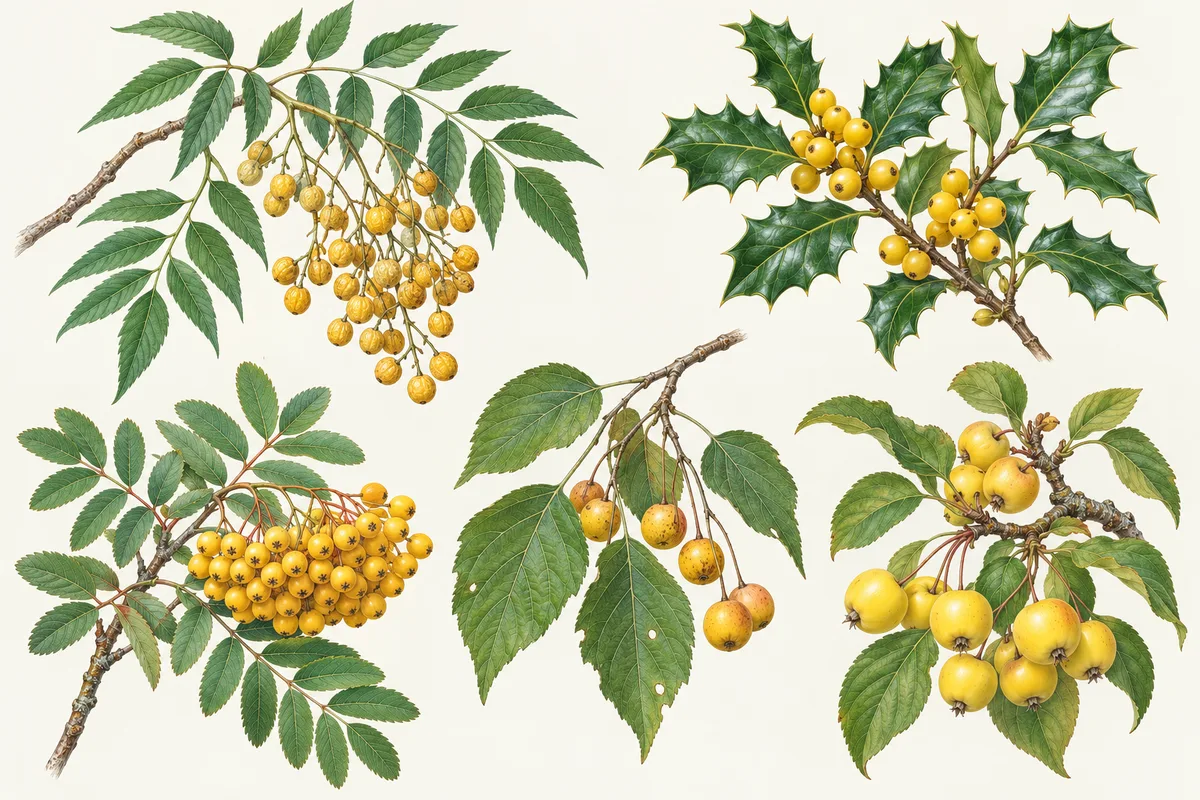
In short
A tree with yellow berries in the southern US is most often a chinaberry (big twice-divided leaves, lilac flowers in spring, wrinkled yellow fruit about half an inch long through winter) or, in Texas and Oklahoma, a western soapberry. Small greenish-yellow fruit on a white-flowering street tree is Callery pear. In UK gardens, check yellow-berried rowans and the Golden Hornet crab apple.
- Yellow berries plus lilac-purple flowers in spring mean chinaberry, which NC State reports as poisonous to people, cats and dogs.
- Three leaflets, long green thorns and fuzzy yellow fruit 1 to 3 inches across mean trifoliate orange.
- Female ginkgo trees drop plum-like yellow-orange seeds about an inch across that smell foul when ripe.
A tree with yellow berries comes from a short list, and the shape of the leaf settles most cases before you look closely at the fruit. Never eat a berry, nut, seed or pod on the strength of a web page or an app; check with a local expert. Several of the trees below are reported poisonous, and this page only helps you put a name on the plant.
Yellow-berried trees by leaf and region
| Tree | Leaf | Yellow fruit | When | Where |
|---|---|---|---|---|
| Chinaberry (Melia azedarach) | Twice-divided, 12–24 in, toothed leaflets | Wrinkled yellow to yellow-green, about 1/2 in, sticky | After spring flowers, often through winter | Introduced across the southern US; native from India to Australia |
| Western soapberry (Sapindus drummondii) | Divided, 8–18 leaflets | Fleshy, yellow becoming black | Yellow first, black later | Native; NC State gives origin as Colorado and New Mexico |
| Callery pear (Pyrus calleryana) | Simple, glossy, oval, to 3 in | Greenish yellow with whitish spots, to 1/2 in | Fall, darkening after frosts | Planted and escaped, East and Midwest |
| Ginkgo (Ginkgo biloba), female | Fan-shaped | Plum-like seeds, about 1 in, yellow-orange, foul-smelling | Fall | Planted street tree |
| Trifoliate orange (Citrus trifoliata) | Three leaflets on a winged stalk; long green thorns | Fuzzy, dull lemon-yellow, 1–3 in | Fall, into winter | Planted and escaped in the Southeast |
| Yellow-fruited American holly, e.g. 'Fallaw' | Evergreen, spiny, 2–4 in | Yellow, on female trees | September–February | Gardens, eastern US |
| Rowan 'Joseph Rock' (Sorbus) | Feather-like | Butter-yellow | Autumn | UK and Ireland gardens |
| Crab apple 'Golden Hornet' (Malus × zumi) | Simple | Deep yellow, about 2.5 cm (1 in) | Autumn, well into winter | UK gardens and parks |
Data come from NC State Extension (chinaberry, soapberry, trifoliate orange, holly), the Missouri Department of Conservation (Callery pear) and the RHS (rowan, crab apple), read on 21 October 2026. Ginkgo details are on our ginkgo page.
Big divided leaves in the South: chinaberry
Across the southern US, the commonest tree with yellow berries is chinaberry. NC State Extension describes leaves 12 to 24 inches long, divided twice into toothed, pointed leaflets up to 2.75 inches long, which makes the tree look lacy. Fragrant lavender-lilac flowers open in spring in sprays 8 to 16 inches long, and the fruit that follows is a wrinkled yellow to yellow-green drupe about 0.4 to 0.5 inch long, sticky, with a hard round seed. It often hangs on the bare branches through winter into spring, which is when most people notice it.
NC State reports chinaberry fruit as poisonous to humans, some livestock, cats and dogs, and lists it as invasive in North Carolina and many southern states. See invasive trees for the other listed trees. It is native from India through China to Australia. If the tree has both yellow berries and purple flowers, or yellow berries on bare winter branches, start here.
Texas and Oklahoma: western soapberry
The native look-alike in the southern Plains is western soapberry. NC State describes divided leaves with 8 to 18 leaflets and fleshy fruit that is yellow, becoming black. NC State lists the fruit as poisonous, with a saponin-type toxin causing nausea, vomiting and diarrhea. Soapberry leaves are divided once, not twice, which is the quickest way to tell it from chinaberry when both grow along the same fence line.
Small fruit on a white-flowering street tree: Callery pear
In the East and Midwest, a street or roadside tree with glossy oval leaves and hard little fruit is often Callery pear, the species behind Bradford pear. The Missouri Department of Conservation gives round fruit up to half an inch across, greenish yellow with whitish spots, holding 2 to 4 black seeds. After freezes the fruit softens, darkens and wrinkles, and birds eat it and spread the seeds. MDC describes the fruit as inedible to people. In spring the same tree is covered in white flowers with a strong, unpleasant smell.
Thorns and three leaflets: trifoliate orange
A small tree or large shrub with bright green twigs, long green thorns and fuzzy yellow fruit like a small orange is trifoliate orange. NC State describes leaves with three leaflets on a winged stalk, the end leaflet larger than the side ones, and dull lemon-yellow fruit 1 to 3 inches across with a rough, slightly fuzzy peel, ripening in fall and often left on the tree into winter. NC State notes it is considered invasive in some states and that handling the plant in sunlight may irritate the skin. It fits the common search "small yellow fruit on a tree with thorns" in the Southeast.
Garden cultivars: yellow holly, rowan and crab apple
Several trees that normally fruit red have yellow-fruited cultivars, which is why the berries alone can mislead.
Holly. American holly berries are usually red or orange, but NC State lists the female cultivar 'Fallaw' as yellow-fruited. The leaves are the clue: thick, leathery, evergreen, 2 to 4 inches long with spiny teeth, and fruit only on female trees with a male nearby. The holly page covers American and English holly.
Rowan. In the UK and Ireland, a rowan with yellow berries is usually a garden cultivar. The RHS describes Sorbus 'Joseph Rock' as an upright tree with feather-like leaves that turn orange, red and purple in autumn and butter-yellow berries, and warns that the fruit is ornamental and not to be eaten. The wild rowan, with red to orange-red berries, is on our rowan page.
Crab apple. A small tree in a UK park or garden with white spring flowers and deep yellow fruit about 2.5 cm long that persist well into winter is very likely Malus × zumi 'Golden Hornet', according to the RHS.
Palms and fan-leaved trees
Palms with clusters of yellow-orange fruit are common in Florida, California and warm coastal towns. The queen palm, a feather-leaved palm, carries bright orange, round to slightly elongated fruits ¾ to 1 inch long, according to UF/IFAS, and UF/IFAS rates it as potentially invasive in Florida.
A tree with fan-shaped leaves and yellowish fruit dropping on the sidewalk is a female ginkgo. Its plum-like seeds are about an inch across, yellow-orange and foul-smelling when ripe; our ginkgo page explains why most street ginkgoes are male.
Using a photo
A photo that shows one fruit cluster together with a whole leaf gives the best lead, and a second photo of thorns or flowers settles harder cases. Tree Identifier names a plant from one photo, and ginkgo, rowan and queen palm are among the species in its Collection. It shows no confidence score or list of alternatives, so check the result against the leaf and region columns in the table. The follow-up chat under each result can answer questions such as how chinaberry differs from soapberry. Its Toxicology notes are AI-written and are not a safety verdict: for anything about eating fruit, ask a local expert.
What a photo can't settle
- Yellow-berried rowans, hollies and crab apples are garden cultivars of species that usually fruit red, so a photo of the berries alone can point to the wrong species; leaves and the tree's setting help.
- Many fruits turn yellow on the way to another colour: soapberry turns black, Callery pear darkens after frost. One photo shows one moment.
- No page or app can tell you a berry is safe to eat. Treat any identification as a name to check with a local expert.
Questions people ask
What tree has yellow berries and purple flowers?
Chinaberry. NC State describes fragrant lavender-lilac flowers in spring sprays 8 to 16 inches long, followed by wrinkled yellow fruit about half an inch long that hangs on after the leaves fall. The leaves are 12 to 24 inches long and divided twice into toothed leaflets. Never eat the fruit.
What tree has yellow berries in winter?
Chinaberry and the Golden Hornet crab apple both hold their fruit into winter: NC State says chinaberry fruit can persist through winter into spring, and the RHS says Golden Hornet's deep yellow fruits persist well into winter. Yellow-fruited hollies keep their berries through winter too.
What tree has yellow berries in Texas?
Usually chinaberry, an introduced tree with big twice-divided leaves, or western soapberry, a native with 8 to 18 leaflets per leaf and fleshy fruit that NC State describes as yellow becoming black. NC State lists soapberry fruit as poisonous, with nausea, vomiting and diarrhea as symptoms.
Are yellow berries on trees poisonous?
Several are. NC State reports chinaberry fruit and soapberry fruit as poisonous, and the RHS says the berries of the yellow rowan 'Joseph Rock' are ornamental and not to be eaten. Never eat a berry, nut, seed or pod on the strength of a web page or an app; check with a local expert.
Sources
- Melia azedarach (chinaberry) — North Carolina Extension Gardener Plant Toolbox, NC State University
- Sapindus saponaria var. drummondii (western soapberry) — North Carolina Extension Gardener Plant Toolbox, NC State University
- Callery Pear (Bradford Pear) — Missouri Department of Conservation
- Citrus trifoliata (trifoliate orange) — North Carolina Extension Gardener Plant Toolbox, NC State University
- Ilex opaca (American holly) — North Carolina Extension Gardener Plant Toolbox, NC State University
- Sorbus 'Joseph Rock' — Royal Horticultural Society
- Malus × zumi 'Golden Hornet' — Royal Horticultural Society
- Syagrus romanzoffiana: Queen Palm (ST609) — UF/IFAS Extension
Keep reading
- Clue guideWhich tree has orange berries? Check the leaf, the thorns and where you are
- Clue guideWhich tree has red berries? Sort it by leaf and season
- Tree profileGinkgo tree identification: the fan-leaf tree and its smelly seeds
- Tree profileHolly tree (Ilex): how to identify American and English holly
- Tree profileRowan tree (mountain ash): how to identify it