Also in Deutsch
Tree profile
Ginkgo tree identification: the fan-leaf tree and its smelly seeds
No other tree has a fan-shaped leaf with veins that fork again and again. Spur shoots on bare branches name it in winter, and a foul smell in fall tells you the tree is female.
In short
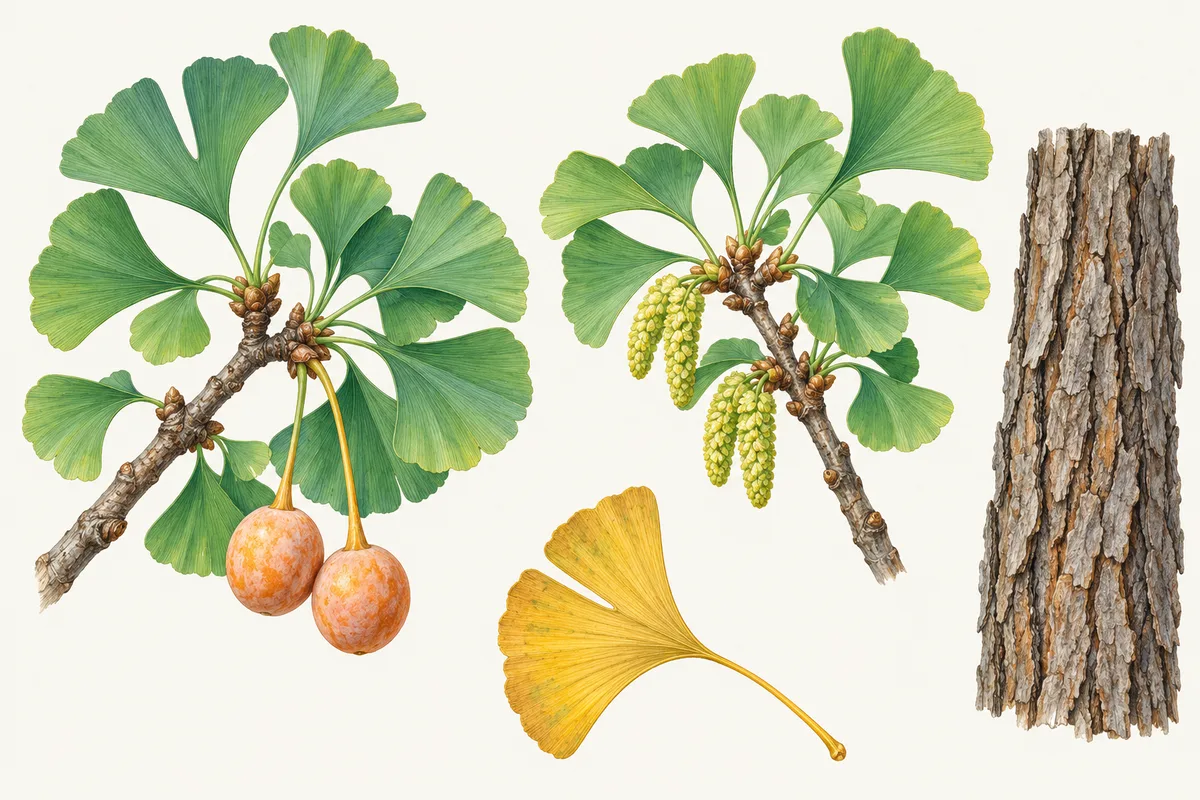
Ginkgo tree identification starts with the leaf: a flat, fan-shaped blade 2 to 3 inches long, often notched in the middle, with fine veins that fork repeatedly and no midrib. The leaves sit in clusters of three to five on short, knobby spur shoots, turn bright gold in fall and often drop within days. Plum-like seeds that smell foul when ripe mean the tree is female.
- The vein pattern settles it: ginkgo veins fork in pairs from the stalk to the edge, with no midrib, unlike any other tree leaf.
- In winter, look for short, knobby spur shoots studding the branches; the leaves grew from them in clusters of three to five.
- Only female trees bear the smelly, apricot-colored seeds; most ginkgoes planted along US streets are male.
Field marks at a glance
- Scientific name
- Ginkgo biloba
- Family
- Ginkgoaceae (ginkgo family)
- Type
- Broadleaf, deciduous
- Leaves
- Simple, fan-shaped, 2 to 3 inches long (Oregon State gives 3 to 7.5 cm long and wide), leathery and hairless, often notched in the middle of the outer edge, hence biloba, two-lobed.
- Veins
- Fine veins that fork in two again and again (dichotomous venation), fanning out from the stalk to the outer edge. There is no midrib.
- Arrangement
- Alternate and single along long shoots; in clusters of three to five on short spur shoots along older branches.
- Fall color
- Bright yellow to gold. Oregon State notes that most of the leaves can drop in a short period, sometimes a single night, leaving a yellow carpet.
- Seeds
- Female trees only. Plum-like, about 1 inch, green turning tan, yellow-orange or apricot; the fleshy outer layer is messy and smells foul when ripe. Inside is a hard, smooth, cream-colored shell.
- Pollen cones
- Male trees carry catkin-like pollen structures about 1 inch (2.5 cm) long in spring; female trees carry tiny, long-stalked pairs of ovules.
- Bark
- Light gray to gray-brown, later darker, with shallow ridges and furrows on older trunks.
- Form and size
- Pyramidal and often gawky when young, spreading with age; 50 to 80 feet tall and 30 to 40 feet wide at maturity. Columnar and dwarf cultivars are planted too.
- Origin
- Native to south-central and southeastern China; planted in streets, parks and yards across the US in USDA zones 3 or 4 to 9.
Ginkgo is one of the easiest trees in North America to name, and one of the strangest. It sits alone in its own family, Ginkgoaceae, it is native to China and planted along streets across the US, and nothing else carries its fan-shaped leaves. Never eat a berry, nut, seed or pod on the strength of a web page or an app; check with a local expert. The questions people actually have are different: is that smelly tree a ginkgo, and is a newly planted one male or female.
How to identify a ginkgo tree in any season
1. The fan-shaped leaf. Each leaf is a flat fan, 2 to 3 inches long, leathery and hairless, often with a notch in the middle of the outer edge. The NC State Extension profile lists the leaves as fan-shaped, 2 to 3 inches long and dichotomously veined. The species name biloba, "two-lobed," comes from that notch; Oregon State University notes that split leaves are most common near the tips of shoots.
2. The veins. Hold a leaf up to the light. Fine, parallel veins run from the stalk to the outer edge, splitting in two again and again. There is no midrib and no network of side veins. This is the single feature that rules out every other tree.
3. Spur shoots. Along older branches, leaves grow in clusters of three to five from short, knobby, woody pegs called spurs; on fast-growing new shoots they sit singly. The Morton Arboretum describes exactly this pattern. In winter, the bare spurs studding every branch make a ginkgo recognizable from across a street.
4. The bark and shape. Bark is light gray with shallow ridges and furrows, darkening and deepening with age. Young trees are often lopsided and sparsely branched; older ones spread into a broad crown 50 to 80 feet tall.
Tree Identifier can name a ginkgo from one photo of a leaf, a spur cluster or the whole tree. The app shows no confidence score, so check the forking veins yourself; with a leaf in hand, they settle the question in seconds.
Male or female: the smell, the seeds and the pollen
Ginkgo trees are either male or female. Only females produce seeds, and those seeds are the reason people ask about ginkgoes every October.
- Female trees: in fall they drop round, plum-like seeds about an inch across. NC State describes them as yellow-orange with a fleshy pulp that smells foul when ripe; Morton calls the covering apricot-colored with a silvery cast, messy and strongly scented. Oregon State quotes a botanist who compared the smell to "raw dog vomit." NC State also lists the seed pulp as able to cause contact dermatitis, so handle fallen seeds with gloves.
- Male trees: in spring they carry catkin-like pollen structures about an inch long, which fall soon after. No seeds, no smell.
- Young trees: you usually cannot tell. Oregon State notes a seedling may take twenty or more years to flower and bear seeds, so a quiet young ginkgo is not proof of a male.
Nurseries sell grafted male cultivars to avoid the smell, and NC State notes that most ornamental ginkgoes in the US are male. Oregon State lists seedless male selections such as Autumn Gold, Princeton Sentry (a narrow column about 60 by 20 feet) and Shangri-la. A named, columnar street ginkgo is very likely a male.
Ginkgo in fall: gold leaves that drop overnight
Ginkgo turns a clear, even yellow to gold in fall, and the Morton Arboretum calls the color vivid. Then it does something few trees do: Oregon State notes that most of the foliage can fall in a short period, sometimes in a single night, leaving a golden carpet under the tree on calm days. A tree that was full gold yesterday and bare today, with a ring of fan-shaped leaves beneath it, is almost certainly a ginkgo.
Our guide to trees with yellow leaves in fall compares ginkgo with aspen, tulip tree, honey locust and the other gold trees by leaf shape.
Where ginkgoes grow and how big they get
Ginkgo is native to south-central and southeastern China, according to NC State, and it is planted rather than wild everywhere in North America and Europe. NC State lists it for USDA zones 3 to 9 and the Morton Arboretum for zones 4 to 9; both describe a tree 50 to 80 feet tall at maturity. NC State notes it needs full sun and good drainage but tolerates a range of soil textures and pH, and it is a common street tree.
You will meet three shapes:
| Form | What you see | Example |
|---|---|---|
| Species or seedling | Gawky and pyramidal when young, broad and irregular when old | Older park trees; may be male or female |
| Columnar | Narrow and upright, often along streets | Princeton Sentry, about 60 by 20 feet (Oregon State) |
| Dwarf | Small, dense, sometimes slightly weeping | Mariken, about 2 by 2 feet after 10 years (Oregon State) |
Ginkgo look-alikes, and why there are so few
No other common tree shares ginkgo's leaf, so true look-alikes are rare. Confusions come from the fall color and the spurs:
- Larch and tamarack also turn gold in fall, drop everything and grow their foliage on short spurs, but the spurs carry tufts of soft needles and the tree bears small cones. See the tamarack page.
- Quaking aspen is a gold fall tree with roundish leaves, but its leaves are toothed, have a midrib and flutter on flat stalks.
- Maidenhair fern has leaflets with the same fan shape and forking veins, which is why ginkgo is also called the maidenhair tree, but it is a fern on the forest floor.
For the general method of reading a leaf (simple or compound, opposite or alternate, edge, veins), see how to identify trees by their leaves.
Ginkgo is one of the species in Tree Identifier's Collection, the 138-species catalog that fills in as you identify. If you find a female tree, pinning it on the app's Tree Map is a simple way to remember which corner of the park to avoid in late October.
Look-alikes and how to tell them apart
Maidenhair fern (Adiantum)
The fern's small leaflets have the same fan shape and forking veins, which gave ginkgo its other name, maidenhair tree. But the fern is a low plant on the forest floor with wiry black stalks, never a tree with a woody trunk and spur shoots.
Tamarack and European larch (Larix)
Larches also turn gold in fall, drop everything and grow their foliage in tufts on short spurs. Look closer: larch tufts are bundles of soft needles and the tree carries small cones, while ginkgo spurs hold three to five flat fans.
Quaking aspen (Populus tremuloides)
A golden fall tree with roundish leaves, but aspen leaves are toothed, have a midrib with side veins and tremble on flat stalks. The bark is smooth and white to greenish, not furrowed gray.
What a photo can't settle
- A photo cannot tell a young, seedless ginkgo's sex; that shows only when a female tree starts bearing seeds, which can take twenty or more years.
- Ginkgo cultivars (columnar, dwarf, weeping or variegated) share the same leaf; a photo names the species but not the cultivar.
- A single fallen leaf on a sidewalk is enough to name a ginkgo, but it does not prove which tree it fell from; check the spurs on the nearest branches.
Questions people ask
How do I tell a male ginkgo tree from a female?
Wait for seeds. Only female trees bear the plum-like, foul-smelling seeds in fall; male trees carry short, catkin-like pollen structures in spring. Oregon State notes a seedling may take twenty or more years to produce seeds, so a young tree with no seeds may still be female. Named cultivars such as Autumn Gold and Princeton Sentry are seedless male selections.
Why does a ginkgo tree smell so bad?
The smell comes from the fleshy outer layer of the seeds that female trees drop in fall. NC State describes it as foul when ripe, and the Morton Arboretum recommends planting only male trees for that reason. If a ginkgo smells, it is female; a male tree never does.
Do ginkgo trees really drop all their leaves at once?
Often, yes. Oregon State notes that a ginkgo can drop most of its fall leaves in a short period, sometimes in a single night, leaving a gold carpet under the tree. Few other trees drop their leaves so suddenly.
Is a ginkgo a conifer or a broadleaf tree?
Neither, strictly. Ginkgo sits in its own family, Ginkgoaceae. Like conifers it bears naked seeds rather than fruit, as the Morton Arboretum notes, but it has broad, flat leaves and loses them every fall, so field guides file it with the deciduous broadleaf trees.
Are ginkgo seeds poisonous?
NC State Extension lists the seeds as the toxic part of the tree: touching the pulp can cause contact dermatitis, and eating it can irritate the mouth and cause stomach upset. Never eat a seed on the strength of a web page or an app.
Sources
- Ginkgo biloba (Ginkgo, Maidenhair Tree) — NC State Extension Gardener Plant Toolbox
- Ginkgo (Ginkgo biloba) — The Morton Arboretum
- Ginkgo biloba — Oregon State University, Landscape Plants