Also in Français
Care guide
When to plant trees, by region, tree and root type
In the Midwest, August to early November suits most deciduous trees; bare-root and slow-rooting trees wait for spring; in Texas the best season is fall and winter.
In short
When to plant trees depends on the tree and the region. Iowa State Extension calls August through early November an excellent time for deciduous trees, and mid-August through September for pines and spruces. Bare-root trees must go in during spring before growth begins. Slow-rooting trees such as magnolia, ginkgo and bald cypress are best planted in spring, and in Texas, fall and winter beat spring.
- Container trees can be planted in any month, according to Clemson Extension; fall gives roots the longest run before summer heat.
- Bare-root trees are planted only while dormant, in spring before the buds open.
- Magnolia, ginkgo, bald cypress, hemlock, sweetgum, tulip tree and willows establish slowly and are best planted in spring, according to Illinois Extension.
- Plant with the trunk flare level with the soil, in a hole two or more times wider than the roots.
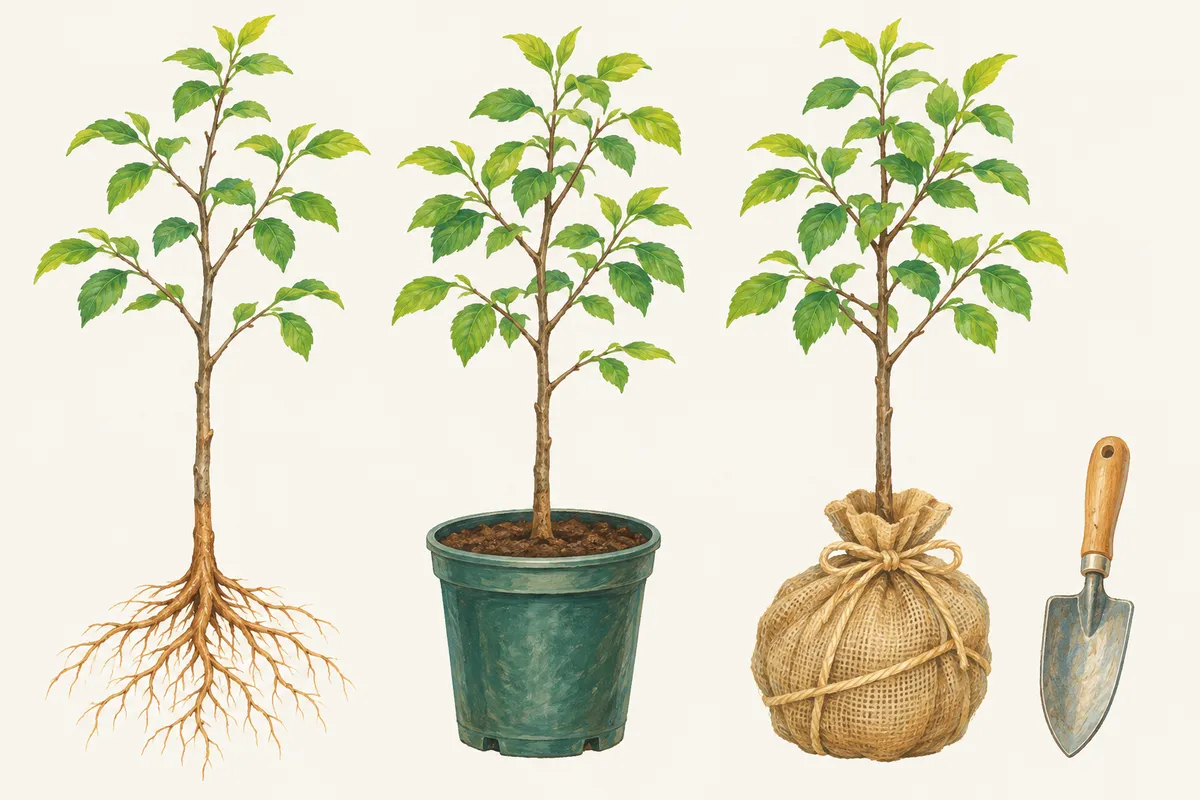
The right time to plant a tree depends on three things: how the tree is sold (bare root, container or balled and burlapped), how fast that species grows new roots, and how hot your summers are. Most of the year works for a container tree that is watered. The windows below are where extension services say a new tree has the best chance.
Planting windows at a glance
| Situation | Best window | Source |
|---|---|---|
| Deciduous trees, Midwest | August through early November (spring also traditional) | Iowa State Extension |
| Pines and spruces, Midwest | Mid-August through September | Iowa State Extension |
| Evergreens, Midwest | Not late October or November | Iowa State Extension |
| Bare-root trees | Spring, before growth begins | Iowa State Extension |
| Slow-to-establish trees (magnolia, ginkgo, bald cypress, hemlock, sweetgum, tulip tree, willows, American hornbeam) | Spring | Illinois Extension, citing the Morton Arboretum |
| Fall-tolerant trees (maple, linden, sycamore, crabapple, hackberry, honey locust, Kentucky coffeetree, catalpa, alder, buckeye, pines, spruces) | Fall or spring | Illinois Extension, citing the Morton Arboretum |
| Container trees, South Carolina | Any month, best in fall | Clemson Extension |
| Balled-and-burlapped trees | Cooler months after leaf drop | Clemson Extension |
| Shade trees, Central Texas | Autumn | Texas A&M AgriLife |
| Most fruit trees, Texas | December through February | Texas A&M AgriLife |
| Citrus, olive, pineapple guava, Texas | After the threat of frost has passed | Texas A&M AgriLife |
Read on 10 November 2026. When a source does not cover your region, the general rule from Illinois Extension applies: the ideal time to plant a tree is when rainfall is regular, which in the Midwest is spring and fall.
Why fall is often best
A new tree's job in its first months is to grow roots into the surrounding soil before it has to supply a full canopy through a hot summer. Iowa State Extension calls August through early November an excellent time to plant deciduous trees, and says late summer and fall are often better than spring: warm days and cool nights suit growth, and few weeds germinate. For evergreens the window is shorter, mid-August through September for pines and spruces, because evergreens planted in late October or November may not root in before winter and can suffer desiccation injury and death.
The southern argument for fall is even stronger. In Central Texas, Travis County horticulturist Daphne Richards told Texas A&M AgriLife that autumn is the "absolute perfect season" for planting trees. Hot, dry summer air pulls water out of the leaves, and a tree planted in spring often runs short and drops its leaves. A tree planted in fall has nearly six months to build roots before the heat returns, and spends the winter putting its resources into roots.
Clemson Extension says container-grown trees can be planted at any time of year but are best planted in fall, when the roots keep growing, and that balled-and-burlapped trees are usually dug and planted in the cooler months after leaf drop.
When spring is better: bare-root and slow-rooting trees
Two kinds of tree should wait for spring.
Bare-root trees are sold dormant with no soil around the roots. Iowa State says they must be planted in spring before growth begins. Until then, keep them cool, above freezing, with damp packing around the roots. Before planting, cut off damaged roots and soak the rest in a bucket of water for one to two hours.
Slow-to-establish species root in slowly and may not settle before the ground freezes. Illinois Extension, citing the Morton Arboretum, lists bald cypress, American hornbeam, ginkgo, magnolias, hemlock, sweetgum, tulip tree and willows as trees to plant in spring. The same article lists trees that do well when planted in fall: alder, buckeye, catalpa, crabapple, hackberry, honey locust, Kentucky coffeetree, linden, maple, sycamore, pines and spruces.
If you are not sure which group a tree belongs to, identify it first. The magnolia page, the ginkgo page and the sweetgum page show how to recognise three of the spring-only trees, and the guide to young trees and saplings covers trees too small to show adult features.
Fruit trees
Fruit trees follow the same logic, with their own dates. Texas A&M AgriLife's statewide fruit specialist, Tim Hartmann, says in a 2026 AgriLife article that December through February is the best time to plant most fruit trees in Texas, so the trees grow a solid root system before they break dormancy in spring and are better able to face summer heat and drought. Subtropical trees such as citrus, olives and pineapple guava are the exception: plant them after the threat of frost has passed. Bare-root fruit trees in colder regions follow the bare-root rule above, planted in spring while still dormant.
How to plant once the date is right
Timing helps only if the tree goes in at the right depth. The two extension sources used here agree on the essentials:
- Find the trunk flare. The flare is where the trunk widens into the roots. Iowa State says it should end up level with the surrounding soil, and warns not to confuse it with the graft union, a bulge or crook usually 1 to 3 inches above the flare on grafted trees. Clemson says even half an inch of extra soil over the root ball can slow water entry.
- Dig wide, not deep. Clemson says the hole should be no deeper than the root ball and at least twice, preferably five times, as wide. For bare-root trees Iowa State gives two to two and a half times the spread of the roots.
- Open up the roots. Clemson says to cut circling roots on container trees and slice pot-bound root balls in three or four places; to remove synthetic burlap completely and at least the top of a wire basket; and to spread bare roots without bending them.
- Mulch and water. Clemson recommends 2 to 4 inches of organic mulch kept away from the trunk, and a root ball kept moist but not saturated for the first months. For fall planting, Iowa State waters every day for three or four days, then tapers to a thorough soak every 7 to 10 days in dry weather, until the ground freezes.
Check the tree before you buy or plant it
A volunteer seedling in the yard has no label at all, and a gift tree may have lost its tag. Before you commit to a spot, confirm the species: it decides the planting season, the mature size and whether the tree is invasive where you live. Tree Identifier names a tree from one photo of a leaf, the bark, a flower or the fruit. Its Care Guide gives general growing notes for the tree it names, and the Light tool and Water Calculator (an AI estimate) can help you plan a spot and a watering routine. They are general notes, not a soil test, and the local windows above still decide the date. The guide to identifying trees in your yard explains which features to photograph.
Once the tree is in, the next timing question is pruning. Newly planted trees need little: only broken, dead or diseased branches in the first years. The guide to when to prune trees gives the windows by species.
What a photo can't settle
- The windows on this page come from Iowa, Illinois, South Carolina and Texas sources. Winters, rainfall and summer heat differ elsewhere, so check your state extension service or local authority for your own months.
- A photo identifies a tree's species, not how well its roots will establish, whether the nursery stock is healthy or whether the site drains well. Those need a look at the root ball and the soil.
- Some trees are invasive in parts of North America. Identify the species, then check your state's invasive plant list before planting.
Questions people ask
Is it better to plant trees in spring or fall?
For most container-grown deciduous trees, fall. Iowa State calls August through early November excellent and often better than spring, and Clemson says container trees are best planted in fall, when roots keep growing. Bare-root trees and slow-rooting trees such as magnolia, ginkgo and bald cypress are the exceptions and go in during spring.
What month is best to plant a tree?
It depends where you live. Iowa State gives August through early November for deciduous trees and mid-August through September for pines and spruces. Texas A&M AgriLife names autumn for shade trees in Central Texas and December through February for most fruit trees in Texas.
Can you plant trees in summer?
Clemson Extension says container trees can be planted at any time of year, but summer is the hardest season. A Texas A&M AgriLife horticulturist explains that hot, dry summer air pulls water from the leaves faster than new roots can replace it, which is why fall-planted trees do better.
Is it too late to plant evergreens in November?
In Iowa, usually yes. Iowa State warns that evergreens planted in late October or November may not root in before winter and can suffer desiccation injury and death. It gives mid-August through September as the window for pines and spruces.
When should I plant a fruit tree?
Texas A&M AgriLife's fruit specialist gives December through February for most fruit trees in Texas, so the roots grow before the buds break; citrus, olives and pineapple guava wait until frost has passed. Bare-root fruit trees elsewhere go in during spring while still dormant.
Sources
- Planting in Late Summer and Early Fall — Iowa State University Extension and Outreach, Yard and Garden
- How to Plant Bare Root Trees — Iowa State University Extension and Outreach, Yard and Garden
- When is the Best Time of Year to Plant Trees? — University of Illinois Extension, Good Growing (Christopher Enroth)
- Planting Trees Correctly (HGIC 1001) — Clemson Cooperative Extension, Home and Garden Information Center
- Expert: Autumn the 'absolute perfect season' for planting trees in Central Texas — Texas A&M AgriLife Today
- When and how to plant fruit trees for 'fruitful' results — Texas A&M AgriLife Today
Keep reading
- Care guideWhen to prune trees, and the trees that break the rule
- Field guideHow to identify young trees and saplings
- Yard guideHow to identify the trees in your yard
- Tree profileMagnolia tree identification: southern magnolia and its relatives
- Tree profileGinkgo tree identification: the fan-leaf tree and its smelly seeds