Also in Deutsch
Tree profile
Bird cherry tree (Prunus padus): how to identify it
The native cherry of wet woods and stream banks in northern Britain: white flowers in long drooping spikes in spring, small bitter black fruit in summer and bark that smells when scratched.
In short
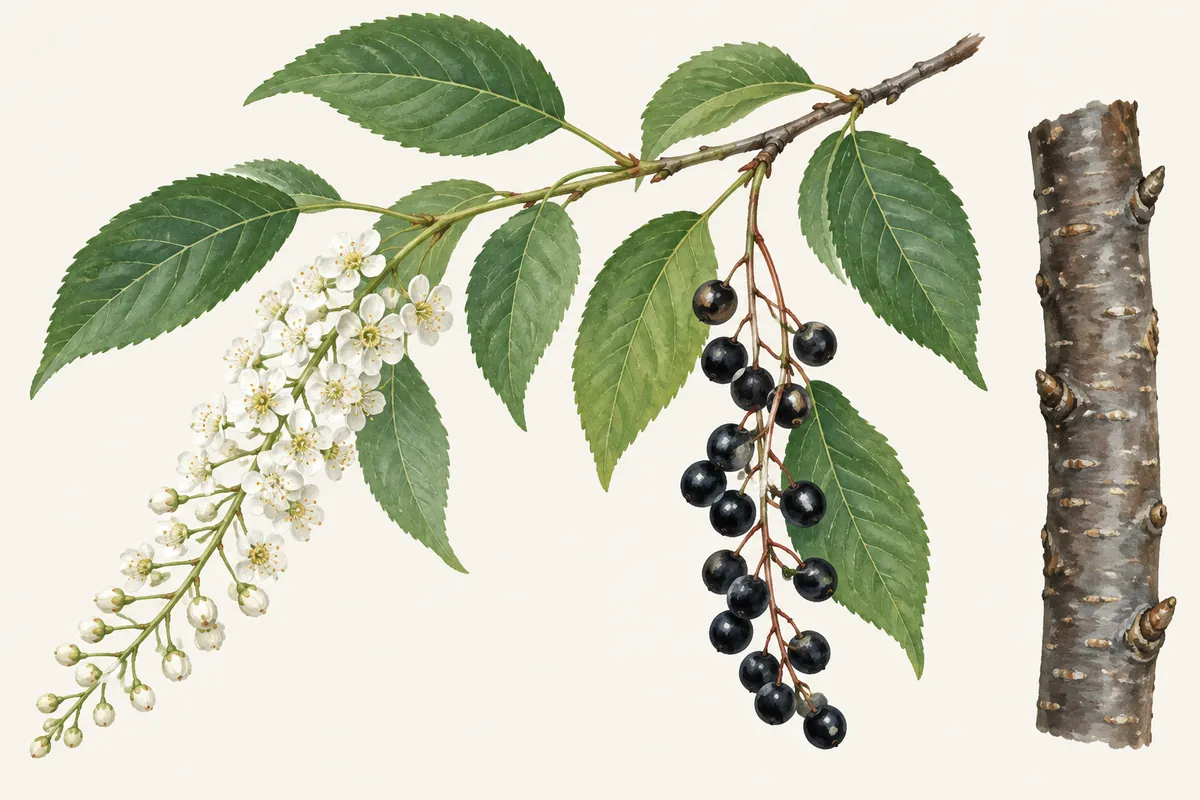
A bird cherry tree is a native European cherry with oval, finely toothed leaves, white almond-scented flowers 8 to 16 mm across in long drooping spikes from April to June, and small, shiny black cherries 6 to 8 mm across that taste bitter. Its peeling grey-brown bark has an unpleasant smell. The leaves contain cyanogenic glycosides: never eat any part.
- Flowers in long hanging spikes: bird cherry. The Woodland Trust gives the hanging clusters as the way to tell it from wild cherry, sour cherry and cherry plum.
- Tufts of hair under the vein joints and two glands at the top of the leaf stalk are the leaf checks the Woodland Trust gives.
- Trees stripped bare and wrapped in silk in May and June are usually hosting bird-cherry ermine caterpillars; Forest Research says the trees normally recover.
- The Woodland Trust reports the foliage is toxic to livestock, and Alaska's Division of Agriculture links it to rare cyanide poisoning in moose. Never eat any part.
Field marks at a glance
- Scientific name
- Prunus padus
- Family
- Rosaceae (rose family)
- Type
- Broadleaf, deciduous
- Leaves
- Oval and pointed, hairless except for tufts of hair under the vein joints, with fine, sharp teeth; two glands at the base of the blade where it meets the stalk (Woodland Trust, Alaska DNR).
- Flowers
- White, five petals, 8 to 16 mm across, heavily scented of almond, in long, slender, drooping spikes (racemes); April in the Woodland Trust's account, May to June in NatureSpot's, late May to early June in Alaska.
- Fruit
- Small, shiny, round, black cherries 6 to 8 mm across, bitter (NatureSpot); reddish black to black, ripening in late summer. Never eat.
- Bark
- Smooth, peeling, grey-brown, with an unpleasant, acrid smell (Woodland Trust); NatureSpot calls it foetid. Pale pores (lenticels) are visible (Alaska DNR).
- Size and form
- Usually a small, often multi-stemmed tree; up to 30 ft in Alaska (Alaska DNR), and the Woodland Trust gives mature trees up to 25 m. Unlike wild cherry, it does not send up root suckers (Woodland Trust).
- Habitat
- Wet woodland, hedgerows and the banks of streams and rivers; common in northern England, Wales and parts of East Anglia, rarer in the south and southwest (Woodland Trust).
- Toxicity
- Produces cyanogenic glycosides (Alaska DNR); foliage toxic to livestock, particularly goats (Woodland Trust). Never eat any part.
Bird cherry is the native cherry of northern Britain's wet woods, stream banks and hedges, and one of its earliest white-flowering trees. It is also the tree most often found wrapped from top to bottom in silk webs in late spring. Check the flowers or fruit first, then the leaf and bark. Never eat a berry, nut, seed or pod on the strength of a web page or an app; check with a local expert.
How to identify a bird cherry tree in four checks
1. Long, hanging spikes of white flowers. The Woodland Trust's bird cherry profile describes white, five-petalled flowers 8 to 15 mm across, heavily scented with an almond smell, in hanging clusters (racemes) on short stalks, in April. NatureSpot gives flowers of 10 to 16 mm in long, slender, drooping clusters from May to June. The Woodland Trust gives the hanging clusters as the clearest difference from wild cherry.
2. Small, bitter, black cherries. After flowering come small cherries, reddish black in the Woodland Trust's account and shiny black, round and 6 to 8 mm across in NatureSpot's, both describing them as bitter. Blackbirds and song thrushes eat them, as do badgers, wood mice and dormice (Woodland Trust). This page does not cover whether any part is edible.
3. Leaf details. Leaves are oval, pointed and hairless apart from tufts of hair in the angles of the veins underneath, with fine, sharp teeth, and the leaf stalk carries two glands at the base of the blade (Woodland Trust). Turn a leaf over to see the tufts.
4. Smelly, peeling bark. The Woodland Trust describes smooth, peeling, grey-brown bark with an unpleasant, acrid smell; it was once hung at front doors as a supposed ward against plague. NatureSpot calls the bark foetid. Scratch a twig and sniff, then wash your hands.
Bird cherry is not one of the 138 species in Tree Identifier's Collection, but a photo of a flower spike or a leafy twig still returns a name. The app shows no confidence score or look-alike list, so look for the hanging spikes and the leaf tufts before you settle on bird cherry.
Webs of bird-cherry ermine caterpillars
A bird cherry covered in grey silk, with the leaves stripped, is the most common reason people search for this tree. Butterfly Conservation names the bird-cherry ermine moth, Yponomeuta evonymella, whose caterpillars feed together in a web on bird cherry and are sometimes a pest of it; it says the web can cover whole trees. The adults fly at night from June to September.
Forest Research lists small ermine moths among the native species that may be mistaken for oak processionary moth. It describes webbing that trails over the whole plant in spring and early summer, says that even in extreme cases the caterpillars should not affect the long-term health and vigour of the plants, and notes that infestation rarely hits the same tree year after year. Small ermine caterpillars are hairless, cream or white with black markings, and are not known to feed on oak; oak processionary moth feeds only on oak and builds rounded nests on trunks and large branches.
If the nest is on an oak, or you are unsure what the tree is, do not touch it; in the UK, Forest Research's Tree Alert is the place to report a suspected oak processionary nest. Tree Identifier's Diagnose tool can give a quick first opinion from a photo of the webbed branches, but it is not a lab diagnosis.
Bird cherry vs wild cherry, black cherry, chokecherry and rowan
Wild cherry. The Woodland Trust names wild cherry, sour cherry and cherry plum as the trees to rule out, and gives two tests: bird cherry's flower clusters hang, and bird cherry does not send up suckers from the roots as wild cherry does. The cherry page covers the true cherries.
Black cherry. The American black cherry, Prunus serotina, has the same hanging spikes. NC State's black cherry profile gives a forest tree of 60 to 80 feet with narrow leaves 3 to 6 inches long with fine incurved teeth and yellow-brown hairs underneath, flower spikes 3 to 6 inches long from late April to May, purple-black cherries about 3/8 inch, and mature bark that turns dark and scaly. Scaly plated bark on a big trunk points to black cherry.
Chokecherry. In North America, the native look-alike is chokecherry. NC State's chokecherry profile describes a shrub or small tree of 20 to 30 feet with serrate leaves, white flowers in spikes, red fruit turning black, and dense thickets from long underground runners. The two are hard to separate on looks alone, so location matters: bird cherry is native to Europe and northern Asia and planted in North America. The chokecherry page gives its field tests.
Rowan. By northern streams in spring, rowan also flowers creamy white. The Woodland Trust rowan profile describes pinnate leaves of 5 to 8 pairs of toothed leaflets plus one at the tip, flowers in dense clusters and scarlet berries in autumn. One look at the leaf separates it; see the rowan page.
Other dark-fruited trees are sorted in trees with black berries.
Where bird cherry grows: Britain, Europe and Alaska
The Woodland Trust lists bird cherry as native to the UK, with a native range across northern Europe and northern Asia. In Britain it is common in northern England, Wales and parts of East Anglia, and rarer in the south, especially the southwest; it favours wet woodland, hedgerows and the banks of streams and rivers. NatureSpot calls it scarce in Leicestershire and Rutland and probably not native there, apart possibly from Grace Dieu Wood.
The Woodland Trust says the foliage is toxic to livestock, particularly goats. In Alaska, where bird cherry was planted in yards and parks, the state's Division of Agriculture describes it as rapidly invading stream sides and natural forests in Anchorage and Fairbanks, recorded as far north as the south side of the Brooks Range. It notes that the tree produces cyanogenic glycosides and that, in rare cases, it has caused cyanide poisoning in moose. There it flowers from late May to early June and can form dense thickets up to 30 feet tall.
If a child or pet may have eaten leaves, seeds or fruit, call NHS 111 (or your local poison control service) or a vet. For the native trees around it, see the guide to UK native trees; Tree Identifier's Tree Map can save each located bird cherry so you can check its fruit later in the summer.
Look-alikes and how to tell them apart
Wild cherry (Prunus avium)
Bird cherry's flower clusters hang in spikes, which the Woodland Trust gives as the way to tell it from wild cherry, and wild cherry sends up suckers from the roots, which bird cherry does not.
Black cherry (Prunus serotina)
Black cherry also has hanging white spikes, 3 to 6 inches long, but its leaves are narrower, 3 to 6 inches, with incurved teeth, and mature bark breaks into dark, scaly plates. It is a forest tree of 60 to 80 feet in its native North America.
Chokecherry (Prunus virginiana)
The closest look-alike, with the same hanging white spikes and black fruit, but native to North America. Chokecherry forms dense thickets from long underground runners; where you are is the first and best clue.
Rowan (Sorbus aucuparia)
Rowan also has creamy-white flowers in spring by northern streams, but its leaves are pinnate, with 5 to 8 pairs of leaflets, its creamy-white flowers sit in dense clusters, and its berries are scarlet in autumn.
What a photo can't settle
- Bird cherry and chokecherry look almost the same in a photo; the continent you are on, and a planted tree's records, settle more than the picture does.
- Out of flower, a young bird cherry can pass for other cherries and plums; the hanging fruit spikes or the leaf glands are the best clues.
- No identification, by app or by page, is a basis for eating a wild fruit.
Questions people ask
Is bird cherry poisonous?
The Woodland Trust says the foliage is toxic to livestock, particularly goats, and Alaska's Division of Agriculture says the tree produces cyanogenic glycosides that have, in rare cases, poisoned moose. This page does not cover edibility. Never eat any part on the strength of a page or an app; call NHS 111, poison control or a vet if needed.
Is bird cherry native to the UK?
Yes. The Woodland Trust lists it as native, from northern Europe and northern Asia, and common in northern England, Wales and parts of East Anglia but rarer in southern Britain. In Leicestershire, NatureSpot calls it scarce and probably not native there, apart from one possible wood.
What are the webs on my bird cherry tree?
Usually caterpillars of the bird-cherry ermine moth (Yponomeuta evonymella), which feed together inside silk that can cover the whole tree. Forest Research says the webs appear in spring and early summer and should not affect the tree's long-term health. The caterpillars are hairless and do not feed on oak.
What is the difference between bird cherry and wild cherry?
The Woodland Trust gives two tests: bird cherry's flower clusters hang in long spikes, and bird cherry does not send up suckers from the roots, unlike wild cherry. Bird cherry's fruit is small, black and bitter (NatureSpot).
Why is bird cherry banned in Alaska?
Alaska's Division of Agriculture reports that European bird cherry, planted in yards and parks, is rapidly invading stream sides and forests in Anchorage and Fairbanks and has spread north of the Arctic Circle. Check the state's quarantine list for the current rules.
Sources
- Bird Cherry (Prunus padus) — Woodland Trust
- Bird Cherry — NatureSpot (Leicestershire and Rutland)
- European Bird Cherry (Prunus padus) — Alaska Department of Natural Resources, Division of Agriculture, Plant Materials Center
- Small ermine moths (native species that may be mistaken for oak processionary moth) — Forest Research
- Bird-cherry Ermine — Butterfly Conservation
- Prunus serotina (Black Cherry) — NC State Extension Gardener Plant Toolbox
- Prunus virginiana (Chokecherry) — NC State Extension Gardener Plant Toolbox
- Rowan (Sorbus aucuparia) — Woodland Trust
Keep reading
- Tree profileChokecherry (Prunus virginiana): how to identify it
- Tree profileCherry trees (Prunus): how to identify them
- Tree profileRowan tree (mountain ash): how to identify it
- Clue guideWhich tree has black berries? Sort it by leaf and cluster
- Field guideNative trees of the UK: the full list with one clue for each