Tree profile
Chokecherry (Prunus virginiana): how to identify it
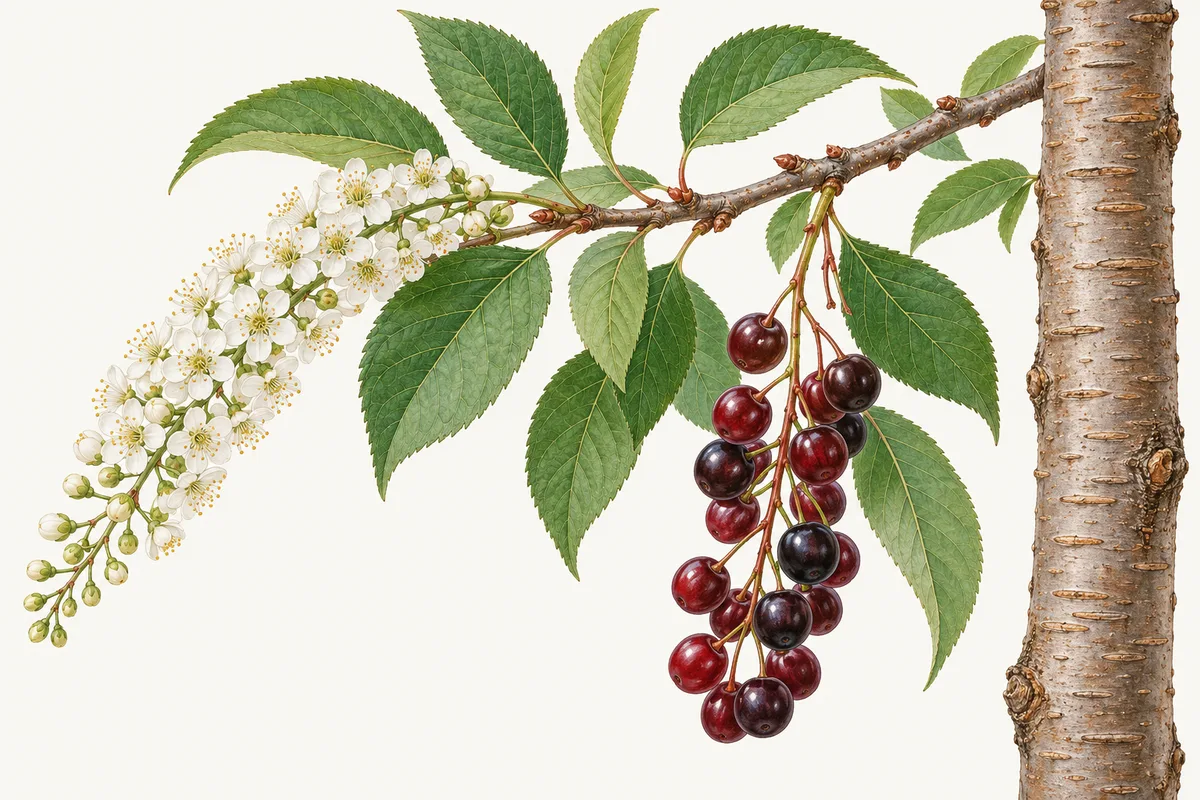
The shrubby wild cherry of the northern US, the Prairies and the West: thickets of smooth gray stems, bottlebrush spikes of white flowers in spring and drooping strings of dark fruit in late summer.
In short
For chokecherry tree identification, look for a thicket-forming shrub or small tree under about 30 feet, with finely toothed leaves 2 to 4 inches long, widest above the middle. White flowers come in cylindrical spikes in May and June, then strings of round fruit about 1/3 inch across turn red, then nearly black. Never eat it: NC State lists the stems, leaves and seeds as containing cyanide.
- Chokecherry is the shrubbiest of the wild cherries: thickets of stems rarely more than 5 inches across, where black cherry grows into a 60- to 80-foot forest tree.
- Leaves widest above the middle, with no rusty hairs along the midrib underneath, separate it from black cherry.
- Stems, leaves and seeds contain cyanide-forming compounds, according to NC State Extension. Never eat any part of the tree, and keep livestock away from wilted branches.
Field marks at a glance
- Scientific name
- Prunus virginiana
- Family
- Rosaceae (rose family)
- Type
- Broadleaf, deciduous
- Leaves
- Alternate, simple, oval and widest at or above the middle (obovate), 2 to 4 inches long, with a sharp tip and fine, sharp teeth; dark green and glossy above, paler below. The leaf stalk has 1 to several small glands near the blade.
- Flowers
- Small white flowers about 1/3 inch across, 20 to 50 together in nodding cylindrical spikes (racemes) 2 to 6 inches long, May to June, after the leaves appear.
- Fruit
- Shiny, round drupe about 1/3 inch (6 to 10 mm), green, then red, then dark purple to nearly black, in drooping strings; ripens in late summer. One hard stone. Never eat.
- Bark
- Smooth, gray-brown to gray, with pale horizontal lenticels; becomes rougher and shallowly fissured on old stems, but never the black, scaly plates of black cherry.
- Twigs
- Slender, light brown to gray, buds about 1/3 inch with brownish scales. Virginia Tech notes a strong, unpleasant odor when a twig is broken.
- Size and form
- Shrub or small tree, 10 to 30 ft; trunk rarely over 5 to 6 inches across. Suckers heavily, forming dense thickets.
- Range
- Newfoundland to British Columbia, south to North Carolina, Tennessee, Missouri, Kansas, Oklahoma, Texas, New Mexico, California and northern Mexico.
Chokecherry is the wild cherry most people across the northern United States and the Canadian Prairies actually meet: a thicket along a fence line, a road ditch or a woodland edge, white with flower spikes in May and hung with dark fruit in August. Minnesota Wildflowers calls it one of the most common trees and shrubs in North America. It is easy to confuse with black cherry, its tall forest cousin, and with chokeberry, an unrelated shrub with a nearly identical name. This page covers how to tell all three apart, the three varieties, and the toxic parts of the plant.
How to identify a chokecherry
Work through these clues in order.
1. Form: a thicket, not a forest tree. Minnesota Wildflowers describes a shrub or small tree of 10 to 25 feet whose trunk rarely exceeds 5 inches in diameter, and which suckers heavily to form dense thickets. NC State's Plant Toolbox gives 20 to 30 feet and long underground runners that send up new plants. A clump of many thin, smooth stems is typical.
2. Leaves: widest above the middle, finely toothed. Minnesota Wildflowers gives leaves 2.5 to 4 inches long and 1 to 2.3 inches wide, oval and widest at or above the middle, with a sharp point, a rounded base and fine, sharp teeth. The upper surface is dark green and glossy. Look at the leaf stalk, 1/3 to 3/4 inch long: it carries one to several small glands near the blade, a cherry trait. NC State adds that crushed leaves have a strong, bitter scent.
3. Flowers: bottlebrush spikes in spring. The flowers come in nodding, cylindrical racemes of 20 to 50, each flower about 1/3 inch across with five round white petals, in May and June (Minnesota Wildflowers). Virginia Tech's choke cherry fact sheet gives clusters 3 to 6 inches long, opening after the leaves.
4. Fruit: strings that go red, then black. The fruit is a shiny, round drupe about 1/3 inch across with one hard stone. Northern Woodlands describes it ripening from green to red to deep purple, often so heavy that branches bend. Virginia Tech gives late summer for ripening. Never eat it.
5. Bark and twigs. Bark is smooth, brownish gray to gray, with pale horizontal lenticels, rougher on older trunks (Minnesota Wildflowers). Virginia Tech notes a strong, unpleasant odor from a broken twig; Northern Woodlands describes the crushed twig's smell as almond-like with a bitter taste. Sources differ on how to describe the smell, but both mark it as distinctive.
Tree Identifier can name a chokecherry from one photo of a leafy branch, a flower spike or the fruit. It shows the common and scientific names without a confidence score or a list of look-alikes, so confirm with the leaf shape and the bark before you settle on chokecherry rather than black cherry.
Chokecherry vs black cherry
These two share drooping strings of white flowers and dark fruit, and the cherry tree identification page covers the wider genus. The field tests:
| Feature | Chokecherry | Black cherry |
|---|---|---|
| Size | Shrub or small tree, 10–30 ft, in thickets | Forest tree, 60–80 ft, single trunk |
| Leaf shape | Oval, widest at or above the middle | Narrower, 3–6 in by 0.75–1.5 in |
| Leaf underside | No rusty hairs on the midrib | Rusty or yellow-brown hairs along the midrib |
| Mature bark | Smooth gray with pale lenticels | Dark, scaly or flaky plates |
| Fruit | Sepals wither and drop | Dried sepals stay on the fruit |
Black cherry figures are from NC State's black cherry page; the midrib and sepal tests are from Minnesota Wildflowers. Northern Woodlands also notes that chokecherry leaves lack the tufts of fur under the midrib that black cherry has. On a young black cherry without plated bark, the leaf underside is the most reliable check.
Chokeberry (Aronia) is the other common confusion, because the names differ by one letter. NC State's black chokeberry page describes a multi-stemmed shrub of 3 to 10 feet with tiny flowers in clusters of 5 or 6 and blackish fruit about 1/2 inch across. It never forms a tree, and its flowers and fruit sit in small bunches rather than long strings.
Common buckthorn also carries black fruit, but in tight clusters along the twig rather than in strings, with a thorn at the twig tip; the buckthorn page covers it.
Varieties, range and 'Canada Red'
Oregon State University's Landscape Plants database gives the species range as Newfoundland to British Columbia, south to North Carolina, Tennessee, Missouri, Kansas, Oklahoma, Texas, New Mexico, California and northern Mexico. It lists three varieties:
- Eastern or common chokecherry (var. virginiana): widespread across southern Canada and much of the United States.
- Western chokecherry (var. demissa): a thicket-forming shrub from British Columbia south into Washington, Oregon, California, northern Mexico and Texas.
- Black chokecherry (var. melanocarpa): southern Canada, the Rocky Mountains, the east slope of the Cascades and southern Oregon to northern California.
NC State gives USDA hardiness zones 2 to 6, which is why chokecherry is common on the Prairies; Minnesota Wildflowers notes it in forests, prairie margins and mid-alpine areas. For other trees of that region, see the Manitoba and Saskatchewan tree identification guide.
In yards and boulevards, the common form is 'Canada Red'. Oregon State describes leaves that open green and turn dark purple, with about 90% of the foliage purple by June. A purple-leaved small tree with cherry flower spikes is almost always this cultivar; the guide to trees with purple leaves sets it beside purple-leaf plum and copper beech.
Toxicity and black knot
NC State Extension states that chokecherry's "stems, leaves, seeds contain cyanide, particularly toxic in the process of wilting", and lists symptoms in animals that include difficulty breathing and dilated pupils. Northern Woodlands reports that the twigs and foliage are eaten by many wild animals but are toxic to cattle and sheep in large quantities, usually when other forage is scarce. Over 70 bird species eat the fruit, according to the same article.
Never eat a berry, fruit, leaf or seed on the strength of a web page or an app; check with a local expert. Tree Identifier's Toxicology tool gives AI-written notes for people, dogs and cats, which is a starting point for questions, not a verdict. Dark fruits on other trees are covered in our guide to trees with black berries.
Black knot is the disease you are most likely to see on a chokecherry. Northern Woodlands describes elongated, black, misshapen galls on the twigs, and badly affected shrubs look severely disfigured. The fungus affects only the genus Prunus, cherries and plums, so a shrub covered in black knots is almost certainly one of those.
Chokecherry is not one of the 138 species in Tree Identifier's Collection, though a photo still returns a name. Saving the find to the app's Tree Map lets you come back in late summer to check the fruit color and the leaf underside.
Look-alikes and how to tell them apart
Black cherry (Prunus serotina)
Black cherry becomes a forest tree of 60 to 80 feet with dark, scaly bark on old trunks. Its leaves are proportionately narrower, with incurved teeth and rusty hairs along the midrib underneath, and the dried sepals stay on its fruit.
Black chokeberry (Aronia melanocarpa)
Chokeberry is a shrub of 3 to 10 feet, never a tree, with flowers in small clusters of 5 or 6 instead of long spikes. Its blackish fruit is about 1/2 inch across and held in small bunches, not hanging strings.
Purple-leaf plum (Prunus cerasifera)
Purple-leaf plum, often planted beside 'Canada Red' chokecherry, has leaves only 1.5 to 3 inches long that keep their purple until they drop in fall, single white or pink flowers crowding the twigs in April, and round fruit up to 1.25 inches.
What a photo can't settle
- Chokecherry and black cherry fruit look almost the same in a photo; tree size, bark and the underside of the leaf settle it.
- The three varieties (eastern, western and black chokecherry) overlap and intergrade; a photo app gives the species, not the variety.
- No identification, by app or by page, is a basis for eating a wild fruit.
Questions people ask
Is chokecherry a tree or a bush?
Both. Minnesota Wildflowers describes it as a woody shrub or small tree of 10 to 25 feet, and NC State Extension gives 20 to 30 feet. It suckers heavily from spreading roots, so in the wild it usually forms a thicket of many thin stems rather than a single trunk.
What is the difference between chokecherry and black cherry?
Size, bark and leaf shape. Black cherry grows 60 to 80 feet with dark, scaly bark on old trunks (NC State). Chokecherry stays under about 30 feet with smooth gray bark. Minnesota Wildflowers adds that black cherry leaves are narrower, with rusty hairs along the midrib underneath, and that its sepals stay on the fruit.
Is chokecherry the same as chokeberry?
No. Chokecherry is a wild cherry, Prunus virginiana, with flowers and fruit in long hanging strings. Chokeberry (Aronia) is a separate shrub of 3 to 10 feet, according to NC State Extension, with flowers in small clusters of 5 or 6 and fruit in small bunches.
Is chokecherry poisonous?
NC State Extension states that its stems, leaves and seeds contain cyanide and are particularly toxic while wilting. Northern Woodlands reports the twigs and foliage are toxic to cattle and sheep in large quantities. Never eat any part of the tree on the strength of a web page or an app; ask a local expert.
What are the black lumps on chokecherry branches?
Usually black knot, a fungal disease of cherries and plums. Northern Woodlands describes elongated, black, misshapen galls on the twigs, and notes the fungus affects only plants in the genus Prunus, so the galls are themselves a clue that the shrub is a cherry or plum.
Sources
- Prunus virginiana (Chokecherry, Choke Cherry, Common Chokecherry) — North Carolina Extension Gardener Plant Toolbox, NC State University
- Choke cherry (Prunus virginiana) fact sheet — Virginia Tech Dendrology
- Prunus virginiana (Chokecherry) — Minnesota Wildflowers
- Prunus virginiana var. virginiana — Landscape Plants, Oregon State University
- Chokecherry, Prunus virginiana (Virginia Barlow, 2008) — Northern Woodlands
- Prunus serotina (Black Cherry) — North Carolina Extension Gardener Plant Toolbox, NC State University
- Aronia melanocarpa (Black Chokeberry) — North Carolina Extension Gardener Plant Toolbox, NC State University
Keep reading
- Tree profileCherry trees (Prunus): how to identify them
- Clue guideWhich tree has black berries? Sort it by leaf and cluster
- Clue guideWhich trees have purple leaves? Tell the cultivars apart
- Prairie provinces field guideTrees of Manitoba and Saskatchewan, zone by zone
- Alberta field guideAlberta trees, natural region by natural region