Tree profile
Cherry laurel (Prunus laurocerasus): how to identify it
The big, glossy evergreen of British hedges and shady woods: leathery leaves up to 15 cm long that smell of cherry when bruised, upright candles of white flowers in spring and black fruit.
In short
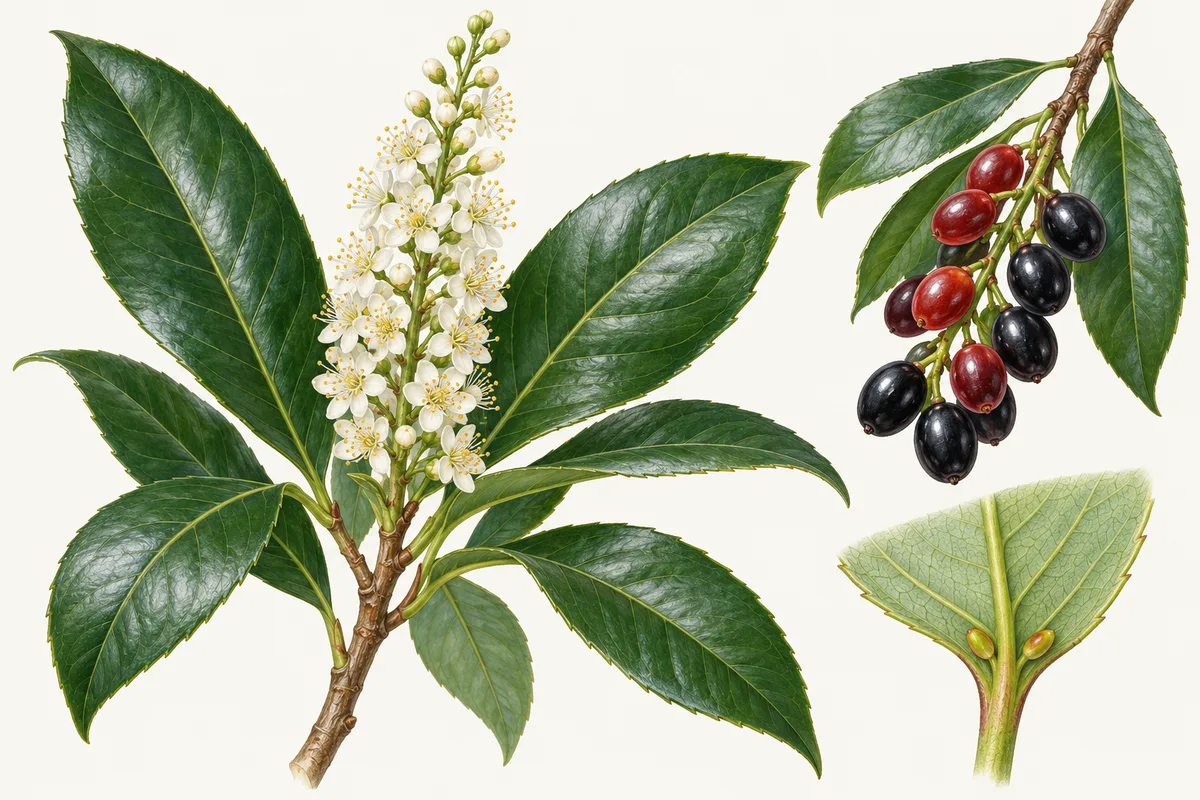
Cherry laurel identification rests on the leaves: evergreen, leathery, glossy dark green, alternate, up to about 15 cm long, with 2 to 8 small glands on the underside near the base and a cherry or almond smell when bruised. In spring it carries upright spikes of small white flowers, up to about 12 cm long, followed by glossy fruit that ripens from red to black. All parts are reported toxic.
- Turn a leaf over and look near the stalk: small glands beside the midrib mark a cherry laurel, not a bay.
- Upright flower spikes shorter than the leaves point to cherry laurel; long spikes of 15 to 25 cm point to Portugal laurel.
- NC State Extension rates cherry laurel a high-severity poison, and BSBI warns that cut or crushed leaves release hydrocyanic acid.
Field marks at a glance
- Scientific name
- Prunus laurocerasus
- Family
- Rosaceae (rose family)
- Type
- Broadleaf, evergreen
- Leaves
- Evergreen, alternate, thick and leathery, glossy dark green above, oblong to elliptic with a pointed tip, up to about 15 cm (6 in) long; edge finely toothed to almost smooth.
- Leaf glands
- 2 to 8 small glands on the underside near the base, beside the midrib (NC State). Leaf stalks and first-year shoots are green.
- Smell
- Bruised leaves and twigs give off a cherry smell (NC State). Bruise a leaf only to sniff it and wash your hands afterwards.
- Flowers
- Small, white, star-shaped, heavily scented, in dense upright spikes (racemes) up to 10 to 12 cm long from the leaf joints, around April and May; they open even in deep shade.
- Fruit
- Cherry-like, under 2.5 cm across, glossy red ripening to purple-black in summer; birds eat them and spread the seed.
- Size and form
- A dense, much-branched evergreen shrub or small tree, usually 3 to 6 m (NC State) and up to about 10 m (BSBI); often a clipped hedge.
- Status
- Non-native in Britain, planted since about the mid-17th century (BSBI); now escaping into woods, where it can form dense thickets.
- Toxicity
- Leaves, seeds and stems contain cyanogenic glycosides; NC State rates the plant a high-severity poison for people, cats, dogs and horses. Never eat any part.
Cherry laurel (Prunus laurocerasus) is the large-leaved, glossy evergreen that makes up countless British garden hedges and, increasingly, the dark understorey of shady woods. Despite its name it is a cherry, not a true laurel. Check the leaf first, then its underside, then the flowers or fruit. Never eat a berry, nut, seed or pod on the strength of a web page or an app; check with a local expert.
How to identify cherry laurel in four checks
1. A big, glossy, leathery leaf. The NC State Extension profile describes evergreen, alternate, leathery leaves, oblong to elliptic with a pointed tip, medium to dark green and lustrous above, the edge finely toothed to nearly smooth. BSBI's account gives leaves about 15 cm long, and NatureSpot says up to 15 cm. NC State's attribute table runs larger still, so treat 15 cm as typical, not a ceiling.
2. Glands on the underside. Turn the leaf over and look along the midrib near the stalk. NC State describes 2 to 8 small glands there, beside the midrib. NC State notes that these glands help separate cherry laurels from some of their relatives, and a bay leaf, from another family altogether, has none.
3. Green stalks and the smell. NatureSpot notes that the leaf stalks and first-year shoots are green. Bruised leaves and twigs give off a cherry smell (NC State). If you test the smell, do it with one leaf, outdoors, and wash your hands afterwards; BSBI warns that cut or crushed material releases hydrocyanic acid.
4. Flowers and fruit. In spring, around May according to NatureSpot, cherry laurel carries dense upright spikes of small, white, star-shaped, heavily scented flowers from the leaf joints, up to about 10 to 12 cm long. They open even in deep shade. The fruits that follow are cherry-like, glossy red at first and black when ripe (BSBI, NatureSpot); NC State describes them as purple-black drupes under 1 inch, ripening in summer and eaten by birds.
Tree Identifier can name a cherry laurel from one photo of a leafy shoot or a flower spike. Cherry laurel is not one of the 138 species in the app's Collection, and the app shows no confidence score or look-alike list, so turn a leaf over and check the glands yourself.
Cherry laurel is toxic: what the sources say
NC State Extension states that the plant has high-severity poison characteristics, lists the leaves, seeds and stems as toxic parts, and names the toxic principles as cyanogenic glycosides (amygdalin, prunasin and prulaurasin). It describes the stems, leaves and seeds as containing cyanide, especially toxic as the plant wilts, and lists cats, dogs and horses among the animals at risk. BSBI adds that glycoside levels are higher in young plants and in summer, and that once cut or crushed, the material releases hydrocyanic acid that can starve animal tissues of oxygen.
Chokecherry is another Prunus whose leaves and seeds are cyanogenic.
That matters when you clear or chip a laurel hedge, and when children or pets are near the black fruit. This page gives no advice on eating or handling any part. If someone may have eaten leaves, seeds or fruit, call NHS 111 (or your local poison control service) or a vet, and take a sprig with you. Tree Identifier's Toxicology notes are AI-written and are not a safety verdict.
Cherry laurel in Britain: hedges, woods and spread
BSBI describes cherry laurel as an evergreen, densely branched shrub or small tree up to about 10 m, introduced around the mid-17th century and afterwards commonly planted on estates and in large gardens. From there it has spread. BSBI's Fermanagh account says it can form dense thickets and has the potential to become as invasive and dominant over native species as Rhododendron ponticum, and that it spreads mainly by layering, with branches rooting where they touch the ground; bird-sown seedlings add to that. NatureSpot calls it widespread as a planted shrub and an occasional escape that may be increasing as an established wild plant, found in woodland and hedgerows.
So a cherry laurel in a wood is not necessarily planted: it may be a layered offshoot of an old estate planting or a bird-sown seedling.
In North America, NC State reports that cherry laurel has escaped cultivation on the Pacific coast west of the Cascades, where it is classed as a weed of concern, and records it in California, Oregon, Washington and British Columbia.
Cherry laurel, Portugal laurel, bay and Carolina cherry laurel
| Plant | Leaves | Flowers | Fruit | Where |
|---|---|---|---|---|
| Cherry laurel (Prunus laurocerasus) | Up to about 15 cm; glands beneath; finely toothed to almost smooth | Upright spikes up to 10–12 cm, spring | Red, then black, in summer | Hedges and woods in Britain; Pacific Northwest |
| Portugal laurel (P. lusitanica) | 6–15 cm, glossy, toothed | Narrow spikes 15–25 cm | Dark purple to black, late summer | Hedges in Britain; native to Iberia |
| Bay laurel (Laurus nobilis) | 2.5–7.5 cm, grey-green, smooth-edged, aromatic | Small, yellowish, March–May | Small black or purple, female plants only | Gardens, pots; native to the Mediterranean |
| Carolina cherry laurel (P. caroliniana) | 5–7.5 cm, smooth-edged on adults; glands beneath | Short spikes about 2.5 cm, March–April | Glossy black, September–October | Native to the southern US |
Portugal laurel. The NC State profile of Portugal laurel describes glossy, dark green, toothed leaves 2 1/2 to 6 inches long and white, fragrant flowers in narrow racemes 6 to 10 inches (15 to 25 cm) long, native to the mountain forests of the Iberian Peninsula. The long flower spikes are the clearest difference; NatureSpot lists it as the main similar species.
Bay laurel. True laurel, Laurus nobilis, belongs to a different family. NC State's bay laurel profile describes smaller, leathery, blue-green to silvery grey-green leaves with smooth edges, used in cooking; male and female flowers on separate plants from March to May; and small black or purple fruit on female plants. A bay leaf has no glands beneath.
Carolina cherry laurel. In the southeastern US, "cherry laurel" usually means this native tree. The NC State profile describes leaves 2 to 3 inches long, smooth-edged on adults but spiny-toothed on seedlings, with a pair of small glands beneath near the base and a maraschino cherry scent when crushed; short flower spikes about 1 inch long in March and April; and lustrous black fruit in September and October. It grows to 35 ft and is rated a high-severity poison too. Its green fruit is covered in the tree with green balls guide.
Holly and rhododendron. NatureSpot also lists rhododendrons among the large-leaved evergreens to rule out, and English holly is the other glossy evergreen of British hedges; the holly page shows its spiny leaves and winter berries.
In a clipped hedge, in flower and in fruit
A hedge clipped every year may never flower, so learn the leaf: large, glossy, leathery, alternate, with glands near the base underneath. In April and May an unclipped laurel is covered in upright white candles of flowers, and from summer the fruit ripens from red to black. For the other trees and shrubs with dark fruit, see the tree with black berries guide; for its deciduous relatives, the true cherries, see the cherry page.
If you are mapping laurel spreading into a local wood, Tree Identifier's Tree Map saves each located identification, and the History tab keeps the photos, which makes it easier to show a site manager where the thickets are.
Look-alikes and how to tell them apart
Portugal laurel (Prunus lusitanica)
Compare the flower spikes: Portugal laurel's are narrow and 15 to 25 cm long, often longer than the leaves, while cherry laurel's are upright and up to about 12 cm. Portugal laurel leaves are smaller, 6 to 15 cm, and clearly toothed.
Bay laurel (Laurus nobilis)
Bay leaves are smaller, about 2.5 to 7.5 cm, blue-green to grey-green, with smooth edges and no glands underneath, and they smell of cooking bay when bruised. Bay has small yellowish flowers in clusters, not white spikes.
Carolina cherry laurel (Prunus caroliniana)
The cherry laurel of the US South has much smaller leaves, 5 to 7.5 cm (2 to 3 in), smooth-edged on adult plants, and very short flower spikes about 2.5 cm long in March and April. It grows to 10 m and is native from the southern US.
Holly (Ilex aquifolium)
Holly leaves are also glossy and evergreen but much smaller, stiff and usually edged with sharp spines, and holly has red berries in winter on female trees only. Cherry laurel leaves are soft-edged and up to 15 cm long.
What a photo can't settle
- Garden cultivars such as 'Otto Luyken', with narrow leaves and autumn flowers, do not match every measurement here, and a photo cannot name a cultivar.
- A clipped hedge with no flowers or fruit has to be named from its leaves, and the glands under the leaf are too small to show in a photo of the whole hedge.
- Whether a child or pet that chewed cherry laurel needs treatment is never settled by a web page or an app: call NHS 111, a poison control centre or a vet.
Questions people ask
Is cherry laurel poisonous?
Yes. NC State Extension rates it a high-severity poison, listing the leaves, seeds and stems, which contain cyanogenic glycosides, and names cats, dogs and horses among those at risk. BSBI warns that cut or crushed material releases hydrocyanic acid. Never eat any part, and call NHS 111, poison control or a vet if a child or pet may have.
Is cherry laurel the same as laurel?
Usually, in Britain. A hedge called laurel is most often cherry laurel (Prunus laurocerasus) or Portugal laurel (Prunus lusitanica), both cherries. The true laurel is bay (Laurus nobilis), a different family with smaller, smooth-edged, aromatic leaves.
How do you tell cherry laurel from Portugal laurel?
Look at the flowers and leaves. Portugal laurel has narrow flower spikes 15 to 25 cm long and smaller, clearly toothed leaves 6 to 15 cm long. Cherry laurel has upright spikes up to about 12 cm and larger leaves, finely toothed to almost smooth.
Is cherry laurel invasive in the UK?
It is spreading. BSBI's Fermanagh account says it forms dense thickets and has the potential to become as invasive and dominant over native species as Rhododendron ponticum, and NatureSpot reports it may be increasing as an established wild plant. It spreads by layering and by bird-sown seed.
What is cherry laurel called in the US?
Prunus laurocerasus is sold as English laurel or cherry laurel. In the US South, cherry laurel usually means the native Carolina cherry laurel (Prunus caroliniana), which has smaller, smooth-edged leaves 2 to 3 inches long and fruit that ripens black in September and October.
Sources
- Prunus laurocerasus (Cherry Laurel, English Laurel) — NC State Extension Gardener Plant Toolbox
- Prunus laurocerasus L. (Fermanagh species account) — Botanical Society of Britain and Ireland (BSBI)
- Cherry Laurel - Prunus laurocerasus — NatureSpot (Leicestershire and Rutland)
- Prunus lusitanica (Portugal Laurel) — NC State Extension Gardener Plant Toolbox
- Prunus caroliniana (Carolina Cherry Laurel) — NC State Extension Gardener Plant Toolbox
- Laurus nobilis (Bay Laurel) — NC State Extension Gardener Plant Toolbox
Keep reading
- Clue guideWhich tree has black berries? Sort it by leaf and cluster
- Tree profileCherry trees (Prunus): how to identify them
- Tree profileHolly tree (Ilex): how to identify American and English holly
- Field guideTree identification in the UK: British trees by leaf, bark and picture
- Clue guideWhich tree has green balls? Sort it by the size of the ball