Tree profile
Jacaranda (Jacaranda mimosifolia): how to identify it
The lavender-blue street tree of Pretoria, Grafton, California and Florida: fern-like leaves, trumpet flowers that often open on bare branches, and flat, round, woody pods.
In short
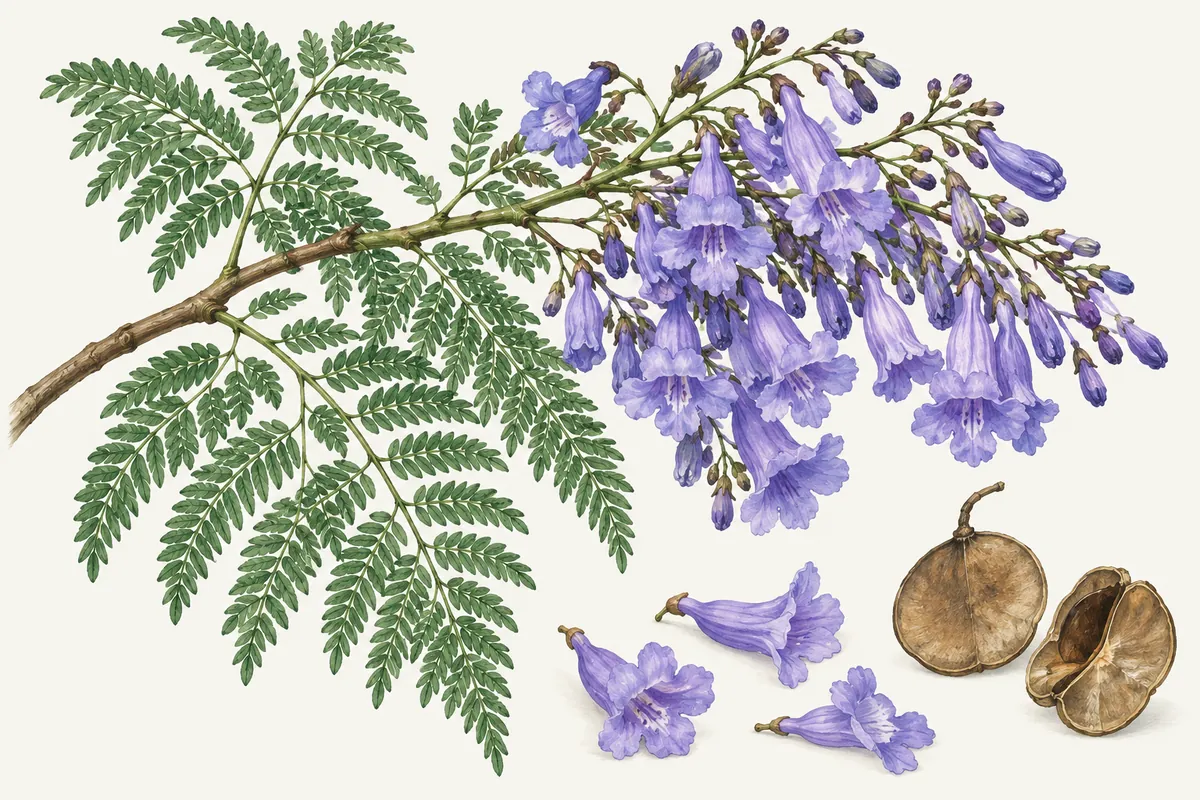
For jacaranda tree identification, check three things: fern-like leaves divided twice into many small leaflets, set in opposite pairs; purple-blue to lavender funnel-shaped flowers 1 to 3 inches long in loose clusters, often opening while the tree is leafless; and flat, round brown pods 1 to 3 inches across. It flowers around May in the northern hemisphere and October to November in Australia.
- Fern-like leaves plus lavender-blue trumpets: jacaranda. Pink powder puffs mean mimosa; red or orange flowers mean royal poinciana.
- The pod settles it out of season: a flat, round, woody disk 1 to 3 inches across, not a long bean pod.
- Jacaranda grows outdoors only where winters stay mild: UF/IFAS gives USDA zones 9B to 11.
- In South Africa it is regarded as invasive in parts of the country, but the environment department did not list it in urban areas in 2014.
Field marks at a glance
- Scientific name
- Jacaranda mimosifolia
- Family
- Bignoniaceae (trumpet-creeper family)
- Type
- Broadleaf, deciduous
- Leaves
- Opposite, twice-divided (bipinnate) and fern-like, with many small pointed leaflets; longer on young trees, up to 39 inches (NC State). Light green (University of Arizona).
- Flowers
- Purple-blue to lavender, funnel-shaped, fragrant, 1 to 3 inches long, in loose clusters (panicles); the tree often blooms while leafless, just before the new leaves (NC State).
- Fruit
- Flat, round, brown to copper capsules 1 to 3 inches across that ripen in fall and release small winged seeds (NC State).
- Bark
- Dark gray, rough, with fine vertical fissures (NC State).
- Size and form
- 25 to 50 ft tall (NC State); 20 to 50 ft tall and wide with an open, spreading crown (University of Arizona). Single or multi-trunked.
- Flowering
- Northern hemisphere: spring to summer, usually around May in Florida (UF/IFAS); mid to late spring in California (UC IPM). Australia: October and November in Grafton.
- Climate
- Frost-tender: USDA zones 9B to 11 (UF/IFAS); withstands about 27°F and can be damaged in Tucson winters (University of Arizona).
- Origin
- Native to Bolivia, Paraguay and northern Argentina (NC State); planted as a street tree in warm climates worldwide.
Jacaranda is the tree that turns whole streets lavender-blue: Pretoria's nickname is Jacaranda City, Grafton in New South Wales holds a festival for it every spring, and it is planted in California gardens and across Central and South Florida. Out of flower it is easy to mistake for a mimosa, and in flower for a paulownia. This page gives the checks in order, the flowering months by hemisphere, and its status in South Africa.
How to identify a jacaranda in four checks
1. Fern-like leaves in pairs. NC State Extension's jacaranda profile describes deciduous, opposite, bipinnately compound leaves: each leaf is divided, and each division divided again into many small, pointed leaflets, so the whole leaf looks like a fern frond. Leaves are longer on young trees, up to 39 inches. The University of Arizona's campus arboretum entry describes them as light green and twice-compound, giving a feathery look.
2. Lavender-blue trumpets, often on bare branches. The flowers are purple-blue to lavender, funnel-shaped, fragrant and 1 to 3 inches long, in loose clusters (NC State). NC State notes that the tree blooms while leafless, just before the new leaves flush out, which is why a flowering jacaranda can look all blue with no green.
3. Flat, round pods. After flowering, jacaranda carries flat, round, brown to copper capsules 1 to 3 inches across, which ripen in fall and release small winged seeds (NC State). Mimosa and royal poinciana, the fern-leaved trees it is most often confused with, both have long, bean-like pods instead.
4. Bark and shape. Bark is dark gray and rough, with fine vertical fissures (NC State). The tree is 25 to 50 feet tall with an open, spreading crown, single or multi-trunked.
Jacaranda is one of the 138 species in Tree Identifier's Collection, so naming one from a photo of the flowers or leaves fills its place in the catalog. The app shows no confidence score or look-alike list, so check the pod or the leaf yourself when a mimosa is nearby.
When jacaranda flowers, by hemisphere
Northern hemisphere. UF/IFAS Gardening Solutions says jacaranda blooms in spring and summer, usually around May, and calls it one of the botanical treasures of Central and South Florida. The UC IPM page gives mid to late spring for California and notes that flowers often fail to form near ocean winds or in areas without much heat. In Arizona, the University of Arizona places flowering in late spring or early summer, with heavier, longer bloom in warm weather.
Southern hemisphere. The season flips. In Grafton, New South Wales, the Grafton Jacaranda Festival says the trees bloom in October and November; the 2026 festival runs from October 23 to November 8. The Australian Humanities Review article by Jodi Frawley traces Grafton's avenues to the early twentieth century, including a case of 84 young jacarandas in 1910, and records that the council inaugurated the festival in 1935. The same article notes that Joseph Maiden, director of the Sydney Botanic Gardens, endorsed jacaranda as an avenue tree for coastal districts.
| Where | Usual flowering | Source |
|---|---|---|
| Central and South Florida | Spring to summer, usually around May | UF/IFAS |
| California | Mid to late spring | UC IPM |
| Arizona | Late spring to early summer | University of Arizona |
| Grafton, New South Wales | October and November | Grafton Jacaranda Festival |
Jacaranda vs paulownia, crape myrtle, mimosa and royal poinciana
Paulownia. The violet spring trumpets are similar, but NC State's paulownia profile describes simple, opposite, heart-shaped leaves 5 to 12 inches long, velvety on both sides, and woody, oval capsules about 1 to 1.5 inches long. Its leaves alone rule it out; the paulownia page covers it.
Crape myrtle. A purple crape myrtle is a frequent confusion. NC State's crape myrtle profile describes simple leaves 1 to 2.75 inches long, ruffled flowers that look like crinkled crepe paper from July to September, small six-valved capsules about half an inch wide, and thin bark that peels in patches. Jacaranda flowers earlier, its leaves are fern-like, and its flowers are smooth trumpets. See the crape myrtle page.
Mimosa. NC State's mimosa profile gives the same twice-divided, fern-like leaf, with leaflets about 3/8 inch that close at night and in rain, but pink powder-puff flowers from May to July and flat, brown, bean-like pods 4 to 8 inches long. The mimosa page has the full comparison.
Royal poinciana. In South Florida this fern-leaved tree flowers at the same time. UF/IFAS Gardening Solutions describes flowers from deep red to bright orange, with yellow cultivars, first appearing between May and July, and pods about 2 by 18 inches. Red or orange flowers and huge pods rule out jacaranda.
More violet-flowered trees are sorted in trees with purple flowers.
Jacaranda in South Africa: invasive status as the agencies state it
The Stellenbosch University Botanical Garden lists jacaranda as a NEMBA Category 3 invasive that may not be propagated or transported, notes that it is regarded as invasive in some parts of South Africa, and gives Pretoria's nickname, Jacaranda City (Jakarandastad), for its many trees.
When the amended Alien and Invasive Species Regulations were published on 1 August 2014, the Department of Environmental Affairs said in a media statement that jacaranda is invasive in parts of the country but that the department had not listed the species in urban areas, where no control is required. The same statement says the rules allow large specimens within 50 metres of farm homesteads. Lists are revised from time to time, so treat this as the position the department stated in August 2014, read on 30 October 2026, and check with your municipality before planting or removing a tree. For indigenous South African trees, see the South African trees guide.
Jacaranda is not native to any of the countries where it is famous: NC State gives its home as Bolivia, Paraguay and northern Argentina. If you are recording street trees, Tree Identifier's Tree Map keeps each located find, so you can return in flowering season.
Look-alikes and how to tell them apart
Paulownia (Paulownia tomentosa)
Paulownia also has violet trumpet flowers in spring, but its leaves are huge, simple and heart-shaped, 5 to 12 inches, and velvety, not fern-like. Its fruit is an egg-shaped woody capsule, not a flat disk.
Crape myrtle (Lagerstroemia indica)
Crape myrtle has small simple leaves 1 to 2.75 inches long, crinkled flowers that look like crepe paper from July to September, and thin bark that peels in patches. Jacaranda leaves are fern-like and its flowers are smooth trumpets.
Mimosa (Albizia julibrissin)
Mimosa shares the fern-like leaf, but its flowers are pink powder puffs of silky threads from May to July, and its fruit is a flat, bean-like pod 4 to 8 inches long. Its leaflets close at night.
Royal poinciana (Delonix regia)
Royal poinciana also has fern-like leaves, but its flowers are deep red to bright orange, or yellow in some cultivars, from May to July, and its pods are huge, about 2 by 18 inches.
What a photo can't settle
- Out of flower, a young jacaranda and a mimosa look alike in a photo of the leaves; the flowers or the pod settle it.
- Jacaranda can also have white flowers (University of Arizona), and a photo cannot name a cultivar.
- Whether a jacaranda on your land must be controlled depends on local rules and changes over time; ask your municipality or environment agency.
Questions people ask
What does a jacaranda tree look like?
A spreading tree 25 to 50 feet tall with fern-like, twice-divided leaves and, in spring, a cloud of purple-blue to lavender trumpet flowers, often before the new leaves (NC State). Flat, round brown pods 1 to 3 inches across hang on after flowering.
When do jacaranda trees bloom?
In Florida, spring to summer, usually around May (UF/IFAS). In California, mid to late spring (UC IPM). In Grafton, New South Wales, October and November, when the town holds its Jacaranda Festival. UC IPM notes trees near ocean winds or without much heat often flower poorly.
Is jacaranda invasive?
In parts of South Africa. Stellenbosch University Botanical Garden lists it as NEMBA Category 3, which may not be propagated or transported. South Africa's environment department said in 2014 that it was not listing the species in urban areas, where no control is required. Check your local rules.
What is the difference between jacaranda and mimosa?
Both have fern-like leaves. Jacaranda has lavender-blue trumpet flowers and flat, round pods; mimosa has pink powder-puff flowers and flat, bean-like pods 4 to 8 inches long (NC State), and its leaflets fold at night.
Can jacaranda grow in cold climates?
Not outdoors. UF/IFAS gives USDA zones 9B to 11, and the University of Arizona notes it withstands about 27°F and can be damaged in Tucson winters. In colder regions a violet-flowered spring tree is more likely a paulownia.
Sources
- Jacaranda mimosifolia (Jacaranda) — NC State Extension Gardener Plant Toolbox
- Jacaranda — UF/IFAS Gardening Solutions
- Jacaranda mimosifolia — University of Arizona Campus Arboretum
- Jacaranda (Home and Landscape) — UC Statewide IPM Program, University of California
- Publication of the amended Alien and Invasive Species Regulations — South African Government (Department of Environmental Affairs), 4 August 2014
- Jacaranda mimosifolia — Stellenbosch University Botanical Garden
- Grafton Jacaranda Festival — Grafton Jacaranda Festival
- Detouring to Grafton: The Sydney Botanic Gardens and the Making of an Australian Urban Aesthetic (Jodi Frawley) — Australian Humanities Review
Keep reading
- Tree profilePaulownia tree identification: the empress or princess tree
- Tree profileMimosa tree identification: how to recognize the silk tree
- Tree profileCrape myrtle tree: peeling bark, crinkled flowers and winter capsules
- Clue guideWhich tree has purple flowers? Check the month, then the leaves
- Clue guideWhich tree has fern-like leaves? Count the divisions first