Tree profile
Laburnum tree (golden chain): how to identify it
The small garden tree hung with yellow chains in late spring: leaves in threes, flowers like sweet peas, and flat brown pods of black seeds that are the most poisonous part.
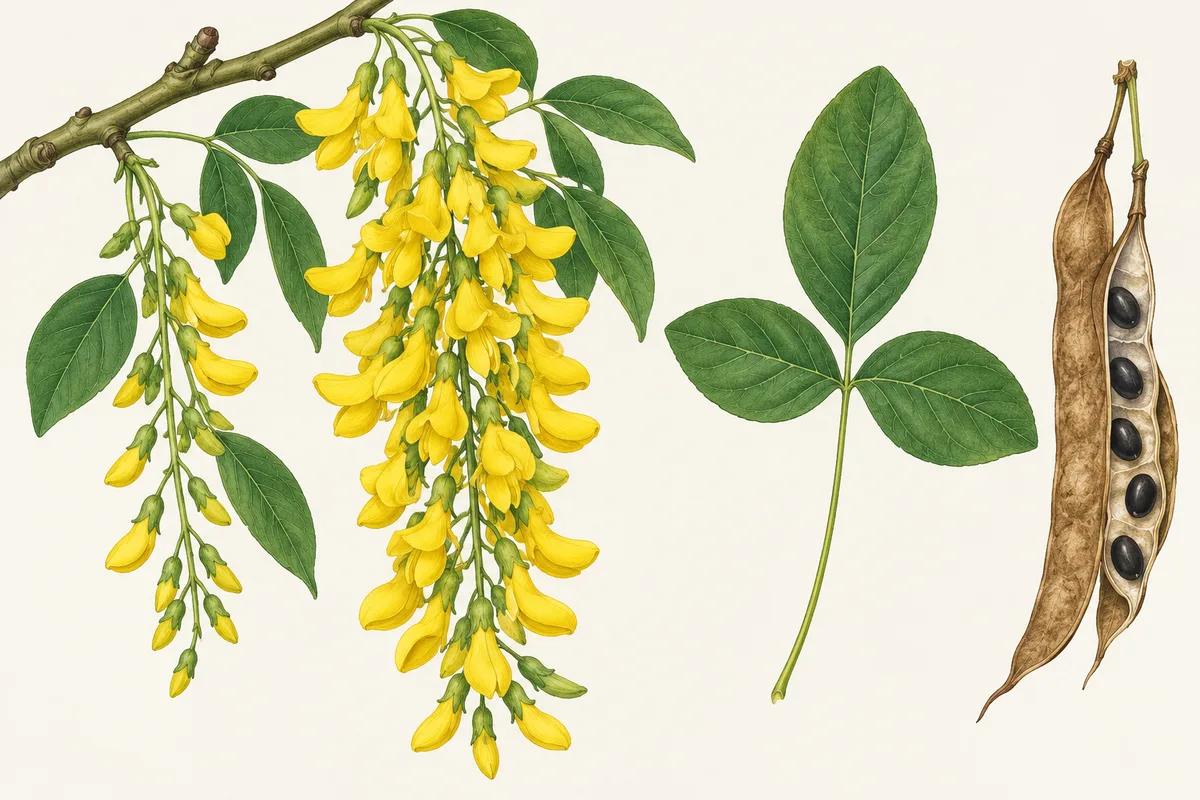
In short
A laburnum tree is a small deciduous tree, usually 4 to 8 m tall, with leaves made of three oval leaflets and, in May and June, hanging chains of golden-yellow pea flowers 10 to 25 cm long, or up to 60 cm on the garden hybrid 'Vossii'. Flat pods of black seeds follow. NC State Extension rates every part highly toxic, the pods and seeds most of all.
- Three leaflets on a long stalk plus hanging yellow pea flowers: laburnum. Black locust has 7 to 23 leaflets and white flowers.
- Garden golden chain trees in Britain are mostly Voss's laburnum, a hybrid with chains up to 60 cm and few pods.
- NC State Extension lists every part as poisonous, with the seed pods the most harmful. Never eat any part, and keep pods away from children and pets.
Field marks at a glance
- Scientific name
- Laburnum anagyroides
- Family
- Fabaceae (pea family)
- Type
- Broadleaf, deciduous
- Leaves
- Alternate, on long stalks, each made of three oval leaflets 2.5 to 7.5 cm (1 to 3 in) long; smooth above and hairy underneath (NC State). The RHS describes them as dark green.
- Flowers
- Golden-yellow pea flowers in hanging chains (racemes), fragrant, 10 to 25 cm long on common laburnum (NC State), in May and June; up to 60 cm on Voss's laburnum (RHS).
- Pods
- Long, flat pods that turn brown and split open, each holding several black seeds (NC State). Never eat or handle them carelessly.
- Bark and twigs
- Bark thin, smooth and light brown on mature trees (NC State); new shoots grey-green (RHS).
- Size and form
- A spreading, bushy small tree, 4 to 8 m in the RHS profile and 4.5 to 9 m (15 to 30 ft) in NC State's.
- Origin
- Central and southern Europe; not native to Great Britain or Ireland, but widely planted in gardens (RHS).
- Toxicity
- NC State rates the plant highly toxic: all parts, the seed pods most harmful; toxic principle cytisine. The RHS lists it as harmful if eaten, including by dogs. Never eat any part.
Laburnum is the small garden tree that turns into a curtain of yellow in late spring, trained over arches in British gardens and planted as a street and yard tree in cooler parts of North America. It is also one of the most poisonous trees in a typical garden. Check the leaf first, then the flowers or pods. Never eat a berry, nut, seed or pod on the strength of a web page or an app; check with a local expert.
How to identify a laburnum tree in four checks
1. Leaves in threes. NC State Extension's laburnum profile describes alternate, long-stalked leaves, each made of three oval leaflets 1 to 3 inches (2.5 to 7.5 cm) long, smooth above and hairy underneath. The RHS profile adds dark green leaflets and grey-green new shoots. Few garden trees have leaves of exactly three leaflets, so this check works from spring to autumn.
2. Hanging chains of yellow pea flowers. In May and June the tree carries fragrant, golden-yellow, pea-shaped flowers in drooping chains (racemes). NC State gives 4 to 10 inches for common laburnum. On Voss's laburnum, the usual garden tree, the RHS gives chains up to 60 cm. The flowers look like small sweet peas because laburnum is in the pea family.
3. Flat pods with black seeds. After flowering come long, flat pods that turn brown and split open, holding several black seeds (NC State). They often hang on into autumn and are the easiest winter clue. NC State names them the most harmful part of the tree.
4. Size and bark. Laburnum stays small: the RHS gives 4 to 8 m, spreading and bushy, and NC State gives 15 to 30 feet. Mature bark is thin, smooth and light brown.
Tree Identifier can name a laburnum from one photo of a flower chain, a leaf or a pod. Laburnum is not one of the 138 species in the app's Collection, and the app shows no confidence score or look-alike list, so count the leaflets yourself before you settle on the name.
Laburnum is poisonous: what the sources say
NC State Extension rates laburnum a high-severity poison. It lists all parts as poisonous, including bark, flowers, leaves, roots, sap, seeds and stems, and names the seed pods as the most harmful part. The toxic principle is cytisine, an alkaloid. NC State notes that small ingestions often cause no symptoms and that nausea and vomiting are the usual signs when they do occur, while larger amounts can cause drowsiness, convulsions and an irregular pulse; its profile carries the warning that laburnum may be fatal if eaten.
The RHS lists laburnum as harmful if eaten, names dogs, rabbits and rodents among the pets at risk, and advises wearing gloves when handling the plant.
This page gives no advice on handling or eating any part. If a child or pet may have eaten pods, seeds, flowers or leaves, call NHS 111 (or your local poison control service) or a vet, and take a piece of the plant with you. Tree Identifier's Toxicology notes are AI-written and are a starting point for questions, not a safety verdict.
Common, Scotch and Voss's laburnum
Three laburnums are planted, and the garden tree is usually the hybrid.
| Laburnum | Flower chains | Flowering | Pods | Notes |
|---|---|---|---|---|
| Common laburnum (L. anagyroides) | 10–25 cm | May–June | Many, black seeds | Native to central and southeastern Europe |
| Scotch laburnum (L. alpinum) | 20–30 cm, hang straighter | About two weeks later, around June | Sharp-edged wing along the upper side | Mountains of the Alps, Apennines, Carpathians and Balkans |
| Voss's laburnum (L. × watereri 'Vossii') | Up to 60 cm | Not given in the sources | Few | Hybrid of the two; holds the RHS Award of Garden Merit |
Scotch laburnum. Trees and Shrubs Online describes leaflets with only a few silky hairs beneath, longer racemes of 20 to 30 cm that hang straighter, flowering a fortnight or two after common laburnum, and a sharp-edged wing along the upper side of the pod as the key difference.
Voss's laburnum. The Trees and Shrubs Online account of the hybrid calls it intermediate between its parents, with racemes up to 60 cm in some clones, and notes that it seldom fruits heavily. A garden laburnum with very long chains and few pods is almost always this one. The RHS describes 'Vossii' as a broad-crowned small tree of 4 to 8 m.
For other garden trees in yellow, see trees with yellow flowers.
Laburnum vs black locust, golden rain tree and broom
Black locust. Also in the pea family, with hanging pea flowers and flat pods, so it is the most frequent confusion in North America. NC State's black locust profile describes pinnate leaves with 7 to 23 leaflets, short paired spines up to 1.25 inches beside each leaf scar, white flowers in clusters 5 to 8 inches long from April to June, and smooth purple-brown pods 2 to 4 inches long. It grows to 30 to 50 feet with thick, deeply furrowed bark. NC State rates it a high-severity poison too. The locust page separates it from honey locust.
Golden rain tree. The name overlaps with laburnum's, but Koelreuteria paniculata is unrelated. NC State's golden rain tree profile gives a tree of 30 to 40 feet with compound leaves 6 to 18 inches long of 7 to 15 leaflets, yellow star-shaped flowers in 12- to 15-inch clusters in July, and hollow, papery, three-sided capsules that go from green to light brown. A yellow-flowered tree in high summer with paper lanterns is this tree, not laburnum.
Broom. Common or Scotch broom has the same yellow pea flowers in late spring, but NC State's broom profile describes a shrub of 4 to 8 feet with green, angled, ridged stems, tiny leaves under an inch long, flowers single or in pairs along the stems, and flat pods 1 to 3 inches long with hairy edges. It never forms hanging chains. NC State rates broom a high-severity poison as well.
Pods of laburnum, black locust and other trees are compared in trees with long seed pods.
Laburnum in British gardens and beyond
The RHS lists laburnum as not native to Great Britain or Ireland; it comes from central and southern Europe and is rated hardy throughout the UK and northern Europe. It is a familiar sight in suburban front gardens and on garden arches. The RHS also lists aphids, leaf miners, powdery mildew, silver leaf and honey fungus among its problems.
In the US, NC State gives USDA hardiness zones 5a to 7b, so laburnum is a tree of the cooler and middle parts of the country rather than the Deep South or Florida.
Outside the flowering weeks, a laburnum is easy to overlook: a small tree with three-leaflet leaves and, from summer, brown pods. If you mark one on Tree Identifier's Tree Map in May, the History tab keeps the photo for when the flowers are gone. For more British garden and wild trees, see the UK tree identification guide.
Look-alikes and how to tell them apart
Black locust (Robinia pseudoacacia)
Count the leaflets: black locust has 7 to 23 on each leaf, not 3, and short paired spines beside the leaf scars. Its hanging flower clusters are white, not yellow, and its bark is thick and deeply furrowed.
Golden rain tree (Koelreuteria paniculata)
Its yellow flowers are small stars in large clusters 30 to 38 cm long in July, well after laburnum has finished. The leaves have 7 to 15 leaflets, and the fruit is a papery, three-sided lantern, not a flat pod.
Broom (Cytisus scoparius)
Broom is a shrub of about 1.2 to 2.4 m with green, ridged stems and tiny leaves under 2.5 cm. Its yellow pea flowers sit singly or in pairs along the stems, never in long hanging chains.
Scotch laburnum (Laburnum alpinum)
A close relative with longer, straighter chains of 20 to 30 cm that open a week or two after common laburnum, leaflets with only a few silky hairs beneath, and a sharp-edged wing along the upper side of the pod.
What a photo can't settle
- A photo of a tree out of flower shows only three-leaflet leaves, and young broom or a clipped shrub can look similar: wait for May or look for old pods.
- Voss's laburnum, common laburnum and Scotch laburnum differ in chain length, flowering date and pod details that a single photo rarely settles.
- Whether a child or pet that chewed a pod needs treatment is never decided by a page or an app: call NHS 111, a poison control centre or a vet.
Questions people ask
Is a laburnum tree poisonous?
Yes. NC State Extension rates it highly toxic and lists all parts as poisonous, with the seed pods the most harmful; the toxin is the alkaloid cytisine. The RHS lists it as harmful if eaten by people and by dogs. If a child or pet may have eaten any part, call NHS 111, poison control or a vet.
What is the difference between laburnum and golden chain tree?
None: golden chain is a common name for laburnum, along with golden rain and bean tree (RHS). Most garden golden chain trees are Voss's laburnum, a hybrid of common and Scotch laburnum, with chains up to 60 cm long.
When does laburnum flower?
Common laburnum flowers in May and June, according to NC State. Scotch laburnum opens about a fortnight later and flowers around June, into July in cool climates (Trees and Shrubs Online). A tree in yellow flower in July is more likely a golden rain tree.
Is laburnum a tree or a bush?
It is a small tree, often bushy and multi-branched. The RHS gives a spreading, bushy tree reaching 4 to 8 m in 10 to 20 years, and NC State gives 4.5 to 9 m. Garden plants are often trained over arches, which can make them look like a climber.
Should I remove laburnum pods?
This page gives no handling advice beyond the sources. NC State calls the pods the most harmful part, and the RHS advises gloves when handling the plant. Voss's laburnum sets few pods (Trees and Shrubs Online), one reason it is the usual garden choice.
Sources
- Laburnum anagyroides (Common Laburnum, Golden Chain Tree, Golden Rain Tree) — NC State Extension Gardener Plant Toolbox
- Laburnum anagyroides (common laburnum) — Royal Horticultural Society (RHS)
- Laburnum × watereri 'Vossii' (Voss's laburnum) — Royal Horticultural Society (RHS)
- Laburnum × watereri — Trees and Shrubs Online (International Dendrology Society)
- Laburnum alpinum — Trees and Shrubs Online (International Dendrology Society)
- Robinia pseudoacacia (Black Locust) — NC State Extension Gardener Plant Toolbox
- Koelreuteria paniculata (Golden Rain Tree) — NC State Extension Gardener Plant Toolbox
- Cytisus scoparius (Scotch Broom) — NC State Extension Gardener Plant Toolbox
Keep reading
- Tree profileLocust trees: how to identify black locust and honey locust
- Clue guideWhich tree has yellow flowers? Region first, then the flower shape
- Clue guideWhich tree has long seed pods? Sort it by leaf, pod and region
- Field guideTree identification in the UK: British trees by leaf, bark and picture