Tree profile
Monkey puzzle tree (Araucaria araucana): how to identify it
A Chilean conifer planted in British gardens since 1795: hard, sharp, triangular leaves clothing every branch, cones the size of a coconut on female trees and a stout, grey trunk.
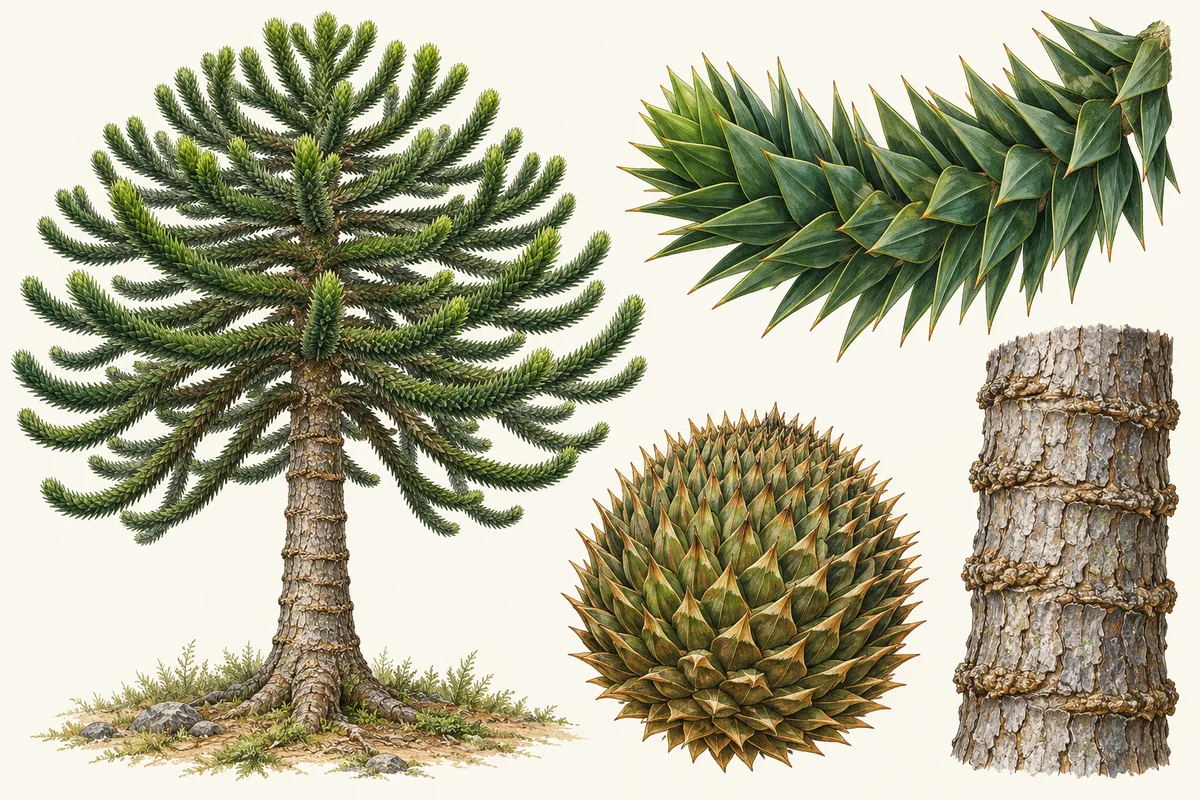
In short
A monkey puzzle tree is an evergreen conifer from Chile and Argentina whose branches are wrapped in stiff, glossy, triangular leaves 3 to 5 cm long, each ending in a sharp spine and set in a tight spiral. Female trees carry round cones 10 to 18 cm long at the branch tips; male trees carry long brown pollen cones. The trunk is straight, stout and often wide like an elephant's foot at the base.
- No other tree in a British garden has leaves like overlapping green spines wrapped around every branch and much of the trunk.
- Round, football-like cones mean a female tree; long, cucumber-shaped brown cones mean a male.
- Norfolk Island pine, its common houseplant relative, has soft leaves about 1 cm long and branches in neat tiers of five.
Field marks at a glance
- Scientific name
- Araucaria araucana
- Family
- Araucariaceae (araucaria family)
- Type
- Conifer, evergreen
- Leaves
- Stiff, leathery, glossy and triangular, 3 to 5 cm long and 0.8 to 2.5 cm wide at the base, ending in a sharp spine; set in a dense spiral that covers each branch. Each leaf stays on the tree for 10 to 15 years.
- Female cones
- Round, 10 to 18 cm long and 8 to 15 cm wide, green and gold with hair-like edges, at the tips of upper branches; they ripen over 2 to 3 years, then turn brown.
- Male cones
- Oblong pollen cones 7 to 15 cm long, green turning yellow then brown at the end of summer, on separate trees from the female cones in most cases.
- Seeds
- Large and brown, 2.5 to 4 cm long, up to about 200 in one cone (NC State). In Britain jays and squirrels carry them off.
- Bark and trunk
- Straight, stout, almost cylindrical trunk; bark described as smooth and purplish brown (Woodland Trust) or grey-brown with horizontal folds and wrinkles (NC State). Old trees widen at the base like an elephant's foot.
- Form and size
- Up to 30 m in Britain (Woodland Trust), up to 40 m and occasionally 50 m in the wild. Branches are rope-like and densely clothed in leaves; a large tree has a straight, clear trunk under a rounded crown.
- Range
- Native to the Andes of southern Chile and western Argentina and to Chile's coastal Cordillera de Nahuelbuta; planted in Britain since 1795 and widely in cool temperate gardens.
The monkey puzzle (Araucaria araucana) is the tree in British front gardens that looks as if it belongs with dinosaurs: every branch is wrapped in hard green scales that end in spines. It comes from the Andes of Chile and Argentina, and the Woodland Trust dates its arrival in the UK to 1795. Once you have seen one, it is hard to mistake, but its houseplant cousin and a few botanic-garden relatives can catch you out.
How to identify a monkey puzzle tree in three checks
1. Touch a leaf, carefully. The leaves are the whole story. The Gymnosperm Database gives them as 30 to 50 mm long and 8 to 25 mm wide, ovate to lance-shaped; the Woodland Trust describes them as stiff, leathery, glossy and triangular, thick and broad at the base, sharp at the edges and tips, set in a spiral. They overlap so closely that the branch looks armoured, and they stay on the tree for 10 to 15 years, so even the trunk of a young tree is often clothed in them.
2. Look at the outline. The branches are thick and rope-like, densely clothed in leaves from base to tip, and on a large tree they spread from a straight, clear trunk. The Woodland Trust describes the trunk as stout and almost cylindrical, and notes that the base of a large tree can resemble an elephant's foot.
3. Find the cones. Scan the branch tips at the top of the crown. Round cones 10 to 18 cm long mean a female tree; oblong pollen cones that turn yellow, then brown, at the end of summer mean a male. Cones are a bonus, not a requirement: no other garden tree in Britain has the leaves.
Tree Identifier can name a monkey puzzle from one photo of a branch or the whole tree, and Araucaria araucana is one of the species in the app's Collection, alongside Norfolk Island pine. The app shows no confidence score and no list of look-alikes, so if the tree is in a pot indoors, check the leaves yourself against the Norfolk Island pine section below.
Leaves, cones, bark and seeds in detail
Leaves. The NC State Extension profile describes the leaves as thick, stiff, scale-like and densely spiralled around the stem, about 1 inch (2.5 cm) wide at the base and up to 2 inches (5 cm) long, ending in a sharp, spiny tip. The page's attribute table gives a slightly different length range (1 to 3 inches), so treat 3 to 5 cm as typical rather than fixed.
Female cones. Female trees bear globular cones 10 to 18 cm long and 8 to 15 cm wide (Gymnosperm Database), described by NC State as pineapple-shaped and holding up to 200 seeds. The Woodland Trust describes them as green and gold with hair-like edges. They ripen over two to three years, then turn brown.
Male cones. Pollen cones are oblong, 7 to 15 cm long and about 5 cm wide, clustered at the branch tips. The Woodland Trust calls them catkins about 10 cm long, made of narrow green stamens that turn yellow and then brown at the end of summer.
Male or female? The species is dioecious: male and female cones grow on separate trees. NC State adds that the tree is mostly dioecious, and that both kinds of cone occasionally appear on one tree. Until a tree bears cones, which takes many years, there is no reliable way to tell its sex from the outside.
Bark. Sources describe it differently, probably because it changes with age. The Woodland Trust gives smooth, purplish-brown bark on a nearly cylindrical trunk; NC State describes grey-brown, deeply wrinkled bark with horizontal folds. Either way, the trunk is straight and unbranched for much of its height on a mature tree, and often widest right at the ground.
Seeds. The seeds are large and brown, 2.5 to 4 cm long. In the UK, the Woodland Trust says, jays and squirrels disperse them. This page gives no advice on eating them.
Monkey puzzle in Britain and Ireland
The Woodland Trust lists monkey puzzle as non-native, planted as an ornamental tree in Europe and North America, and reaching up to 30 m. The Gymnosperm Database notes trunks over 100 cm in diameter on trees in the UK and Ireland, but knows of no cultivated tree taller than 30 m, and rates the species hardy to USDA zone 8. The common name dates from the mid-1800s, according to the Woodland Trust.
Most British monkey puzzles are planted specimens, standing alone in a park, a lawn or a front garden; the Woodland Trust lists the species as non-native, so a monkey puzzle in a wood was planted there or grew from a nearby planted tree. If you meet a dark, spiky conifer in a churchyard instead, it is far more likely to be a yew, which has flat, soft needles in two rows. For the broader picture of conifers in British parks and woods, see the conifer identification guide and the UK tree identification guide.
In the wild the species is a different story. The Gymnosperm Database reports that the IUCN rates it at high risk of extinction because its natural range, in the Andes at about 37 to 40 degrees south and in Chile's Cordillera de Nahuelbuta, is small, severely fragmented and still declining. It also reports the oldest documented tree, from a ring chronology near Neuquén in Argentina, at 711 years.
Monkey puzzle, Norfolk Island pine and bunya pine
Three araucarias are planted outside their home ranges, and they are mixed up often enough that autocomplete is full of the comparisons.
| Tree | Leaves | Branches | Cones | Where you meet it |
|---|---|---|---|---|
| Monkey puzzle (A. araucana) | Hard, triangular, 3–5 cm, spiny | Rope-like, upturned, crowded | Round, 10–18 cm | Gardens in Britain, Ireland, cool temperate areas |
| Norfolk Island pine (A. heterophylla) | Soft, awl-shaped, about 1 cm | Level tiers of about five | Spiny, globe-shaped | Houseplant in Britain; outdoors in Florida and coastal California |
| Bunya pine (A. bidwillii) | Adult 0.7–2.8 cm; juvenile 2.5–5 cm in two rows | Pyramidal crown, dome-shaped with age | About 30 cm, up to 10 kg | Queensland; botanic gardens |
Norfolk Island pine. The NC State profile of Norfolk Island pine describes dark green, awl-shaped leaves about 1/2 inch (1.3 cm) long, soft with sharp points, and wide-spaced branches in whorled horizontal tiers, typically five per whorl. It is hardy only in USDA zones 9a to 11b, which is why British readers meet it as a potted "living Christmas tree". If your tree is indoors and its leaves are soft, it is not a monkey puzzle.
Bunya pine. The Gymnosperm Database entry for bunya pine describes adult leaves 0.7 to 2.8 cm long, glossy and dark green, spreading around the shoot, and juvenile leaves 2.5 to 5 cm long in two rows. Its cones, about 30 by 22 cm and up to 10 kg, are among the largest of any conifer. It is native only to Queensland.
Pines. Despite the old name Chile pine, a monkey puzzle is not a pine. True pines carry long needles in bundles; see the pine page for how to read them. For true firs, see the fir page.
When the tree is browning or dropping branches
"Monkey puzzle tree going brown" is one of the most common searches about this tree in the UK. None of the sources on this page gives a cause, and a photograph alone cannot sort one out: where the browning starts (old leaves low down, or young growth high up), how fast it spreads, and what the soil and roots look like all matter. Note those three things before you ask for advice, and keep dated photos of the same branch.
Tree Identifier's Diagnose tool can describe what it sees in a photo of a browning branch and gives a severity rating, which is a reasonable first step. Because monkey puzzles are tall, spiny and often close to houses, any decision about pruning or felling belongs with a qualified arborist who can inspect the tree in person. If you are logging monkey puzzles on walks, the app's Tree Map saves each located identification so you can find a fruiting female again next year.
Look-alikes and how to tell them apart
Norfolk Island pine (Araucaria heterophylla)
Feel a branch: Norfolk Island pine has soft, awl-shaped leaves about 1 cm long, not hard triangular spines 3 to 5 cm long, and its branches stand in level tiers of about five. It is frost-tender, so in Britain it is a houseplant, not a garden tree.
Bunya pine (Araucaria bidwillii)
Bunya pine's adult leaves are smaller, 0.7 to 2.8 cm, and young shoots carry narrow leaves in two flat rows; its cones are huge, about 30 cm and up to 10 kg. It is a Queensland tree seen in botanic gardens, not in British front gardens.
Pines (Pinus)
Pines carry long, thin needles in bundles, not short, broad, triangular leaves wrapped tight around the shoot, and their cones are woody and scaly, usually longer than wide. A monkey puzzle's female cone is round, 10 to 18 cm long.
What a photo can't settle
- Telling a young monkey puzzle from a young bunya pine in a botanic garden can need the cones, which take years to appear.
- A photo shows whether the tree is a monkey puzzle, but not why its branches are browning: that needs an arborist who can see the roots, soil and the whole crown.
- Male and female trees look the same until they bear cones, so a young or cone-free tree cannot be sexed from a picture.
Questions people ask
Where does the monkey puzzle tree come from?
From the Andes of southern Chile and western Argentina, between about 37 and 40 degrees south, and from Chile's coastal Cordillera de Nahuelbuta. The Woodland Trust says it was first brought to the UK in 1795 and is under threat in Chile from over-harvesting.
How do you tell a male monkey puzzle from a female?
Look at the cones at the branch tips. Female trees carry round cones 10 to 18 cm long, green and gold while they ripen. Male trees carry oblong pollen cones 7 to 15 cm long that turn yellow, then brown, at the end of summer. NC State notes that a few trees carry both.
Is the monkey puzzle tree endangered?
In the wild, yes. The Gymnosperm Database reports that the IUCN rates it at high risk of extinction because its range is small, fragmented and still shrinking. Planted trees in Britain and elsewhere do not change that status.
How old can a monkey puzzle tree get?
The oldest documented tree, dated from its rings near Neuquén in Argentina, was 711 years old, according to the Gymnosperm Database, which adds that ages over 1,000 years are likely possible. Garden trees in Britain date from 1795 at the earliest.
Why is my monkey puzzle tree going brown?
A photo cannot settle it. Browning on old, low branches near the trunk and browning spread through young growth in the upper crown have different causes, and the soil, roots and weather matter. Because the tree is tall and spiny, ask a qualified arborist to inspect it in person.
Is a monkey puzzle a pine?
No. It is a conifer, but in the araucaria family, not the pine family. Its older names Chile pine and Chilean pine are traditional, and it shares the genus Araucaria with Norfolk Island pine and bunya pine, which are not pines either.
Sources
- Monkey puzzle (Araucaria araucana) — Woodland Trust
- Araucaria araucana — The Gymnosperm Database (conifers.org)
- Araucaria araucana (Monkey Puzzle Tree) — NC State Extension Gardener Plant Toolbox
- Araucaria heterophylla (Norfolk Island Pine) — NC State Extension Gardener Plant Toolbox
- Araucaria bidwillii (Bunya pine) — The Gymnosperm Database (conifers.org)
Keep reading
- Field guideConifer identification: three questions about the needles, then the cone
- Field guideTree identification in the UK: British trees by leaf, bark and picture
- Tree profileYew (Taxus): how to identify it
- Tree profilePines (Pinus): how to identify a pine tree
- Field guideHow to identify trees by their shape