Tree profile
Service tree (Sorbus domestica): how to tell it from rowan
A critically endangered tree in Britain that looks like a rowan in leaf, but its sticky green buds, rough bark and little pears or apples give it away.
In short
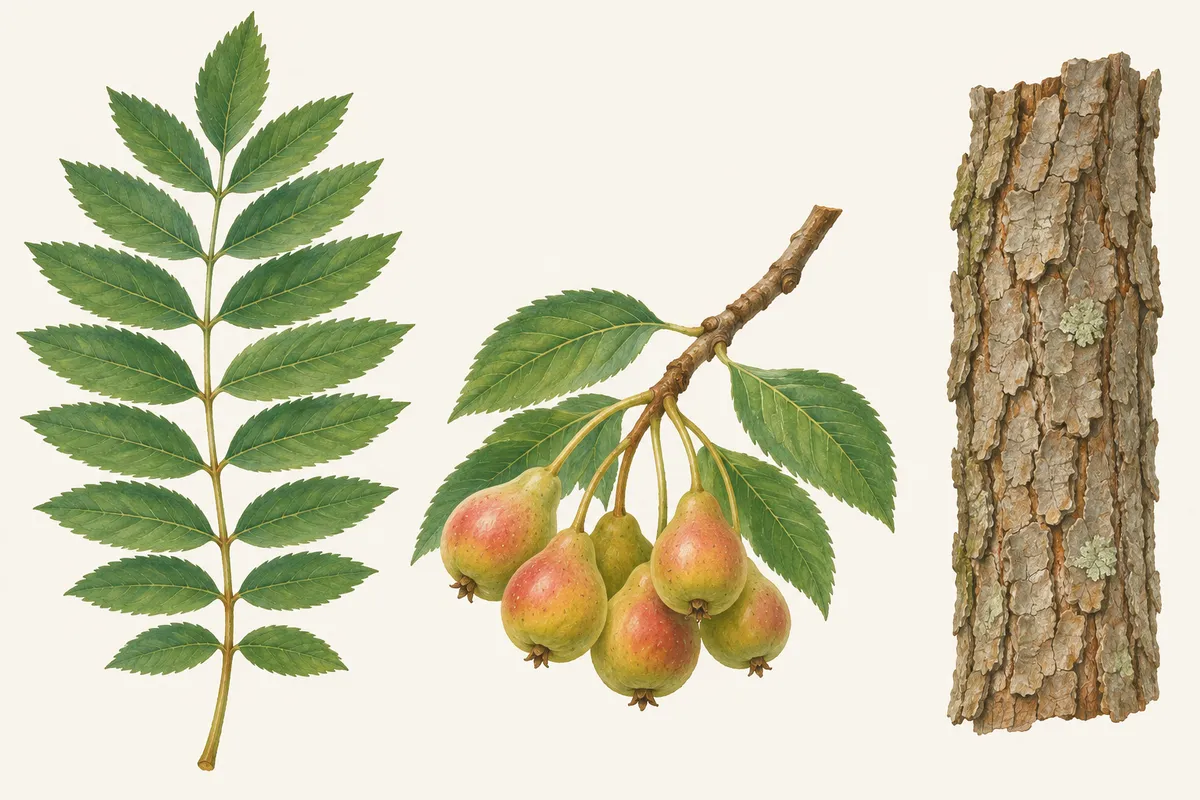
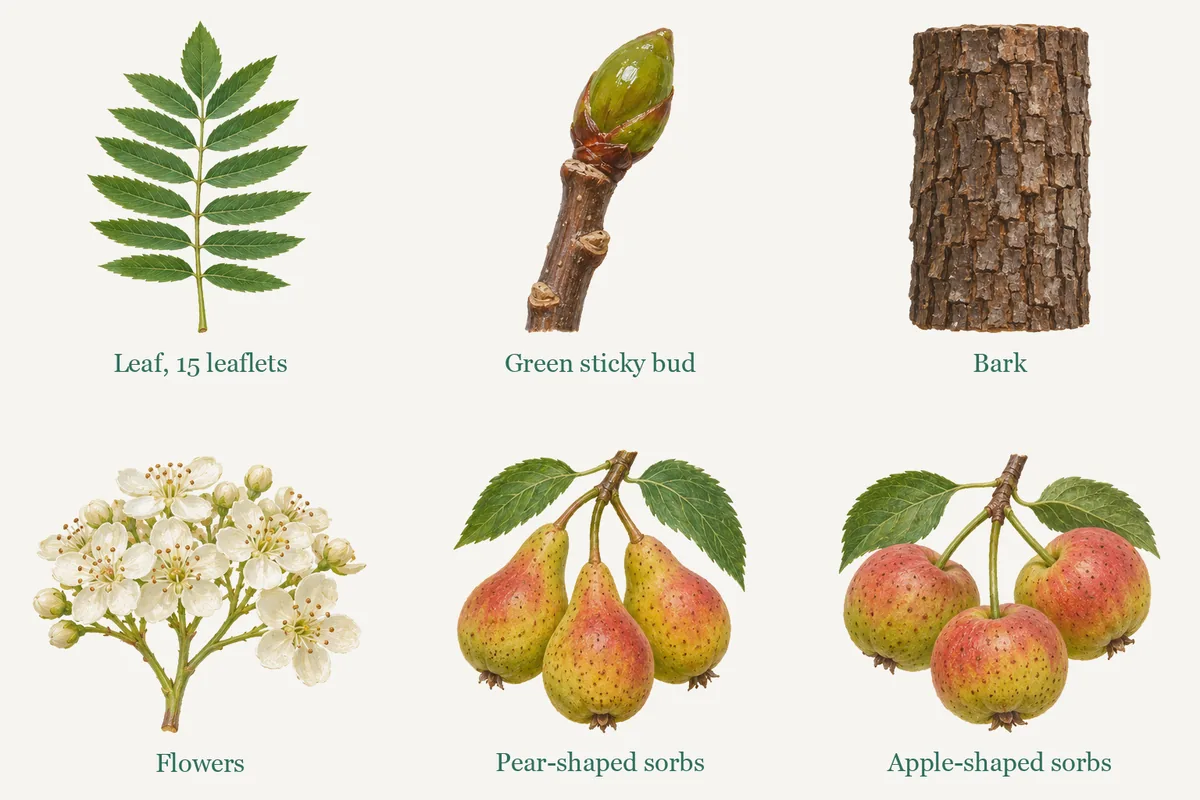
Service tree identification means separating it from rowan, whose leaves it copies: 13 to 21 toothed leaflets on a leaf 15 to 22 cm long. The service tree has sticky, glossy green buds about 15 mm long where rowan's are purple and hairy, bark that cracks into small rectangles, and fruits 2 to 3 cm long shaped like small apples or pears, not red berries.
- Feel the winter buds: sticky and green means service tree, hairy and purple means rowan.
- Fruit settles it: rowan berries are under 1 cm and red, service tree fruits 2 to 3 cm and russet green.
- Also called the true service tree, sorb or whitty pear; it is not the wild service tree, whose leaves are lobed.
Field marks at a glance
- Scientific name
- Sorbus domestica (syn. Cormus domestica)
- Family
- Rosaceae (rose family)
- Type
- Broadleaf, deciduous
- Leaves
- Alternate, pinnate, 15 to 22 cm long (RHS; 12 to 24 cm in Hemery), with 13 to 21 narrow, toothed leaflets, grey-downy at first, later hairless. Orange-red or yellow in autumn.
- Buds
- Sticky, glossy green, pointed, about 15 mm long; rowan's are purple and hairy.
- Bark
- Smooth and grey when young, then orange-tinged or red-brown, cracking into small rectangles, flaky and finely fissured.
- Fruit (sorbs)
- Apple- or pear-shaped, 2 to 3 cm long (RHS; Hemery gives 18 to 40 mm), green, flushed brownish-red on the sunny side; ripe late summer to October.
- Flowers
- Creamy white or pink-flushed, 13 to 18 mm across, in domed clusters about 10 cm wide, May and June.
- Size and crown
- Up to about 20 m (RHS), 15 to 20 m (EUFORGEN); domed, open crown with level, spreading branches; low and sprawling on exposed cliffs.
- Where
- Native to southern and central Europe, especially the Balkans, Italy and southern France. In Britain very rare: a few trees on cliffs in Glamorgan and Gloucestershire, the Wyre Forest line, and plantings.
The service tree is a rowan in disguise: in leaf, the two are almost the same, and the Worcestershire action plan warns that it is easily mistaken for rowan when not in flower or fruit. Once you know where to look, though, it differs on every other part of the tree: sticky green buds, rough bark, and fruits that look like tiny pears or apples. It is listed as critically endangered in Britain, its native status is still argued over, and the few wild ones grow on sea cliffs in South Wales and Gloucestershire and in the Wyre Forest. Most you will meet are planted, in arboretums, botanic gardens and parks.
How to identify a service tree
Start with the leaves to place it in the rowan group, then use any of the other four checks to separate it from rowan.
1. Leaves: like a rowan's. The RHS describes pinnate leaves 15 to 22 cm long with 13 to 21 dark yellowish-green leaflets, partly serrated. Gabriel Hemery, a forester and author, gives 12 to 24 cm, usually 6 to 8 pairs of narrow-oblong, toothed leaflets plus one at the tip, grey-downy at first and later hairless. The leaf alone will not separate it from rowan.
2. Buds: sticky and green. This is the best year-round test. Hemery describes the service tree's buds as sticky, glossy green, pointed and about 15 mm long, and notes that rowan's are brown. Our rowan page describes rowan's as purple, hairy and egg-shaped, the end bud up to 8 mm. Touch a bud: sticky means service tree.
3. Bark: cracked into small squares. The RHS describes orange-tinged brown bark cracking into small rectangles; Hemery says it is smooth and grey when young, then red-brown, flaky and finely fissured. Rowan bark stays smooth and silvery or greyish-brown, with raised lenticels.
4. Fruit: small apples or pears. The fruits, called sorbs, are 2 to 3 cm long according to the RHS and the Oxford Botanic Garden, shaped like small apples or pears, green and flushed brownish-red on the sunny side. Rowan's berries are bright red and under 1 cm.
5. Crown. Mature trees have a domed, open crown with level, spreading branches, up to about 20 m tall (RHS). On exposed cliffs, Hemery notes they can be prostrate.
Tree Identifier can name a tree from a photo of a fruiting branch, which is the clearest single view of a service tree. It shows the common and scientific names without a list of look-alikes, so check the buds before you call it: in a park, a rowan is far more likely.
Service tree vs rowan, wild service tree and ash
| Feature | Service tree | Rowan | Wild service tree | Ash |
|---|---|---|---|---|
| Leaf | Pinnate, 13–21 leaflets, alternate | Pinnate, 5–8 pairs of leaflets plus one, alternate | Simple, maple-like lobes, alternate | Pinnate, opposite |
| Winter buds | Sticky, glossy green, about 15 mm | Purple, hairy, up to 8 mm | Round, green, pea-like | Dark, velvety, opposite |
| Bark | Cracking into small rectangles | Smooth, silvery-grey | Square plates | Pale brown to grey, fissured with age |
| Fruit | Apple or pear shape, 2–3 cm, russet green | Red berries, about 8 mm | Brown, speckled, 10–15 mm | Winged seeds |
The Oxford Botanic Garden notes that service tree, wild service tree and rowan are told apart mainly by their fruit, and gives 2 to 3 cm for the service tree's apples or pears against under 1 cm for rowan's red-orange berries. The wild service tree page covers that tree's lobed leaves and chequers. The Woodland Trust's ash profile gives European ash 3 to 6 opposite pairs of leaflets, dark velvety buds and winged keys; the North American ashes are on our ash page, and our guide to trees with compound leaves sorts the other feather-leaved trees.
Flowers, fruit and the two fruit forms
The service tree flowers in May and June. The Worcestershire action plan describes bunches of white flowers that produce small pear-shaped fruits "about the size of a large damson" in October. The RHS describes greyish-cream flowers in domed clusters about 10 cm across, and Hemery gives individual flowers 13 to 18 mm across, creamy white or flushed pink.
Two fruit forms are named, forma pomifera with apple-shaped fruit and forma pyrifera with pear-shaped fruit, and both appear on planted trees. The Oxford Botanic Garden says the fresh fruit is very astringent and becomes soft and edible only after bletting, like medlars; it was used for preserves and alcoholic drinks. The RHS, by contrast, lists the tree as potentially harmful and its fruit as ornamental and not to be eaten. This page does not give foraging advice.
Despite heavy flowering and fruiting, the species produces little viable seed, the Oxford Botanic Garden says, and spreads mainly by root suckers. In its European range, EUFORGEN describes a light-demanding tree, a weak competitor in mixed stands, that tolerates drought and frost down to −30 °C.
The service tree in Britain: Wyre Forest and the cliffs
Britain's first recognised service tree grew in the Wyre Forest in Worcestershire. The Worcestershire action plan records that it was described in 1678 by Alderman Edmund Pitt in a letter to the Royal Society, and that a poacher burnt it down in 1862. Cuttings had already been raised at Arley Castle and planted around Worcestershire, at Arley Arboretum, Croome Park, Worcester Cathedral, Bewdley and the Oxford Botanic Garden; a replacement planted in the Wyre Forest in 1916 still stands. The plan counts 30 known trees in Worcestershire.
In the mid-1980s, wild trees were found on soft, south-facing cliffs on lime-rich soils in Glamorgan and Gloucestershire, and one Glamorgan tree was estimated at about 400 years old. The Oxford Botanic Garden says this South Wales population, found in 1983, is unlikely to have been planted, which is why the service tree may be a British native after all. It is listed as critically endangered on the Vascular Plant Red Data List for Great Britain, but has no legal protection.
Its name goes back to the Latin sorbus, the name for the fruit, and the Oxford Botanic Garden links "whitty pear" to its rowan-like leaves and pear-shaped fruit. With location turned on, Tree Identifier's Tree Map pins the find, so you can return in October to check the fruit, and the follow-up chat under a result can answer questions about its history. For the native trees it grows among, see our UK native trees list.
Look-alikes and how to tell them apart
Rowan (Sorbus aucuparia)
Rowan's leaves are almost the same, but its winter buds are purple and hairy, not sticky and green, its bark stays smooth and silvery-grey, and its fruit is a bright red berry about 8 mm across in heavy clusters, not a little pear 2 to 3 cm long.
Wild service tree (Sorbus torminalis)
Despite the shared name, its leaves are simple and lobed like a maple's, not divided into leaflets, and its brown speckled fruits are 10 to 15 mm. It is a rare native of old English woods.
Ash (Fraxinus excelsior)
Ash also has pinnate leaves, but they grow in opposite pairs along the twig and its winter buds are dark and velvety. Its fruit is a bunch of winged seeds, not a fleshy apple or pear.
What a photo can't settle
- Out of flower and fruit, a service tree looks like a rowan in a photo of its leaves; the sticky buds and the bark are what separate them, and both need a close look.
- Whether a British service tree is a wild native, a descendant of the Wyre Forest tree or a recent planting is a question for records and genetics, not a photograph.
- The apple-shaped and pear-shaped fruit forms are varieties of one species; a photo app names the species, not the form.
Questions people ask
What is the difference between a service tree and a wild service tree?
They are separate species. The service tree, or true service tree (Sorbus domestica), has rowan-like compound leaves and fruits shaped like small apples or pears, 2 to 3 cm long. The wild service tree (Sorbus torminalis) has simple, maple-like lobed leaves and brown speckled fruits 10 to 15 mm across.
Is the service tree native to Britain?
It is disputed. The Oxford Botanic Garden says it may be native, citing a small South Wales population found in 1983 that is unlikely to have been planted. Gabriel Hemery calls it long-established but very scarce, and Worcestershire's action plan notes it is critically endangered on the British Red Data List.
Why is the service tree called the whitty pear?
The Oxford Botanic Garden links the name to its rowan-like leaves and to the fruit's pear shape and gritty stone cells. The first recognised English tree, in the Wyre Forest, was known as the Whitty Pear.
Can you eat service tree fruit?
This page gives no foraging advice. The Oxford Botanic Garden says fresh fruit is very astringent and was eaten only after softening, like medlars, while the RHS lists the tree as potentially harmful and its fruit as not to be eaten. Never eat any fruit on the strength of a web page or an app.
Sources
- Sorbus domestica (service tree) — Royal Horticultural Society
- Sorbus domestica (service tree): Plants 400 profile — Oxford Botanic Garden and Arboretum, University of Oxford
- True Service Tree (Sorbus domestica): Species Action Plan — Worcestershire Biodiversity Partnership, Worcestershire County Council
- True Service-tree (Cormus domestica) — Gabriel Hemery
- Ash (Fraxinus excelsior) — Woodland Trust
- Sorbus domestica: service tree — EUFORGEN (European Forest Genetic Resources Programme)
Keep reading
- Tree profileRowan tree (mountain ash): how to identify it
- Tree profileWild service tree (Sorbus torminalis): how to identify it
- Tree profileAsh trees (Fraxinus): how to identify them
- Tree profileWhitebeam tree (Sorbus aria): how to identify it
- Clue guideWhich tree has compound leaves? Count the leaflets, then check the twig