Tree profile
Wild service tree (Sorbus torminalis): how to identify it
A rare native of old English woods with leaves like a maple's, fruits called chequers and bark that cracks into small squares, often taken for field maple.
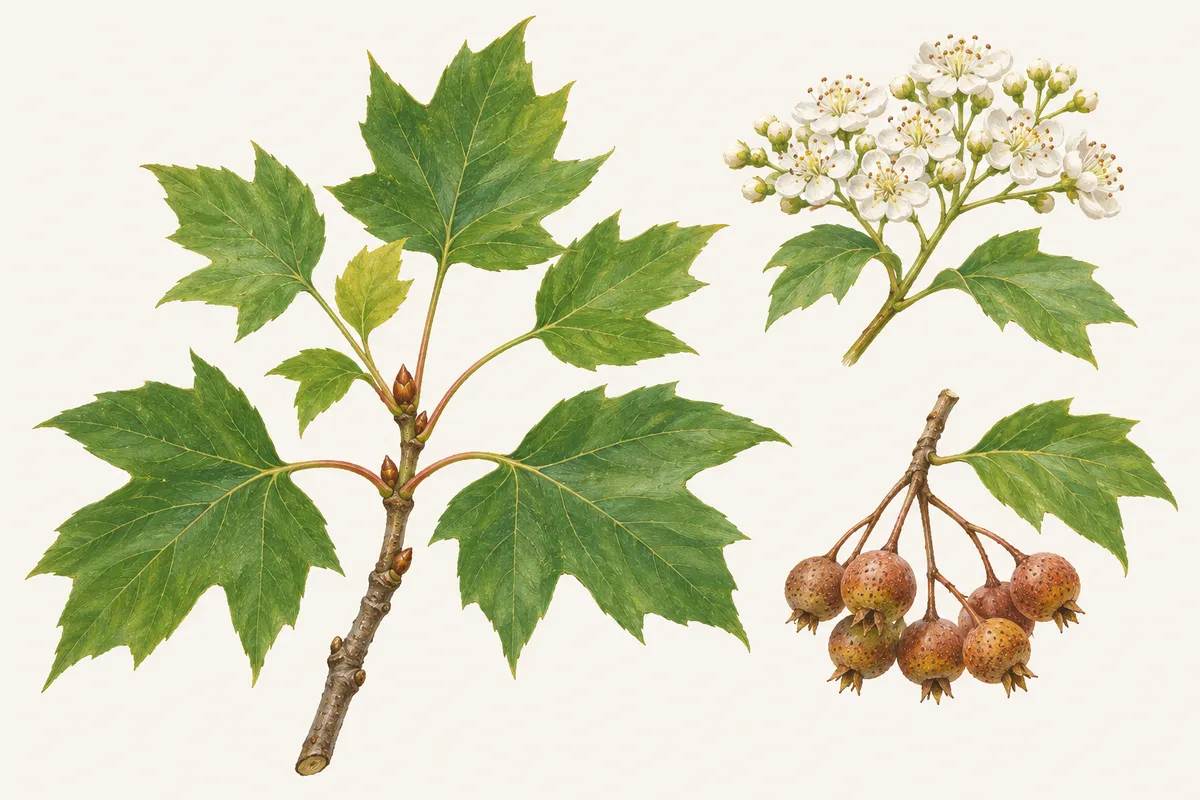
In short
Wild service tree identification turns on the leaf: it looks like a maple's, with sharp, unequal lobes, but it grows alternately on the twig, never in opposite pairs. In autumn the tree carries brown oval fruits 10 to 15 mm across speckled with pale dots, called chequers; winter buds are round, green and pea-like; and the bark cracks into small square plates.
- Alternate, maple-like leaves rule out every maple: maples have opposite leaves.
- Brown, pale-speckled chequers instead of winged seeds confirm it from late summer.
- The Woodland Trust treats it as an indicator of ancient woodland, so a wild one is worth recording.
Field marks at a glance
- Scientific name
- Sorbus torminalis
- Family
- Rosaceae (rose family)
- Type
- Broadleaf, deciduous
- Leaves
- Alternate, simple, maple-like, 7 to 10 cm long, with sharp, unequal lobes (3 to 4 in the Woodland Trust's count, 5 to 7 in SAPS's), the lowest pair spreading almost at right angles; stalk 15 to 40 mm. Shiny and nearly hairless when old.
- Autumn colour
- Coppery to blood-red; yellow on some trees.
- Fruit (chequers)
- Oval, green-brown to light brown, speckled with pale dots, 10 to 15 mm, ripe in September to late autumn.
- Flowers
- Creamy-white, five petals, about 15 mm across, in rounded clusters of 20 or more, May and June.
- Buds
- Rounded and green, like little peas, not hairy, on slender, shiny grey-brown twigs.
- Bark
- Brown to dark grey, shallowly fissured, cracking into square plates that peel to leave a chequered look.
- Size
- Up to 25 m in woods (Woodland Trust, SAPS); 8 to 12 m in gardens after 20 to 50 years (RHS). Conical crown with rising branches.
- Where
- Scattered in oak and ash woods on clay and lime-rich soils; an ancient woodland indicator in the UK. Native to the UK and parts of Europe, Africa and Asia.
The wild service tree is the most overlooked native tree in Britain: its leaves look so much like a maple's that walkers pass it as a field maple, and it is rare enough that many never meet one. It is a member of the rose family, related to rowan and whitebeam, and its brown, speckled fruits, called chequers, gave their name to pubs across southern England. One check on the twig and one on the fruit separate it from any maple.
How to identify a wild service tree
Use these checks in order; the first rules out maples straight away.
1. Leaf arrangement: alternate. The leaves sit one at a time along the twig, never in opposite pairs. All maples, field maple included, have opposite leaves, so an alternate "maple" leaf is probably a wild service tree.
2. Leaf shape: sharp, unequal lobes. The Woodland Trust describes 3 to 4 unequal lobes, similar to a maple's but less distinct. SAPS gives leaves 7 to 10 cm long, shiny on both sides and nearly hairless when old, with the lowest lobes spreading almost at right angles to a stalk 15 to 40 mm long.
3. Fruit: chequers. From late summer, look for small oval fruits, green-brown then light brown, 10 to 15 mm across and covered with small pale dots (lenticels). SAPS gives them about 15 mm long and ripe in September; the Woodland Trust says they mature in mid to late autumn. No maple has a fruit like this.
4. Buds: green peas. In winter, the Woodland Trust describes rounded green buds "like little peas" on slender, shiny, grey-brown twigs, not hairy. Field maple's buds are small and grey, on long stems.
5. Bark: little squares. The bark is brown to dark grey and cracks into square plates. SAPS says it peels in rectangular pieces and leaves a chequered effect on older trees.
When the leaves are high in the canopy, Tree Identifier can name the tree from a photo of a fallen leaf, the bark or the fruit. It gives no confidence score or list of alternatives, so check the leaf arrangement on a low twig before you trust any single photo.
Wild service tree vs field maple and whitebeam
| Feature | Wild service tree | Field maple | Common whitebeam |
|---|---|---|---|
| Leaf arrangement | Alternate | Opposite | Alternate |
| Leaf shape | Sharp, unequal lobes | 3–5 rounded lobes | Oval, toothed, not lobed |
| Underside | Green, nearly hairless | Softly hairy | White felt |
| Sap from leaf stalk | None | Milky | None |
| Fruit | Brown speckled chequers, 10–15 mm | Paired winged seeds, wings in a line | Scarlet berries |
| Bark | Square plates | Light brown, flaky | Smooth, grey |
The Woodland Trust lists field maple as the wild service tree's look-alike because of the leaf shape. Its field maple profile and our field maple page describe the rounded lobes, the winged seeds with their wings in a straight line and the golden yellow autumn colour; our page adds the opposite leaves and the milky sap of a snapped stalk. Whitebeam is a closer relative, and its white, felted leaf underside makes it easy to separate; our whitebeam page also covers Swedish whitebeam, a planted tree whose lobed leaves can be mistaken for wild service.
Rowan, the third native relative, has feather-like compound leaves and red berries, and looks nothing like a wild service tree; it is described on our rowan page.
Flowers, fruit and autumn colour
Flowers open in May and June. SAPS describes them as creamy-white with five petals, about 15 mm across, in branched, rounded clusters of 20 or more, each flower with two styles joined halfway down. They are pollinated by insects, and the Woodland Trust says they provide pollen and nectar.
The chequers follow. They are hard and astringent at first, and the Woodland Trust says they must be softened by frost, or "bletted", before they become edible; it adds that they were said to taste like dates, were given to children as sweets and were still sold about 100 years ago. The RHS, on the other hand, lists the tree as potentially harmful and its fruit as not to be eaten. This page does not give foraging advice: never eat a fruit on the strength of a web page or an app. Birds eat the fruit, and the Woodland Trust notes that wood pigeons spread the seeds.
Autumn colour is one of the best clues from a distance. SAPS describes a vivid blood-red, the Woodland Trust a rich, coppery red, and the RHS reddish or yellow. A red tree with maple-like leaves in an English wood in October is worth a closer look, since the Woodland Trust describes field maple turning a rich golden yellow.
Where it grows and why it matters
The Woodland Trust describes the wild service tree as native to the UK and parts of Europe, Africa and Asia, often found in oak and ash woods and in pockets of ancient woodland, growing best on clay and lime-rich soils. SAPS calls it rare, scattered in oak-ash woods on clay and limestone. It also spreads by suckers, so several young stems around an old tree are common.
Because it seldom spreads far from established woods, the Woodland Trust treats it as an ancient woodland indicator: finding one may mean a woodland of long standing and rich habitat. Our UK native trees list places it among the trees of lowland woods.
Size varies with setting. In woods it can reach 25 m (Woodland Trust; SAPS), with a conical crown and ascending branches. Planted in a garden, the RHS gives 8 to 12 m tall and 4 to 8 m wide after 20 to 50 years, and rates it H6, hardy throughout the UK. The wood has a fine grain and a silvery sheen. Silver leaf disease and fireblight are listed by the Woodland Trust as threats.
The wild service tree is easy to confuse with its rarer cousin, the true service tree, whose leaves are compound like a rowan's. With location turned on, Tree Identifier's Tree Map pins the find, so you can come back in autumn for the chequers and the red leaves, and the follow-up chat under a result can answer questions about ancient woodland indicators.
Look-alikes and how to tell them apart
Field maple (Acer campestre)
Field maple's leaves grow in opposite pairs, have 3 to 5 rounded lobes and ooze milky sap from a snapped stalk, and the tree bears paired winged seeds. Wild service leaves are alternate, with sharper lobes, and the fruit is a brown speckled chequer.
Whitebeam (Sorbus aria)
A close relative. Whitebeam leaves are oval and only toothed, not lobed, and covered in white felt underneath; its berries are scarlet. Wild service leaves are lobed, green on both sides, and its fruit is brown.
Swedish whitebeam (Sorbus intermedia)
A planted street tree with lobed leaves, but the lobes are shallow, cut up to a third of the way to the midrib, the underside is grey-white with hairs, and the berries are red to orange-red, not brown.
What a photo can't settle
- From a single leaf photo, a wild service leaf can pass for a maple's; the alternate arrangement shows only when several leaves along a twig are in the frame.
- Wild service tree hybridises with whitebeams, and the hybrids have intermediate leaves; a photo app names a species, and a hybrid may need a specialist.
- Whether a tree is an old wild tree or a planted one, which matters for its value as an ancient woodland indicator, cannot be read from a photo.
Questions people ask
How do I tell a wild service tree from a field maple?
Look at how the leaves sit on the twig. Maples, including field maple, have opposite leaves; wild service leaves alternate. Field maple's lobes are rounded and its stalk bleeds milky sap, and it bears winged seeds, while the wild service tree has sharper lobes and brown speckled fruits.
Why is the wild service tree called the chequer tree?
Its fruits are called chequers. The Woodland Trust says they were said to taste like dates and were given to children as sweets, and that it is unclear whether the fruit or the Chequers inns gave the other its name. The bark, cracking into squares, also looks chequered.
Is the wild service tree rare?
Yes. SAPS describes it as rare, scattered in oak and ash woods on clay and limestone, and the Woodland Trust treats it as an ancient woodland indicator: finding one may signal an old, special woodland.
Can you eat wild service tree fruit?
This page does not give foraging advice. The Woodland Trust says the fruit was eaten after it softened (bletting), while the RHS lists the plant as potentially harmful and says the fruit is not to be eaten. Never eat any fruit on the strength of a web page or an app.
Sources
- Wild service tree (Sorbus torminalis) — Woodland Trust
- Wild Service-tree (Sorbus torminalis) — Science and Plants for Schools (SAPS)
- Sorbus torminalis (wild service tree) — Royal Horticultural Society
- Field maple (Acer campestre) — Woodland Trust
Keep reading
- Tree profileField maple (Acer campestre): how to identify it
- Tree profileWhitebeam tree (Sorbus aria): how to identify it
- Tree profileRowan tree (mountain ash): how to identify it
- Field guideNative trees of the UK: the full list with one clue for each
- Field guideTree identification in the UK: British trees by leaf, bark and picture