Clue guide
Which tree has red bark? Check whether it is smooth, flaky, fibrous or only on the twigs
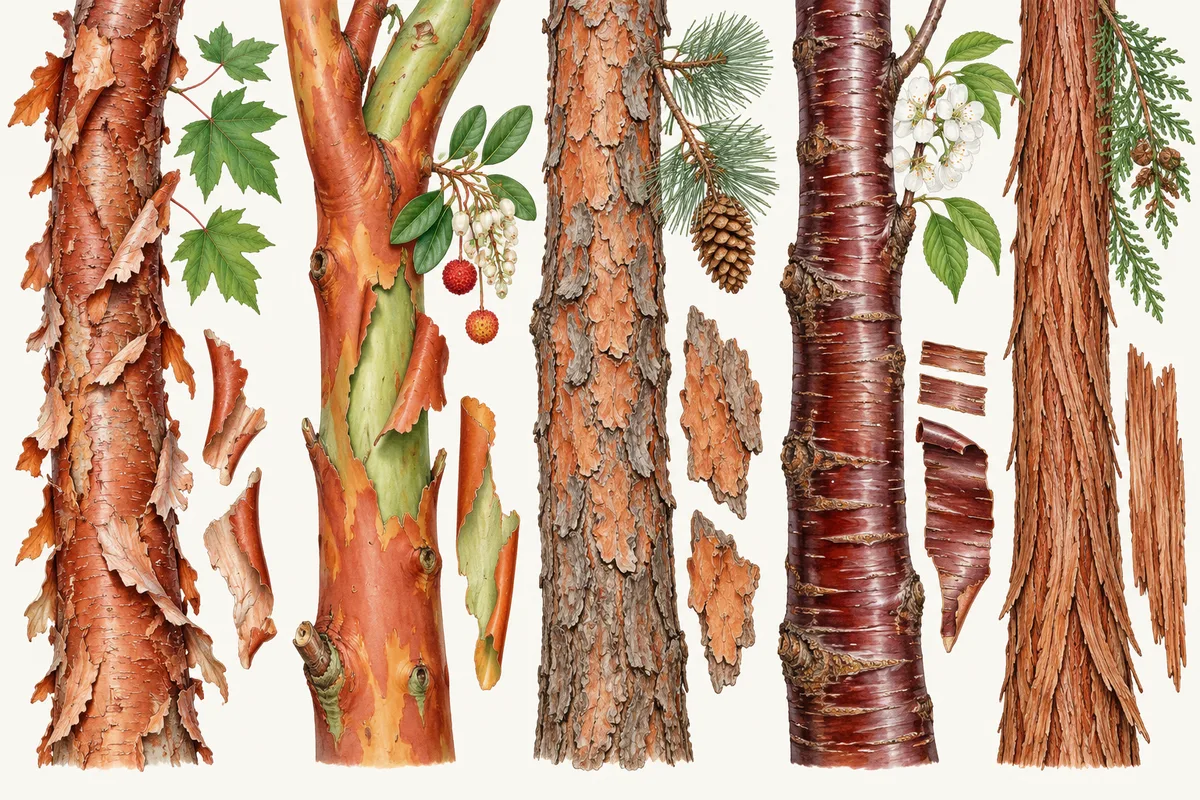
Red bark comes from a short list of trees, and its texture sorts them: glossy and smooth, flaking in plates, thick and fibrous, or red only on the young twigs.
In short
A tree with red bark is most often a Pacific madrone or a manzanita in the West (smooth reddish-orange bark), a Tibetan cherry (glossy mahogany bark with horizontal lenticels), a Scots pine or red pine (flaky orange-red or pinkish plates), or a coast redwood (thick, fibrous reddish-brown bark). Red only on the twigs in winter means coral bark maple or red-twig dogwood.
- Smooth, satiny red bark on an evergreen with leathery leaves means Pacific madrone, from British Columbia to San Diego County; on a low, twisted shrub it means manzanita.
- A pine whose bark turns reddish-orange toward the crown and stays brown at the base is a Scots pine, the UK's only truly native pine according to the Woodland Trust.
- Bright red stems on a bare shrub in winter are red-twig dogwood or a coral bark maple; the color is strongest on young growth.
A tree with red bark comes from a short list, and the texture of the bark sorts it faster than the exact shade. Look at four things in this order: whether the bark is smooth or rough, whether the tree has needles or broad leaves, whether the red is on the whole trunk or only on young twigs, and where you are. A wet trunk always looks redder, so check on a dry day if you can.
Red-barked trees by texture and region
| Tree | Bark | Leaf | Where |
|---|---|---|---|
| Pacific madrone (Arbutus menziesii) | Smooth, reddish-orange on trunk and limbs | Evergreen, shiny, leathery | Vancouver Island to San Diego County |
| Manzanitas (Arctostaphylos) | Smooth, red, on twisted stems | Evergreen; bell-shaped flowers | California and the West |
| Tibetan cherry (Prunus serrula) | Glossy, red-brown to mahogany, horizontal lenticels | 2–4 in, toothed, alternate | Planted; native to China |
| Coral bark maple (Acer palmatum 'Sango-kaku') | Coral-red twigs and young branches | 5–9 lobes, opposite | Planted |
| Red-twig dogwood (Cornus sericea) | Bright red to blood-red young stems | Opposite, smooth-edged | Most of North America; planted |
| Scots pine (Pinus sylvestris) | Scaly orange-brown, reddish toward the crown, brown at the base | Paired, twisted, blue-green needles | Native to the UK; planted widely |
| Red pine (Pinus resinosa) | Reddish to pinkish, broad flat scaly plates | Needles in pairs, 10–16 cm | Southeastern Manitoba to Newfoundland, Great Lakes |
| Coast redwood (Sequoia sempervirens) | Reddish-brown, thick, furrowed, fibrous | Flat needles in two rows | Southwest Oregon to central California |
Data come from the USDA Forest Service (madrone), UC IPM (manzanita), NC State Extension (Tibetan cherry, Japanese maple, red-twig dogwood, coast redwood), the Woodland Trust (Scots pine) and Natural Resources Canada (red pine), read on 21 October 2026.
Smooth red bark: madrone, manzanita and Tibetan cherry
Smooth bark that looks polished or satiny narrows the list to three.
Pacific madrone is the red-barked tree of the West Coast. The USDA Forest Service's Silvics of North America describes smooth reddish-orange bark on the trunk and limbs, shiny green, tough, leathery evergreen leaves, and a tree that seldom exceeds 34 m (110 ft), tall and straight on good sites but low and shrubby with several stems on poor ones. Its range runs from the east coast of Vancouver Island and the mainland of British Columbia south to near Palomar Mountain in San Diego County. Its bark also peels in thin layers, covered on the peeling bark page.
Manzanitas are the lower, twisted relatives of the West. The University of California's IPM program describes them as evergreen ground covers and shrubs with red bark and bell-shaped flowers, with the climate zone varying by species. Many manzanita species look alike, and their flowers and young stems are needed to tell them apart.
Tibetan cherry is the red-barked tree of gardens and parks, especially in the UK. NC State describes glistening, red-brown to mahogany-like bark with horizontal lenticels, small white flowers about 0.6 inch across in late spring, and alternate, toothed leaves 2 to 4 inches long. It is native to China. The horizontal bands of lenticels are the cherry signature; see the cherry page for the other cherries.
Red only on the young twigs: coral bark maple and red-twig dogwood
If the trunk is ordinary but the young stems glow red, especially in winter, the plant is grown for its twigs.
Coral bark maple is a Japanese maple cultivar. NC State lists 'Sango-kaku' among the cultivars with coral-colored twigs and notes that some Japanese maples have colorful twigs and young branches. The leaves give it away as a maple: opposite, 2 to 5 inches long, with five to nine lobes and toothed edges, on a small tree 15 to 25 feet tall. The Japanese maple page separates it from the other small maples.
Red-twig dogwood, also called red-osier dogwood, is a shrub rather than a tree, but it is the commonest answer to "red bark in winter". NC State describes a large, multi-stemmed shrub 6 to 9 feet tall with slender, upright stems, bright red to dark blood-red, most vivid on young, vigorous growth. Its leaves are opposite and smooth-edged, and its fruit is white with a blue tinge. It is native to most of North America. The dogwood page covers the tree dogwoods.
Flaky orange-red plates: Scots pine and red pine
Two pines carry reddish bark, and the needles tell them apart.
Scots pine is the answer in the UK and on many North American properties where it was planted. The Woodland Trust describes scaly orange-brown bark, reddish toward the crown and brown toward the base, developing plates and fissures with age, and blue-green, slightly twisted needles in pairs on short side shoots. It reaches 35 m and is the only truly native pine in the UK. The bright upper trunk is the field mark: look up rather than at the base.
Red pine, also called Norway pine, is native to the Great Lakes states and eastern Canada. Natural Resources Canada describes scaly bark becoming furrowed into broad, flat, scaly plates, reddish to pinkish, with needles in bundles of two, 10 to 16 cm long, and nearly stalkless cones 4 to 7 cm long. Its range runs from southeastern Manitoba to Newfoundland. The red pine and white pine page adds the needle snap test and compares it with white and jack pine.
Thick, fibrous red-brown bark: coast redwood
A huge conifer with thick, stringy bark the color of cinnamon is a coast redwood or one of its relatives. NC State describes reddish-brown, hard, furrowed and very thick bark with scaly, fibrous ridges, cinnamon-brown inner bark, a buttressed base, and flat, stiff needles in two rows with two white bands underneath. It grows 60 to 200 feet or more, native from southwest Oregon to central California in moist, foggy coastal country. Giant sequoia in the Sierra Nevada and dawn redwood, planted in parks, also have red fibrous bark; the redwood and sequoia page tells the three apart by needles and cones.
Using a photo
A photo of red bark alone leaves several candidates open. Frame the trunk together with a branch of leaves or needles, or add a cone. Tree Identifier names a plant from one photo, and Scots pine, coast redwood, giant sequoia and Japanese maple are among the species in its Collection. It shows no confidence score or list of alternatives, so check the result against the bark and leaf columns in the table. The follow-up chat under each result can answer questions such as how Scots pine differs from red pine, and the bark identification guide covers bark that is not red.
What a photo can't settle
- Bark color shifts with age, weather and light: a wet trunk looks redder, and old trunks of many trees turn gray or brown at the base.
- Pines, junipers and redwood relatives with reddish bark look alike in a photo of the trunk alone; include needles or cones.
- Cultivated maples and dogwoods with colored stems come in many named varieties that a photo cannot always separate.
Questions people ask
What tree has red bark in California?
On the coast, a coast redwood (thick, fibrous, reddish-brown bark on a huge conifer) or a Pacific madrone (smooth reddish-orange bark on an evergreen broadleaf). A twisted evergreen shrub with smooth red bark and bell-shaped flowers is a manzanita.
What tree has red bark in winter?
On bare shrubs, red-twig dogwood, whose stems NC State describes as bright red to dark blood-red and most vivid on young growth, or a coral bark maple such as the Japanese maple 'Sango-kaku'. On evergreens, Scots pine and red pine keep their orange-red to pinkish bark all year.
What pine tree has red, flaky bark?
Red pine in the Great Lakes states and eastern Canada: NRCan describes reddish to pinkish bark in broad, flat, scaly plates and needles 10 to 16 cm long in pairs. Scots pine, planted across North America and native to the UK, has scaly orange-brown bark that turns reddish toward the crown and short, twisted, blue-green needles in pairs.
What tree has red bark inside?
Many trees show reddish or cinnamon inner bark where the outer bark is cut or knocked off. NC State gives coast redwood a cinnamon-brown inner bark under its reddish-brown outer layer.
What small tree has red, peeling bark?
In the West, Pacific madrone, which stays low and shrubby on poor sites. In gardens, paperbark maple and river birch are the usual answers. The peeling bark guide covers them; Tibetan cherry has glossy red bark too, but NC State does not describe it as peeling.
Sources
- Pacific Madrone (Silvics of North America) — USDA Forest Service
- Manzanita (Plant identification) — UC Statewide IPM Program, University of California Agriculture and Natural Resources
- Prunus serrula (Tibetan cherry) — North Carolina Extension Gardener Plant Toolbox, NC State University
- Acer palmatum (Japanese maple) — North Carolina Extension Gardener Plant Toolbox, NC State University
- Cornus sericea (red-twig dogwood) — North Carolina Extension Gardener Plant Toolbox, NC State University
- Scots pine (Pinus sylvestris) — Woodland Trust
- Red pine (Pinus resinosa) — Natural Resources Canada, Trees, insects and diseases of Canada's forests
- Sequoia sempervirens (coast redwood) — North Carolina Extension Gardener Plant Toolbox, NC State University
Keep reading
- Clue guideWhich tree has peeling bark? Sort it by the color underneath
- Field guideTree bark identification: seven bark types and the trees that have them
- Tree comparisonRedwood vs sequoia: coast redwood, giant sequoia and dawn redwood
- Tree profileJapanese maple identification: the species, then the leaf group
- Tree comparisonRed pine vs white pine: how to tell them apart, with jack pine