Tree profile
Spindle (Euonymus europaeus): how to identify it
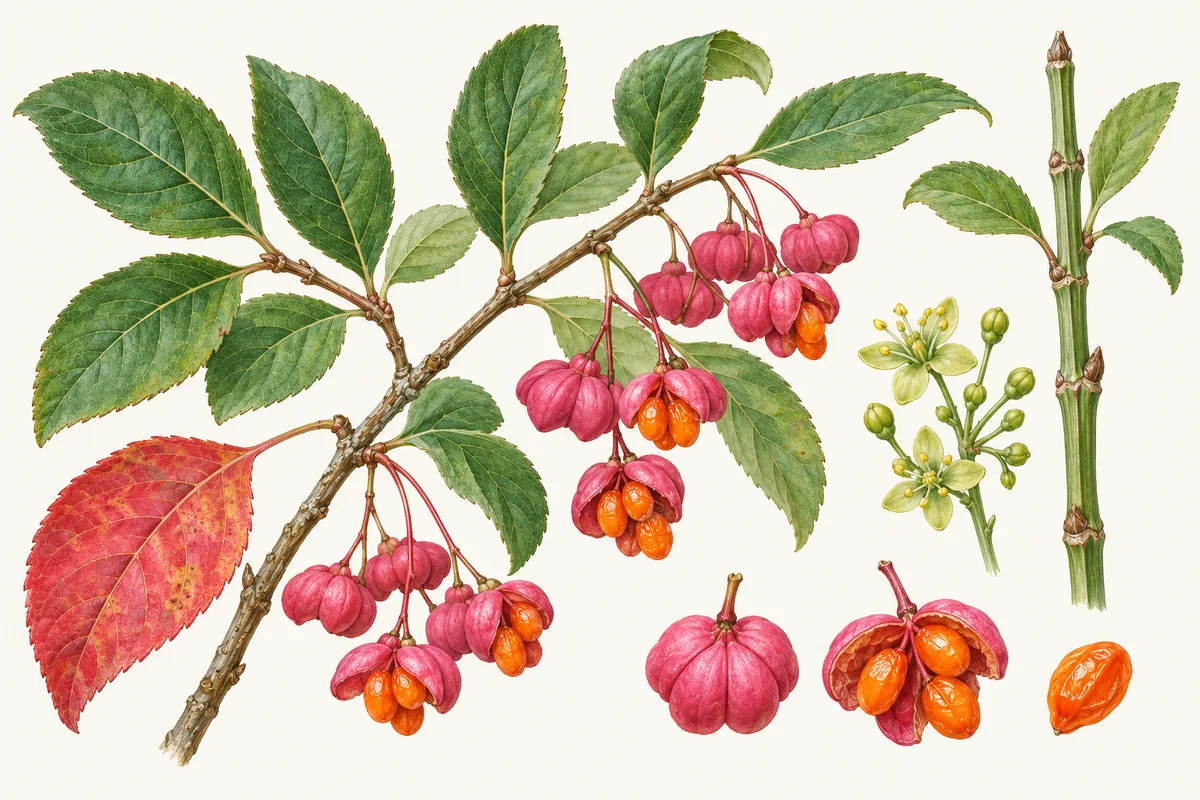
A native small tree of British hedges and wood edges: green, angular twigs, finely toothed leaves in opposite pairs and, in autumn, bright pink fruits that split to show orange seeds.
In short
Spindle tree identification is quickest in autumn: look for bright pink fruits, shaped like popcorn, that split open to show bright orange seeds. The rest of the year, check for green, four-angled twigs with light brown corky markings and opposite leaves 2.5 to 7.5 cm long with tiny rounded teeth, turning orange-red in autumn. Spindle grows to about 6 m in hedges and wood edges. Its leaves and fruit are toxic.
- Pink fruit splitting to show orange seeds is the quickest test, and the Woodland Trust lists it as the winter clue too.
- In leaf, spindle can pass for dogwood; dogwood leaves have smooth edges and veins curving toward the tip, while spindle leaves are finely toothed.
- The Woodland Trust says the leaves and fruit are toxic to humans; never eat any part.
Field marks at a glance
- Scientific name
- Euonymus europaeus
- Family
- Celastraceae (staff-vine family)
- Type
- Broadleaf, deciduous
- Leaves
- Opposite, simple, 2.5 to 7.5 cm (1 to 3 in) long, oval to lance-shaped with a pointed tip; edge lined with tiny rounded teeth; shiny and slightly waxy, dull dark green in some lights.
- Autumn colour
- A rich orange-red in Britain (Woodland Trust); NC State records anything from tan and yellow-green to burgundy on planted shrubs in the US.
- Twigs and bark
- Young twigs green, slender, straight and four-angled (square in cross-section), with light brown corky markings; bark darkens to grey-brown with ridges on old stems.
- Flowers
- Small, yellowish green, with four petals, in loose clusters of 3 to 5 in May and June; easy to overlook.
- Fruit
- Bright pink to pinkish-red capsules 1 to 2 cm across, shaped like popcorn, that split in autumn to show bright orange seeds.
- Size and form
- An upright shrub or small tree, typically to 6 m, rarely 10 m (Woodland Trust), growing rounder and wider with age (NC State).
- Habitat
- Wood edges, hedgerows and scrub across much of Europe, especially on chalky soils; less common in Scotland; an indicator of ancient woodland in the UK.
- Toxicity
- The Woodland Trust says the leaves and fruit are toxic to humans; NC State Extension lists every part as poisonous. Never eat any part.
Spindle (Euonymus europaeus) is a native small tree of British hedges that most people walk past until October, when it lights up with bright pink fruits and orange seeds. In summer it is a plain green shrub with toothed leaves in opposite pairs. Check the fruit first, then the twigs, then the leaves. Never eat a berry, nut, seed or pod on the strength of a web page or an app; check with a local expert.
Most searches for "spindle tree" in the UK turn up a manor, a plywood brand and a parkrun. This page is about the tree.
How to identify spindle: fruit, twigs, leaves
1. The fruit (September to winter). The Woodland Trust describes bright pink fruits with bright orange seeds, similar in shape to popcorn, ripening in autumn. The NC State Extension profile gives pinkish-red capsules 1/2 to 3/4 inch (about 1 to 2 cm) across that split open to show seeds each wrapped in a fleshy orange coat (an aril). The Woodland Trust lists these vivid pink fruits and orange seeds as the winter identification clue as well, because they often show on bare twigs.
2. The twigs (all year). Spindle twigs are deep green, thin and straight, with light brown corky markings, and both buds and twigs are angular (Woodland Trust). NC State describes young branches as square in cross-section. Roll a twig between finger and thumb: you can feel the four corners. The Woodland Trust notes that the green bark darkens with age, and NC State describes mature bark as grey-brown with ridges.
3. The leaves (spring to autumn). Leaves sit in opposite pairs, 1 to 3 inches (2.5 to 7.5 cm) long, oval to lance-shaped with a pointed tip and a wedge-shaped base (NC State). The edge carries tiny rounded or sharp teeth that you may need to look at closely. In autumn the Woodland Trust describes a rich orange-red before the leaves fall.
4. The flowers (May and June). Small clusters of four-petalled flowers, yellowish green and about 1 cm across, in groups of 3 to 5. They are easy to overlook, but they tell you where the fruit will be.
Tree Identifier can name a spindle from one photo, and the fruiting branch is the best thing to photograph. Spindle is not one of the 138 species in the app's Collection, and the app shows no confidence score or look-alike list, so check the twig and leaf edge yourself.
Spindle is toxic: what the sources say
The Woodland Trust states that both the leaves and fruit are toxic to humans, the berries having a laxative effect. NC State Extension rates European spindle as low severity but lists the bark, flowers, fruits, leaves, roots, seeds and stems as poisonous parts, and reports that eating large quantities of any part can cause vomiting, diarrhoea, weakness, chills, convulsions and coma. It names the toxic principle as unidentified, possibly a glycoside.
Bright pink fruit at child height in a hedge is exactly the risk. This page gives no advice on handling or tasting any part. If a child or a pet may have eaten spindle fruit, call NHS 111 (or your local poison control service) or a vet, and take a fruiting twig with you. Tree Identifier's Toxicology notes are AI-written and are not a safety verdict.
Where spindle grows and when to look
The Woodland Trust describes spindle as native to much of Europe, most often found on the edges of woods and in hedges, scrub and hedgerows. It thrives on chalky soils, is less common in Scotland, and is counted as an indicator of ancient woodland. It typically grows to 6 m and rarely to 10 m, and can live for more than 100 years. NC State gives the wider native range as Britain to Sweden, south to Spain, the Caucasus and western Asia. It is also native in Ireland (see the Irish native trees guide).
Through the year:
| Season | What to look for |
|---|---|
| Winter | Green, four-angled twigs with corky markings; pink fruits often still hanging |
| Spring | Opposite pairs of new, finely toothed leaves on green twigs |
| May–June | Small clusters of yellowish-green, four-petalled flowers |
| Autumn | Orange-red leaves, then pink fruits splitting to show orange seeds |
Spindle is one of the native trees that give British hedgerows their autumn colour; the guide to trees with red leaves in fall puts it next to field maple, cherry and the other hedge trees. Its leaves feed the caterpillars of the magpie, spindle ermine and scorched moths, as well as the holly blue butterfly, and starlings and other birds eat the fruit (Woodland Trust).
Spindle, dogwood, burning bush and other Euonymus
Dogwood. The Woodland Trust names dogwood (Cornus sanguinea) as the tree spindle is most easily confused with when in leaf. Both have opposite leaves and grow in the same hedges. The Woodland Trust's dogwood page describes oval leaves about 6 cm long with smooth edges and curving veins, which leave stringy, latex-like threads when you pull a leaf gently apart. Dogwood fruit is a small black berry, and its new twigs turn bright red in winter. Spindle leaves are toothed, its twigs green and square, its fruit pink.
Burning bush. The East Asian Euonymus alatus, also called winged spindle, is planted for its scarlet autumn colour. The NC State profile of burning bush describes opposite leaves 1 to 3 inches long, red in fall, and green to greenish-brown stems with 2 to 4 corky wings 1/4 to 1/2 inch wide. Those wings are the test. NC State notes that the North Carolina Invasive Plant Council lists it as invasive. For other invasive hedge shrubs, see the buckthorn page.
Eastern wahoo. North America's native spindle, Euonymus atropurpureus, ranges from Ontario and Nova Scotia south to Florida and west to Montana and Texas. NC State describes larger leaves, 2 1/2 to 4 inches long, and small flowers with four reddish-purple petals; its four-lobed capsule is pink or pale purple. If you are in eastern North America and find pink capsules in woods, check flower colour in spring.
Japanese spindle. Euonymus japonicus is an evergreen hedge shrub, often variegated, with glossy, leathery leaves 1 to 3 inches long, and pink to reddish capsules with orange-red seeds (NC State). The evergreen leaves settle it in winter.
For other trees whose bright fruit catches the eye, see the tree with red berries guide.
Spindle in gardens and on walks
The Woodland Trust says cultivated forms of spindle are grown in gardens for their autumn colour, so not every spindle you meet is wild, and a photo cannot name a cultivar. NC State also reports European spindle in eastern Canada and the eastern United States and warns that it has weedy to invasive tendencies there, because birds spread the seeds.
If you find a fruiting spindle in a hedge and want to see it flower next May, Tree Identifier's Tree Map keeps each located identification you save, and the History tab keeps the photo. For the other native trees of British hedgerows, start with the UK native trees guide.
Look-alikes and how to tell them apart
Dogwood (Cornus sanguinea)
Check the leaf edge and veins: dogwood leaves have smooth edges and veins that curve toward the tip, and pulling a leaf apart gently leaves stringy threads. Dogwood fruit is a small black berry, and its new twigs turn bright red in winter, not green.
Burning bush (Euonymus alatus)
Look along the stems: burning bush grows 2 to 4 flat corky wings, each 6 to 12 mm wide, on green to greenish-brown twigs. Its autumn leaves turn bright red. Spindle twigs have corky markings, not wings.
Eastern wahoo (Euonymus atropurpureus)
A North American relative, not wild in Britain. Its four small petals are reddish-purple rather than yellowish green, and its leaves are larger, about 6 to 10 cm long.
Japanese spindle (Euonymus japonicus)
Japanese spindle is evergreen: its leaves are thick, glossy and leathery and stay green all winter, often in variegated garden forms. European spindle drops its leaves in autumn.
What a photo can't settle
- From a photo of leaves alone, spindle and dogwood can be hard to separate; the leaf edge, which needs a close view, decides it.
- Garden cultivars of European spindle and hybrids between Euonymus species may not match the wild description, and a photo cannot name a cultivar.
- Whether someone who ate spindle fruit needs treatment is never settled by a web page or an app: call NHS 111, a poison control centre or a vet.
Questions people ask
Are spindle tree berries poisonous?
Yes. The Woodland Trust says both the leaves and the fruit are toxic to humans, the berries having a laxative effect, and NC State Extension lists every part of the plant as poisonous. Never eat any part, and call NHS 111 or a vet if a child or pet may have eaten some.
What does a spindle tree look like in winter?
A slender shrub or small tree with straight, green, four-angled twigs and small green buds. Fruits often hang on after the leaves fall, bright pink with orange seeds, which makes a leafless spindle easy to spot in a hedge.
Why is it called spindle?
Its creamy-white wood is hard and dense, and the Woodland Trust says it was used to make spindles for spinning wool, as well as skewers, pegs and knitting needles. Today the timber is used for artists' charcoal.
Where does spindle grow in the UK?
On wood edges, in hedgerows and in scrub, especially on chalky soils, according to the Woodland Trust. It is less common in Scotland, and it is counted as an indicator of ancient woodland.
How do you tell spindle from burning bush?
Look at the twigs. Burning bush (Euonymus alatus), a garden shrub from East Asia, carries 2 to 4 corky wings along its stems. Spindle has smooth, green, square twigs with only small corky markings. Both have opposite leaves, red to orange autumn colour and orange seeds.
Sources
- Spindle (Euonymus europaeus) — Woodland Trust
- Euonymus europaeus (European Spindle Tree) — NC State Extension Gardener Plant Toolbox
- Dogwood (Cornus sanguinea) — Woodland Trust
- Euonymus alatus (Burning Bush) — NC State Extension Gardener Plant Toolbox
- Euonymus atropurpureus (American Wahoo) — NC State Extension Gardener Plant Toolbox
- Euonymus japonicus (Japanese Spindle Tree) — NC State Extension Gardener Plant Toolbox
Keep reading
- Field guideNative trees of the UK: the full list with one clue for each
- Clue guideWhich trees have red leaves in fall? Sort them by leaf shape
- Clue guideWhich tree has red berries? Sort it by leaf and season
- Field guideTree identification in the UK: British trees by leaf, bark and picture
- Winter field guideWinter tree identification, from buds to bark