Garden guide
Low pollen trees for allergy sufferers, and the trees that cause the sneezing
Allergy comes from trees whose pollen rides the wind. Trees with showy flowers that need insects release far less, and female trees of some species release none.
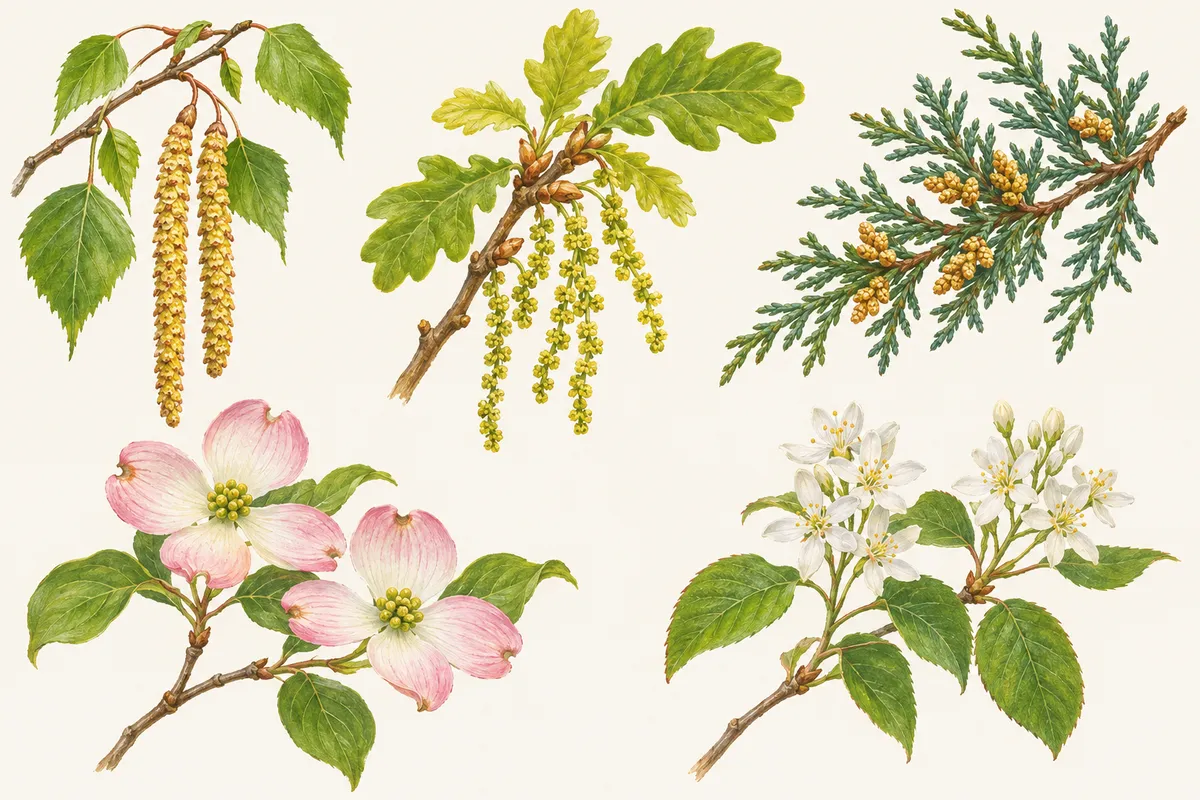
In short
Low pollen trees are mostly insect-pollinated trees with showy flowers. An American Academy of Allergy, Asthma & Immunology work group lists serviceberry, eastern redbud, fringe tree, flowering dogwood, persimmon, American holly, tulip tree, saucer magnolia and sassafras among candidates. The trees that cause allergy are wind-pollinated: oak, birch, maple, elm, ash, cedar and juniper, cottonwood, mulberry, walnut, hickory and pecan.
- Allergy trees have tiny, dull flowers, often in hanging catkins, and release clouds of pollen; low-pollen trees have big, colourful flowers that bees visit.
- In species with separate male and female trees, the female tree releases no pollen, but it bears fruit or seeds instead.
- Your own tree is only part of the load: most pollen lands within about 100 m to 2.7 km of its source, and some travels hundreds of kilometres.
Low pollen trees exist, but a "hypoallergenic garden" does not: the pollen that makes you sneeze in spring can blow in from trees streets away. What you can control is what grows next to your windows. This page is general information, not medical advice; an allergist can test which pollens you actually react to. The rule allergists use is simple once you know how to see it on a tree: avoid trees whose pollen travels by wind, and choose trees whose pollen travels on insects.
Trees that cause allergy, and lower-pollen choices
| Cause most tree-pollen allergy (wind-pollinated) | Lower-pollen candidates (insect-pollinated) |
|---|---|
| Oak, birch, alder, hazel, beech, hornbeam | Serviceberry (Amelanchier arborea) |
| Maple and box elder | Eastern redbud (Cercis canadensis) |
| Elm, ash, hickory, pecan, walnut | Fringe tree (Chionanthus virginicus) |
| Cottonwood, aspen, poplar, willow | Flowering dogwood (Cornus florida) |
| Cedar, juniper, cypress | Persimmon (Diospyros virginiana) |
| Mulberry, olive, sweetgum, sycamore | American holly (Ilex opaca) |
| Pine, fir, Douglas-fir | Tulip tree (Liriodendron tulipifera) |
| Saucer magnolia, common sassafras, Japanese pagoda tree |
The left column combines the trees named by the Asthma and Allergy Foundation of America and the wind-pollinated street trees named by an AAAAI work group report. The right column is the work group's own table of insect-pollinated trees commonly sold in the US, which also lists mountain laurel and Washington hawthorn. The report presents its list as candidates, not a guarantee, and says specific recommendations depend on where you live.
Why some trees fill the air with pollen
Trees move pollen in one of two ways. Wind-pollinated trees make enormous amounts of small, light pollen and let the air carry it; the AAAAI report gives roughly 1 billion grains for an elm tree and 500 billion for an oak. Their flowers are small and dull, with no petals to speak of, and many are packed into catkins. The AAFA puts it plainly: wind-carried pollen is the only type of tree pollen to which most people are sensitive. Insect-pollinated trees make less pollen, heavier and sticky, and spend their effort on big petals and scent to attract bees. That pollen mostly stays on the flower.
Distance matters too. The AAAAI report estimates that about 90% of wind-borne pollen lands between less than 100 metres and 2.7 kilometres from its source, while the rest can travel hundreds to thousands of kilometres. Juniper pollen from Texas has been tracked to Ontario. Removing one oak beside a bedroom window reduces your own dose, but it does not clean the neighbourhood air.
How to tell a wind-pollinated tree from an insect-pollinated one
You can sort most trees in spring by looking at the flowers:
- Catkins: hanging, tassel-like chains of tiny flowers that puff yellow dust when you tap them. Birch, alder, hazel, oak, walnut, hickory, poplar, cottonwood and mulberry all carry them. The tree with catkins guide names a tree from its catkins.
- Little green or reddish clusters before the leaves: maple, elm and ash flower early, in tight, petal-less clusters that most people never notice. Their pollen is in the air before the tree is green.
- Small brown or yellow cones in spring: on cedars, junipers, pines and firs, the small male cones shed pollen and then drop. A yellow film on a car or a pond in spring is often conifer pollen.
- Large petals, scent and bees: redbud's magenta pea flowers on bare twigs, dogwood's four white bracts, serviceberry's white starry flowers, the tulip tree's orange-and-green cups and magnolia's goblets all mean insect pollination.
The AAAAI report notes one trap: insect-pollinated trees are sometimes blamed for symptoms because they bloom at the same time and place as a wind-pollinated tree. It also cites reported sensitisation to horse chestnut and catalpa pollen, both insect-pollinated, so showy flowers are a strong rule, not an absolute one.
The lower-pollen trees, and how to recognise them
These are the trees from the AAAAI work group's table, with what to look for:
- Serviceberry (Amelanchier): small tree with white, five-petalled flowers in early spring and small red to purple fruit in early summer. See the serviceberry page.
- Eastern redbud: heart-shaped leaves and magenta-pink pea flowers growing straight from bare twigs and even the trunk; flat pods after. See redbud.
- Flowering dogwood: opposite leaves with veins that curve toward the tip, four white or pink bracts in spring, red berries in autumn. See dogwood.
- Tulip tree: four-lobed leaves with a squared-off tip and tulip-shaped green-orange flowers high in the crown. See tulip tree.
- Magnolia: big goblet flowers, often before the leaves on saucer magnolia. See magnolia.
- American holly and persimmon: both have separate male and female trees. The work group suggests female plants of such species to cut pollen further, at the price of fruit. Holly berries and persimmon fruit appear only on female trees, so a tree with fruit is female. See holly and persimmon.
- Sassafras: leaves of three shapes on one tree (oval, mitten and three-lobed) and spicy-smelling twigs. See sassafras.
Female trees, timing and the UK season
The AAFA explains that in trees with separate sexes, the female tree bears fruit, seeds or nuts and does not release wind-carried pollen, while the male tree releases it. The AAAAI report adds that many cities planted male trees to avoid fruit litter and so concentrated pollen in streets. Asking for a female tree of a dioecious species, or a fruiting one, is a lower-pollen route, but the fruit, seeds or berries come with it.
In the US, the AAFA says trees produce the most pollen from February through April, and as early as December or January in the South. In the UK, the Met Office says tree pollen is the first pollen of the year, typically from late March to mid-May, affects about 25% of people with hay fever, and names birch, oak and ash as common culprits. The NHS says hay fever symptoms are usually worse between late March and September and suggests wraparound sunglasses, keeping windows shut and changing clothes after being outside. For which birch you have, see the birch page.
Using a photo to check a tree before you plant or remove it
Before you blame or buy a tree, name it. Photograph a leaf and, in spring, the flowers or catkins; Tree Identifier names the tree from one photo and shows its scientific name, which is what allergy lists use. If you are not sure whether a tree is the wind-pollinated kind, ask the follow-up chat under the result how the species is pollinated, then check the answer against the flowers on the tree. Tree Identifier's Care Guide covers watering, light and pruning for a tree you decide to keep. It cannot tell you whether you are allergic to that tree; that is a question for an allergist.
What a photo can't settle
- A photo can name a tree, but not its sex in every species: a male and a female tree of the same species can look identical until they flower or fruit.
- No list can say which tree pollen you react to; an allergist's skin or blood test can.
- Lower-pollen trees still need the right climate zone, soil and space, so check a choice with your local extension service or nursery before planting.
Questions people ask
Which trees are worst for pollen allergy?
The Asthma and Allergy Foundation of America lists alder, ash, aspen, beech, birch, box elder, cedar, cottonwood, elm, hickory, juniper, maple, mulberry, oak, olive, pecan, poplar, walnut and willow. In the UK the Met Office names birch, oak and ash as common culprits.
Do flowering trees cause allergies?
Rarely, as a rule. The AAAAI work group says showy flowers are almost always insect-pollinated and most insect-pollinated plants are not a community-level risk. It notes exceptions: sensitisation to horse chestnut and catalpa pollen has been reported, and flowering trees often bloom at the same time as wind-pollinated ones.
Are female trees better for allergies?
In species with separate male and female trees, yes: the AAFA says female trees bear fruit, seeds or nuts and do not release wind-carried pollen. The AAAAI work group suggests female plants of such species but warns you then get the fruit or seeds.
When is tree pollen season?
In the US, the AAFA says trees release the most pollen from February through April, starting as early as December or January in the South. In the UK, the Met Office gives late March to mid-May, and says tree pollen affects about 25% of people with hay fever.
Sources
- Landscape Plant Selection Criteria for the Allergic Patient (AAAAI Work Group Report, J Allergy Clin Immunol Pract 2018) — American Academy of Allergy, Asthma & Immunology
- Tree Pollen Allergy — Asthma and Allergy Foundation of America
- Pollen: What are the different types? — Met Office
- Hay fever — NHS
Keep reading
- Clue guideWhich tree has catkins? Check the month, the leaf and what comes after
- Tree profileServiceberry (Amelanchier): juneberry, shadbush and saskatoon
- Tree profileRedbud tree (Cercis canadensis): how to identify it
- Tree profileDogwood tree identification: flowering dogwood and its look-alikes
- Tree profileBirches (Betula): how to identify a birch tree