Clue guide
Which tree has white berries? Check where they grow, the leaf and the month
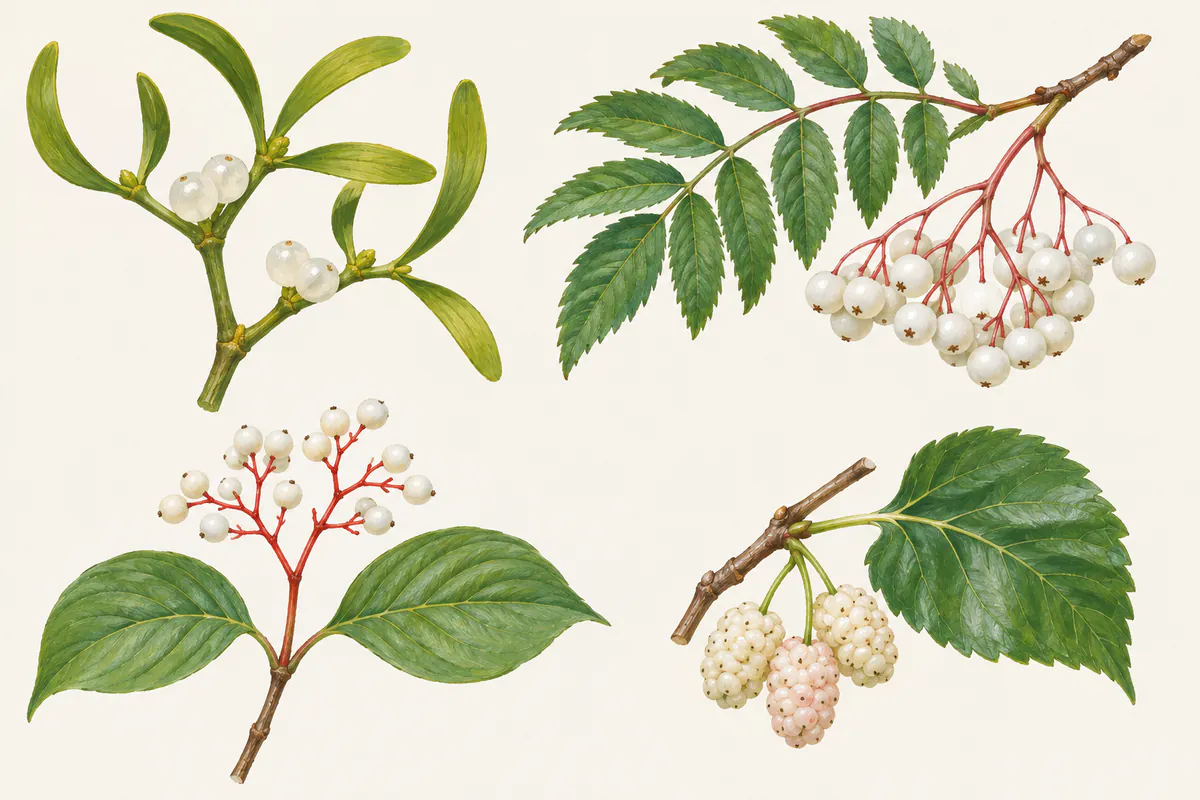
White berries on a tree come from a short list: a clump growing in the crown, a feather-leaved rowan, a dogwood on red stalks, a mulberry, a popcorn tree, or a vine that should never be touched.
In short
A tree with white berries in winter is most often carrying mistletoe: an evergreen clump in a bare crown with sticky white berries. Otherwise check a Kashmir rowan in UK gardens (feather-like leaves, white berries about 12 mm), gray dogwood (opposite leaves, white fruit on red stalks, August to October), white mulberry (fruit like a pale blackberry, June) or Chinese tallow (white waxy seeds in split capsules).
- A green ball of leaves in a bare winter tree, with white berries, is mistletoe growing on the tree, not the tree's own fruit.
- White berries on a hairy vine with leaves in threes, climbing a trunk, are poison ivy: do not touch the vine, the leaves or the berries.
- Opposite leaves and white fruit on red stalks in fall point to gray dogwood; feather-like leaves and porcelain-white clusters to a white-berried rowan.
A tree with white berries is rarer than one with red or black fruit, and the first question is whether the berries belong to the tree at all. Never eat a berry, nut, seed or pod on the strength of a web page or an app; check with a local expert, and call poison control if a child or pet has swallowed one. Several of the plants below are listed as poisonous, and one of them, poison ivy, should not even be touched.
White berries by plant, season and region
| Plant | Leaf | White fruit | When | Where |
|---|---|---|---|---|
| European mistletoe (Viscum album) | Oval, leathery, evergreen, in pairs | Waxy white berries in clusters of 2–6 | About October–May | Grows on apple, lime, poplar and other trees; UK mainly southern England and the West Midlands |
| American mistletoe (Phoradendron leucarpum) | Thick, waxy, evergreen | White, sticky pulp | Winter | On maples and oaks; Mid-Atlantic south to Florida, west to Texas |
| Kashmir rowan (Sorbus cashmiriana) | Feather-like, up to 19 leaflets | White, about 12 mm (1/2 in), in clusters | Long-lasting; the RHS gives no months | Planted in gardens; holds the RHS Award of Garden Merit |
| Gray dogwood (Cornus racemosa) | Opposite, 2–3.5 in, pale below | About 1/4 in, on red stalks | August–October | Native, eastern and central US and southern Canada |
| White mulberry (Morus alba) | Glossy, toothed; unlobed, mitten or 3-lobed | White to pink, up to 1 in, like a blackberry | June | Native to China; naturalized across the eastern and central US |
| Chinese tallow (Triadica sebifera) | Smooth-edged, 1–3 in, long sharp tip | Three white, waxy seeds in a split capsule | Late summer on, persisting | Invasive in the Southeast and Texas; native to China and Japan |
| Snowberry (Symphoricarpos albus), a shrub | Opposite, 1–3 in | Round, green turning white | Fall, long-lasting | Native to North America; planted in gardens |
| Poison ivy and poison sumac | Three leaflets (ivy); 7–13 in pairs (sumac) | White to green-yellow or amber (ivy); pale yellow or cream (sumac) | — | Across the US; NIOSH points to USDA range maps |
Data come from the Woodland Trust (European mistletoe), the RHS (Kashmir rowan), the CDC's NIOSH (poison ivy and poison sumac) and NC State Extension (the others), read on 9 November 2026.
Berries in the crown in winter: mistletoe
When people search for a pine tree or an oak with white berries in winter, the answer is usually mistletoe. Mistletoe is a separate plant growing on the tree's branches: a rounded clump of green leaves that stands out once the host has dropped its own.
European mistletoe, the one in UK searches, has oval, leathery leaves in pairs and waxy white berries in clusters of two to six, from around October until May, according to the Woodland Trust. It grows most often on apple, lime and poplar, and is also recorded on blackthorn, hawthorn, rowan and willow. In the UK it is found mainly in the south of England and the West Midlands. The Woodland Trust states that mistletoe leaves, stems and berries are all poisonous.
American mistletoe grows on the branches of maple and oak trees across the Southeast. NC State Extension describes thick, waxy green leaves and white berries with a sticky pulp in winter, which birds eat and spread. Its range runs from the Mid-Atlantic states south to Florida and west to Texas. NC State lists the berries as toxic if eaten in quantity, with stomach upset, vomiting, diarrhea, difficulty breathing, lowered blood pressure and a slow pulse among the symptoms, and flags the plant as a problem for dogs, cats and horses.
If the "pine" has dusty blue-white berries among scale-like or prickly needles, it is more likely a juniper or redcedar, covered on the tree with blue berries guide.
Feather-like leaves: white-berried rowans
A rowan tree with white berries is a garden plant, not the wild rowan, which fruits red to orange (see the rowan page). The commonest is Kashmir rowan. The RHS describes a large spreading shrub or small tree 4 to 8 metres tall, with pinnate leaves of up to 19 oblong leaflets, dull pink flowers in spring, and long-lasting clusters of white fruit about 12 mm wide. It has little autumn leaf colour, so the white berries are often the most visible thing on it in October. The RHS says the fruit is ornamental and not to be eaten. If the clusters are yellow rather than white, see the tree with yellow berries guide.
Opposite leaves and red stalks: gray dogwood
Check where the leaves meet the twig. Leaves in opposite pairs and small white fruit held on red stalks mean a white-fruited dogwood. NC State describes gray dogwood as a suckering shrub 4 to 15 feet tall that can reach about 27 feet as a small tree, with opposite leaves 2 to 3.5 inches long, pale to nearly white underneath. Its white fruits are about 1/4 inch across, appear from August through October, and sit on red stalks through fall and early winter, after the birds have taken most of the fruit. Creamy white flower clusters 1.5 to 2.5 inches across come first, in May and June. It is native from Manitoba and Quebec south through the eastern and central US. Other shrub dogwoods with whitish fruit, such as red-osier dogwood, are compared on the dogwood page; the tree-sized flowering dogwood has red fruit.
Fruit like a white blackberry: white mulberry
A tree with white berries that look like blackberries is a white mulberry. According to NC State, the fruit is a blackberry-like cluster up to about 1 inch long, carried only by female trees, maturing in June and ripening white or pink, sometimes dark red or purple-black. The tree reaches 30 to 60 feet, and its leaves are the giveaway: glossy and smooth above, toothed, 3 to 6 inches long, and mixed on one tree between unlobed, mitten-shaped and three-lobed. Snap a leaf stalk and a milky latex appears. White mulberry is native to China, has naturalized across the eastern and central US, and can hybridize with the native red mulberry. The mulberry page tells red from white by the leaf surface. This is the main candidate for "trees with white berries in summer".
White seeds after the capsules split: Chinese tallow
In the Southeast and along the Gulf Coast, white "berries" on a tree in fall and winter are often the seeds of Chinese tallow, the popcorn tree. NC State describes a three-parted capsule about 1/2 to 3/4 inch long that turns brown to almost black, then splits to show three white, waxy seeds that look like popped corn; they ripen from late summer and persist on the tree. The leaves are smooth-edged, 1 to 3 inches long, with a long pointed tip and two small glands where the blade meets the stalk, and they turn red to yellow in fall. All parts bleed a milky sap when damaged. NC State lists the fruit and leaves as poisonous (nausea and vomiting) and the tree as invasive in North Carolina, Florida, Georgia, Texas and other states. The full profile is on the Chinese tallow page.
A low shrub with white berries: snowberry
If the white berries are on a twiggy shrub no taller than a person, it is probably snowberry, a garden shrub. NC State describes a suckering shrub 3 to 6 feet tall with opposite, oval leaves 1 to 3 inches long and round berries that are green, then white as they ripen in fall, and long-lasting. It is native to North America. NC State lists the fruit as low-severity poisonous, with vomiting and diarrhea. Snowberry is not a tree, but it is often what "small white berries" turns out to be.
Never touch: poison ivy and poison sumac
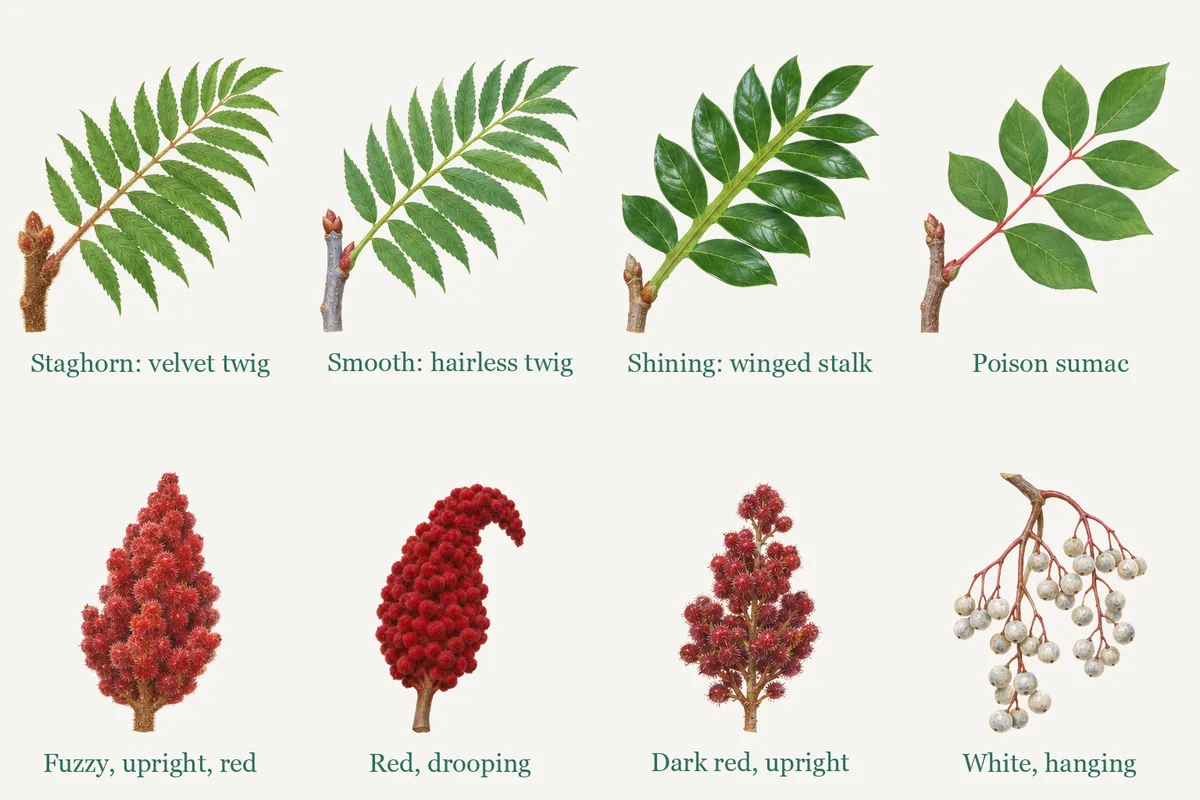
The most important white berries to recognize grow on a vine or a shrub, often right next to or up a tree. The CDC's NIOSH page on poisonous plants describes eastern poison ivy as a hairy, rope-like vine with three shiny green leaflets from one small stem, sometimes yellow or green flowers, and white to green-yellow or amber berries; its leaves may turn red in fall. Western poison ivy is a low shrub that does not climb. Poison sumac is a woody shrub with stems bearing 7 to 13 leaflets in pairs and glossy, pale yellow or cream-colored berries.
How to tell them from the trees above:
- A hairy vine on the trunk. Berries on a vine clinging to the bark belong to the vine, not the tree. Mistletoe grows as a clump in the crown, never as a rope up the trunk.
- Leaves in threes. Poison ivy's leaflets come in threes; mistletoe's leaves come in pairs, a rowan's in a long row of leaflets, a dogwood's singly in opposite pairs.
- Many leaflets on a shrub. A shrub with 7 to 13 paired leaflets and pale, hanging berries is poison sumac; the sumac page tells it from staghorn and smooth sumac, which carry red fruit clusters.
All three plants release urushiol, an oil that causes an allergic rash in most people, according to NIOSH; a tiny trace of the oil is enough, and smoke from burning the plants can cause severe breathing problems. Do not touch, cut or burn them, and never eat the berries. If skin touches the plant, NIOSH advises rinsing right away with rubbing alcohol, a poison-plant wash or dishwashing soap and plenty of water. Get medical help for a severe reaction, and call poison control if any part is swallowed.
Region and season shortcuts
- UK, winter: a green ball high in an apple, lime or poplar is European mistletoe. In a garden, a rowan with white clusters is Kashmir rowan or a similar cultivar; white berries on a low shrub are snowberry.
- US, fall: opposite leaves and white fruit on red stalks mean gray dogwood in the East and Midwest; split capsules with popcorn seeds mean Chinese tallow in the South.
- US, winter: white berries in a bare oak or maple are American mistletoe; white berries on a hairy vine climbing a trunk are poison ivy.
- Summer: pale blackberry-shaped fruit dropping on a sidewalk in June is white mulberry.
- Australia: the trees above are introduced or garden plants there; for native species, start from the Australian native trees guide.
If the berries are dark, see the tree with black berries guide; if they are red, the tree with red berries guide.
Using a photo
Photograph one fruit cluster together with a whole leaf, and add a second photo of the twig showing whether the leaves are opposite or alternate. For mistletoe, take one photo of the clump and one of the host tree's own leaves. Tree Identifier names a plant from one photo of the leaf, bark, flowers or fruit. It shows no confidence score or list of alternatives, so check the result against the leaf and season columns in the table. The follow-up chat under each result can answer questions such as how gray dogwood differs from snowberry. Tree Identifier's Toxicology notes are AI-written and are not a safety verdict: for anything about eating fruit, ask a local expert.
What a photo can't settle
- Mistletoe berries sit on the host tree's branches, so a photo of the berries can return the mistletoe, the host, or a mix of both; photograph the leaves of each separately.
- White mulberry fruit ripens white, pink, red or nearly black, and white and red mulberries hybridize, so fruit colour alone does not settle the species.
- No page or app can tell you a berry is safe to eat. Treat any identification as a name to check with a local expert.
Questions people ask
What tree has white berries in winter?
Usually none: the berries belong to mistletoe growing in the tree. The Woodland Trust gives European mistletoe berries from about October to May, and NC State says American mistletoe fruits in winter on maples and oaks. Chinese tallow's white seeds and a Kashmir rowan's berries also hang on after the leaves fall.
What are white berries called?
No single plant is called white berries. On trees, people usually mean mistletoe, a white-fruited rowan such as Kashmir rowan, gray dogwood, white mulberry or the white seeds of Chinese tallow. On a low garden shrub they usually mean snowberry, and on a hairy vine, poison ivy.
What tree has white berries that look like blackberries?
White mulberry. NC State describes blackberry-like fruit up to about 1 inch long on female trees, ripening in June white or pink, sometimes dark red or purple-black. The leaves are glossy, toothed and mixed on one tree: unlobed, mitten-shaped and three-lobed.
Is a rowan with white berries a different tree?
Usually a different species or a garden cultivar. Wild rowan fruits red to orange. Kashmir rowan (Sorbus cashmiriana) carries long-lasting white berries about 12 mm wide below leaves of up to 19 leaflets, according to the RHS, which says the fruit is ornamental and not to be eaten.
Are white berries on trees poisonous?
Many are listed as toxic. The Woodland Trust says mistletoe leaves, stems and berries are all poisonous; NC State lists American mistletoe and Chinese tallow fruit as poisonous. Never eat a berry because a page or an app named the plant. If someone has swallowed one, call poison control.
Sources
- Mistletoe (Viscum album) — Woodland Trust
- Phoradendron leucarpum (American mistletoe) — North Carolina Extension Gardener Plant Toolbox, NC State University
- Sorbus cashmiriana (Kashmir rowan) — Royal Horticultural Society
- Cornus racemosa (gray dogwood) — North Carolina Extension Gardener Plant Toolbox, NC State University
- Morus alba (white mulberry) — North Carolina Extension Gardener Plant Toolbox, NC State University
- Triadica sebifera (Chinese tallow tree) — North Carolina Extension Gardener Plant Toolbox, NC State University
- Symphoricarpos albus (common snowberry) — North Carolina Extension Gardener Plant Toolbox, NC State University
- Poisonous Plants and Work — CDC, National Institute for Occupational Safety and Health (NIOSH)
Keep reading
- Clue guideWhich tree has red berries? Sort it by leaf and season
- Clue guideWhich tree has black berries? Sort it by leaf and cluster
- Tree profileMulberry (Morus): how to identify it
- Tree profileDogwood tree identification: flowering dogwood and its look-alikes
- Tree profileChinese tallow tree (Triadica sebifera): how to identify it