Garden guide
Drought tolerant trees for dry gardens, from US extension and RHS lists
Trees that public lists name for dry sites in the US West and Midwest and in southern Britain, how to recognise each one, and why even these need watering for their first years.
In short
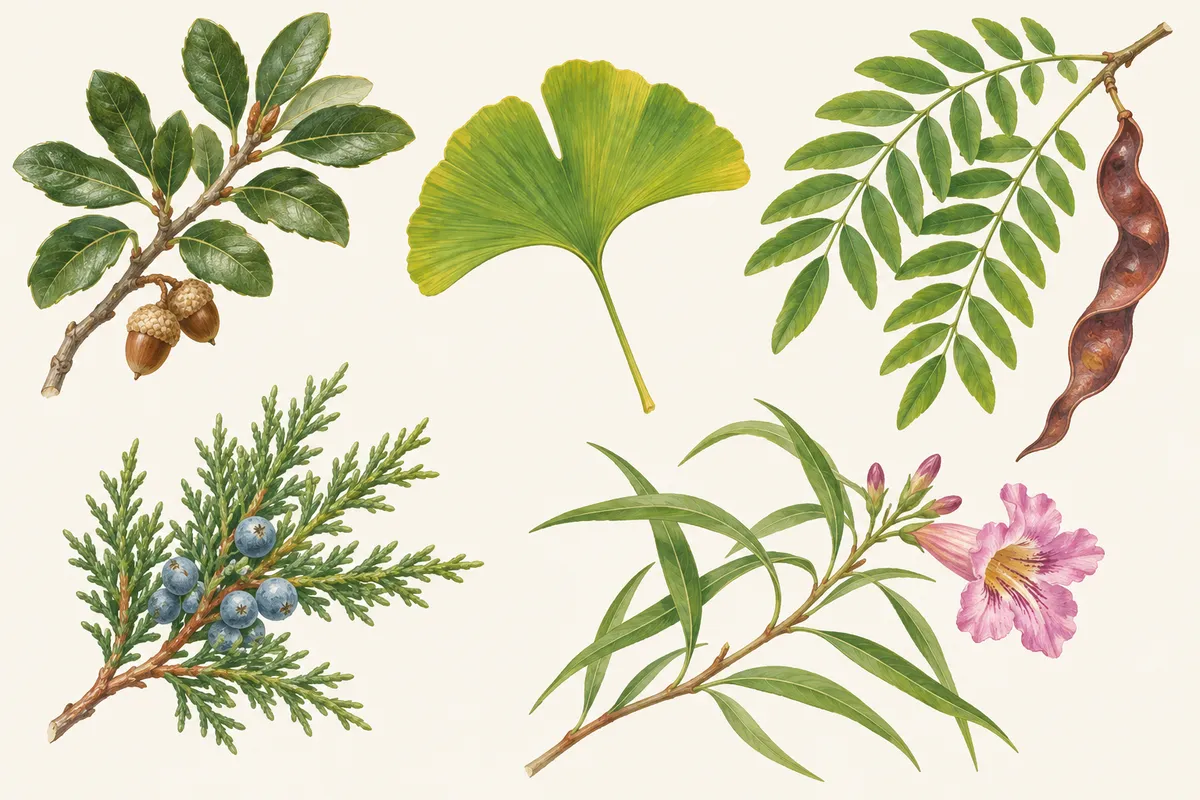
Drought tolerant trees named by Colorado State University Extension include bur oak, common hackberry, thornless honeylocust, Kentucky coffeetree, western catalpa, goldenrain tree, Rocky Mountain juniper and ponderosa, bristlecone and pinyon pines. For hot, dry sites in Britain, the RHS lists holm oak, cork oak, olive, strawberry tree, ginkgo, Judas tree and Scots pine. All need regular watering until established.
- Drought tolerant means a tree survives dry spells once its roots are established, not that it never needs water: CSU says many plants need at least two growing seasons to establish.
- Many drought-tolerant trees share field marks: small or divided leaves, grey or silvery foliage, needles or scales, and thick, rough bark.
- Match the list to your region: a tree on a Colorado list may sulk in a wet British winter, and Mediterranean trees on the RHS list can be hit by frost.
Drought tolerant trees are the ones that keep going through a dry summer without extra water once their roots have spread. Every list below comes from a public source, not our own preference, and each one is written for a climate: Colorado's dry, high plains, northern Illinois, or the free-draining south of Britain. Start from the list closest to where you live, then check the tree's size against your space, and note the field marks so you can recognise the tree in a park or a neighbour's garden before you plant one.
The lists at a glance
| Region and source | Trees named for dry conditions |
|---|---|
| Colorado, large and medium trees (CSU Extension) | Bur oak, common hackberry, thornless honeylocust, Kentucky coffeetree, western catalpa, goldenrain tree, boxelder, 'Purple Robe' black locust |
| Colorado, small trees (CSU Extension) | Bigtooth maple, Tatarian maple, Russian hawthorn, thornless cockspur hawthorn, Ussurian pear, Gambel oak, apricot |
| Colorado, conifers (CSU Extension) | Rocky Mountain juniper, Utah juniper, one-seed juniper, ponderosa pine, pinyon pine, bristlecone pine, Arizona cypress |
| Northern Illinois (Morton Arboretum) | Bur oak, thornless honeylocust, both rated drought tolerant |
| Southern Britain, hot dry sites (RHS) | Holm oak, cork oak, Turkey oak, olive, strawberry tree, almond, plum, cockspur thorn, Judas tree, ginkgo, goldenrain tree, snow gum, wild service tree, Atlas and deodar cedar, Italian cypress, black pine, Scots pine |
| Britain, general drought list (RHS) | Mimosa, Judas tree, common hawthorn, goldenrain tree, hop tree, purging buckthorn, whitebeam 'Lutescens'; yew and Scots pine among conifers |
Sources: Colorado State University Extension fact sheet 7.229, the Morton Arboretum's bur oak and thornless honey-locust pages, and the RHS pages on trees for climate change resilience and drought-resistant plants, all read on 10 November 2026.
North American shade trees for dry yards
These are the large trees on the Colorado and Illinois lists, with sizes from those sources and the marks that identify them.
- Bur oak: the Morton Arboretum rates it drought tolerant once established, adaptable to many soils including clay, 70 to 80 feet tall and as wide. Big leaves with five to seven rounded lobes, dark green above and silvery green beneath; acorns with large fringed caps covering most of the nut. Native to the eastern US and the Great Plains. See bur oak.
- Common hackberry: CSU gives 45 by 45 feet, a rounded crown and knobby bark, and notes that it sheds leaves during drought. Look for corky, warty ridges on grey bark and lopsided leaf bases. See hackberry.
- Thornless honeylocust: CSU gives 35 to 55 feet; the Morton Arboretum rates it drought tolerant and tolerant of clay, alkaline soil and road salt, with fine compound leaves of 20 to 30 small leaflets and flat, curling red-brown pods. The Arboretum also says it is overused in towns and should be planted only after considering alternatives. See the locust page.
- Kentucky coffeetree: CSU gives 55 by 35 feet, slow growth and ridged bark, with female trees holding seedpods through winter. Very large, twice-compound leaves and thick, leathery pods. See Kentucky coffeetree.
- Western catalpa: CSU gives 50 by 35 feet, large heart-shaped leaves, fragrant June flowers and long seed pods. See catalpa.
- Goldenrain tree: CSU and the RHS both list it; CSU describes leaves that open red and turn green, yellow summer flowers and lantern-like fruit.
Conifers for the driest sites
The Colorado list leans on native conifers that grow wild on dry slopes. CSU gives ponderosa pine 60 by 30 feet, with plate-like bark, growing to about 9,000 feet; pinyon pine 25 by 15 feet, bushy, with edible seeds, at 4,500 to 8,000 feet; and bristlecone pine 35 by 20 feet, slow, up to 11,700 feet. Among junipers, CSU lists Rocky Mountain juniper (30 by 15 feet, full sun), one-seed juniper and Utah juniper, which it describes as very long-lived with a large taproot. Arizona cypress, a cone-shaped evergreen, is the cypress on the list. The ponderosa pine page and the juniper page cover how to tell them apart; the desert tree identification guide covers trees of the true deserts further south.
Trees for hot, dry gardens in Britain
The RHS climate change guide lists trees for free-draining, south-facing sites in southern areas expected to have hotter, drier summers. Among large trees it names holm oak, cork oak, Turkey oak, Hungarian oak and the Lucombe oak, plus wild service tree; among medium trees, Judas tree, ginkgo, goldenrain tree, snow gum and the whitebeam 'Lutescens'; among small trees, strawberry tree, olive, almond, plum and cockspur thorn; and among conifers, Atlas and deodar cedars, Italian cypress, black pine and Scots pine.
The same page carries warnings. Beech is ill adapted to these dry conditions and not a wise choice in southern and eastern Britain; eucalyptus has been frequently implicated in subsidence and should not go near buildings (see the tree roots near a house guide); and Mediterranean trees may still suffer frost damage in an occasional cold winter. The RHS drought-resistant list adds two natives, common hawthorn and purging buckthorn, and notes that many drought-tolerant plants have silver or grey-green leaves that reflect the sun. See the olive, ginkgo and hawthorn pages for field marks.
Getting a drought tolerant tree established
The trees above earn their reputation only after their roots have spread. CSU Extension advises giving adequate water in the first years after planting, then cutting irrigation back gradually, and says many plants need at least two growing seasons to establish. It also warns that some trees perform poorly on hot south or windy west exposures and do better on cooler east or north sides. The RHS suggests planting small specimens, watering less often but more thoroughly, mulching to keep moisture in, and not feeding at planting, because lush growth is more vulnerable to drought and frost.
Using a photo to check what thrives near you
The surest drought test is local: trees that look healthy at the end of a dry summer in unwatered parks and verges near you. Photograph a leaf or a twig with needles and Tree Identifier names the tree from one photo, with its origin and growing conditions. Its Water Calculator gives an AI-written watering estimate for an identified plant, which is a starting point, not a schedule for a newly planted tree. Tree Identifier's Care Guide covers watering, light and pruning. Ask your local extension service or a nursery whether a tree suits your soil before buying.
What a photo can't settle
- A photo names a tree but not its cultivar, and drought tolerance can vary between selections of one species; check the label or the nursery's records.
- These lists are written for particular climates (Colorado, northern Illinois, southern Britain). Ask your local extension service or a nursery which trees suit your rainfall, soil and winter cold.
- No tree is drought-proof when young or when planted in the wrong exposure: CSU warns that some do poorly on hot south or windy west sides.
Questions people ask
What is the most drought tolerant tree?
No source here ranks one tree first. Among Colorado State University's choices, the native junipers and pines grow on the driest, highest sites: pinyon pine to about 8,000 feet and bristlecone pine to 11,700 feet. Utah juniper, CSU notes, is very long-lived with a large taproot.
Are oak trees drought tolerant?
Some are. The Morton Arboretum lists bur oak as drought tolerant once established and adaptable to many soils, and CSU includes bur oak and Gambel oak on its xeric list. For hot, dry sites in southern Britain the RHS names holm oak, cork oak, Turkey oak and Hungarian oak.
What drought tolerant trees are native to the UK?
The RHS drought-resistant plants list names common hawthorn (Crataegus monogyna) and purging buckthorn (Rhamnus cathartica) as natives, and lists yew and Scots pine among its conifers. Its climate change list adds wild service tree and Scots pine for hot, dry, free-draining sites.
How long do drought tolerant trees need watering?
Until established. Colorado State University Extension advises adequate water during the first years after planting, then a gradual cut in irrigation, and says many plants need at least two growing seasons to establish. The RHS advises watering less often but more thoroughly, and mulching to keep moisture in.
Sources
- Xeriscaping: Trees and Shrubs (Fact Sheet 7.229) — Colorado State University Extension
- Trees for Climate Change Resilience — Royal Horticultural Society
- Drought-resistant plants — Royal Horticultural Society
- Bur oak — The Morton Arboretum
- Thornless honey-locust — The Morton Arboretum
Keep reading
- Tree profileBur oak (Quercus macrocarpa): how to identify it
- Tree profileHackberry tree identification: warty bark, lopsided leaves
- Tree profileKentucky coffeetree (Gymnocladus dioicus): how to identify it
- Tree profilePonderosa pine (Pinus ponderosa): how to identify it
- Regional guideDesert tree identification in the American Southwest